What is an AI-native organization? How to build an AI-native organization?
An AI-native organization is not about applying an AI "patch" to a traditional enterprise. Instead, it involves re-designing business logic, organizational structure, and incentive mechanisms around human-machine collaboration. This article starts from common cognitive misunderstandings and, combined with case studies of companies such as Alibaba, Huawei, and Transn, dissects the core characteristics and implementation paths of AI-native organizations. It aims to help managers understand the essential leap from "adding AI functions" to "growing AI genes."
A few days ago, I had a chat with a friend who works in enterprise services. He told me something.
His company spent over half a year equipping each department with AI tools and conducting dozens of training sessions. It was a grand effort. But when they did the year-end review, they found that the actual usage rate of AI was less than 15%.
He was completely confused. They had bought the tools, provided the training, and offered incentives. Why didn't people use them?
At that time, I told him that he might have got things backward.
He wasn't building an AI-native organization; he was just applying an AI "patch" to a traditional organization.
No matter how well the "patch" is applied, the underlying "bones" are still the old ones.
He was silent for a long time.
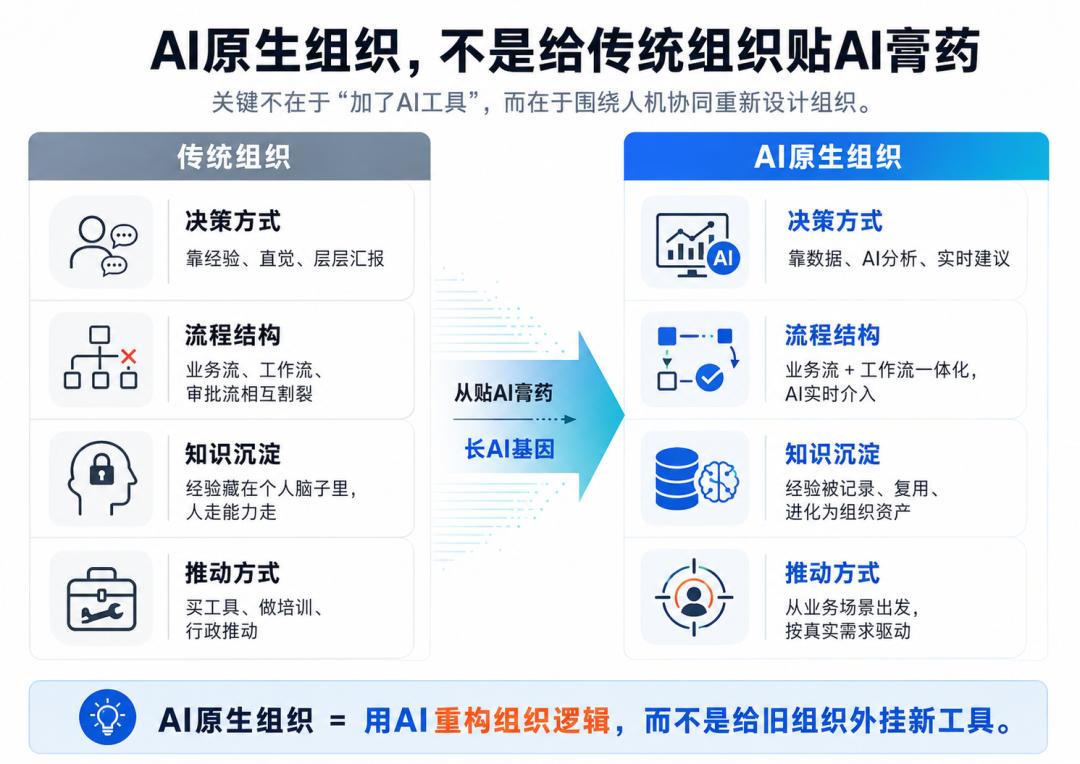
To be honest, I understand his confusion. Because 90% of the discussions about "AI transformation" in the market are about how to add AI functions to existing organizations, rather than how to make organizations grow AI genes.
These two things are worlds apart.
Let me start with a fact that might challenge your perception.
Gartner predicts that by 2025, 90% of large enterprises will establish a CAIO, which is the Chief AI Officer. Deloitte's survey is even more straightforward: 77% of early adopters of AI have already set up this position.
It sounds reasonable, right? Everyone is doing it.
But if you think about it carefully, what's the difference between this and when every company set up an "Internet Director" back then?
Around 2005, many traditional enterprises realized the importance of the Internet, so they set up an Internet Director, meaning that someone was in charge of Internet-related matters. Then what? That director spent three years trying to promote things within the company but achieved nothing. Finally, he left.
Because the Internet is not the responsibility of a single director; it's the responsibility of the whole company.
The same goes for AI.
You can set up a CAIO, but if your organizational structure, decision-making process, incentive mechanism, and collaboration mode are all traditional, the CAIO will be a commander without troops. What can he promote?
So, let's go back to the original question: What exactly is an AI-native organization?
Here's my personal understanding.
First, think about what an "Internet-native organization" is.
ByteDance is an Internet-native organization because it has been operating in an Internet way from day one. Content distribution relies on algorithms, collaboration is done through Feishu, and decision-making is based on data. There are no hierarchical structures and processes like those in traditional enterprises.
But if you want to transform a newspaper into an Internet company, you can't just add a website. You have to change its topic selection method, editorial process, assessment criteria, and even the organizational structure itself.
The same logic applies to AI-native organizations.
It's not about "adding AI to an existing organization." Instead, it starts from the underlying business logic and is designed around human-machine collaboration.
36Kr published an in-depth report some time ago, analyzing the practices of companies like Alibaba, Huawei, Lenovo, and Feishu. I found that they have three common characteristics in the process of AI transformation.
The first characteristic is that intelligent decision-making replaces experience-based decision-making.
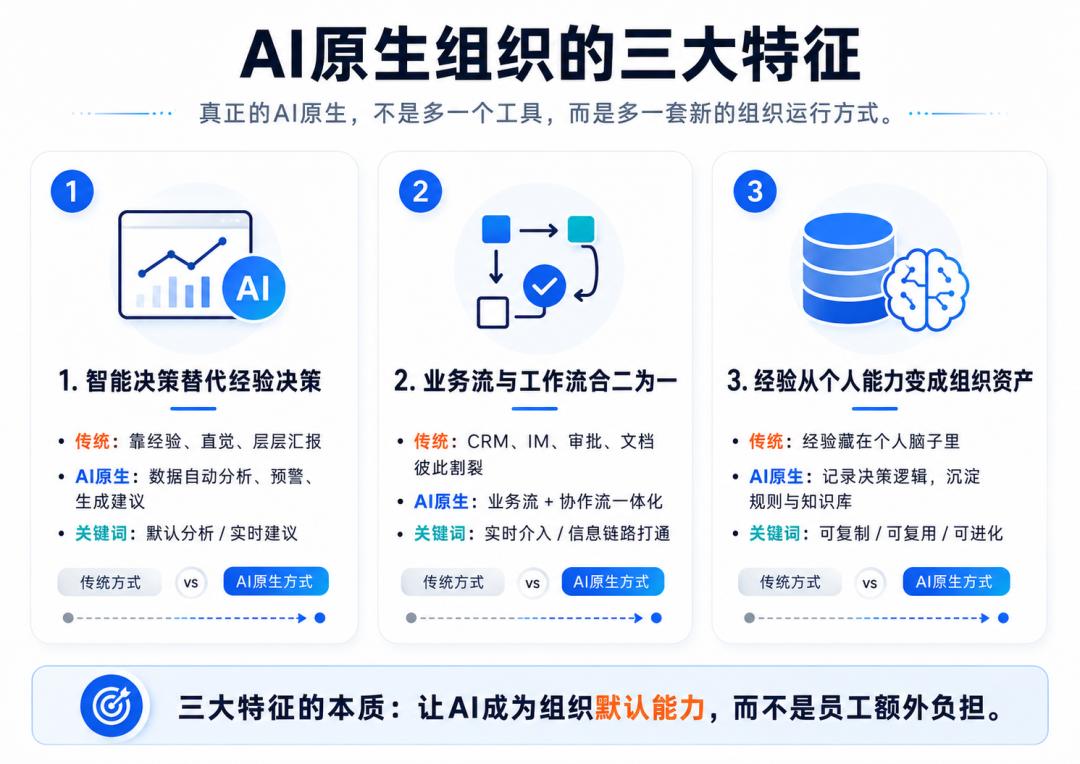
In traditional organizations, how are decisions made? They rely on Lao Wang's industry experience and General Manager Zhang's intuitive judgment. These experiences are in Lao Wang's head. Once Lao Wang leaves, the decision-making ability goes with him.
In an AI-native organization, it's different. When business data flows through the underlying system, AI automatically conducts analysis and early warning, and decision-making suggestions are directly pushed to the responsible person. The basis for decision-making is data, not feelings.
Huawei's approach is to integrate AI into the entire data lifecycle, making intelligent analysis the default ability of the data platform. Note the word "default." It's not that you actively search; the system automatically provides it to you.
The second characteristic is the integration of business processes and workflow.
Think about today's enterprises. Business processes run in the CRM system, and workflow runs in DingTalk or Feishu. The two systems are separated. Project progress is in System A, meeting minutes are in System B, and approval processes are in System C. To integrate a complete information link, manual transfer is required.
Feishu's approach is to connect IM, documents, and business processes in the collaboration suite, allowing AI to intervene in project nodes at any time. It's not a post-event summary but real-time intervention.
The third characteristic is the replicability of experience.
In traditional organizations, experience accumulation is a difficult problem. A top salesperson who has accumulated strategies over ten years takes all that experience away when he leaves.
In an AI-native organization, AI becomes the "carrier" of experience. It automatically records your decision-making logic, updates business rules, and turns an individual's experience into reusable assets for the organization.
He Enpei, the founder of Transn, said something I quite agree with: "Rather than waiting for employees to become AI experts, it's better to let the organization develop AI capabilities."
Individuals may leave, but the organization's AI capabilities can be precipitated, accumulated, and evolved.
By now, you may say, "I understand the theory, but how can it be implemented in practice?"
After all, most companies are not Alibaba or Huawei. They don't have a technical team of thousands of people and a budget of billions.
I've thought about this for a long time and would like to share some of my observations and ideas.
First, it's a matter of cognition.
Many bosses' understanding of AI is still at the "tool" level. They buy a team version of ChatGPT and open Claude for employees, thinking that their company has become AI-enabled.
This is as absurd as thinking a company became Internet-enabled just by buying a computer in 2005.
In the 1880s, when electricity began to be popularized in the United States, many factory owners spent a lot of money to buy generators and motors and installed them in their factories. But after installation, they found that production efficiency didn't improve significantly.
Why?
Because they only replaced steam engines with electric motors, but the layout of the entire factory, the design of the assembly line, and the division of labor among workers remained unchanged. Electricity only changed the power source, but the production mode was still that of the steam era.
Those who truly benefited from electricity were those who understood what electricity could bring. They redesigned the factory layout, invented the assembly line, and made each workstation independently powered. This led to the revolution in large-scale industrial production.
I often think that the current stage is quite similar to 1880.
Everyone is installing AI, but few are truly redesigning their "factories."
After cognition comes the organizational level.
I think Transn's approach is quite worth learning from. After setting up a CAIO, they didn't let the CAIO work alone. Instead, they established an AI Native Decision Committee. Under it, there are several groups according to business lines: the Language Intelligence Group, the Industry Intelligence Group, and the Brand Sales Group. Each group has a clear leader and promotion goal.
Actually, it means that AI is not the responsibility of the technical department; it's the responsibility of each business line.
They also have a rule that I particularly like: All AI projects must have a runnable DEMO, and they must clarify what business problems they can solve. Projects without a DEMO won't be discussed in meetings, and those that can't clarify business value will be directly rejected.
This rule directly eliminates 90% of PPT projects.
Moreover, they have established an "AI Joint Fleet," with more than 20 cross-departmental teams working on AI application development. Note that it's not the technical team doing it; it's the business teams themselves.
This leads to a particularly core point: AI applications must be integrated into business scenarios from the very beginning, triggered by real needs, rather than being imposed by the technical department.
Then comes the incentive level.
This is also what many companies tend to overlook.
Transn has established a mechanism called "Energy Gold." Every time an AI application is used by a colleague and the user is satisfied, the development team accumulates Energy Gold. The more it's used and the higher the satisfaction, the greater the benefit.
The right to judge is given to the users, and the right to make decisions is given to the data.
The smart part of this mechanism is that it turns the promotion of AI from an "administrative order" into a "market behavior." Whether an AI tool is useful or not is not determined by the boss but by the colleagues' actual usage.
This forms a positive feedback loop: the more it's used, the better it gets; the better it gets, the more it's used.
But to be honest, I'm still exploring.
Most of the cases I mentioned earlier are practices of large enterprises, which have sufficient resources, dedicated manpower, and budgets. For small and medium-sized teams, many of these practices may not be directly applicable.
So, I've been thinking about whether there are some lighter and more universal ideas.
I've summarized a few, which may not be entirely correct. I'd like to share them with you.
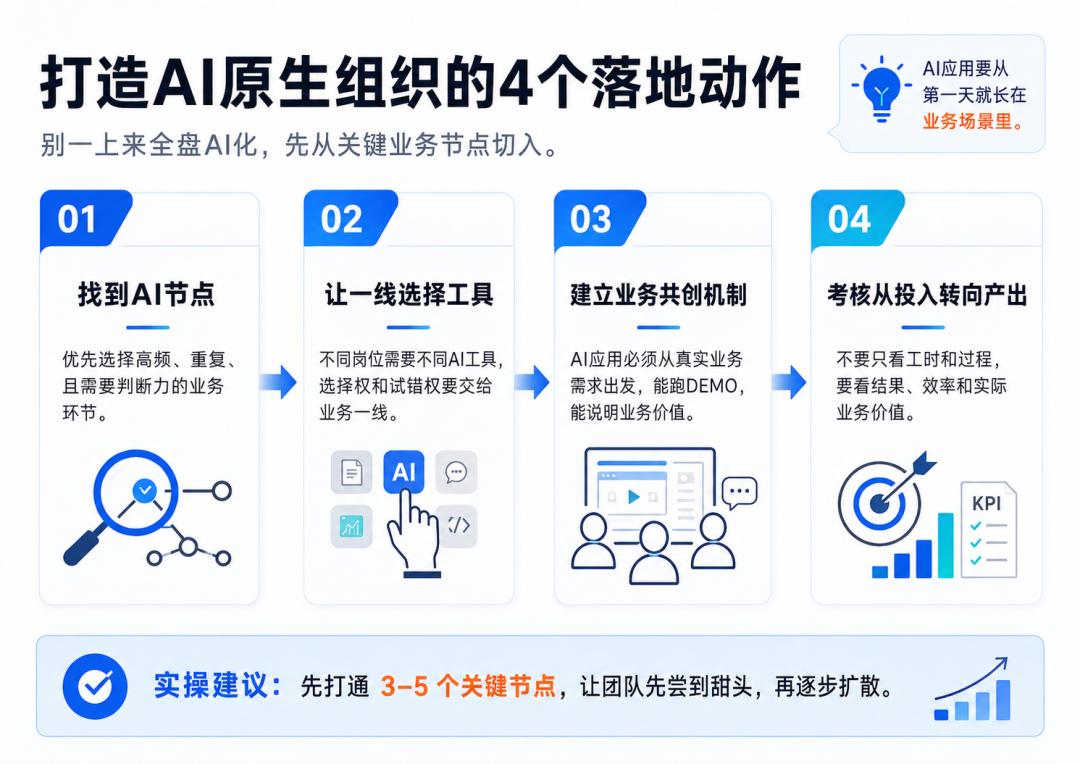
First, find your "AI nodes."
Not all positions are suitable for AI transformation, and not all processes require AI intervention. You need to find those high-frequency, repetitive, but judgment-required links in your business. These are your AI nodes.
For example, topic analysis in the content team, user segmentation in the operation team, and competitor tracking in the product team. These tasks used to take a lot of manual time. Now, with tools like Deepresearch or Claude Code, efficiency can be increased several times.
Don't try to implement AI across the board at first. First, connect three or five key nodes to let the team truly feel the value of AI.
Trust me, once a team tastes the benefits at a certain node, they will look for the next node on their own. This is more effective than 100 training sessions pushed by the boss.
Second, give front-line employees the right to choose tools.
Many companies make the mistake of having the IT department purchase a set of AI tools uniformly and then forcing all employees to use them.
This logic is flawed.
People in different positions need different AI tools. Content creators may need Claude more, data analysts may need GPT more, and coders may rely on Codex. A one-size-fits-all approach will only make everyone unhappy.
Instead, give each person a certain right to choose tools and even a certain budget for AI tools, so that they can choose, try, and decide which one to use on their own.
Good experiences in tool usage will spread naturally, which is more effective than any top-down promotion.
Third, change the assessment criteria.
This is the most difficult but also the most important part.
If you say you want to implement AI transformation but still assess based on working hours, output quantity, and traditional KPIs, you're forcing employees to pretend to use AI.
A person who can truly use AI may only work three hours a day but produce more than someone who is not good at using AI and works ten hours a day. If you assess based on working hours, the efficient person will be at a disadvantage.
So, the assessment criteria should shift from "input" to "output" and from "process" to "result." This is easier said than done because it touches the root of the entire management system.
But if you don't change it, AI transformation will be just empty talk.
As I'm writing this, I suddenly think of DeepSeek.
Liang Wenfeng revealed to Liu Yonghao that DeepSeek only has 160 employees.
160 people.
These 160 people developed a large model that made the entire Silicon Valley tremble. OpenAI has 3,500 people, Anthropic has 3,000 people, and DeepMind has 8,100 people. DeepSeek achieved comparable results with less than one-twentieth or even one-fiftieth of their manpower.
Moonshot AI (Dark Side of the Moon) is also similar. With about 300 people, it delivered a trillion-parameter model using only 1% of the industry's computing power.
Is this a victory of technology? Of course.
But have you ever thought that it's also a victory of the organization?
A team of 160 people can achieve such results, which means their organizational method must be completely different from that of traditional companies. Their internal collaboration mode, decision-making process, knowledge accumulation, and talent density must have a special structure.
Although we don't know exactly how DeepSeek operates internally, the result itself shows one thing.
In the AI era, more people don't necessarily mean stronger. Innovation density is the ultimate competitiveness.
And innovation density is not achieved by simply increasing the number of people; it's designed through the organization.
Finally, let's talk about a more fundamental question.
I've been thinking about whether an AI-native organization is an "upgrade" or a "rebirth."
I think it's a rebirth.
Just like the transition from a horse-drawn carriage to a car, it's not just about installing an engine on the carriage. You have to reinvent the wheels, redesign the steering wheel, rebuild the roads, and re-establish traffic rules.
The entire ecosystem has to be reconstructed.
The same goes for an AI-native organization. It's not about adding a layer of AI to your existing organization. Instead, it's about rethinking what your organization should look like if AI had existed from the very beginning.
The answer to this question is different for each industry and each company. No one can give you a standard template.
But I always believe in one thing.
The gap between those who start thinking about this question today and those who only start acting when forced into a corner will be unimaginably large in five years.
It's not because you're not smart enough or not hardworking enough.
It's because you need to get on some "trains" early enough.