Hourly wage of 800, minimum master's degree: What exactly do the AI data "alchemists" that big companies are scrambling to hire do?
In the traditional perception of the public, AI data annotation has always carried a certain color of a "digital assembly line."
It usually means sitting in front of a computer, repeatedly processing pictures, voices, or texts. For example, drawing boxes around pedestrians and vehicles in self-driving images one by one, proofreading subtitles sentence by sentence for voice systems, or labeling data according to established rules. Its characteristics of low threshold, low salary, and mechanical nature are comparable to those of an "electronics factory" in the AI era.
However, after the wave of large models swept through the AI industry, an unexpected change began to occur in the data annotation industry. Although there is still a huge demand for traditional data annotation work, more and more AI companies, especially leading large model manufacturers, are looking for a new type of annotator with more technical content.
Now, some relevant positions in companies such as Alibaba, ByteDance, DeepSeek, and MiniMax are no longer named "data annotation," but have been renamed "Data Master," "AI Question Expert," "Data Alchemist," etc.
The requirements for capabilities have also changed accordingly. The educational requirements for many positions have been raised to a master's degree or above. Talents with professional backgrounds in law, finance, medicine, programming, linguistics, etc., or those with rich work experience and competition experience are more popular.
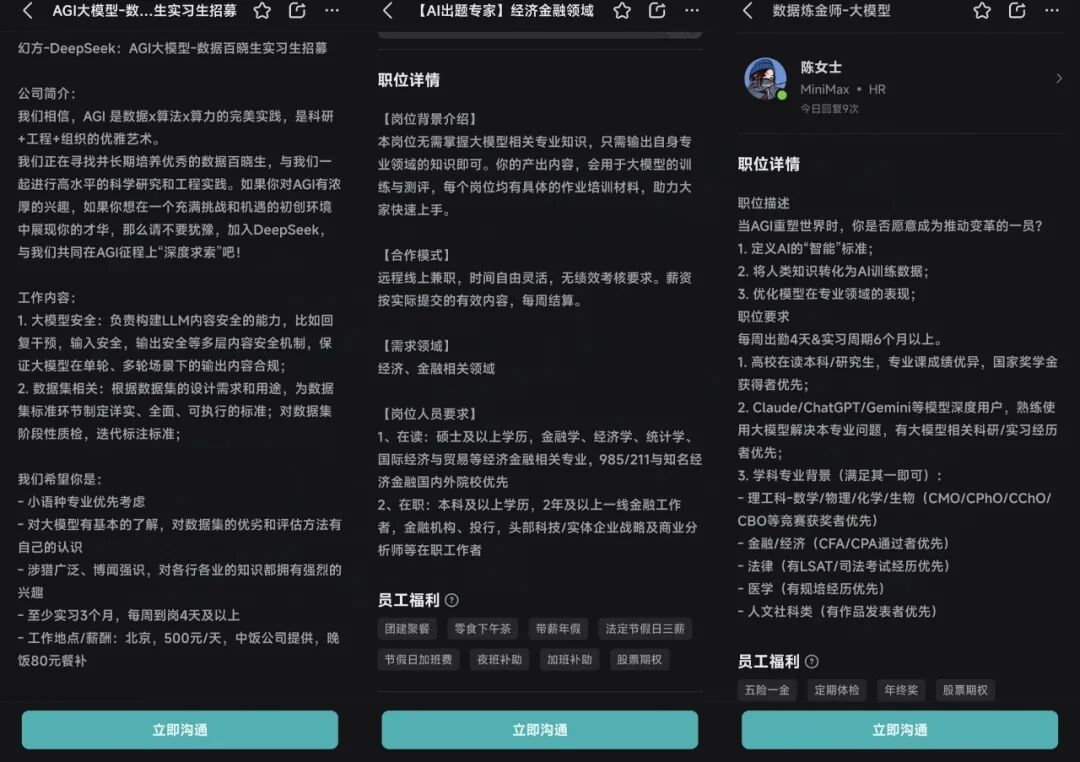
After the requirements are improved, the salary and benefits of these positions have also increased significantly. On recruitment platforms such as Boss Zhipin, the hourly rate for tasks in vertical fields such as finance, law, and medicine has reached 500 - 800 yuan. Even for outsourcing positions in large companies, the monthly salary of such positions has increased from the traditional level of 3,000 - 4,000 yuan to about 8,000 - 10,000 yuan.
Data annotation in the era of large models is becoming a much more complex profession. Behind this change, there is actually a shift in the AI industry itself.
01. Why do AI data annotation suddenly need experts?
The data supply model in the large model industry is changing.
Early large model training highly relied on a large amount of public data. Manufacturers scraped text, pictures, and videos from the Internet to let the model learn language rules and world knowledge. At this stage, computing power, parameters, and data scale largely determined the upper limit of the model's ability, which also formed the Scaling Law in the pre-training stage.
However, the data on the Internet is ultimately limited. In 2024, Ilya Sutskever, the former chief scientist of OpenAI, once put forward a view that the data on the Internet for training models is about to be exhausted, which may end the pre-training paradigm we are familiar with in the past.
Specifically for Chinese, this problem of data shortage may be more serious. The "White Paper on Large Model Training Data" released by the Alibaba Research Institute shows that there is a significant difference in the proportion of Chinese and English corpora on the Internet. The proportion of English corpora is as high as 59.8%, while that of Chinese corpora is only 1.3%.
At the same time, Internet data is not a naturally high-quality resource. A large amount of content in it contains repeated, noisy, incorrect, or even contradictory corpora. The model can learn language patterns from Internet data, but it may not be able to form reliable judgments.
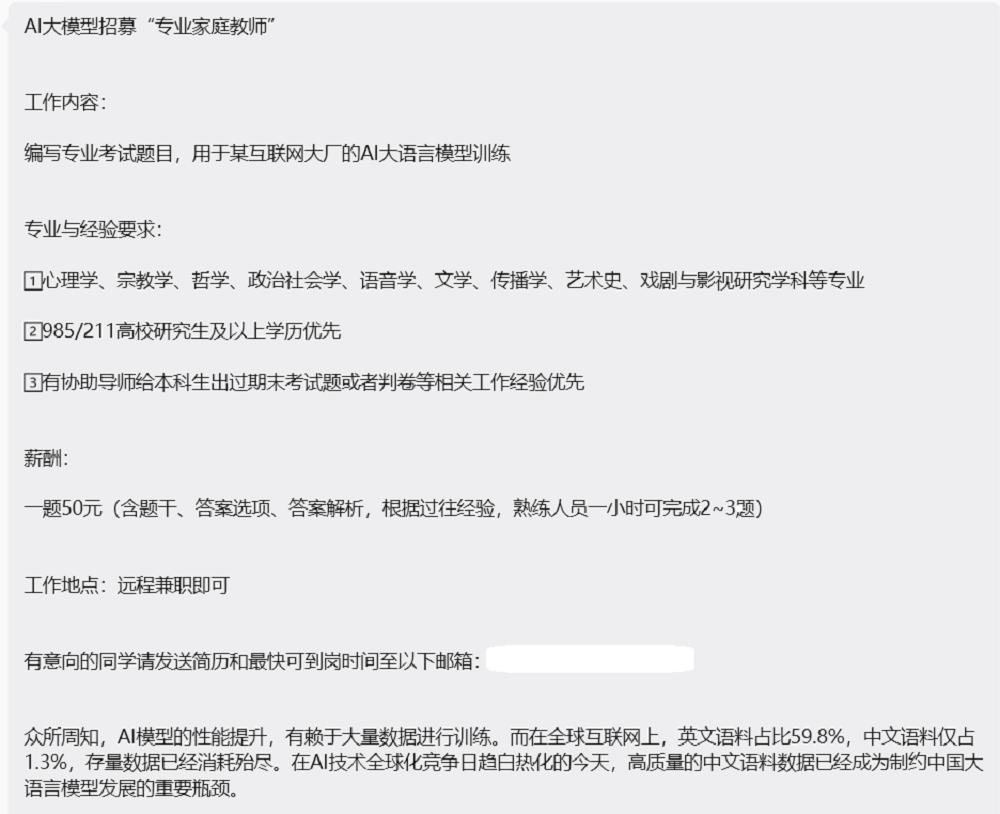
The requirements for a data annotation position in a large company mention the shortage of high-quality Chinese data.
Although synthetic data is regarded as a way to alleviate this problem, it is difficult to fundamentally solve it. The data generated by the model is limited by its own ability boundary. It can expand existing knowledge, but it is difficult to create judgment criteria beyond its own cognition.
Therefore, the Scaling in the post-training stage has gradually become the focus of the industry. At this stage, the improvement of the model's ability increasingly depends on human feedback, including model evaluation, preference data construction, and RLHF. The model needs humans to tell it what answers are better, what logic is more in line with reality, and what expressions are more in line with professional standards.
In professional fields such as finance, law, and medicine, as well as in complex tasks such as reasoning and creative writing, only people with profound professional knowledge and judgment ability can produce truly high-quality data to support the improvement of the model's ability.
02. The hourly rate can reach 500 yuan, but a degree is not the key to success
With the continuous increase in the importance of post-training, since the second half of 2025, domestic large companies such as ByteDance and Alibaba, and leading AI manufacturers such as DeepSeek, MiniMax, and Zhipu have successively promoted their expert data platforms or senior data annotation positions on recruitment platforms, university communities, and social media to attract more professional talents to join.
In order to understand the specific content of this new type of data annotation work, Zhidongxi interviewed two participants. They entered the industry through different paths, are in different career stages, and have obvious differences in their feelings about the work. However, they are all involved in the same thing: helping the model learn how to judge, understand, and express.
Last year, Molly, who has more than a decade of work experience in finance and the Internet, saw the recruitment information of ByteDance's expert data platform Xpert on a social platform and immediately submitted her resume.
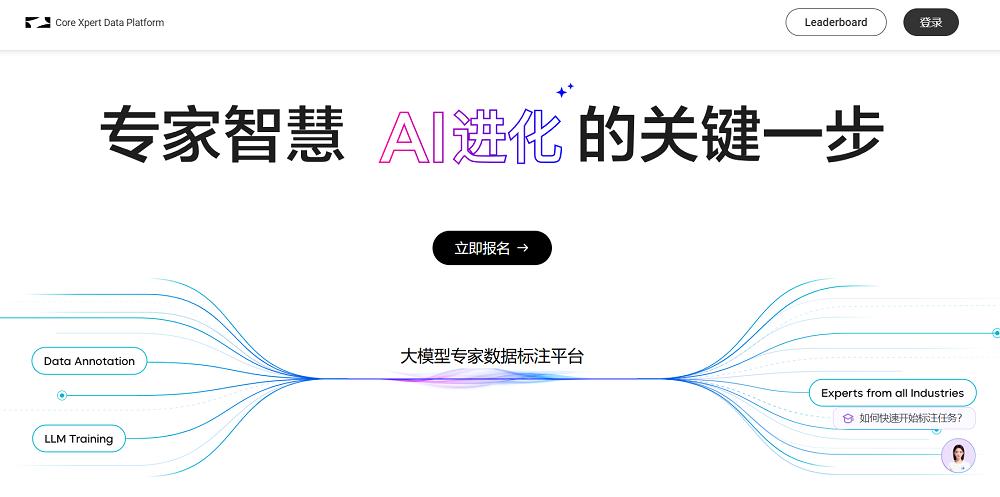
ByteDance's expert data annotation platform Xpert
Before actually entering the platform, she first needed to pass a test. Candidates not only need to prove their professional background but also design questions that can "stump the model." The platform will call multiple models simultaneously for verification. Only when at least two models fail to answer correctly can the question have a chance to be recognized as valid.
Molly doesn't think the test is difficult, but she also noticed that many candidates participating in the test get stuck at this stage. In her opinion, the reason is not just the level of education, but the difference in real industry experience. "Many master's and doctoral students don't have real work experience, so it's difficult for them to design questions with in-depth industry knowledge," she said.
Finally, Molly joined the expert task group in the business and finance direction. She mentioned that such tasks often correspond to real business scenarios. Taking the investment due diligence scenario as an example, multiple models will simulate institutions to evaluate projects and generate analysis reports of tens of thousands of words around risks, operations, and business feasibility.
Her job is to compare and judge these results from the perspective of a financial professional: which analysis is more in line with the real business logic, whether the risk identification is sufficient, and whether the evaluation framework is close to the actual decision-making process. After making the selection, the work doesn't end. She also needs to further break down the judgment process, explain the basis from multiple dimensions, and point out the problems in other answers.
This type of task is paid by the hour and is graded according to the test results and professional abilities. Molly observed that in the finance direction, an hourly rate of 300 - 500 yuan is not uncommon.
It should be noted that the hourly rate of this job cannot be directly converted into a monthly salary. Its salary is completely linked to the workload. How many tasks an expert takes on each day and how many tasks the platform releases each day will affect the expert's total income over a period of time.
On Xpert, most tasks can be completed online, but the whole process needs to be recorded to prevent cheating and ensure that the judgments come from real experts, not other AI tools.
In Molly's view, the core ability requirement for this job is not a degree but long-term accumulated industry experience. Only those who have really done investment and evaluation know where the problems of the model lie.
In addition to financial-related tasks, Molly sometimes actively chooses some logic questions with a lower hourly rate. In her eyes, these tasks are more like board games, so she finds them quite interesting.
When talking about these experiences, Molly always shows obvious excitement. When we asked her if she enjoys this job, she said without hesitation, "Very happy."
03. Under the creative shell, is data annotation still an assembly line?
Not everyone views this job as enjoyable as Molly.
Yuan Xing, who graduated from China University of Mining and Technology, joined an Internet giant as an outsourcer in May 2025 to engage in AI novel annotation work and left the company half a year later. This was his first job in life. He said, "Before joining the company, I had no work experience and had never done data annotation."
The AI novel project team he was in was newly established and was short of people. Compared with mature teams that give priority to recruiting practitioners with annotation experience, this team values writing backgrounds more.
Yuan Xing happened to meet this requirement. He has publishing experience and has won some writing awards. Therefore, even though he lacked annotation experience, he still passed the interview and joined the team smoothly.
However, after actually joining the company, he found that the actual content of this job is not completely consistent with the outside world's imagination of "AI novels": Under the shell of creative work, it is essentially a highly segmented data production process.
Yuan Xing's team needs to process the results generated by multiple models at the same time: the same novel instruction will be given to the company's model and other competing models for answers, and the annotators are responsible for reading and comparing them one by one and judging the problems according to the rules.
This job has relatively high requirements for professional abilities. About half of the people in the team have worked as screenwriters, and the others have experience in online novel writing and media contributions. Annotators need to judge whether the characters' behaviors are in line with the settings, whether the plot development is reasonable, and whether the conflicts are valid. Everything is broken down into detailed scoring criteria.
After identifying the problems, annotators also need to score the model outputs and manually rewrite the text in some projects, delete redundant descriptions, repair logical loopholes, or readjust the structure. One of the tasks is to "extract a detailed outline" for a long novel. A novel with more than a dozen chapters and tens of thousands of words needs to be refined into a structured outline chapter by chapter and then used as data input for the model's expansion and training.
In essence, this is more like an assembly line job that requires literary judgment, with highly repetitive and standardized tasks. Yuan Xing believes that annotators are in a very low position in the ecological chain.
Yuan Xing said that his working hours are from 9:30 am to 6:30 pm every day, with a 90-minute break at noon. The working hours are flexible, and he basically doesn't work overtime.
Although there are certain requirements for literary aesthetics and writing abilities, Yuan Xing's salary is not high. He works in Beijing, and his monthly take-home income is about 8,000 yuan. His social insurance and housing fund are paid according to the local minimum standard.
04. The same data annotation, different professional realities
Although both are engaged in data annotation, Molly and Yuan Xing are in two completely different worlds: one is a highly professional and value-fulfilling position, while the other, although also requiring professionalism, is more like a boring and depressing assembly line.
This differentiation has also shaped their completely different understandings of the AI industry.
Molly has obvious recognition of this job. In her view, creating data and training AI is essentially a process of knowledge sharing. Financial experts, legal experts, and psychological counselors are all inputting their experience into the model, and the model then returns it to society at a lower cost.
In the past year, she has clearly felt that the model is iterating faster and faster. In the financial field, regulatory rules and industry changes are frequent, and early models often couldn't recognize these changes. Now, similar problems have decreased.
In addition to the annotation work, Molly has also applied AI to her other identity. She runs a psychological counseling studio. In the past, counselors needed to spend a lot of money to seek professional supervision (evaluation and support for other counselors' work by experienced counselors), but now, she has started to use the model to meet some of the supervision needs.
She believes that this will make professional services more accessible to the public.
Yuan Xing's feelings are more restrained. He admits that the model is improving, but this improvement is not always obvious. Especially in the field of novels, he hasn't seen any amazing changes in half a year.
More importantly, he always has difficulty confirming how much effect his labor has actually produced. The model absorbs a large amount of data, and he only processes a very small part of it. Even if the model improves, he can't clearly judge which changes really come from his work.
He describes this feeling as a "black box." The labor exists, but the results are far away from him.
Yuan Xing also mentioned an experience in his narrative - "being nitpicked." In daily work, the data must be modified by quality inspectors before being submitted. After each modification by the quality inspector, they will @ the annotator in the group and point out the problems. The group is almost full of problem feedback and never mentions what is well-written.
However, in the highly subjective task of novel annotation, the so-called "errors" are not always absolute but more like differences in understanding. But in the process, they are still presented as problems that need to be corrected.
Yuan Xing observed that many annotators start to doubt their own value at work, and the working atmosphere they are in is also quite depressing. During his half-year of work, two colleagues left the company because of this.
05. Conclusion: Who is teaching AI to understand the world?
How to efficiently organize human experience is becoming the key factor in the next stage of competition for large models. In this process, participants like Molly and Yuan Xing form the key nodes connecting the model with real industry experience: they reorganize their professional knowledge and judgment ability in a form that is easy for the model to understand and absorb and then inject it into the training and feedback process.
In the era of large models, this work no longer exists in a relatively single and fixed form but is further refined and disassembled. From general annotation to domain division of labor, from simple judgment to complex reasoning, from result scoring to process explanation, data production is forming a more detailed task chain.
At the same time, we also need to see the different experiences that this new type of knowledge work brings to people. Some people gain a sense of value from it, while others are consumed in the repetitive and standardized process. How to treat people's experience with more dignity and make the value of professional judgment more clearly visible is becoming an unavoidable problem in this new production system.
Note: Molly and Yuan Xing are both pen names.
This article is from the WeChat public account "Zhidongxi" (ID: zhidxcom). Author: Chen Junda, Editor: Xinyuan. Rep