The 4th China AIGC Industry Summit was successfully held in Beijing! Nearly 20 industry experts decoded the opportunities of Agents and non-consensus.
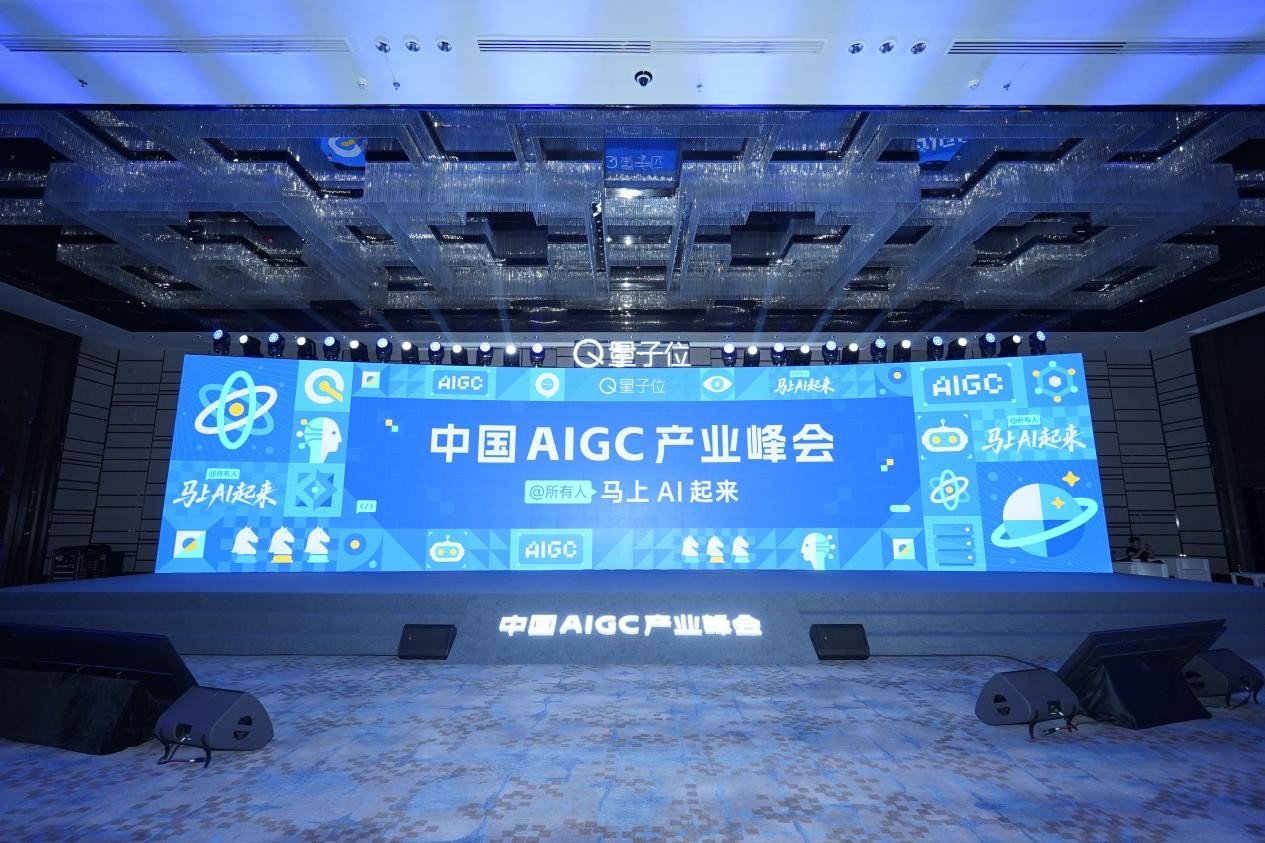
Today, the 4th China AIGC Industry Summit hosted by QbitAI kicked off in Beijing.
In 2026, the AI industry has been advancing by leaps and bounds. From "Lobster" to "Harness", popular Agents have successively become well - known and swept across the whole network. Facing the emerging new business forms and new ways of playing, many practitioners and ordinary users are confused: How to find the right way to use AI? How to seize the industry opportunities? And how to keep up with the pace of the industry development?
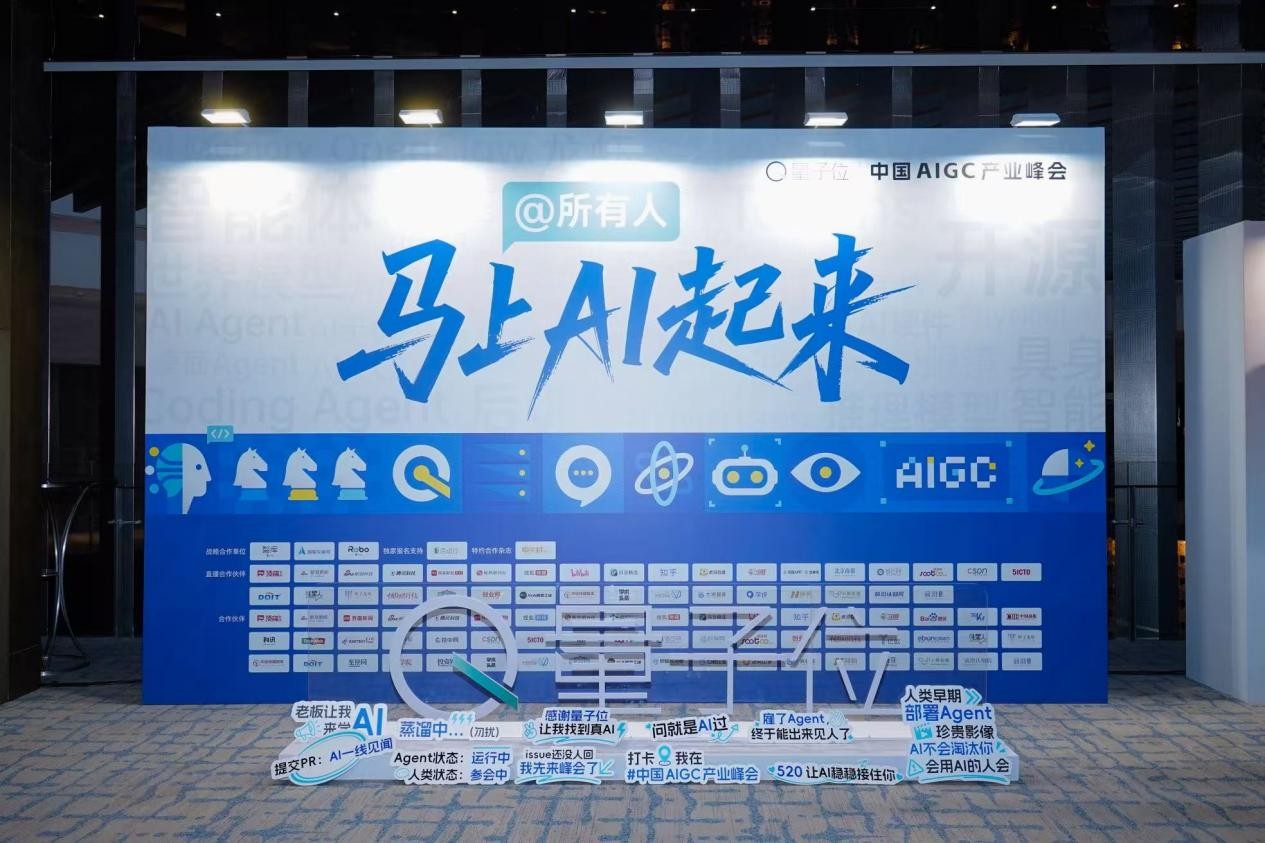
Against this background, this summit, themed "Hey everyone, let's embrace AI now", gathered nearly 20 heavyweight industry guests, and linked up leading industry enterprises, emerging startups, and top academic forces. It launched in - depth exchanges and ideological collisions around core issues such as the commercial implementation of AI Agents, breakthroughs in multimodal technologies, in - depth exploration of scenarios in various industries, and changes in computing power infrastructure.
The guest lineup is truly luxurious:
Representatives from leading enterprises such as Kunlun Tech, SenseTime, Baidu, Ant Group, MiniMax, Amazon Web Services, and JD.com gathered at the scene. Top scholars such as Qiu Xipeng, a specially - appointed professor at Fudan University, and Huang Chao, an assistant professor at the University of Hong Kong, brought forward - looking technology judgments. Front - line practical players such as Shanda EverMind, Taichu Yuanqi, Fengxing Online, Easyshare Health Group, Quwan Technology, ColaOS & MarsWave, and EvoMap shared their implementation experiences. Zhang Lu, the founding partner of Silicon Valley's Fusion Fund, brought a new perspective on the AI industry and the computing power track.
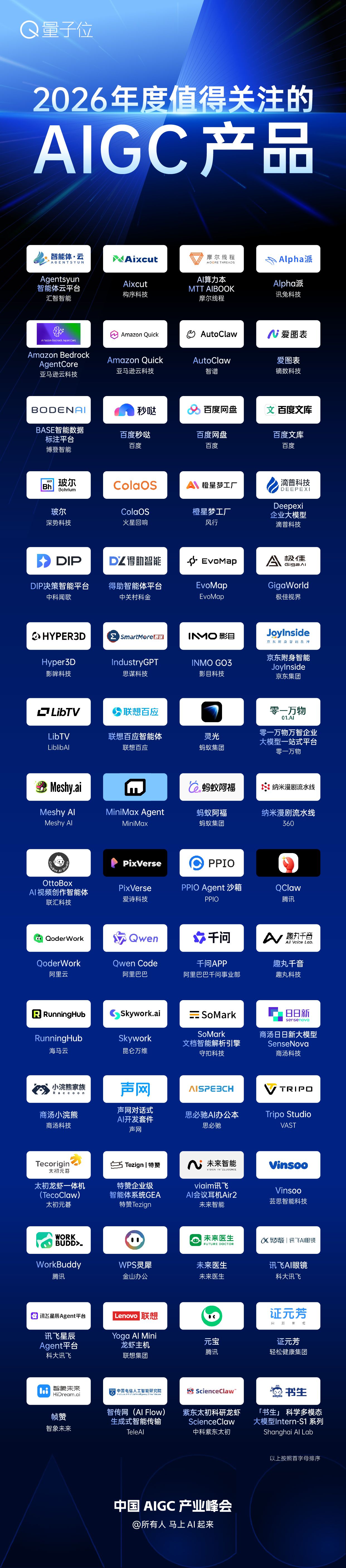
Meanwhile, QbitAI officially announced two major awards, "2026 AIGC Enterprises Worth Attention" and "2026 AIGC Products Worth Attention", and simultaneously released the "2026 China AI Application Panoramic Map Report".
Targeting technological innovation and insight into the core trends of industry development
In 2026, AI Agents have evolved from hot topics in industry discussions to real issues that enterprises and developers must face. At this summit, many industry experts dissected the key paths and challenges of Agent implementation from different perspectives.
Fang Han, the chairman and CEO of Kunlun Tech, answered the question "How should individuals and enterprises respond to the impact of Agents" from a front - line perspective. He said that the impact is real, but the key is not whether to be impacted, but how to get through the transition period.
Wang Xiaoye, the technical director of the product technology department of Amazon Web Services, focused on "Crossing the implementation gap of Agents" and dissected the engineering challenges and solutions between top - level large models and enterprise - level AI Agents.
Huang Chao, an assistant professor and doctoral supervisor at the University of Hong Kong, combined with the academic frontier perspective to discuss the technological opportunities and industry challenges brought by the paradigm shift of AI Agents.
Deng Yafeng, the vice - president of Shanda Group and the CEO of EverMind, shared the self - evolving technology driven by long - term memory and explained how AI evolves from tool - type applications to sustainable digital productivity systems.
While Agents have become the focus of the industry, the large models that provide underlying support for them are also constantly breaking through their capability boundaries.
Lin Dahua, the executive vice - president and chief scientist of SenseTime, deeply analyzed "From multimodal unity to spatial intelligence: Towards a new frontier of AI that can perceive, generate, and act".
Dai Wenjun, the person - in - charge of JD's JoyInside business, further extended this proposition to the physical world and shared how AI steps out of the screen and enters real terminals and real scenarios.
Qiu Xipeng, a specially - appointed professor at Fudan University, the assistant dean of Shanghai Chuangzhi College, and the founder of Mos Intelligence, brought the latest R & D results of the MOSS multimodal large model and shared the optimization ideas of cutting - edge technologies.
Digging deep into niche tracks, front - line players share implementation practices
Specifically in different fields, where exactly are the opportunities? At this summit, many practical players in the AI track gave answers. They brought mature application cases that can be implemented and referenced across the industry.
Yi Zhengchao, the CEO of Fengxing Online, put forward a core judgment, believing that from AI programming empowering development and creation to AI video revolutionizing content production, "Crowd - creation is the core lever of AI productivity".
Zhu Guangxiang, the general manager of Baidu's Miaoda product, shared the product concept of "Everyone is a creator" and demonstrated a new model where imagination releases productivity and AI empowers ordinary users to reduce costs and improve efficiency.
Hu Weiqi, the person - in - charge of MiniMax's ToB commercialization in China, titled his speech "Intelligence with Everyone" and shared MiniMax's real strategies and thinking in the past year.
Ma Xiaowu, the executive vice - president of Easyshare Health Group, based on the vertical health field, titled his speech "From evidence - based intelligent agents to an AI - driven health service growth flywheel" and expounded the new - type health service capabilities centered on AI.
In addition, the paradigm reconstruction of AI infrastructure is also one of the main lines of attention at this year's conference.
Zhang Lu, the founding partner of Fusion Fund, based on the dual perspectives of global capital and industry, put forward "Reconstruction of the computing power narrative" and deeply interpreted the new paradigm of AI infrastructure from training to inference.
Hong Yuan, the chief product officer and senior vice - president of Taichu Yuanqi, titled his speech "Domestic AI computing power lays the foundation for the new future of Token intelligence" and explored the development path of domestic computing power adapting to the new - era AI industry.
GenAI Talk + Agent Round - table Debate
In addition to the keynote speech session by industry experts, the conference also arranged a heavy - weight GenAI Talk and an Agent round - table with intensive viewpoints this year.
In the GenAI Talk session, Shen Yujun, the chief scientist of Ant Lingbo Technology, and Li Gen, the co - founder and editor - in - chief of QbitAI, had an in - depth discussion around the core proposition "In the second half of AI 2.0, from AIGC to AIGA".
During the discussion, Shen Yujun reviewed the rapid evolution of AIGC in fields such as text, images, and videos in the past few years and judged that AI 2.0 has entered the second half, transitioning from AIGC to AIGA.
He further pointed out that when AI moves from the digital world to the physical world, there are both technological challenges and implementation opportunities. Ant Lingbo's "General Brain" is a response to this proposition. At the technical level, Shen Yujun introduced the full - stack technology layout from spatial intelligence, dexterous operation to environmental feedback. Finally, Shen Yujun also shared Ant Lingbo's open - source strategy and made prospects for embodied intelligence to enter thousands of households.
In the Agent round - table session, the theme was set as "In 2026, the uncertainties and non - consensus opportunities of Agent products".
Zhuang Minghao, the vice - president and chief strategy officer of Quwan Technology and the host of "The Art of Slaying Dragons", Feng Lei, the CEO of ColaOS & MarsWave, and Zhang Haoyang, the founder of EvoMap, debated on the same stage.
The guests deeply compared the iterative logic of Agent products with that of traditional apps, shared the core criteria for evaluating the value of Agent products, and discussed the product decision - making and function planning ideas under the rapid iteration of models.
On this basis, they also predicted the future development forms of super Agents and multi - specialized collaborative Agents, envisioned the new cooperation and business possibilities of the Agent ecosystem, analyzed the non - consensus breakthrough points under homogeneous competition, and discussed the new changes brought by the large - scale implementation of AI Agents to the work patterns of industry practitioners.
Announcement of the lists of "2026 AIGC Enterprises/Products Worth Attention"
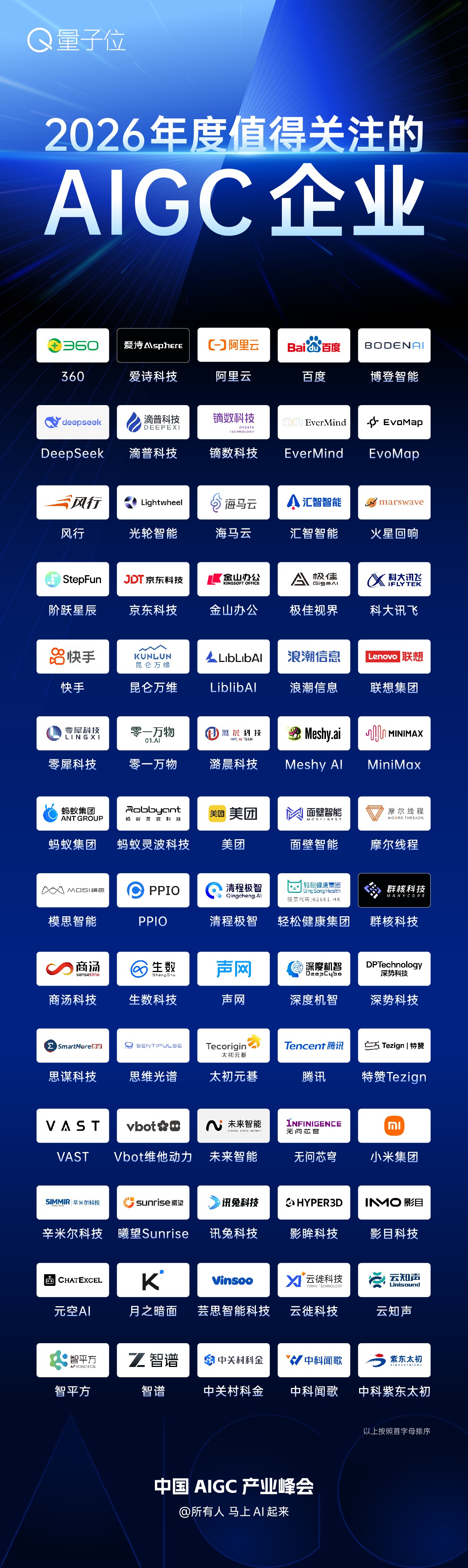
Continuing the tradition of previous summits, the conference officially announced the double lists of "2026 AIGC Enterprises Worth Attention" and "2026 AIGC Products Worth Attention".
This selection collected hundreds of applications from enterprises and product teams. QbitAI combined the actual performance, user feedback, and industry influence of generative AI enterprises and products in the past year, and referred to the opinions of dozens of industry experts, investors, technical leaders, and industry practitioners to select the final results.
The list of "2026 AIGC Enterprises Worth Attention" covers all links of the entire industrial chain from underlying computing power, basic models to industry applications. The list of "2026 AIGC Products Worth Attention" spans multiple tracks such as AI content creation, intelligent customer service, code assistance, video generation, enterprise knowledge management, and industrial design.
Release of the "2026 China AI Application Panoramic Map Report"
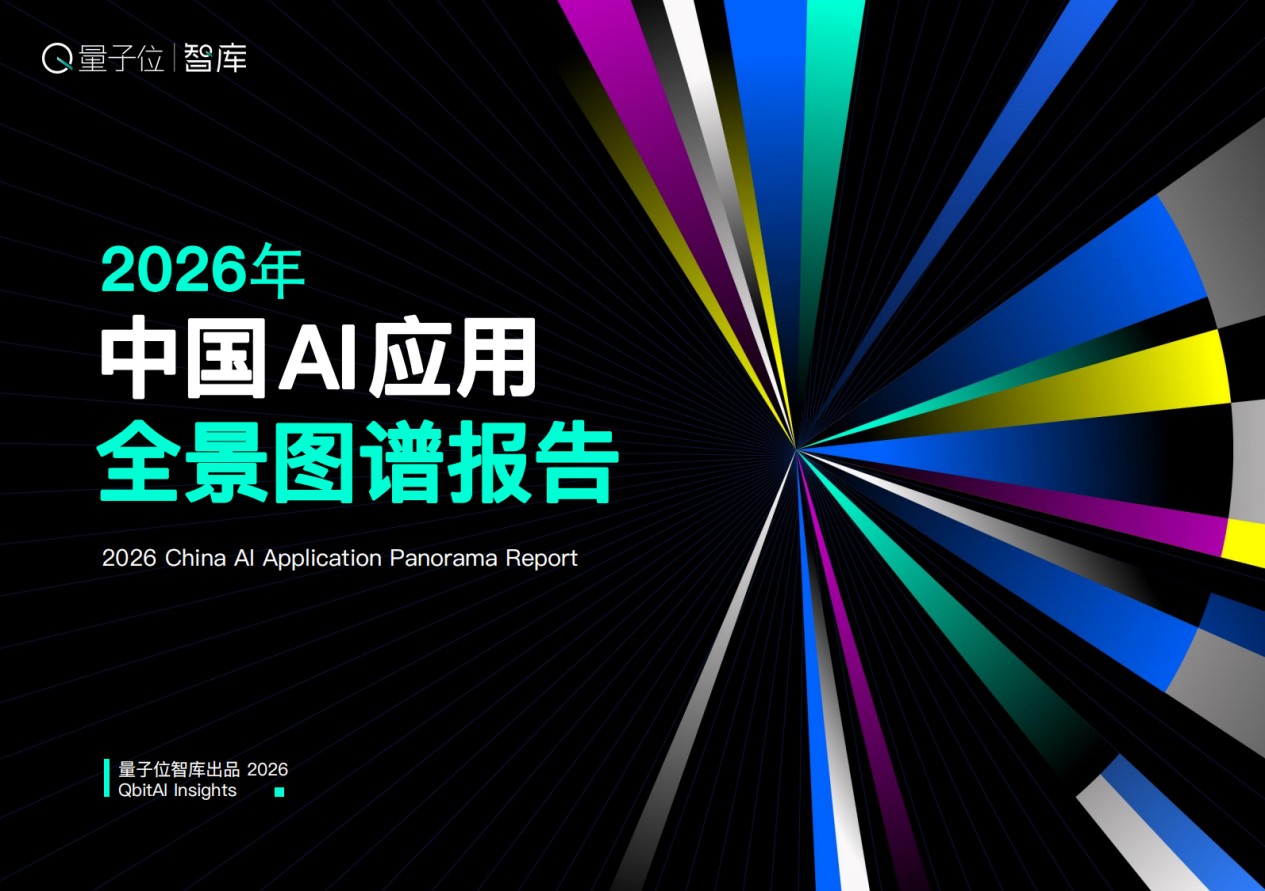
At the conference, the "2026 China AI Application Panoramic Map Report" painstakingly created by QbitAI Think Tank was simultaneously released to the public, showing the market pattern and development dynamics of domestic AI applications, and deeply analyzing the most potential and competitive products and tracks.
This report spans three major dimensions: AI software and hardware for consumers, ToB vertical applications in various industries, and the underlying development layer that supports the operation of the entire ecosystem. It has extracted five core trends that are reshaping the industry:
The wave of Agentization where AI evolves from "answering questions" to "completing tasks"; the ecological competition among major platforms to compete for the default user entry; the popularization of models where DeepSeek re - prices the entire industry and the technological dividend shifts to the application layer; the successful implementation of the business model with the real awakening of users' willingness to pay; and the large - scale penetration of B - end vertical scenarios such as medical, legal, and education fields.
Download link: https://jkhbjkhb.feishu.cn/wiki/W5D7wuDcbiPXDLkaRLQcAJpOn8f