The 2026 Government Work Report mentioned "future energy". Why does it matter to you and me?
In the 2026 Government Work Report, "Future Energy" was listed as the top priority for the cultivation of future industries for the first time, surpassing quantum technology and embodied intelligence, sending a clear signal - the energy revolution has risen from "infrastructure support" to a national core strategy. What does this mean?
In recent months, several regions in China have been troubled by two issues. On one hand, new energy vehicle owners complain about the long waiting time at charging piles. On the other hand, data center operators have received notices from the power grid, asking them to shift peak - time electricity consumption. These two issues may seem unrelated, but in fact, they point to the same problem - Is our electricity supply insufficient?
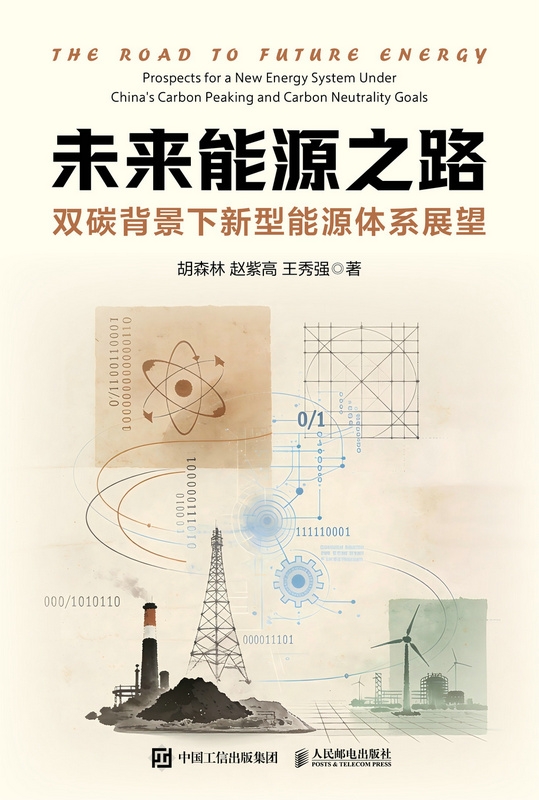
Actually, the answers to these two questions are hidden in the book "The Road to Future Energy".
From AI computing power to new energy vehicles
The development of artificial intelligence technology has led to a sharp increase in electricity demand. According to statistics from the China Academy of Information and Communications Technology, the electricity consumption of data centers nationwide reached 166 billion kilowatt - hours in 2024, accounting for about 1.68% of the total electricity consumption of the whole society. The SemiAnalysis report states that the energy consumed by using large - scale models for question searches is 10 times that of conventional keyword searches. In simple terms, every time ChatGPT answers a question, the electricity consumption is about 10 times that of a traditional search engine. The annual electricity consumption of a medium - sized data center is already equivalent to the total electricity consumption of a county. This means that the resonance between computing power demand and energy consumption is forming an "energy black hole". "Future Energy" is not only a matter for the power grid but also determines the upper limit of China's AI competitiveness and the digital and intelligent transformation of all industries.
Looking at new energy vehicles, as of the end of 2025, the number of new energy vehicles in China reached 43.97 million, accounting for 12.01% of the total number of vehicles. In 2025 alone, 12.93 million new energy vehicles were newly registered, accounting for almost half of the total number of newly licensed vehicles that year. The industry predicts that by 2030, this number may exceed 100 million, and the annual electricity consumption will exceed 150 billion kilowatt - hours, equivalent to the current total electricity consumption of Guangdong Province.
The instability of clean energy exacerbates the power imbalance
Since the development of human society, there have been two major energy transitions, namely from firewood to coal and from coal to oil. Now, the new domestic and international situations have put forward new and higher requirements for China's energy transition.
In the book "The Road to Future Energy", the author details the current different fields such as fossil energy and secondary energy, as well as the new models of energy transition. Taking wind power and photovoltaics as examples, according to the latest data released by the National Energy Administration, as of the end of 2025, the cumulative installed capacity of wind power and photovoltaics in China has historically exceeded that of thermal power, with the total of the two exceeding 1.84 billion kilowatts, accounting for 47.3%. It is worth mentioning that the 2025 Government Work Report also clearly requires accelerating the construction of new energy bases in "deserts, gobi, and wastelands" and coordinating the construction of local consumption and external transmission channels.
The traditional energy supply model is "source follows load" - power plants generate electricity, users consume electricity, and the power grid regulates in between. However, even with the introduction of wind power and photovoltaics, an old problem still exists: wind and solar power generation "relies on the weather". When there is no sunlight at night or the wind speed is too low, the continuous output is limited, and the pressure on the power grid is greater.
Let's start with photovoltaics. Due to its relatively high technological maturity, photovoltaics has become the first choice for energy - poor countries. However, its output curve basically follows the sun - reaching its peak at noon, dropping sharply to zero in the evening, and having no output at night. It sounds regular, but once there are cloudy days, rain, snow, or sandstorms, the output can drop by more than 70% within a dozen minutes.
Now let's look at wind power. The book "The Road to Future Energy" points out that currently, China is both the world's largest wind power market and the largest wind turbine supplier. China's 14th Five - Year Plan clearly states that the total installed capacity of wind power and solar power will reach over 1.2 billion kilowatts by 2030. However, the uncertainty of wind power is more complex than that of photovoltaics. If the wind speed is too low, the turbines won't turn; if it's too high, the blades will cut out for protection. What's more troublesome is that wind power often shows an "anti - peak - shaving" characteristic - when the electricity load is the lowest at night, the wind is often the strongest; in the afternoon during the summer peak electricity consumption, the wind is the weakest. Data from a wind power base in the northwest shows that during the large - scale wind power generation at night in spring and winter, "wind curtailment" often occurs, while during the most tense electricity consumption period in the summer daytime, the wind power output is less than 10% of the installed capacity.
Returning to the question at the beginning, the instability of clean energy exacerbates the imbalance between supply and demand in the power system. The charging of electric vehicles and the fluctuations in AI computing power bring new randomness to the electricity consumption side. With instability on both ends, all the pressure is put on the power grid.
The imagination space of combustible ice and geothermal energy
In addition to wind power and photovoltaics, China's energy landscape is far more extensive. To achieve a real energy transition, we need to turn our attention to potential resources that have not been commercially developed on a large scale. In the book "The Road to Future Energy", the author presents two possibilities: combustible ice and geothermal energy.
Combustible ice is a crystalline substance formed by gas molecules and water molecules under low - temperature and high - pressure conditions. After decomposition into gas, the methane content is generally over 80%, and can reach up to 99.9%. Based on the reserves of combustible ice, its heat is equivalent to twice the total heat of known coal, oil, and natural gas in the world. The combustible ice resources in the South China Sea of China are equivalent to nearly 10 billion tons of oil equivalent, and continuous gas production has been achieved in trial mining in the past few years. Although the problems of mining cost and safety and environmental protection have not been completely solved, as a transitional clean fossil energy, it may become a stable supplement for natural gas power generation in the eastern coastal areas in the future.
In addition, the direction of geothermal energy is actually more down - to - earth. The book "The Road to Future Energy" points out that China has very considerable geothermal energy resources, with reserves of up to 10 billion tons of standard coal. The geothermal energy resources in Southwest, Northeast China, and Inner Mongolia are relatively rich, and they are also distributed in North and Northwest China.
Shallow geothermal heat pump technology has been applied in many new public buildings and residential projects across the country, providing heating in winter and cooling in summer, with an energy efficiency more than 40% higher than that of traditional air conditioners. If geothermal development can form a synergistic effect with the drilling technology of oil and gas fields, there is room for further cost reduction.
The core of energy transition: improving the flexibility of the power system
Of course, neither combustible ice nor geothermal energy can replace the dominant position of coal - fired power or wind and solar power in the short term. However, they represent an idea: energy transition should not be "putting all eggs in one basket" but rather building a diversified and hierarchical supply system. The author of "The Road to Future Energy" points out that the core of this system lies in comprehensively improving the flexibility of the power system. First of all, it is necessary to develop various technologies, such as pumped - storage energy, electrochemical energy storage, and compressed - air energy storage. This can not only help the power grid regulate the power load but also provide flexible dispatching capabilities for the power system.
In addition, the demand side needs to respond more actively. Simply put, it means making the electricity price "flexible". After widening the price difference between peak and off - peak electricity, electric vehicle owners can choose to charge during off - peak hours, and data centers can move non - urgent computing tasks to periods when the electricity price is low. In Shenzhen, the charging piles in an office building have automatically reduced the price during the peak photovoltaic power generation period at noon, and the effect is immediate.
Another aspect is the intelligentization of the power grid itself. The author also points out in the book that technologies such as virtual power plants and V2G (Vehicle - to - Grid) are moving from pilot projects to wider promotion. In the future, each electric vehicle will not only be an electricity - consuming device but also a mobile energy - storage unit, capable of sending electricity back to the grid when needed.
Let's boldly imagine - in the near future, new energy private cars can be fully charged with "off - peak electricity" at night and, when parked in the workplace during the day, feed the surplus electricity back to the grid during peak electricity consumption periods. New energy vehicles can even be combined with photovoltaic power generation equipment and energy - storage equipment. In special situations where the power grid cannot supply electricity normally, they can participate in forming small micro - grids in the city as mobile energy - storage terminals, contributing to energy security.
The energy transition may seem grand, but at the specific level, it boils down to questions like how to charge a car, when a data center should perform computing tasks, and how to make charging cheaper for the public. These problems are being solved one by one.
In the next few years, with the deepening of the power market reform and the further reduction of energy - storage costs, a more efficient, cleaner, and more economical energy system is taking shape. This path is not destined to be smooth all the way, but as "The Road to Future Energy" repeatedly reminds us: the direction has been set, and all that's left is to get involved. We are all part of it.