Finish 15 months' work in 1 month. Claude Mythos hunted down 271 vulnerabilities, some of which had been hidden for 20 years.
Today, Mozilla released a highly popular in - depth review blog post -
The Firefox team fixed 423 security vulnerabilities in just one month with Claude Mythos Preview!
Surprisingly, the number of vulnerabilities fixed in April alone exceeded the total of the previous 15 months.
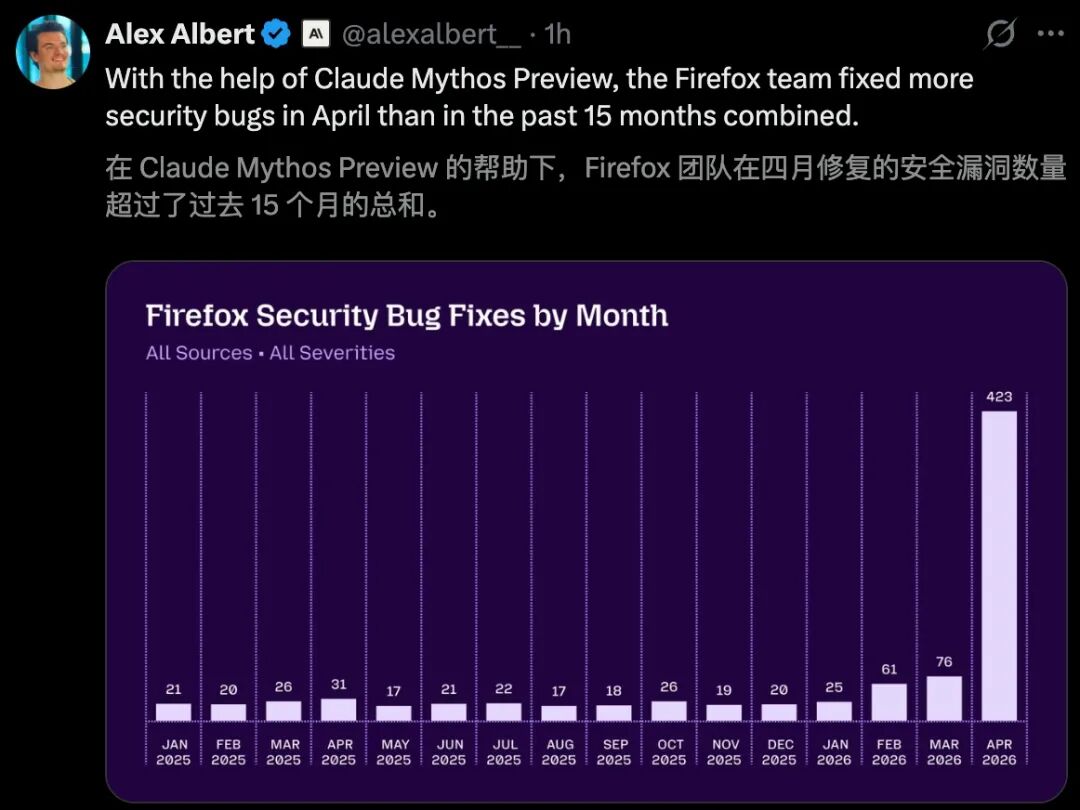
In 2025, Firefox fixed an average of 21.5 security vulnerabilities per month. In April of the same period, only 31 vulnerabilities were resolved.
This overwhelming advantage has completely shaken the tech circle, and the comment section has been flooded with "Wow" from AI experts.

An expert's in - depth review: The real "top hunter"
"Suddenly, these bugs became very easy to handle," this is the exact words written by a Mozilla engineer.
Just a few months ago, AI - generated security vulnerability reports were still a "nightmare" for the open - source community - they seemed reasonable but were actually full of nonsense.
Maintainers spent a lot of time verifying a "discovery" only to find it was all an illusion!
However, everything has changed dramatically in just a few months. There are two main reasons:
First, the model itself has become more powerful; second, the engineering methods for using the model have made a qualitative leap.

To put it simply, the model is getting stronger at a rapid pace, and engineers are quickly learning how to use it.
The product of these two trends results in the exaggerated number of 423 vulnerabilities fixed by Firefox in one month.
271 vulnerabilities, 180 of high - risk, some hidden for 20 years
Since February this year, the Firefox team has been collaborating with Anthropic.
They first used Claude Opus 4.6 and fixed 22 security vulnerabilities in Firefox 148.

When Firefox 150 was released, Mythos Preview came along. No one expected that it would uncover 271 security vulnerabilities at once.
What's even more astonishing are the details. Among these 271 vulnerabilities:
180 were rated as "high - risk" (sec - high)
80 were rated as "medium - risk" (sec - moderate)
11 were rated as "low - risk" (sec - low)
High - risk (sec - high) vulnerabilities can be triggered as long as users browse the web normally.
In the past decade, such vulnerabilities were often discovered by external white - hat hackers through high - reward programs, with a single vulnerability fetching a reward of thousands or even tens of thousands of dollars.
Now, Mythos has directly uncovered 271 of them. Subsequently, it also fixed more in versions 149.0.2, 150.0.1, and 150.0.2.
Among the total 423 security vulnerabilities fixed in April, 271 were directly discovered by Mythos, and 41 were from external security researchers.
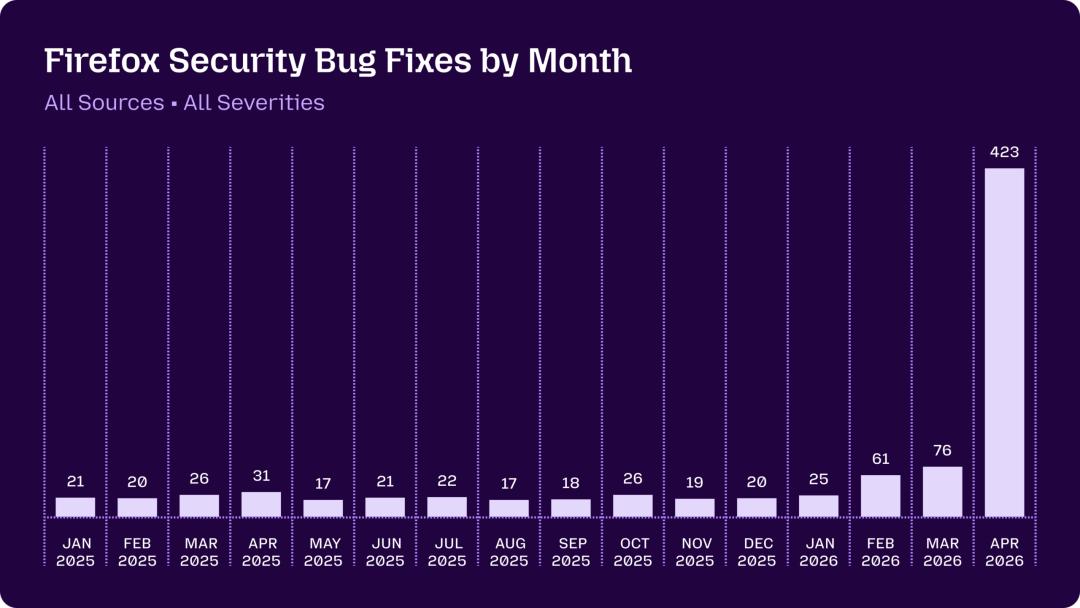
The remaining 111 were discovered by the internal team through other models besides Mythos, fuzz testing, and other methods.
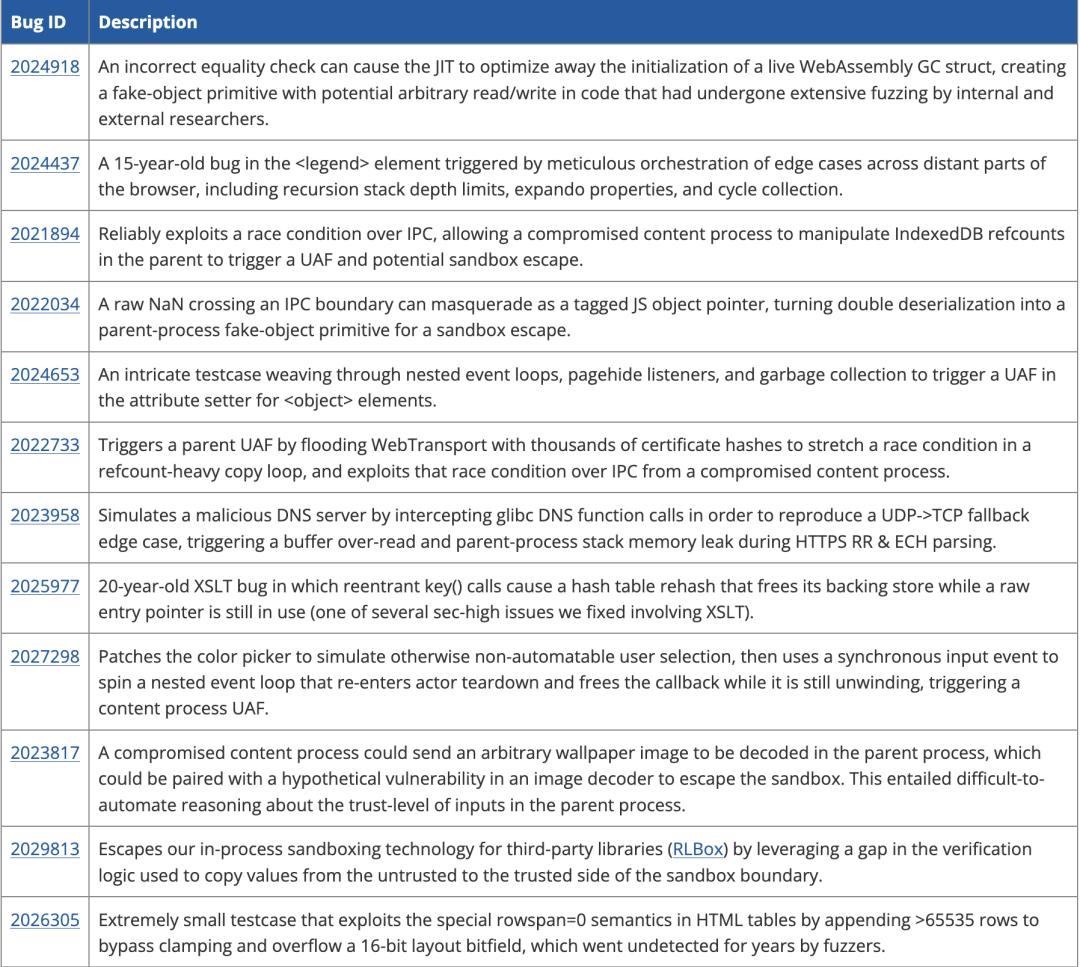
More importantly, Mozilla also made public detailed reports of 12 vulnerabilities.
There was a vulnerability in the HTML
It can even find "sandbox escapes", the kind with a $20,000 reward
What shocked the security community the most is that Mythos found multiple "sandbox escapes" vulnerabilities.
Browsers run each web page in a "sandbox". Even if a web page is controlled by an attacker, it cannot escape this isolation area.
A sandbox escape means finding a way to "break out" of this isolation area and gain higher privileges.
How difficult are these types of vulnerabilities to find? Even fuzzing has a hard time covering them.
Mozilla's "Bug Bounty Program" offers a maximum reward of $20,000 for sandbox escape vulnerabilities, which is the ceiling of the entire bounty system.

Even with the top - level reward, Firefox security engineer Brian Grinstead admitted, "The number of sandbox escape vulnerabilities found by Mythos has exceeded the total found by human security researchers."
Mythos also has a very hardcore way of finding "sandbox escapes":
It writes a malicious patch on its own and injects it into the sandbox process, and then uses this code to attack the most secure part of the browser.
The whole process requires creative thinking and a deep understanding of the multi - process architecture.
Agentic Harness, just one line of code to switch models
However, a powerful model is only half of the story.
Initially, they tried to use GPT - 4 or Claude Sonnet 3.5 for "static code analysis", but the false - positive rate was too high, making it impossible to scale.
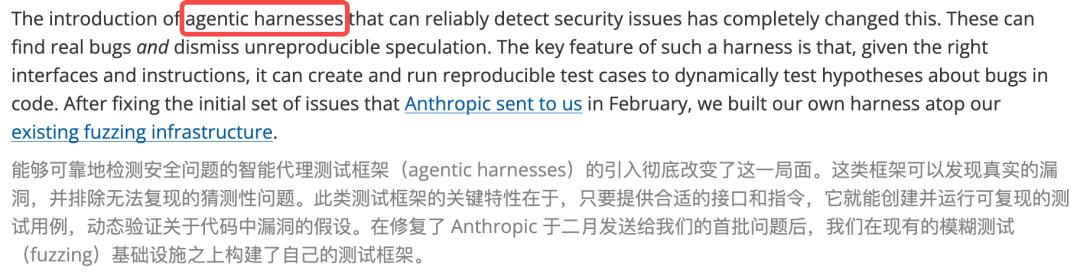
The emergence of Agentic Harness became a turning point. The core logic of this system is -
Discover vulnerabilities: Give the model a piece of code and let it find bugs.
Dynamic verification: The model writes test cases to dynamically verify assumptions. Only those that can be reproduced count, and those that cannot be reproduced are automatically excluded.
Deduplication and triage: Automatically compare with known vulnerabilities to avoid duplicates.
Tracking and fixing: Enter the formal security bug lifecycle.
At first, the team manually monitored the model's operation in the terminal and adjusted the prompts.
After it worked, they started parallelizing, running on multiple temporary virtual machines simultaneously, with each VM responsible for scanning a specific file or function.
It's worth mentioning that once the pipeline is set up, switching models is just a matter of one line of code.

Switching from Opus 4.6 to Mythos Preview was almost seamless.
Moreover, every time the model is upgraded, the effectiveness of the entire pipeline will be amplified synchronously: stronger discovery ability, more accurate verification, and higher - quality reports.
As some security experts said, "The real leverage may not only lie in the model itself, but in the engineering capabilities of the harness."
Over 100 people worked overnight, not an automatic bug - fixing process
Finding vulnerabilities by Mythos Preview is just the first step.
In the blog post, Brian Grinstead said straightforwardly: For each bug, one engineer writes the patch, and another engineer conducts the code review.
The patches written by AI can only be used as a reference and cannot be directly deployed.
To handle this unprecedented flood of vulnerabilities, more than 100 engineers participated in code contributions.
Those who write patches, conduct code reviews, set up pipelines, classify bugs, test fixes, and manage the release process were all involved.
This is the largest - scale security - fixing operation in Firefox's history and has resulted in the most secure Firefox version ever.
Direct confrontation: Anthropic VS OpenAI
The 423 vulnerabilities fixed by Firefox are just the tip of the iceberg.
In this competition of AI security capabilities, Anthropic and OpenAI are sprinting at full speed along two completely different routes -
And the strategies of the two companies are clearly laid out.
Let's first look at Anthropic.
At the beginning of April, when Claude Mythos Preview was released, they also launched a "Project Glasswing".

Anthropic released its most powerful model ever. Then, they locked it up.
They claim that Mythos has discovered thousands of high - risk vulnerabilities in every major operating system and browser, including a vulnerability in OpenBSD that had been latent for 27 years.
Now, look at OpenAI. Their approach is the opposite, aiming for as wide an open - up as possible.
Just one week after Anthropic released Mythos, OpenAI quickly followed up and released GPT - 5.4 - Cyber. The TAC program was simultaneously extended to thousands of individual defenders and hundreds of security teams.
Today, GPT - 5.5 - Cyber is available to the highest - level users of the TAC program, which can be used to hunt for vulnerabilities, analyze malware, and reverse - engineer attacks.

According to the official blog introduction, GPT - 5.5 - Cyber achieved an 81.9% success rate in network tasks.
OpenAI's logic is clear: verify identities → grant hierarchical authorizations → enable as many defenders as possible to get the most powerful weapons.

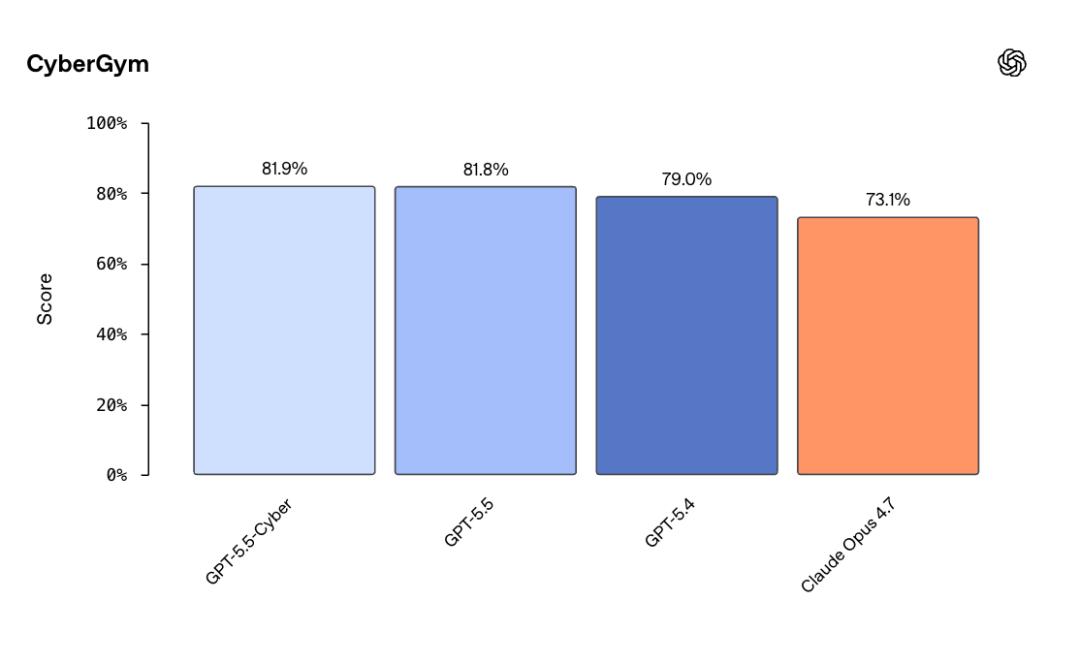
Now, both Anthropic and OpenAI are desperately building walls. However, the spread speed of AI security capabilities may be faster than their wall - building speed.
Reference materials:
https://x.com/alexalbert__/status/2052468573516513762?s=20
https://x.com/TechCrunch/status/2052420271970390042
https://x.com/AnthropicAI/status/2052466175540629965?s=20