Backed by two major investment firms under Lei Jun, a post-2000 "genius student" from Harbin Institute of Technology secures tens of millions of US dollars in financing.
Robot Outlook reported on May 19th that recently, RoboParty, a Shanghai-based full-stack open-source bipedal humanoid robot manufacturer, announced the completion of a tens of millions of dollars Angel + round of financing. The financing was led by Shunwei Capital, with additional investment from Xiaomi Strategic Investment.
This is the second round of financing completed by RoboParty within less than a month. After this round of financing, it will further promote the implementation of open-source bipedal humanoid robots in developer communities, university laboratories, and industrial scenarios, and obtain support in aspects such as the supply chain, industrial ecosystem, and global expansion.
According to information from Qichacha, RoboParty had previously completed 3 rounds of financing in a row.
In November 2025, RoboParty completed a seed round of financing with an amount of approximately ten million dollars. The financing was led by Xiaomi Strategic Investment and Matrix Partners China, with follow-on investments from Galaxy General Robotics, Light Source Capital, etc.
In December 2025, it completed a Seed + round of financing. The investors included Guoxiang Capital, Xiaomi Strategic Investment, Huaying Capital, BV Baidu Ventures, Matrix Partners China, Light Source Capital, etc.
In March 2026, it completed an Angel round of financing of 20 million dollars (equivalent to approximately 136 million RMB). The investors included Guoxiang Capital, Matrix Partners China, AnChuang Investment, Baichuan Capital, Saina Capital, Pudong Venture Capital Group, Shanghai Future Industry Fund, etc.
After consecutive rounds of financing, RoboParty began to further promote its open-source robot route.
In January 2026, it officially open-sourced the prototype of the bipedal humanoid robot ROBOTO Origin and continued to promote the construction of the software and hardware ecosystem in the direction of open-source robots.
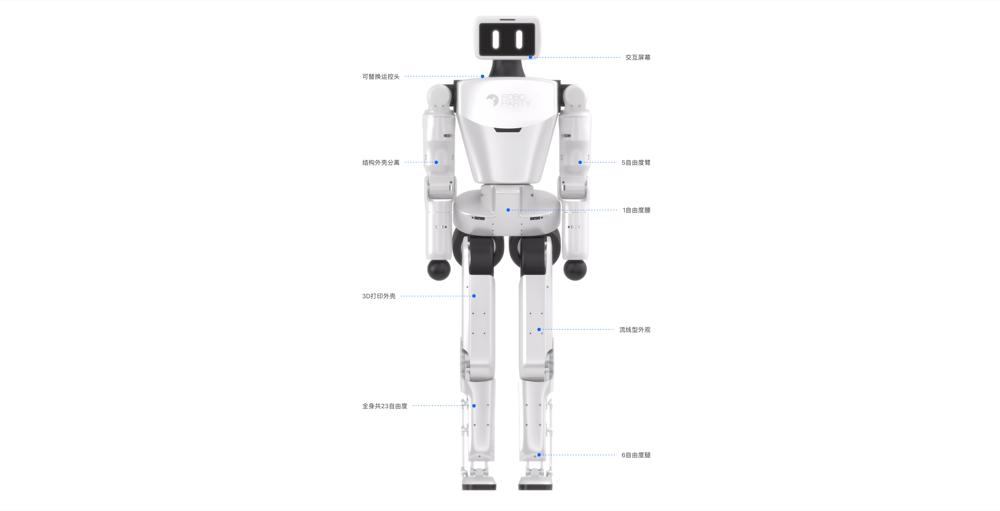
The prototype of Robo Party's ROBOTO Origin
As of now, the GitHub project built based on its open-source prototype has received 1.7K Stars, and the number of global developer communities has exceeded 5,000.
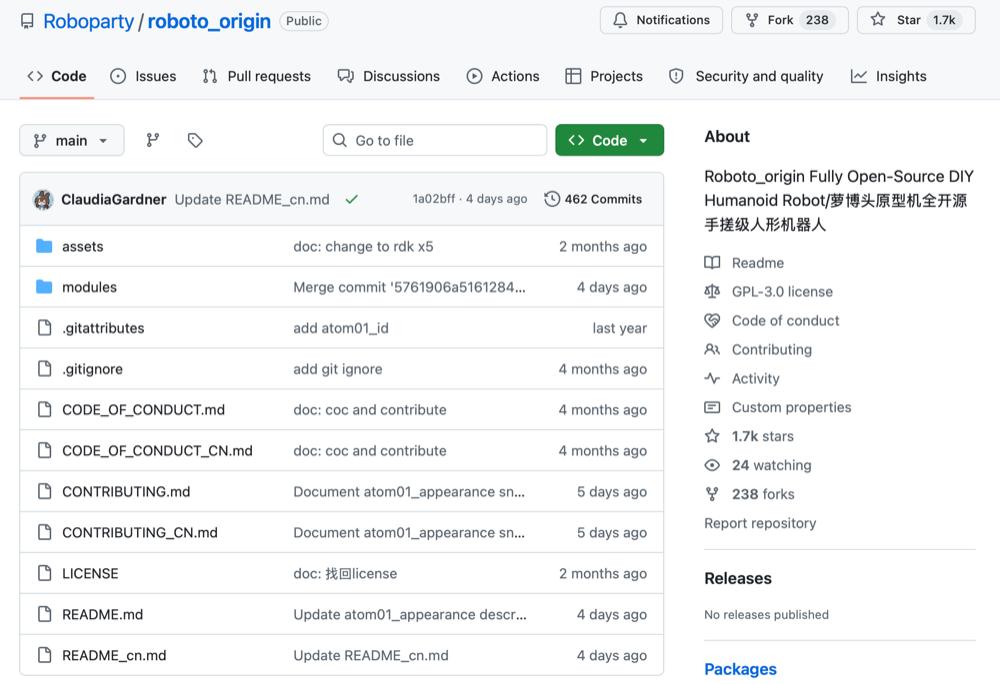
Huang Yi, the founder and CEO of RoboParty, is one of the youngest entrepreneurs in the current humanoid robot industry.
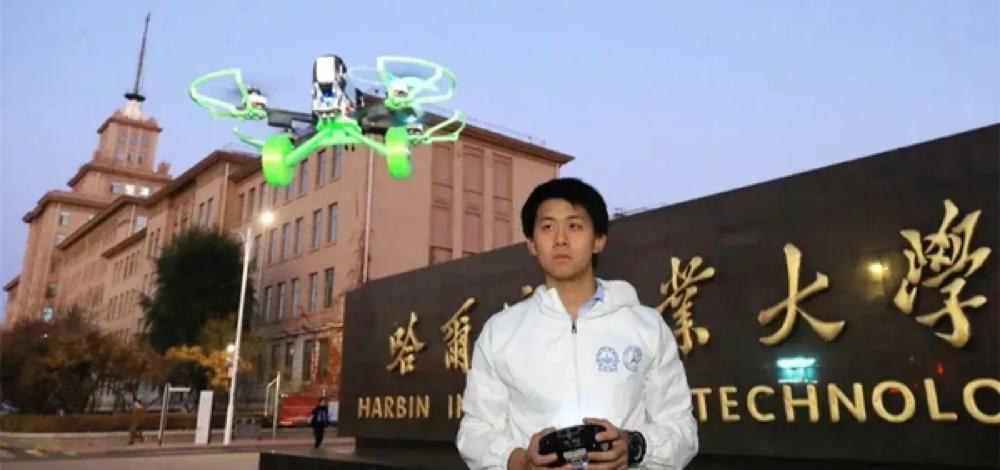
Huang Yi, the founder and CEO of RoboParty
Huang Yi was born in 2004. He studied at the School of Future Technology of Harbin Institute of Technology, majoring in intelligent robotics. In 2023, he won the first prize in the National College Students' Science and Technology Competition with an air-ground amphibious drone project.
At the end of the same year, Huang Yi completed the development of the walkable bipedal robot AlexBot in his dormitory at a cost of approximately 15,000 yuan and publicly shared the R & D process, design drawings, and part of the source code on platforms such as Zhihu, GitHub, and Feishu. Subsequently, the project was replicated and applied by more than a dozen enterprises and universities.
In March 2025, Huang Yi graduated from undergraduate one year ahead of schedule and founded RoboParty, focusing on full-stack open-source bipedal humanoid robots.
In terms of the team, RoboParty is currently continuously attracting young technical talents to join. Its members are from universities such as Tsinghua University, Peking University, Zhejiang University, Harbin Institute of Technology, Carnegie Mellon University, Stanford University, and the National University of Singapore.
RoboParty revealed that its next-generation product is planned to be launched in the second half of 2026, continuing to promote the upgrade of performance and open capabilities in the direction of open-source bipedal humanoid robots.
This article is from the WeChat official account “Robot Outlook”. Author: Jiang Yu, Editor: Mo Ying. Republished by 36Kr with authorization.