Sinking servers to the seabed, this is for real.
“With a total investment of 1.6 billion yuan, a PUE as low as 1.15, over 95% direct supply of green electricity, and annual power savings of 61 million kWh. In the East China Sea off Lingang, Shanghai, the world's first undersea data center directly connected to offshore wind power has been put into operation.”
In 2026, people are having a great time using AI, but those in the computing power center business are almost overwhelmed. The demand for computing power is growing so rapidly that heat dissipation and power supply cannot keep up. The industry has reached a stage where imagination is crucial. Not long ago, someone proposed the concept of space computing power, suggesting launching data centers into outer space. And now, someone has actually thrown servers into the sea.
This is not an introduction to a future concept. It has already happened. With an investment of 1.6 billion yuan, more than 2,000 servers have been thrown into the sea. In the East China Sea off Lingang, Shanghai, east of Xiaoyangshan Island, 192 cabinets are packed into a four - story underwater machine room, 10 meters deep under a sea platform, running computing power continuously. The entire structure weighs 1,950 tons, approximately equivalent to the weight of 1,300 family cars. Just 500 meters away, there are more than 50 wind turbines, and the wind power is directly connected, with a green electricity supply rate of over 95%.
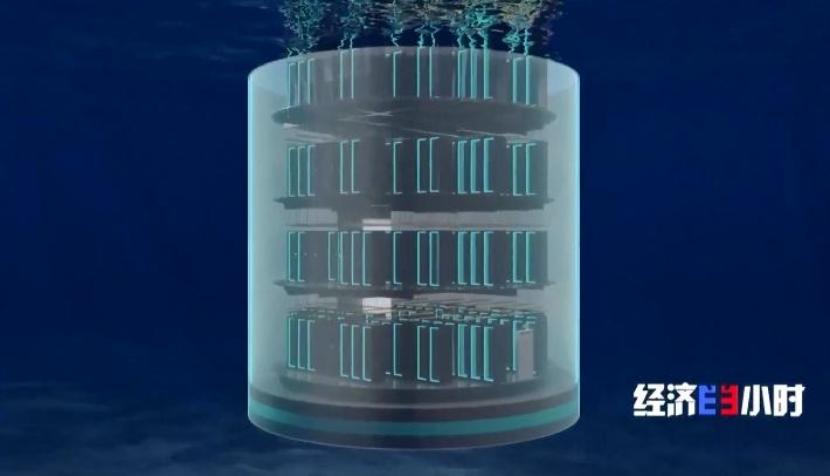
Let's first look at some data. PUE (Power Usage Effectiveness, an indicator of data center energy efficiency, the closer to 1, the better): This undersea data center has a PUE of 1.15 (this is an excellent figure, and we will introduce it in detail later), while the national average is 1.48. Freshwater consumption: zero. Floor area: 200 square meters, while a land - based data center of the same scale would require 2,000 square meters. After full - scale operation, it can save 61 million kWh of electricity annually.
That is to say, submerging servers in the sea not only doesn't damage them but also saves electricity, water, and land compared to placing them on land, and has a lower failure rate.
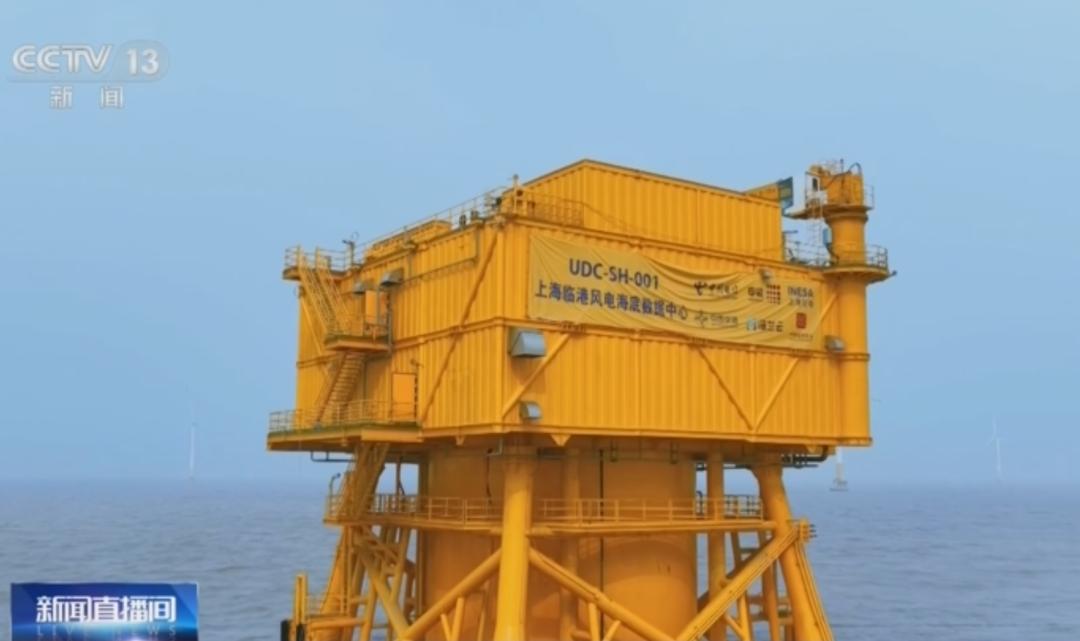
The CCTV broadcast this news a few days ago. After watching it, I dug into the details behind it and found that this matter is much more interesting than what was reported in the news.
Looking back, this is a path that has been explored and verified for many years. After repeated verification, it was finally ensured that computing power could be safely submerged in water. Looking towards the future, the two major undertakings of computing power centers and green energy have intersected on this path, and a crucial step has been taken in this grand plan.
It's worth telling the whole story from the beginning.
01: Why sink servers into the sea?
A data center can be either complex or simple. Simply put, it has to solve two core problems: power supply and heat dissipation.
Everyone knows that servers need electricity. However, many people don't know that the electricity used for server cooling may be about the same as the electricity consumed by the servers themselves.
There is a core indicator in the industry to measure the energy efficiency of data centers, called PUE, Power Usage Effectiveness. The calculation method is also very intuitive: divide the total electricity consumption of the entire data center by the electricity consumption of IT equipment (servers, storage, and networks). If the PUE is 2, it means that for every 1 kWh of electricity the server uses for work, the air - conditioning and other supporting facilities use another 1 kWh for cooling and maintaining operation.
In an ideal state, the PUE should be 1, which means all the electricity is used for computing without any waste on heat dissipation. But in reality, it can never reach 1 and can only get infinitely close.
The average PUE of data centers across the country is about 1.48. In other words, for every 3 kWh of electricity consumed by data centers in China, about 1 kWh is used by air - conditioners.
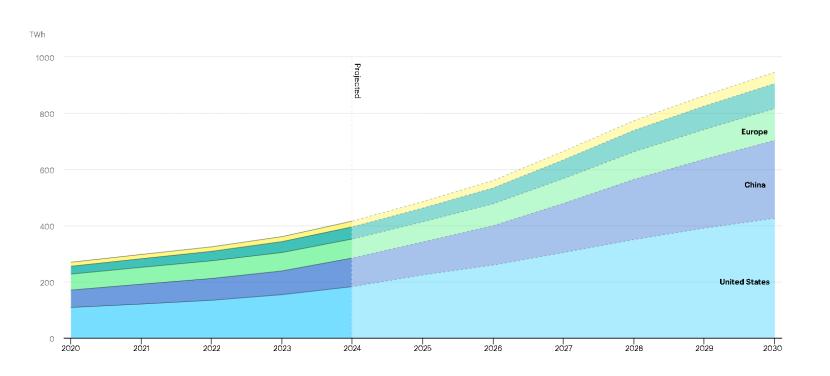
In 2024, the electricity consumption of global data centers was approximately 415 terawatt - hours, accounting for 1.5% of the world's total electricity consumption. The IEA (International Energy Agency) predicts that this figure will more than double to 945 terawatt - hours by 2030. This is only the energy consumption of traditional data centers. After the advent of AI, the situation has become even more exaggerated.
Previously, a standard CPU server had a power consumption of about 300 watts. When replaced with a GPU server for AI training, the power consumption of the same machine may reach 3,000 watts, a ten - fold increase. According to an IEA report, the electricity consumption of AI - dedicated servers is expected to increase by 30% annually.
A person who has been in the data center industry for 20 years told me a very vivid picture: For an office building, the outdoor air - conditioning units on the roof are sufficient for the whole building. But if you convert this building into a data center, the heat dissipation requirements will increase exponentially. The area occupied by air - conditioning and power supply equipment may even be larger than that of the servers. At that time, even if the roof and the downstairs square are filled with outdoor air - conditioning units, it may not be enough to dissipate the heat.
Therefore, the global data center industry has been thinking about the same thing in recent years: how to find a cheaper cold source. The answers are surprisingly consistent: turn to nature.
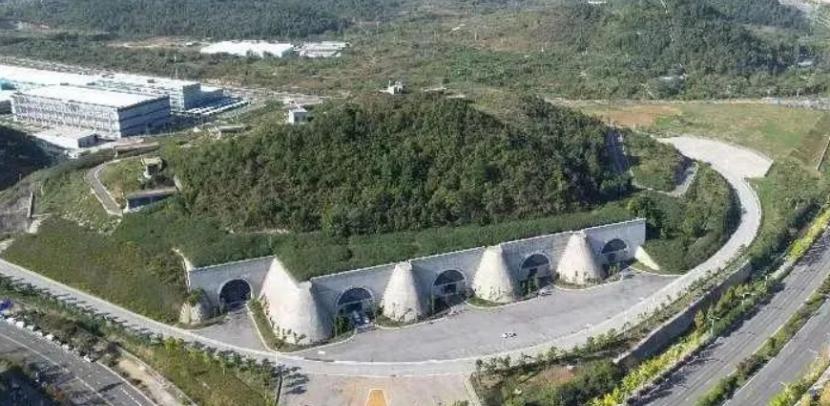
Previously, Facebook tried to build data centers in high - latitude regions of North America, the closer to the Arctic Circle, the better, because of the naturally low temperature. A few years ago, Tencent built its data center in a cave in Guizhou, where the temperature remains constant throughout the year. In this regard, the first criterion for large companies when choosing a location is not transportation or talent, but coolness.
China's "Eastern Data, Western Computing" project follows the same logic: build data centers in Inner Mongolia, Guizhou, Gansu and other places. The western regions have abundant electricity, cheap coal - fired power, and a lot of new energy sources; the weather is cold, and in places like Ulanqab, it is below zero for most of the year, with strong natural heat dissipation capacity. The eight computing power hubs and ten data center clusters essentially chase after cheap electricity and free cold sources in the west.
What about the eastern cities?
Cities like Shanghai, Shenzhen, and Beijing are exactly the places with the strongest demand for computing power. Financial transactions, AI inference, and cross - border data processing are very sensitive to latency. Data cannot always be sent to a cave in Guizhou, 2,000 kilometers away, for processing and then sent back. However, these cities have the most expensive land, the strictest energy consumption indicators, and extremely hot summers.
So, the sea is the answer.
The average annual temperature of seawater is only about 15 degrees Celsius, with extremely high fluidity. Its heat dissipation capacity is dozens of times that of lake water. Moreover, large - scale construction of offshore wind power is underway, and the electricity is right there. The two most important things for a data center, a cold source and a power source, are both available at sea.
Logically, sinking servers into the sea is actually the most natural solution.
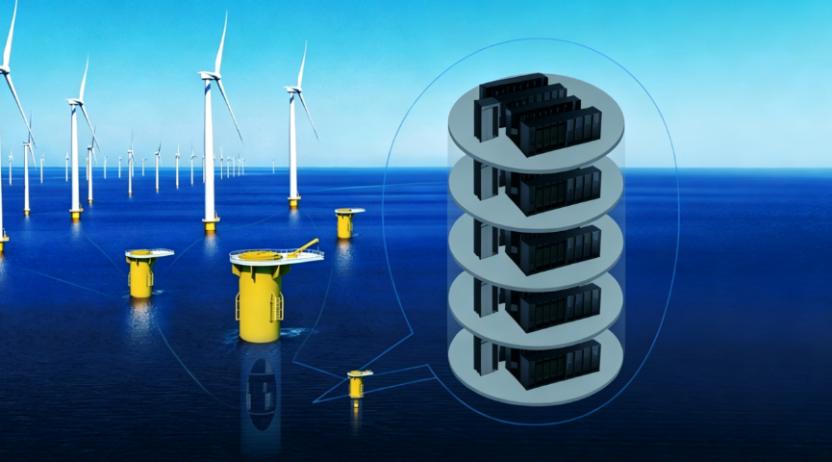
02: How many steps are there in sinking computing power into the sea?
The idea of putting a data center on the seabed was not first conceived by the Chinese.
In 2015, Microsoft launched a project called Project Natick. In the first experiment, the idea was quite simple: throw a server into the sea to see if it would break. They sank a cylindrical sealed cabin with a diameter of about 2.4 meters to the bottom of the Pacific Ocean, containing servers, and let it run for 105 days to see if servers could really work in the sea.
The conclusion was yes.
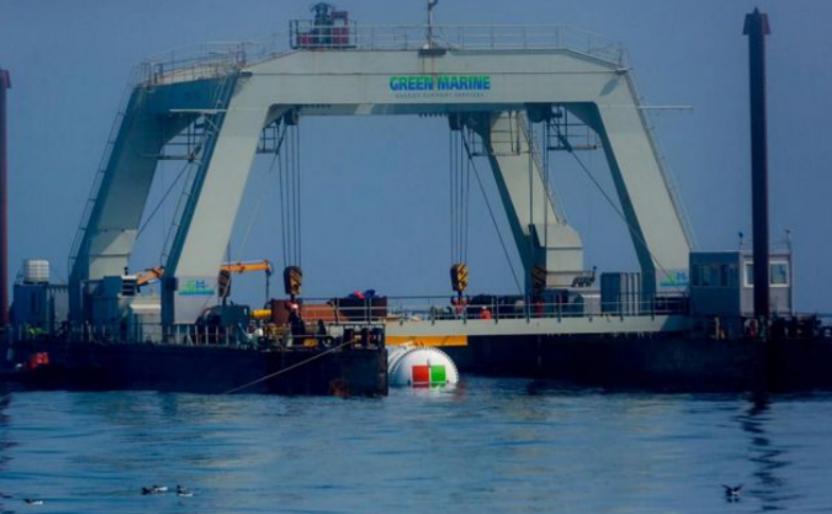
In 2018, Microsoft carried out the second round and officially deployed. In the waters off the Orkney Islands in Scotland, they sank a sealed container with 864 servers to a depth of about 35 meters in the North Sea. They used local tidal and wind energy for power supply and let the seawater cool the servers naturally, and then left it alone.
Two years later, in 2020, Microsoft retrieved the container from the sea. When they opened it, the data was astonishing.
Among the more than 800 undersea servers, only 6 malfunctioned, with a failure rate of about 0.7%. At the same time, Microsoft set up a control group on land with 135 servers. After running for the same two - year period, 8 servers failed, with a failure rate close to 6%. The failure rate of the undersea servers was about one - eighth of that of the land - based servers.
This was a counter - intuitive result. Microsoft's explanation was that the sealed cabin was filled with dry nitrogen, without oxygen, water vapor, dust, or the vibration and temperature fluctuations caused by people coming in and out. The servers operated in an almost sterile environment, greatly reducing the hardware aging rate.

Without human interference, dust, or temperature fluctuations, everything went smoothly. A place completely free of humans is probably the most ideal working environment for servers.
Microsoft's experiment proved one thing: undersea cooling is reliable. The next step was taken by the Chinese.
In 2020, Hailanxin, a domestic listed company in the marine equipment industry, acquired a Canadian deep - sea equipment team. This team had participated in the engineering work of Microsoft's Natick project. More importantly, they had accumulated more than 20 years of experience in the deep - sea field. The know - how accumulated through experience is very important: what kind of microorganisms grow in which places, what kind of water currents and geological conditions exist in which sea areas, and how to design connectors to ensure they can work underwater for 20 years without problems.
With this technical foundation, the first commercial undersea data center was established in Hainan.
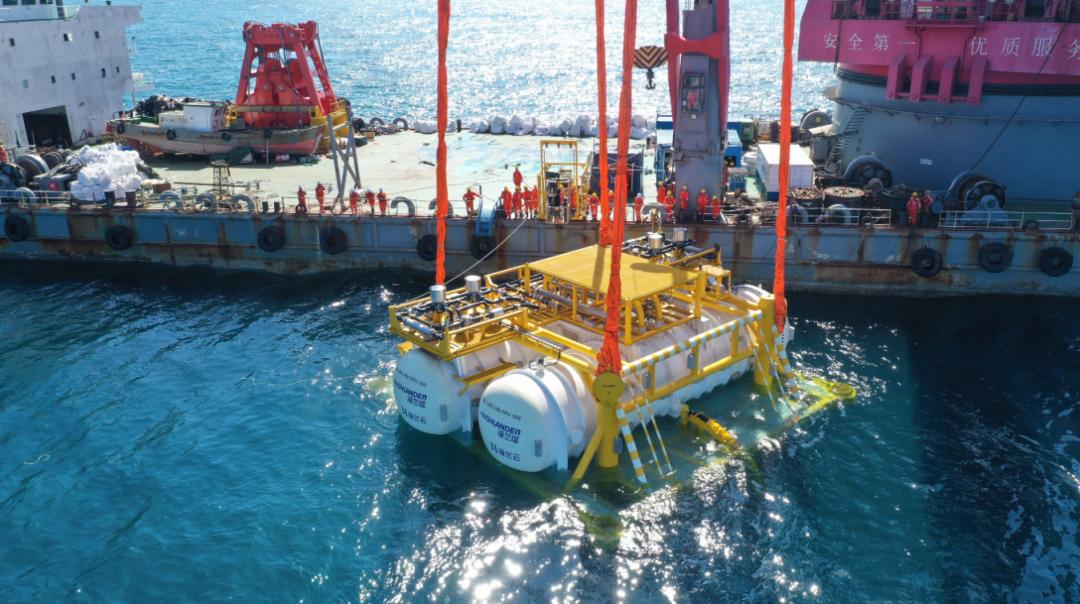
The data center was located in Qingshui Bay, Lingshui, Hainan, about 3 kilometers offshore and 40 meters deep. The design idea was to sink a sealed tank to the seabed, connect it to the on - shore control station through a submarine cable, and use seawater for natural cooling. It was put into trial operation in 2022.
After running for more than three or four years, several core data were obtained. The PUE was less than 1.2, far better than the national average of 1.48. The cooling energy consumption was reduced by more than 90%, which means annual power savings of about 3 million kWh and savings of about 15,000 tons of fresh water. The on - shore part only occupied 400 to 500 square meters, about one - fifth of that of a land - based data center of the same scale.
It may seem that moving the data center to the seabed solves all problems, but it's far from that.
In Hainan, the cold source problem was solved, and the cost was verified, but the power source was still a shortcoming. Hainan's power grid mainly relies on thermal power, accounting for more than 70%. The undersea data center used on - shore utility power, and a submarine cable was laid, which cost tens of millions of yuan. Although the daily operating cost was indeed low, when considering the heavy - asset investment during the construction period, the economic efficiency was not good. Moreover, using thermal power for power supply is not green enough in the long run.
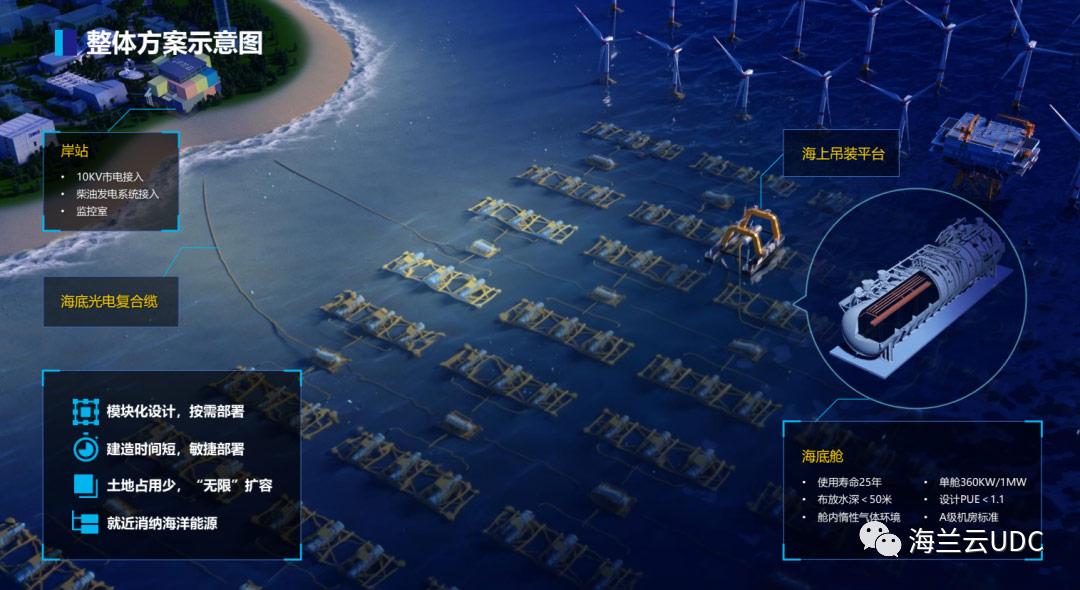
How to solve both the cold source and power source problems simultaneously? So, the next step was Shanghai.
The Shanghai project had a completely different idea: it was located in the sea area east of Xiaoyangshan in Lingang, only 500 meters away from an existing 200 - megawatt offshore wind farm. The wind power was directly connected to the data center through a submarine cable