Valuation Soars 15-Fold in 7 Months: Why Has Reflection AI Suddenly Exploded?
In 2023, the most discussed question in the market was: "Who can develop a model more powerful than GPT?"
By 2026, a new question began to emerge:
Who can define the open standards for future AI?
In the past two years, closed - source model systems such as OpenAI, Anthropic, and Google Gemini have demonstrated the great value of "large models". Meanwhile, another force is rapidly rising: the "open model ecosystem" represented by DeepSeek, Tongyi Qianwen, and Llama is changing the deployment logic of AI by global enterprises and governments.
The reason is quite simple.
More and more enterprises are beginning to realize that AI is not just a SaaS tool, but the core production system of the future. What truly matters is not just "whose model is smarter", but who owns the model, who controls the cost, who has control over the data, and who can truly run AI on their own infrastructure.
Against this backdrop, a company that has been established for only one and a half years has suddenly become one of the most - watched new AI forces in Silicon Valley.
01┃ A 15 - fold surge in valuation in 7 months: Why has Reflection AI suddenly exploded?
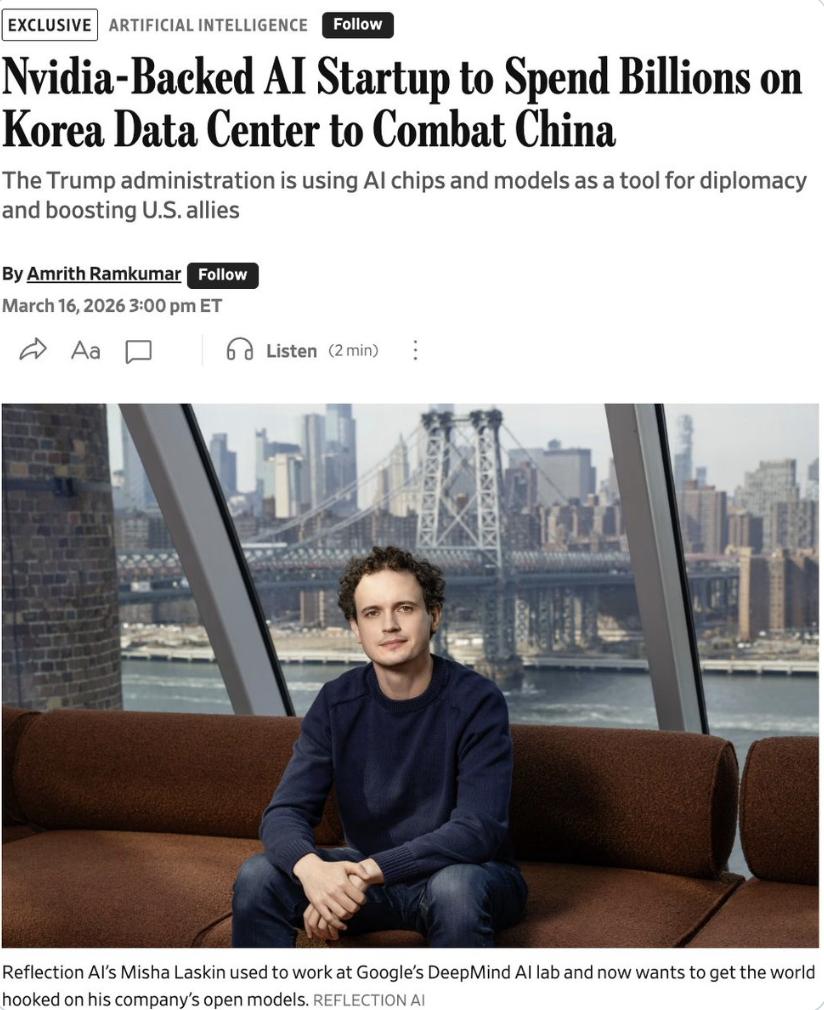
Reflection AI recently completed a $2 billion financing round, with a latest valuation of $8 billion. Compared with its valuation of approximately $545 million seven months ago, it has increased nearly 15 - fold. What's even more noteworthy is that the company hasn't even officially launched its flagship model yet. Nevertheless, it has quickly become the focus of the global capital market.
The investment lineup for this round of the company is extremely luxurious, including:
- NVIDIA
- Eric Schmidt
- Citigroup
- Lightspeed Venture Partners
- Sequoia Capital
- and 1789 Capital supported by Donald Trump Jr.
Meanwhile, market news indicates that the valuation for Reflection AI's new round of financing has been further pushed up to approximately $25 billion.
In the current AI industry, few companies can achieve such a valuation leap within a year. The reason is that the market truly values not whether it has a hit product today, but whether it has the opportunity to become an "infrastructure - type company" in the future AI world.
02┃ The core question in the second half of the AI era: How can enterprises truly own AI?
In the past few years, the way most enterprises have accessed AI has been quite simple: by calling the OpenAI API.
This model was extremely effective in the early stage of the AI boom because it allowed enterprises to quickly access the most advanced model capabilities with little need to build complex infrastructure. Today, a large number of AI SaaS, AI Agents, and even many so - called AI startups are essentially built on this model. However, as AI begins to truly enter the core business of enterprises, the problems with this model are becoming increasingly obvious.
Firstly, the data does not truly belong to the enterprises themselves. When all requests are completed through third - party models, enterprises can never fully control their data security and system boundaries.
Secondly, it is difficult to optimize costs. For large enterprises, long - term, high - frequency, and large - scale calls to closed - source model APIs will ultimately result in extremely high inference costs, and these costs are often difficult to customize in depth.
Meanwhile, the model itself is difficult to optimize at the underlying level for specific enterprise business scenarios.
More importantly, many government, financial, medical, and national defense - related institutions cannot accept having their core AI systems fully run on external platforms. For these industries, AI is not just an efficiency tool but the core production system of the future. They naturally hope that the model can be deployed on their own infrastructure, with their own data control, inference capabilities, and long - term cost management capabilities.
As AI becomes a real productivity tool, large enterprises, governments, and financial institutions are increasingly inclined to:
Own their own AI.
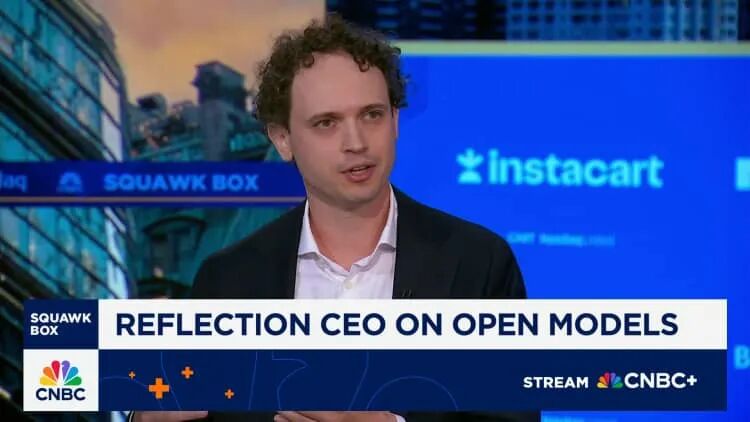
This is why the "open model" is rapidly rising. The direction chosen by Reflection AI is not to create another ChatGPT; it is more like creating:
"The American version of DeepSeek + an enterprise - level AI infrastructure platform"
03┃ "Open model + private stack": The core strategy of Reflection AI
Reflection AI's strategy is actually quite interesting. It is neither completely closed - source nor completely open - source, but adopts a "open model + private training stack" hybrid model.
Simply put, Reflection AI will open up the model weights, allowing enterprises to truly own and deploy the model and customize it in depth according to their own needs. At the same time, it retains the privatization capabilities of the training system, data system, and underlying infrastructure. This means that it retains both the scalability of the open ecosystem and the core technological barriers of top - tier AI laboratories.
This model actually meets the real needs of large institutions for AI. For real large enterprises, what they need is not just "a chatbot", but a complete set of controllable, deployable, and long - term optimized AI systems. They hope that AI can run in their own cloud environment, on their own servers, or even on their national - level infrastructure, rather than relying permanently on a single supplier.
Therefore, compared with the completely closed - source system, Reflection AI's model is more likely to enter the truly high - value large market. In other words, Reflection AI is targeting not the ordinary consumer - level AI application market, but the future multi - trillion - dollar "enterprise AI infrastructure market".
04┃ What is truly scarce is not the model, but "the ability to train the next - generation model"
Many people today instinctively compare Reflection AI with OpenAI and Anthropic. However, what those truly concerned about it in Silicon Valley value is not "its current model capabilities", but:
Whether it has the ability to become a next - generation AI laboratory.
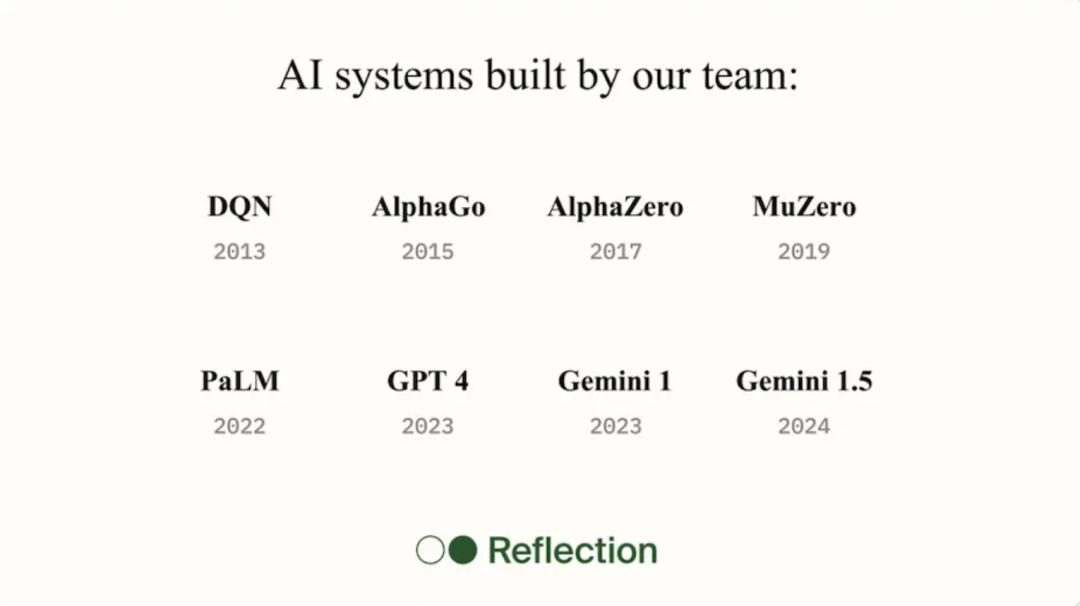
Reflection AI currently has a team of about 60 people, but the backgrounds of its core members are extremely impressive. The team members have participated in the R & D of many key projects, including:
- Gemini
- PaLM
- AlphaGo
- AlphaCode
- ChatGPT
- Character AI
and other key projects.
Among them, co - founder Ioannis Antonoglou is one of the co - developers of AlphaGo.
Reflection AI's current real core asset is not a demo product, but the large - scale training system it has begun to build, the MoE (Mixture - of - Experts) architecture capabilities, GPU cluster scheduling capabilities, and the AI infrastructure required for the future open model ecosystem. It seems that what it is competing for is not "an AI application", but the underlying standards in the future AI world.
05┃ Why did NVIDIA make a heavy - stake bet?
In the past two years, NVIDIA's investment logic has become increasingly clear. It is not just selling GPUs. It is actively supporting the core ecosystem of the future AI world, including:
- OpenAI
- Anthropic
- CoreWeave
- Thinking Machines
- Reflection AI
...
Behind this is actually a complete strategy: Whoever can consume the largest amount of future AI computing power is the one NVIDIA must bind to.
One of the greatest values of Reflection AI is that it may become one of the core infrastructures of the "open AI camp". Especially in the context of:
1) The United States hopes to establish a domestic open AI ecosystem;
2) The rapid rise of Chinese open - source models;
3) Enterprise - level AI is shifting from API calls to private deployments
Under this backdrop, the strategic significance of Reflection AI is not just a business issue; it is more like a part of the discourse power in the next - generation AI ecosystem.
06┃ What truly attracts investors to Reflection AI
From an investment perspective, what makes Reflection AI most attractive is not just the valuation growth. The real key is that it has several extremely scarce characteristics.
Firstly, it's the team.
Entrepreneurship by core members of DeepMind, Gemini, and AlphaGo is one of the rarest resources in the AI industry.
Secondly, it's the capital structure.
Top - tier institutions such as NVIDIA, Sequoia, Lightspeed, and Eric Schmidt have all placed bets on it, which means it has officially entered the global AI core capital circle.
Thirdly, it's its position.
AI is moving from the simple SaaS tool and API call stage to a new stage of enterprise AI, sovereign AI, local AI, and controllable AI, and Reflection AI is right at the center of this structural trend.
Finally, and most importantly: it has the opportunity to become a next - generation AI infrastructure company.
Many people today instinctively think of Reflection AI as "just another large - model company". However, it may be more like Linux, Android, or even AWS in the AI world. Once the open ecosystem forms a network effect, its long - term value is likely to far exceed that of a single model product.
Conclusion: In the second half of the AI era, it's no longer about "who develops it first"
The AI industry is entering a new stage. In the first half, the competition was about who could train the most powerful model first. In the second half, the competition is about:
- Who can build an ecosystem;
- Who can establish standards;
- Who can enable enterprises to truly deploy AI;
- Who can become the next - generation AI infrastructure.
The reason why Reflection AI is being frantically pursued by top - tier Silicon Valley capital is essentially that it has the opportunity to become a key node in the future global open AI system.
This article is from the WeChat official account "Silicon Rabbit King" (ID: gh_1faae33d0655), written by Silicon Rabbit King, and is published by 36Kr with authorization.