AI has entered the "Results Delivery Era", and Baidu is the first to cross the self-sustaining threshold.
After the Hong Kong stock market closed on May 18th, Baidu released its financial report for the first quarter of 2026. The data shows that in Q1 2026, Baidu achieved a total revenue of 32.1 billion yuan. The revenue from Baidu's general business was 26 billion yuan, a year-on-year increase of 2%, exceeding market expectations.
Among them, the changes at the business structure level are particularly eye - catching. In this quarter, Baidu's AI business revenue reached 13.6 billion yuan, a significant year-on-year increase of 49%, accounting for 52% of Baidu's general business revenue, and it has maintained growth for multiple consecutive quarters.
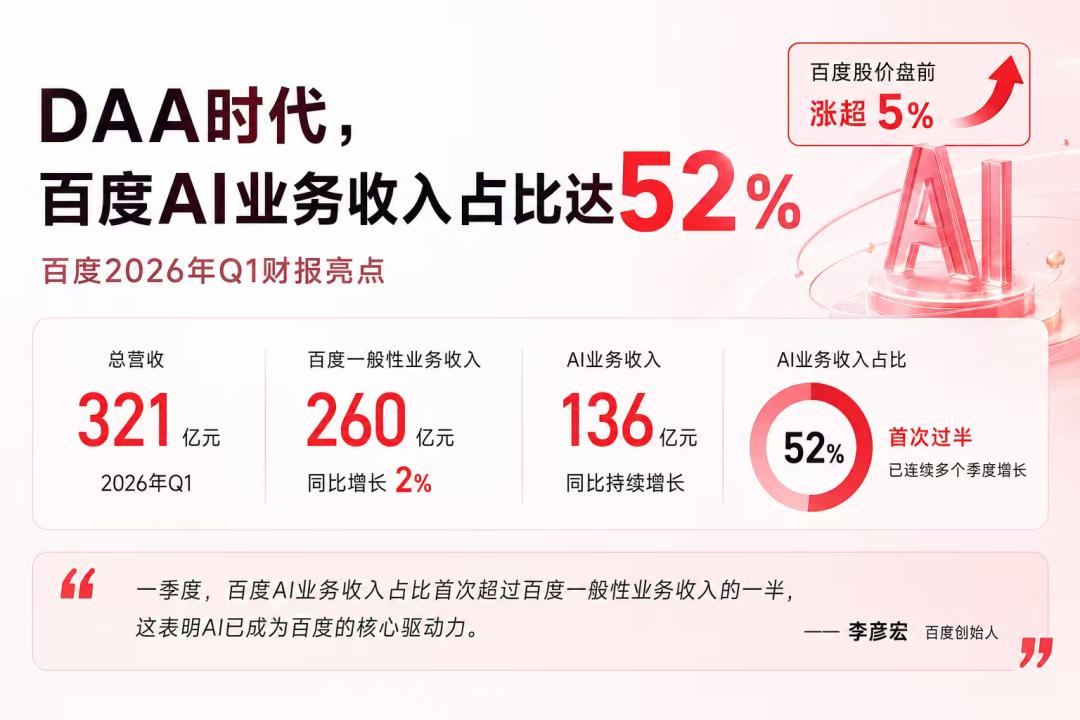
Overall, with the surge in enterprise demand and the support of its differentiated full - stack AI capabilities, Baidu delivered an outstanding report card this quarter, with steady and positive performance and an accelerated AI commercialization process. More importantly, the significant change that the AI business structure accounts for more than half not only demonstrates Baidu's solid and stable business fundamentals but also clearly sends a signal to the market: AI is no longer just a "decorative element" in Baidu's narrative logic but has truly become the "core growth engine" for stable value output.
Currently, the AI industry competition has officially entered the 2.0 era. The competition among giants has shifted from "computing power stacking" to "real revenue generation." Against this background, Baidu, which has completed value realization first, is expected to enter a golden window period for revaluation in the capital market.
01
AI competition enters the second half, and the industry needs a new yardstick
In the past three years, the essence of AI competition has been an arms race regarding large - model capabilities. At that time, the number of parameters, Benchmark scores, and DAU (Daily Active Users) were regarded as absolute standards for measuring a company's competitiveness.
However, after entering 2026, as capital's enthusiasm faded, the market no longer blindly pays for the illusory AGI dream but has shifted to commercial values that can be implemented, profitable, and able to build barriers. This has directly led to the collective failure of traditional measurement yardsticks. The most typical case is that Anthropic's monthly active user volume is only 15% of OpenAI's, but it achieved an annualized revenue overtaking for the first time by deeply cultivating B - end industrial services. This intuitively proves that in the AI 2.0 era, simple traffic dividends do not equal long - term commercial value.
To maintain its voice, OpenAI launched TPD (Daily Token Consumption), trying to use the "power generation" logic of the industrial era to measure the productivity in the intelligent era. However, this indicator has inherent defects. Tokens can only calculate the input cost of computing power but cannot measure the actual output value, which indirectly covers up real - world problems such as idle GPU rotation, ineffective interactions, and resource waste commonly existing in the industry. In essence, it has not escaped the extensive thinking of "burning money to expand scale."
This also shows from another perspective that in the current AI competition, the industry lacks not better models but a yardstick that can measure "how much work AI has actually done." At the Baidu Create 2026 Conference, Robin Li proposed the DAA (Daily Active Agents) indicator, shifting the measurement standard of AI from "how much computing power is consumed" to "how many results are delivered."
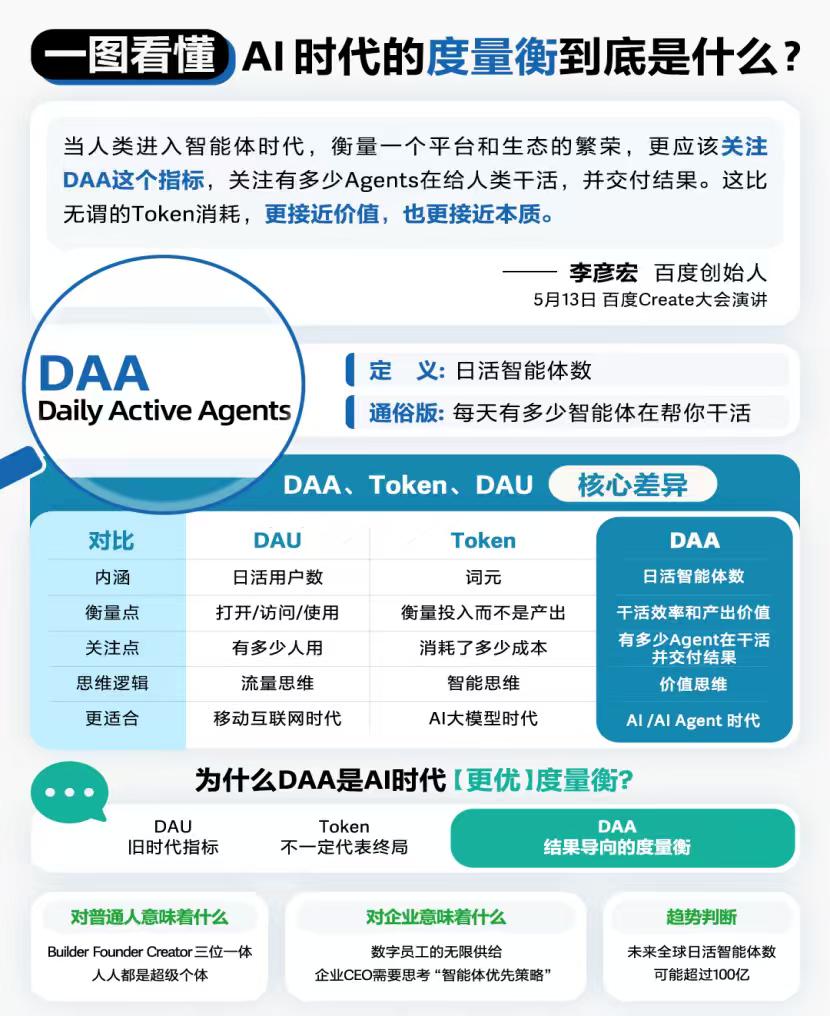
The essence of DAA is to bring the core question of the industry back from what the model "knows" to what the AI agent can "accomplish" independently without human intervention.
It is based on a rigorous triangular model: DAA scale (how much work is done) × task completion rate (how well the work is done) × single - task value (how much the work is worth). The three are linked to accurately quantify the real and effective output of AI, eliminate the moisture of invalid data, and directly target the essence of industrial services. Compared with the cost perspective of Tokens, DAA directly targets revenue and precisely matches the requirements of industrial implementation.
Almost at the same time, this logic was confirmed at the factual level in the capital market. Baidu's Q1 2026 financial report shows that the proportion of its AI business revenue has significantly increased to 52%, making it one of the few companies that can verify AI output with financial data.
It is worth noting that this revenue is not the inflated output value of cloud computing power leasing but the technical output calculated according to the DAA triangular model after agents in various industries truly "solve problems and improve efficiency" for customers.
02
Capable intelligent agents bring revenue to Baidu
According to the financial report, in the first quarter of 2026, the revenue from Baidu's core AI new business reached 13.6 billion yuan, accounting for 52% of Baidu's general business revenue, and it has been growing for multiple consecutive quarters. Among them, Baidu AI Cloud recorded a revenue of 8.8 billion yuan, a year - on - year increase of 79%; Baidu AI applications recorded a revenue of 2.5 billion yuan; AI - native marketing services recorded a revenue of 2.3 billion yuan, a year - on - year increase of 36%.
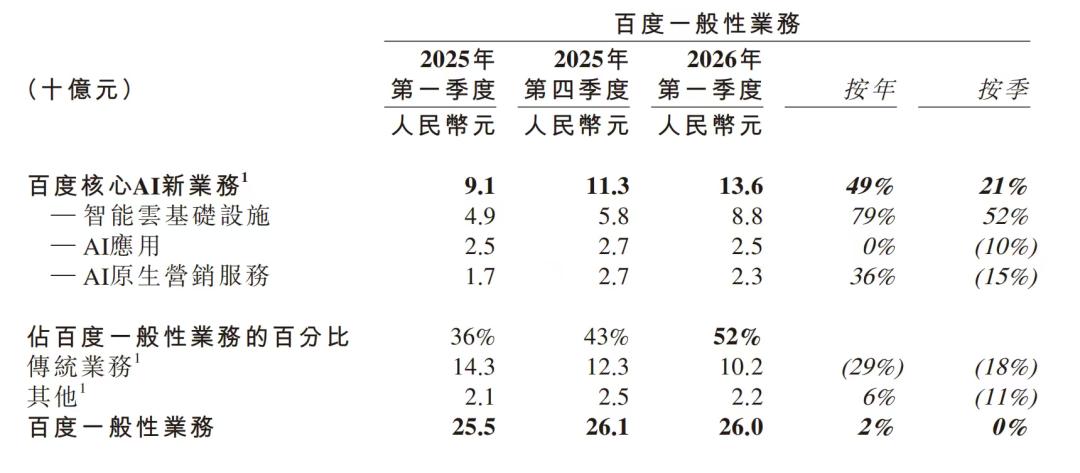
Behind the steady expansion of revenue is the commercial value and technological premium released by AI entering specific business scenarios and running continuously.
For example, in the scenario of a globally leading automated terminal, even though the original control system has been optimized to the extreme, Baidu's self - evolving decision - making intelligent agent, Famo, still helped the intelligent control system achieve an absolute indicator improvement of 10.21% in the prototype demonstration, continuously exploring the incremental space for intelligent logistics scheduling.
In the professional creation and development scenario, the no - code platform Miaoda 3.0 can generate AI applications with a single click of natural language, significantly lowering the threshold for software development. Since its release, the applications generated by Miaoda have served more than 10 million users, created 1 million commercially valuable applications, and the OPC monetization amount has reached the tens of millions level.
In the office and personal efficiency scenario, the general intelligent agent DuMate (Baidu's partner), launched in March this year, breaks the limitations of traditional AI assistants. With natural language as the entry point, it completes the closed - loop of complex tasks across applications and files. Data shows that DuMate has a monthly access volume of 1.16 million, ranking among the top three in the industry list, with a monthly access growth rate of up to 114.72%. At the same time, it topped the two authoritative evaluation lists of PinchBench and DeepResearch Bench, and its comprehensive interaction and execution ability ranks among the top in the industry.
In the brand marketing and content creation scenario, the digital human intelligent agent Baidu Huibo Star has been officially upgraded to Baidu Yijing, becoming the world's first full - scenario multi - intelligent agent digital human platform, and the overseas version of Yijing has been launched simultaneously. Baidu Yijing cooperated with Coca - Cola to create a World Cup - limited TVC. From creative insight to storyboard design, camera movement scheduling, and editing rhythm, all were completed by AI. Five characters in five cities have a consistent style, reaching the professional advertising production level, helping the brand achieve low - cost, high - quality, and fast - paced global content promotion.
It is not difficult to see from these cases that Baidu's AI is no longer a tool for "calling once and answering one question" but has become a productivity unit that "embeds in the process and runs continuously." These AI capabilities that are rooted in business scenarios, embedded in business processes, and can run stably for a long time have also built a solid and stable revenue foundation for Baidu, officially opening a new development stage for Baidu.
03
Why is it Baidu that takes this step first?
The increase in the proportion of AI revenue and the proposal of the DAA indicator both point to a premise: Baidu has enabled AI to run continuously in real scenarios and stably output value, and therefore has the ability and confidence to use DAA to measure this "achievement."
This ability does not come from accidental breakthroughs in a single model or application but is a systematic victory built on the four - layer full - stack architecture of "chip, cloud, model, and agent."
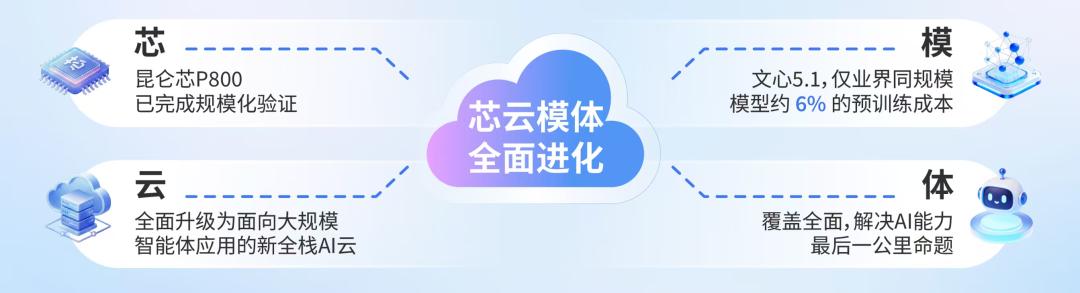
As one of the few global technology giants with full - link self - research capabilities, Baidu has a complete technology stack of Kunlun chips, Baidu Smart Cloud, Wenxin Big Model, and intelligent agent applications, and has created an efficient positive - feedback flywheel: the optimization of the underlying chips and computing power infrastructure directly serves the training and reasoning of the upper - layer large models. The iteration of the large - model capabilities reaches user needs through intelligent agents and helps precipitate more high - value data. The data finally feeds back to the underlying architecture again, achieving a positive cycle and ensuring that AI capabilities can break away from the technical vacuum and achieve high - frequency, fast, and low - cost self - evolution.
More importantly, the self - controllability from the underlying chips to the upper - layer applications allows Baidu to firmly control the initiative in computing power costs, technology iteration rhythm, and commercial pricing, and build a highly resilient and long - term self - sustaining profit model.
At the computing power hardware level, Baidu has deconstructed the problem of "self - controllable computing power" with its self - developed Kunlun chips, avoiding the risk of external supply chain fluctuations for domestic enterprises. Currently, the Kunlun P800 has completed large - scale verification and has been delivered to multiple ten - thousand - card clusters, meeting the requirements of large - scale training of cutting - edge large models for computing precision, operator stability, framework adaptation, and long - term operation. At the same time, the Tianchi 256 - card super - node based on the Kunlun chip has been successfully lit up and will be launched in June. Its throughput performance has increased by 25% compared with the previous generation, the reasoning efficiency has increased by 50%, and it is compatible with mainstream large models.
At the infrastructure level, Baidu Smart Cloud has built a complete AI - native infrastructure for enterprises, enabling enterprises to complete their intelligent transformation on a mature AI - native cloud without building an intelligent agent - native cloud from scratch, continuously releasing industrial spill - over value. According to the market data released by the AI cloud industry institution Smart Hyperparameter, Baidu Smart Cloud won the "double first" in the number of winning bids and the winning bid amount.
At the model level, the Wenxin Big Model has achieved technological self - controllability and continuous and efficient evolution, becoming a long - term security guarantee for Chinese enterprises' AI transformation. Recently, the Wenxin Big Model 5.1 was officially launched, using the "multi - dimensional elastic pre - training" technology. With only about 6% of the pre - training cost of models of the same scale in the industry, it has reached the leading level in basic effects and ranked first in the domestic LMArena search list and text list.
At the application implementation level, Baidu relies on a diversified AI - native product matrix such as the general intelligent agent DuMate, the Skills ecosystem, the full - scenario digital human platform "Baidu Yijing," the no - code platform Miaoda, and the self - evolving decision - making intelligent agent Famo 2.0 to comprehensively output intelligent solutions for enterprises and individual users, helping all walks of life complete "self - evolution."
When the industry moves from "model competition" to "result competition," the real dividing line is no longer technical parameters but who can continuously deliver verifiable value. Judging from the current financial performance, winning bid data, and implementation ecosystem, Baidu has taken the lead in crossing this dividing line.
In response, the capital market has also given a positive feedback. Recently, many domestic and foreign investment banks, including Citigroup and Macquarie, have raised Baidu's investment rating and target price again, demonstrating a high degree of recognition of Baidu's full - stack AI layout, scenario - based implementation ability, and long - term commercial value.
*Disclaimer:
The content of this article only represents the author's views.
The market is risky, and investment should be cautious. In any case, the information in this article or the opinions expressed do not constitute investment advice to anyone. Before making an investment decision, if necessary, investors must consult professionals and make decisions carefully. We have no intention to provide underwriting services or any services that require specific qualifications or licenses for all parties in the transaction.