Explore Agents, multimodality, applications, and computing power all in one day! Highlights of the summit are here. Join us on May 20th at the event to embrace AI together!
As we enter 2026, AI is advancing at an ever - accelerating pace. Beyond the onlooker experience, everyone can't help but ask themselves:
What on earth is the relationship between the new AI things like the so - called "lobster" and Harness that are flooding our friend circles and me? Is it really necessary to keep up?
AI startups and AI financing are in full swing. Where are the opportunities for me?
Others are already using AI to make videos, write code, and run projects. Am I already one step behind?
...
In the end, almost all questions will converge into the same one: How on earth should I use AI?
If you're still hazy about these questions, why not come to the 4th China AIGC Industry Summit? In just one day, we'll clarify all the most notable people, events, and judgments in the AI industry this year.
Let me give you a little spoiler in advance.
18 top - notch guests, 1 round - table discussion on the Agent theme, 1 annual list, and 1 panoramic map — all the content has been finalized.
In terms of the lineup, there are industry leaders like Kunlun Wanwei, Zhipu, SenseTime, Baidu, Ant, and MiniMax, as well as a global perspective brought by Amazon Web Services and Silicon Valley's Fusion Fund. There are also representatives from the academic and open - source frontiers like Qiu Xipeng from Fudan University and Huang Chao from the University of Hong Kong, as well as active practical players like Shanda EverMind, Taichu Yuanqi, and Quwan Technology.
In the agenda, from the commercial implementation of Agents, the latest breakthroughs in multi - modality and spatial intelligence, to the in - depth penetration of AI in scenarios such as entertainment, healthcare, and enterprise services, and then to the paradigm shift in computing power and AI infrastructure... Almost all the most notable AI topics of the year are covered in this one day.
Without further ado, let's get straight to the point.
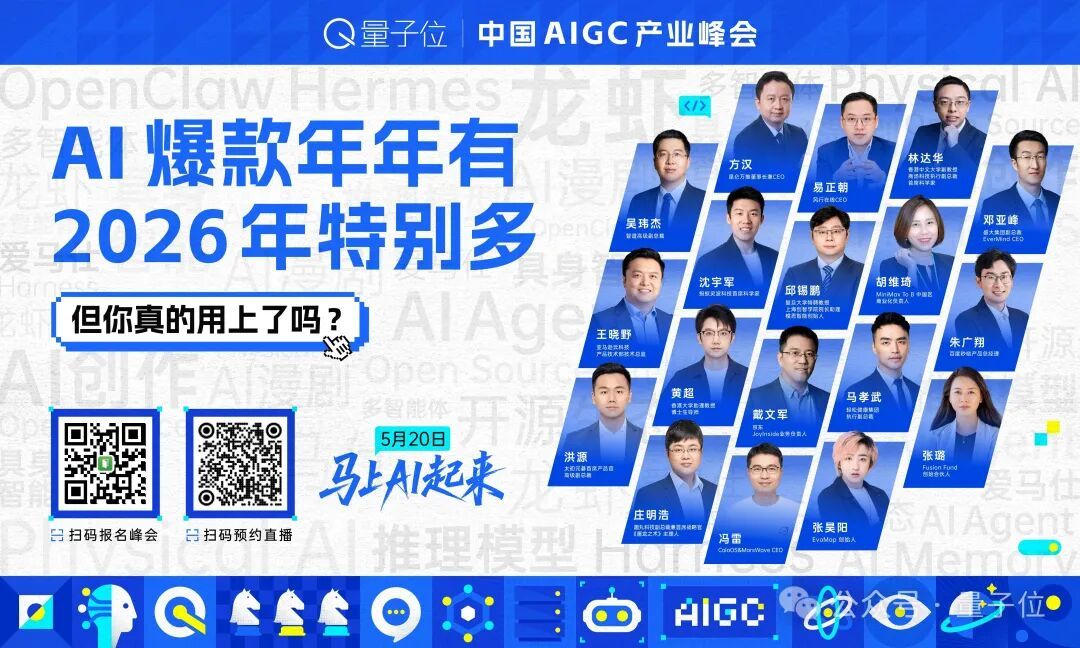
Highlight 1: How can Agents be implemented? Players from different perspectives have their own insights
If last year people were still on the fence about "whether Agents are the future", in 2026, the answer to this question is self - evident.
"Agents are not the future; they are the present" — this is the judgment brought by Wu Weijie, the senior vice - president of Zhipu. He will share Zhipu's latest practical experience in the commercial implementation of Agents.
However, for Agents to truly enter enterprises, it's not an overnight success. Wang Xiaoye, the technical director of the product technology department at Amazon Web Services will focus on how to bridge the gap in Agent implementation and break down the most difficult path from the most powerful models to enterprise - level AI Agents.
And Huang Chao, an assistant professor at the University of Hong Kong will discuss the challenges and opportunities of the paradigm shift in AI Agents from the perspective of academic and open - source frontiers. The HKUDS GitHub open - source platform he leads has accumulated over 240,000 Stars, ranking among the global Top 50, and his voice is beyond doubt.
Meanwhile, for Agents to truly become a "digital productivity system", they need more fundamental capabilities. Deng Yafeng, the vice - president of Shanda Group and the CEO of EverMind will share the self - evolution driven by long - term memory and explore how AI can evolve from a "tool" into a sustainable and growing digital productivity system.
Of course, speeches alone are not enough. This year's summit has specially set up a round - table discussion on the Agent theme: Uncertainties and non - consensus opportunities of Agent products in 2026.
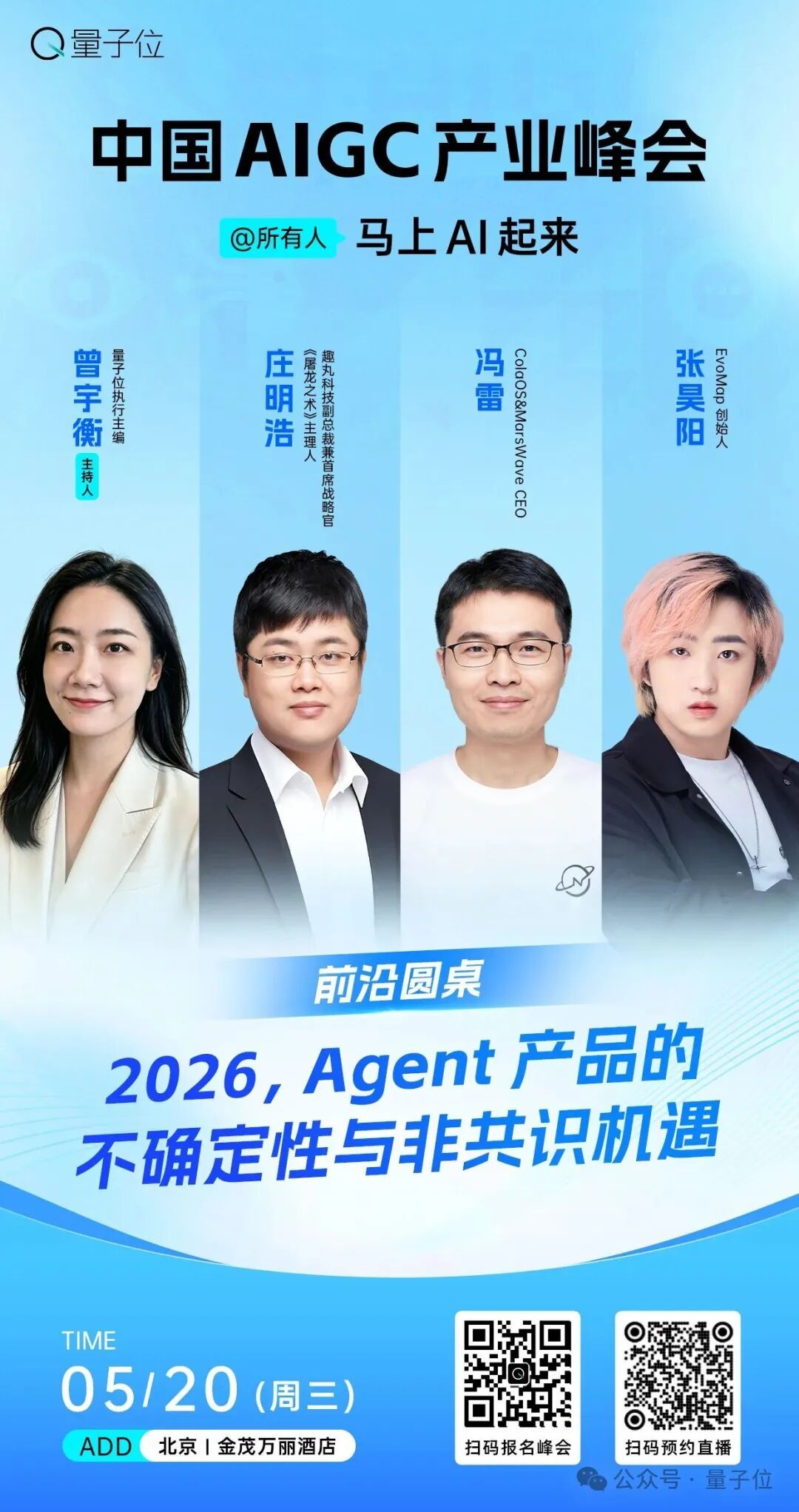
The attending guests include Zhuang Minghao, the vice - president and chief strategy officer of Quwan Technology and the host of "The Art of Slaying Dragons", Feng Lei, the CEO of ColaOS & MarsWave, and Zhang Haoyang, the founder of EvoMap.
These three are all in - depth players in the front - line of Agent products. From product forms to operating systems, from multi - agent frameworks to self - evolution engines, what non - consensus views will they collide with? It's really worth looking forward to.
Highlight 2: Beyond Agents, the boundaries of model capabilities are also expanding
Although Agents are one of the absolute protagonists of this year's summit, it cannot be ignored that the capabilities of the models supporting Agents are also extending outward at an astonishing speed — from the "digital" to the "physical", the cognitive boundaries of AI towards the world are being redefined.
Lin Dahua, the executive vice - president and chief scientist of SenseTime will share how multi - modality models evolve from "understanding" and "generating" to a new stage of spatial intelligence that is truly perceptible, generative, and actionable.
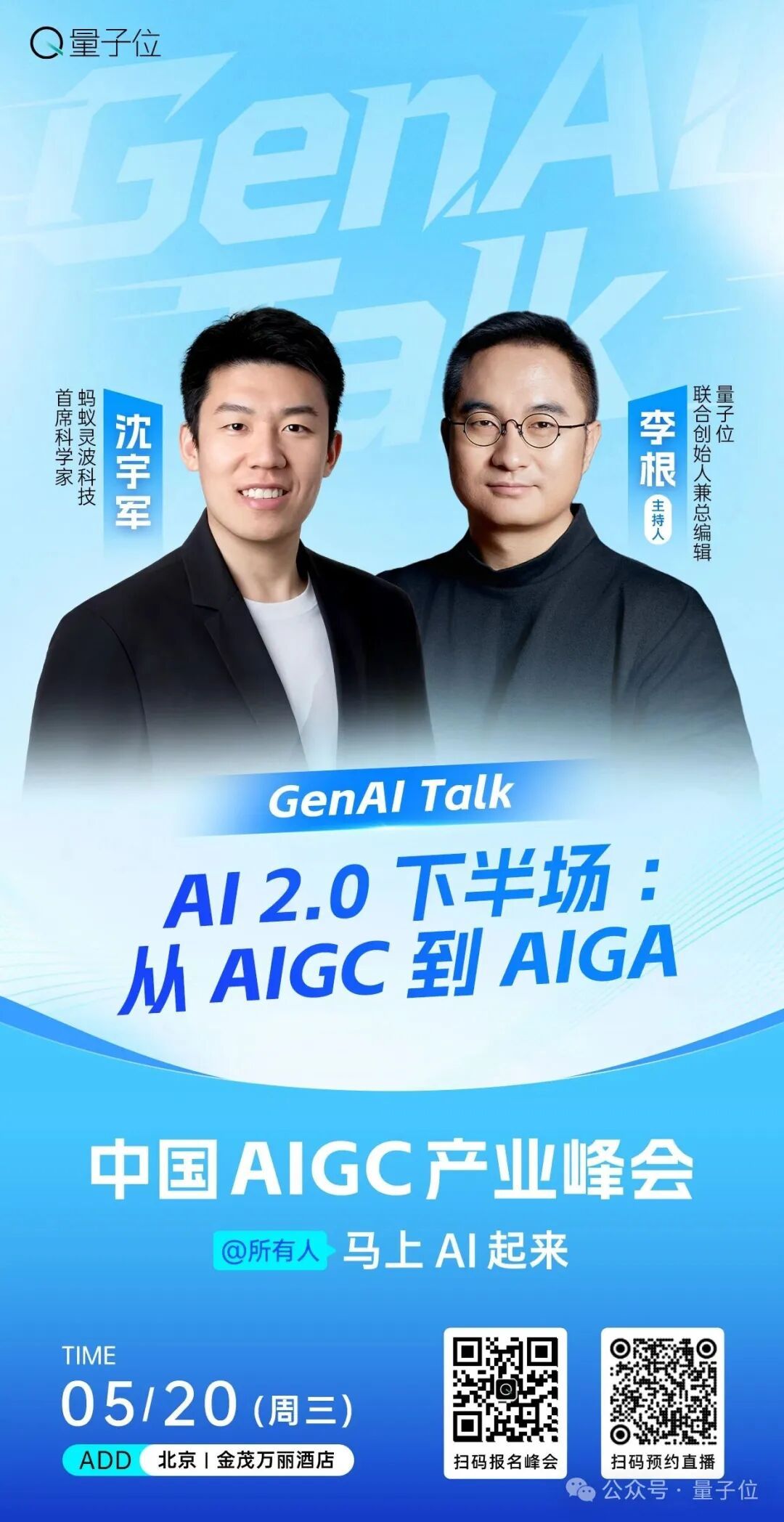
In the GenAI Talk session in the morning, Shen Yujun, the chief scientist of Ant Lingbo Technology will have a discussion around a core proposition: In the second half of AI 2.0, from AIGC to AIGA. When generative AI moves from "content" to "action", the entire industrial logic will be rewritten.
And Dai Wenjun, the person in charge of JD's JoyInside business will further push this proposition into the physical world. When AI steps out of the screen and into real terminals and real scenarios, the "AI World" truly begins.
At the model level, Qiu Xipeng, a specially - appointed professor at Fudan University and the founder of Mos Intelligence will share the latest progress of the MOSS multi - modality model and its inference optimization. This "front - line figure in large models" who has led the research and development of the MOSS series of open - source large models will bring hardcore content that combines academia and engineering.
Highlight 3: How to play specifically? These application players present successful cases
Whether it's models or Agents, where exactly are the opportunities in different fields?
Fang Han, the chairman and CEO of Kunlun Wanwei gives his answer first. Over the years, he has led Kunlun Wanwei to place bets on multiple AIGC directions such as AI music, AI social media, and AI short dramas. His sharing will, from a front - line perspective, talk about what has been successfully implemented and what pitfalls have been encountered in the specific applications of AIGC this year.
Immediately afterwards, "practical players" from different tracks will take the stage in turn:
In the field of entertainment creation, Yi Zhengchao, the CEO of Fengxing Online will bring a core judgment — from AI programming to AI videos, mass innovation is the core lever of AI productivity. He will tell how AI evolves from a single - point tool to a lever that can leverage the entire creator ecosystem, enabling ordinary people to support a creative team.
At the level of productivity tools, Zhu Guangxiang, the product general manager of Baidu Miaoda will share their product concept of "everyone is a creator". When the threshold is leveled by AI, imagination becomes the new productivity.
In the direction of enterprise - level AI, Hu Weiqi, the commercialization director of MiniMax's ToB business in China will bring MiniMax's real - world strategies and thinking in the ToB battlefield this year.
In the large - scale health track, Ma Xiaowu, the executive vice - president of EasysHealth Group will break down the growth flywheel from evidence - based intelligent agents to AI - driven health services, demonstrating the real growth engine of AI in serious medical scenarios.
In entertainment, office work, enterprises, healthcare... AI is no longer the "object of discussion" but the "tool being used". In each niche track, someone has already started to present cases.
Highlight 4: From training to inference, the story of computing power is also being rewritten
Beyond models and applications, another main line worthy of attention in 2026 is the paradigm reconstruction of AI infrastructure.
In the past few years, when everyone discussed computing power, they defaulted to one premise — serving training. But in 2026, the trend has changed. The demand for inference has skyrocketed, and the training cost is high. The entire computing - power narrative is shifting from "training - driven" to "inference - driven".
Zhang Lu, the founding partner of Fusion Fund will interpret the reconstruction of the computing - power narrative from the dual perspectives of global capital and industry. When AI infrastructure shifts from training to inference, a paradigm shift is taking place.
On the side of domestic computing power, Hong Yuan, the chief product officer and senior vice - president of Taichu Yuanqi will bring his thoughts on the path of domestic computing power. When "Token" is becoming the new measurement unit in the AI era, how can domestic computing power lay the foundation for the new future of Token intelligence? He will give his answer.
Highlight 5: Get a full view of the AI panoramic ecosystem with a list and a report
Continuing the tradition of previous sessions, at this year's summit, technology pioneers, industry leaders, and emerging forces will collide in a panoramic way again.
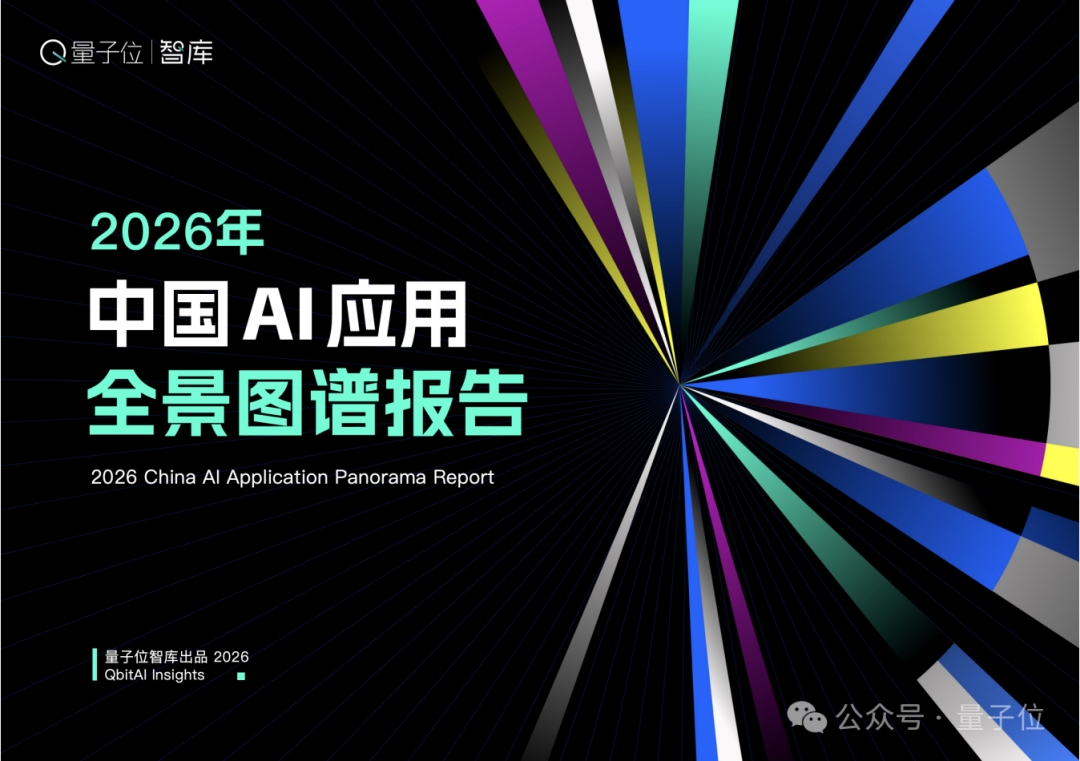
To provide more references for the industry, we will also award two types of awards: Notable AIGC enterprises in 2026 and notable AIGC products in 2026, as well as a panoramic map of Chinese AIGC applications.
The former are the high - potential enterprises and products selected by QbitAI based on the performance and feedback of AIGC enterprises and products in the past year, combined with the observation of technologies and scenarios in 2026.
The latter is a comprehensive and three - dimensional panoramic map of Chinese AIGC applications drawn by QbitAI Think Tank, which is used to show the market pattern and development trends of domestic AIGC applications and conduct in - depth analysis of the most potential and competitive products and tracks.
Held on May 20th
Finally, here are the time, location, and the most comprehensive agenda. There are also freebies for attendees waiting for you on - site. See you then!

Time: 9:30, May 20th
Location: Jinmao Renaissance Hotel, Beijing
Now, the China AIGC Industry Summit is open for hot registration. Welcome to click the link to register for off - site participation: https://hdxu.cn/1Hjr1
This summit will also be live - streamed online. Welcome to make an appointment to participate: QbitAI Video Account.
Introduction to the attending guests
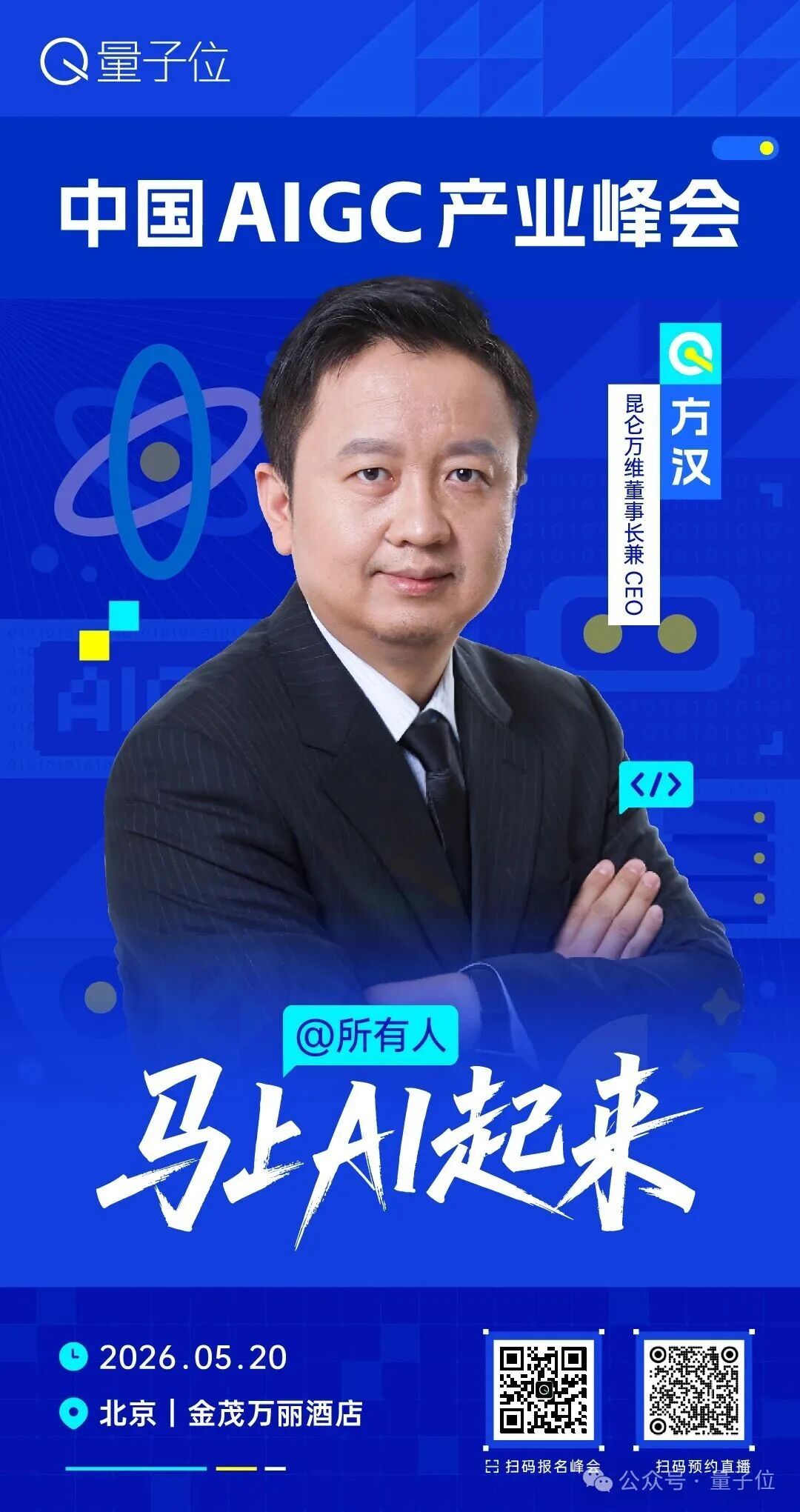
Fang Han
Chairman and CEO of Kunlun Wanwei
Fang Han graduated from the Department of Modern Physics of the University of Science and Technology of China. He has worked at the Institute of High - Energy Physics of the Chinese Academy of Sciences, Turbolinux, AsiaInfo, and Oak Pacific Interactive. In 2008, he assisted Mr. Zhou Yahui in founding Kunlun Wanwei. Fang Han has 30 years of experience in the Internet industry. He started participating in and advocating the open - source movement in 1994. He is one of the founders of Chinese Linux and one of the "Four Swordsmen of Chinese Linux". He wrote the first domestic Linux book, "Practical Guide to Linux". He is also one of the earliest network security experts in China. He was responsible for the whole - network security auditing of the three major telecom operators, led the development of the first domestic P2P download software, DUDU Accelerator, and was in charge of the research and development of the web - game "Three Kingdoms: The Wind of War", which had the highest market share in China. He is one of the most senior participants in the Chinese Internet.
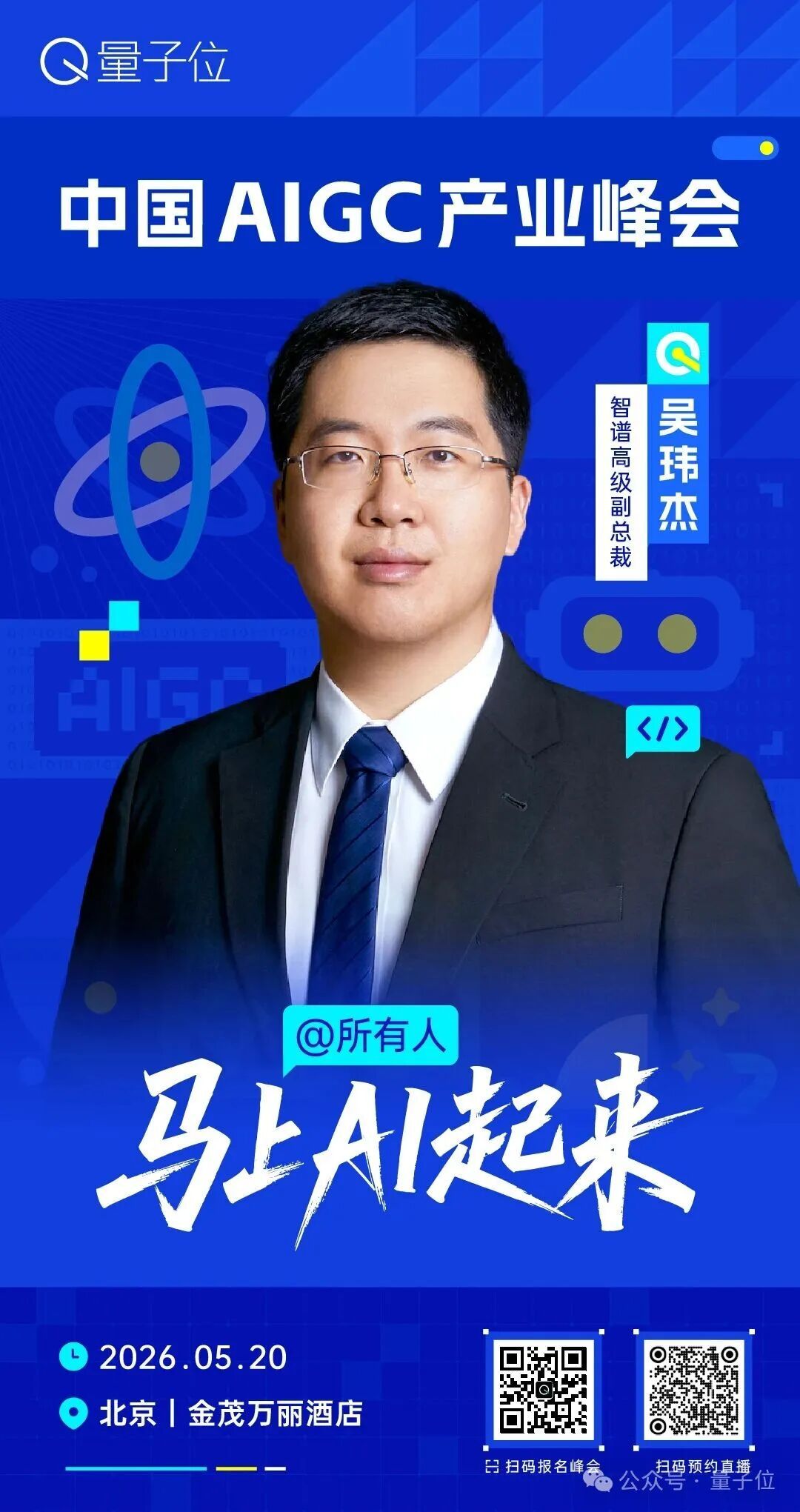
Wu Weijie
Senior vice - president of Zhipu
Wu Weijie currently serves as the senior vice - president of Zhipu, responsible for the commercialization of the company's MaaS platform. He also serves as the general manager of the Pan - Internet Business Unit and the general manager of the Zhejiang subsidiary. He has rich experience in commercial management and project implementation in the fields of artificial intelligence, the Internet, and information technology. He has previously served as the global chief commercial officer of ByteDance's enterprise applications (including brands such as Feishu, LarkPeople, and Mubu), the vice - president of GE Digital Group in Greater China, and the co - chief development officer and chief investment officer of Fosun Group. In addition, he has also engaged in commercial management work at Cisco, SAP, Oracle, and other companies.
Dr. Wu Weijie graduated from the University of Electronic Science and Technology of China. He also holds an International Master of Business Administration degree from the University of Hong