The "father of lobster" burns tokens worth 9.4 million yuan per month. He really wouldn't be able to afford it if he hadn't joined OpenAI.
Peter Steinberger, the "Father of Lobster," posted a screenshot of his CodexBar backend on X.
It's a rather astonishing screenshot —
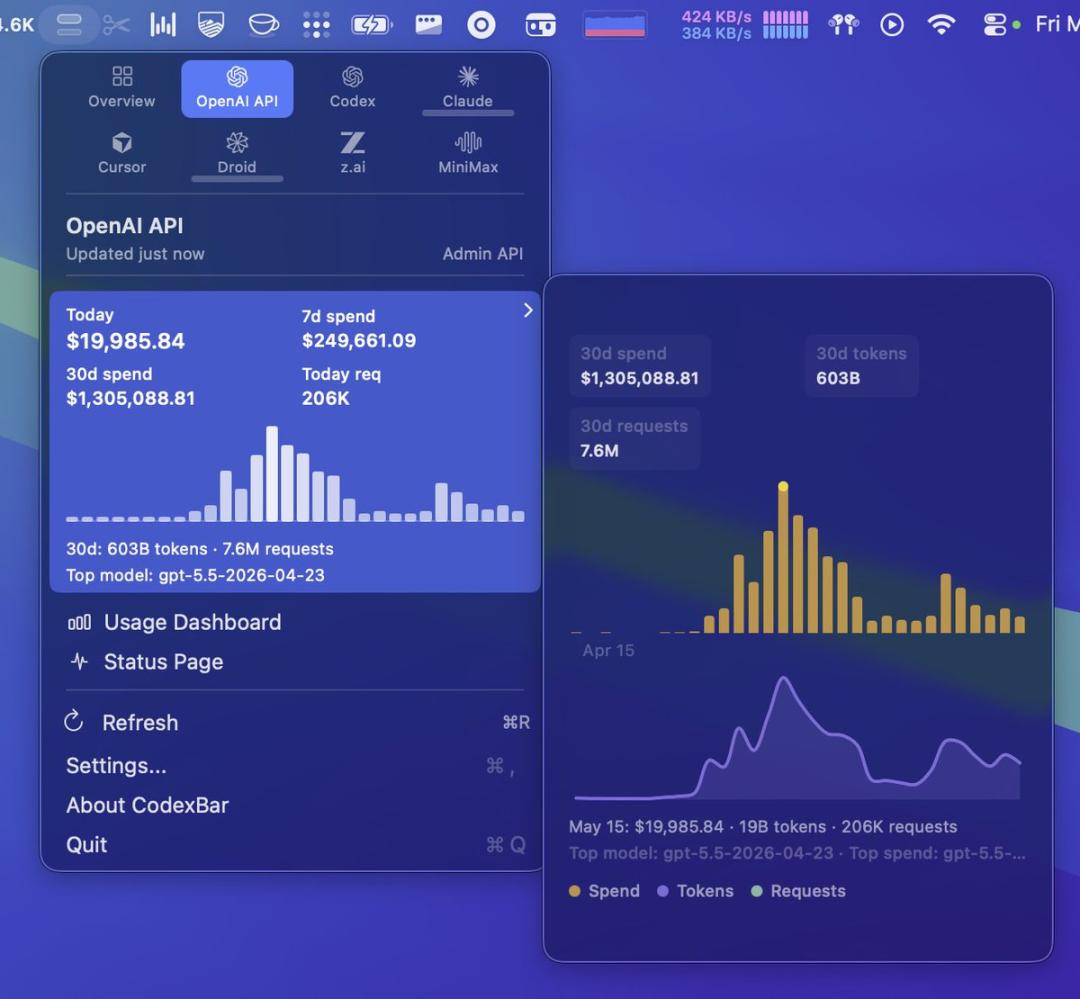
The information and numbers revealed on it made my eyes pop out:
In the past 30 days, the total cost of his OpenAI API calls reached $1,305,088, approximately equivalent to 9.4 million RMB;
Meanwhile, he consumed 603 billion tokens and initiated 7.6 million requests;
The most commonly used model is GPT - 5.5.
All the above costs are borne by OpenAI.
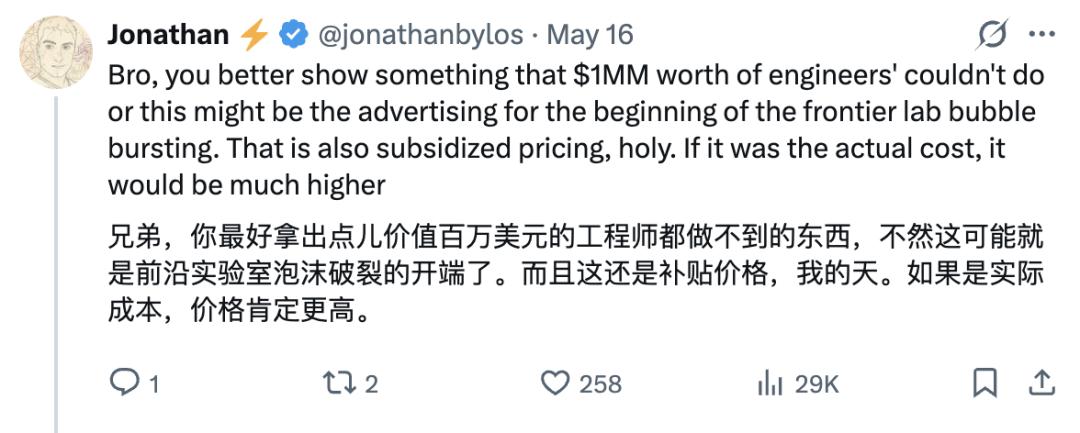
I'm not the only one who was stunned. Many netizens also exclaimed:
Dude, you'd better come up with something that engineers worth millions of dollars can't do, or this might be the beginning of the bubble burst in the cutting - edge laboratory.
And you're enjoying the subsidized price. My goodness.
If someone else were to call this many tokens at the actual cost, the price? I don't even dare to think about it.
Most of the money was spent on developing OpenClaw
Peter basically used all these countless tokens to develop OpenClaw.
He said that after being acquired by OpenAI, his team now only has three people.
In this era, the quality of a team matters more than its size. Moreover, Peter's team has a huge silicon - based external support!
Peter said that they will run about 100 Codex instances in the cloud simultaneously.
This is a wise move by Peter — instead of creating "a super - versatile Agent," he split it into a large number of small Agents.
This is actually one of the very popular topics recently, namely "multi - Agent group collaboration."
These Codex instances will automatically review PRs, scan for security vulnerabilities, check for duplicate issues, write repair programs, monitor benchmark regression, and even listen to meeting content and then create PRs on their own.
Moreover, they collaborate with each other, reviewing, supervising, and patching each other's loopholes.
Peter himself is also very honest. He clearly said that although the team's development is completely written using Codex, "some of the rather messy PRs I fixed were probably done by Claude."
(Note: The team also uses Clawpatch.ai, Vercel's Deepsec, and Codex Security for vulnerability and security analysis.)
Among these 100 Codex instances, some Agents are responsible for doing the work, while others are responsible for monitoring the work of other Agents...
To be honest, this situation seems strange at first glance, but it makes perfect sense after careful consideration.
Humans are responsible for setting goals, and Agents are responsible for execution. A very obvious "assembly - line Agent collaboration" has emerged in the entire software development process.
Doesn't this scene look like a real software company?!!!
It's just that the employees are gradually changing from humans to AI Agents. *Sighs and shrugs*.

In addition, by carefully looking at the Codexbar released by Peter, it can be found that his daily request volume reaches 206,000 times.
Converted, it's about 2.4 calls per second.
This information is actually more meaningful than the idea that Peter is "raising Agents in a competitive environment" (not really). Because it means that all Codex instances are working stably for a long time and continuously.
As we all know, once an Agent runs online for a long time, it will easily be stuck by many problems in real - world scenarios, such as messy and redundant context information, ever - growing memory data, or mutual interference and misguidance among multiple Agents.
It costs a lot of money in a month!
Facing the sky - high bill of $1.3 million for 30 days, Peter responded to the doubts.
Although the monthly token call volume is astonishing, this is just the result of Peter turning on the fast mode.
In order to allow these Agents to collaborate continuously at a high frequency and respond quickly, the system needs to maintain a very aggressive inference scheduling, which will directly drive up token consumption.
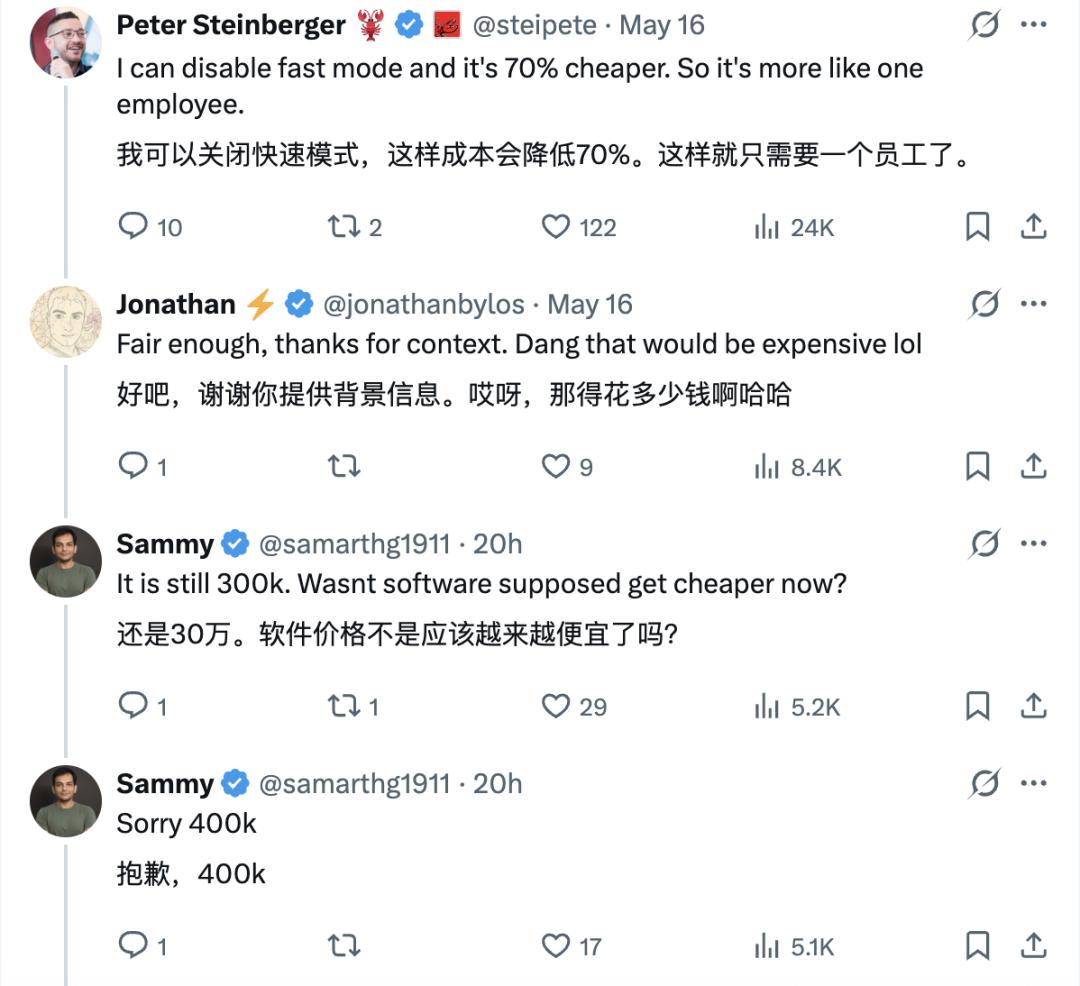
I can turn off the fast mode, and the cost will be reduced by 70%.
Allowing the Agents to work "a bit slower" can immediately reduce the cost. It sounds really cost - saving.
But, when netizens did the math, they immediately found that even after saving 70% of the cost, Peter's monthly token cost is still as high as $400,000.
That is 2.72396 million RMB.
This is just Peter's token call cost in the past 30 days!
Do you know that in March this year, Reuters reported that OpenAI planned to expand its employee number to 8,000...
Looking back, Peter said that "it's not expensive at all" because his thinking follows a completely different logic.
When asked about the return on investment, he said that all the products developed by his team are open - source and compatible with mainstream models and open - source models. "The return on investment is quite high."
He also said:
After disabling the fast mode, my spending is lower than the cost of an engineer, and the effect is definitely much better.
So, Peter is not comparing Codex with "tool costs," but with "engineering team costs," especially in San Francisco.
It's not uncommon for a senior engineer to earn hundreds of thousands of dollars a year.
Now, OpenClaw allows 100 Agents to undertake a large amount of repetitive engineering work. This kind of work is very mechanized, and AI is naturally suitable to replace a large amount of engineering manpower.
Altman previously mentioned in a public speech that the future will be an "extremely multi - agent" world.
Now, OpenClaw under Peter's management is starting to show that flavor.
Following this trend, software development will gradually change from "humans using tools" to "humans managing Agent teams."
In other words, whether "burning $1.3 million a month" is cheap or expensive completely depends on your perspective.
One More Thing
Since Peter said that most of the huge number of tokens were spent on developing OpenClaw, what about the rest?
Peter didn't hide it and said —
"I'm also preparing several startup projects at the same time~"
Obviously, Peter is no longer satisfied with just using 100 Agents to develop OpenClaw.
As for what the new startup projects are, let's look forward to it!
Reference link: [1]https://x.com/steipete/status/2055346265869721905
This article is from the WeChat official account "QbitAI," author: Focus on cutting - edge technology. 36Kr is authorized to publish.