The former CEO of Kepler ventures into a new startup again, and Sota Unbounded bets on the overseas expansion of "robot brains".
On May 14th, GeekPark learned that Hu Debo, the former CEO of Kepler Robotics, has embarked on his second venture in the embodied intelligence field. His new company is named "Sota Boundless".
This time, he has chosen a different path from Kepler.
In 2023, when the humanoid robot industry was just heating up, Hu Debo co - founded Kepler Robotics, focusing on full - stack bipedal humanoid robots, chassis with dual arms, and industrial scenarios. Two years later, Kepler has become one of the representative companies of humanoid robots in the domestic industrial scenario and completed a 100 - million - level Series A++ financing in April this year.
However, Hu Debo's new project does not continue to bet on the full - stack of the whole machine, nor does it choose the industrial implementation scenario. Sota Boundless focuses more on the "brain" of embodied intelligence itself: centered on the world action model, multi - modal VLA, and data collection system, it attempts to solve the most difficult part when robots truly enter the physical world - not just "seeing" the world, but understanding contact, movement, space, and physical changes.
In terms of the commercialization path, Sota Boundless has also chosen a more "atypical" route: starting from the sorting in the backstage of European and American supermarkets, it extends to commercial scenarios such as store replenishment, shelf arrangement, and e - commerce picking, and uses global customers, data closed - loop, and the synergy of the Chinese hardware supply chain as early barriers.
In Hu Debo's view, the overseas market has a more urgent demand for robot labor substitution, but there are not many solutions that can truly be delivered. Starting from the Chinese supply chain and connecting overseas customers, deployment, operation and maintenance, and data compliance chains is itself a high threshold.
01
The World Action Model Route,
Using the Agent Mode in the Early Stage
In Hu Debo's view, the current bottleneck of embodied intelligence is not that robots cannot work at all, but that the underlying paradigm has not converged.
Text and images are essentially discrete information, while robots face a continuous and non - linear physical space: bottles can roll, flexible objects can deform, grasping generates contact force, and there is real - time feedback between actions and the environment. Robots not only need to recognize "what this is", but also judge "where I should grasp, with how much force, what obstacles to bypass, and what will happen next".
This is also the problem that many existing technical routes encounter in real scenarios. VLA and multi - modal VLA can already complete some grasping and operation tasks, but it is more like learning action patterns from a large number of demonstrations. When the object posture, occlusion relationship, and contact state in the scene change, the model needs to truly understand spatial relationships, physical laws, and action consequences, rather than just "imitating what was done in the past".
Therefore, Sota Boundless focuses its core investment on the world action model.
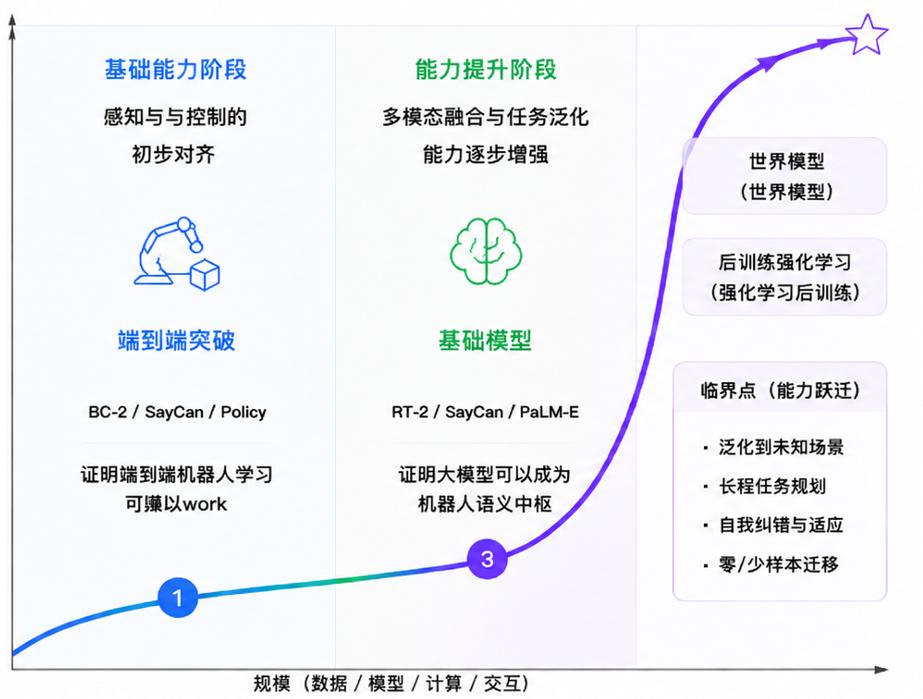
Model Thinking | Image Source: Sota Boundless
According to Hu Debo's judgment, the value of the world model lies in that it not only enables robots to "see" the physical world, but also allows robots to form the ability to predict the physical world internally: how an object will move after being pushed, how a flexible object will deform under force, and what results different actions will lead to. Further to the world action model, it combines this understanding of the world with action generation, enabling robots to directly plan and output actions based on the physical state.
Sota Boundless hopes to build a physical intelligent brain centered on a unified latent - space world action model. It not only uses visual, language, and action data, but also incorporates multi - modal information such as Ego videos, tactile sensations, end - effector states, contact processes, and task logics. In other words, from the training base, the model is not simply learning "the observed world", but learning "how a body acts in the world".
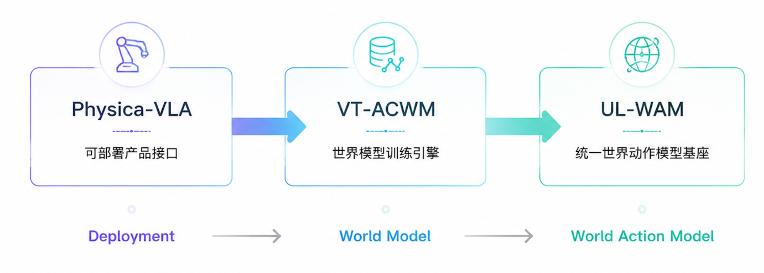
Model Thinking | Image Source: Sota Boundless
However, before the world action model is truly mature, Sota Boundless will not bet all its capabilities on an end - to - end model. At this stage, it uses a set of agentic AI architectures, internally called Physica - Claw.
This architecture is more like a robot operating system: the upper layer is responsible for user interaction, task understanding, scheduling, and orchestration, and the lower layer accesses different skills. For tasks with clear rules and stable environments, traditional motion control, path planning, grasping and placement modules can be called; for links that require recognition, judgment, and generalization, multi - modal VLA can be called; for tasks that require spatial reasoning, physical prediction, and complex operations, they are handed over to the world model or the world action model.
The advantage of this architecture is that it allows robots to "get to work" first. Real - world commercial scenarios cannot wait for a perfect end - to - end large model to appear before deployment.
Hu Debo believes that the agent architecture is only part of the current - stage solution, not the final form. In the long run, if the world action model is strong enough, the capabilities originally scattered in VLM, VLA, task decomposition, traditional control, and multiple skills will gradually be internalized by the model. At that time, the architecture of the robot brain will become simpler and easier to scale. Because the more modules there are, the more complex the series connection is, and the more difficult it is for the system to continuously improve through data and computing power. True scalable intelligence often comes from a more unified and concise model structure.
To reach this step, data is another bottleneck that cannot be bypassed.
Currently, the embodied intelligence industry generally lacks high - quality physical interaction data. Internet videos can provide rich visual information, but they cannot fully record actions, forces, contacts, and body states; traditional robot teleoperation data is closer to the task itself, but it is costly, inefficient, and difficult to scale up. Hu Debo is not optimistic about the route of simply relying on full - simulation machine teleoperation to collect data, because this method is too costly and has too low collection efficiency, making it difficult to become a truly scalable data paradigm.
Therefore, Sota Boundless will develop its own data collection equipment, including head - mounted Ego visual collection equipment and full - modal UMI handheld collection equipment, hoping to collect not only visual and action data, but also full - modal information such as tactile sensations, contact states, and end - effector postures.
In Hu Debo's vision, the data sources of Sota Boundless will be divided into several layers: the first layer is Ego videos, public data sets, and video data, which solves the data scale and is used to internalize extensive world knowledge and operation diversity; the second layer is full - modal UMI collection, which is used to expand physical interaction data at the lowest possible cost and solve embodied alignment; the third layer is the deployment data after the robot enters the real commercial scenario, which is used for post - training, reinforcement learning, and improvement of scenario success rates.
02
Bringing the Chinese Supply Chain to Overseas Scenarios
If Sota Boundless bets on the embodied intelligence brain in terms of technology, then in terms of commercialization, it bets on another kind of "full - stack" ability: not self - developing everything from motors, joint modules to chassis and the body, but connecting the brain, operating system, end - effector, data collection, hardware integration, overseas delivery, and operation and maintenance systems around real scenarios.
This is also one of the biggest features of Hu Debo's current venture.
Currently, the robot hardware supply chain has changed. Components such as joints, chassis, batteries, control boards, and structural parts are becoming more and more mature. The response speed, cost, and engineering capabilities of the Chinese supply chain are also sufficient to support more scenario - based robot solutions.
Therefore, Sota Boundless did not choose to build a complete humanoid robot body from scratch, but adopted a more open ecological cooperation model: cooperating with core component supply chain partners and integrating and customizing the body according to different scenarios. Hu Debo believes that this can not only reduce R & D costs and cycles, but also allow the company to more flexibly choose the most suitable hardware combination in different scenarios.
However, this does not mean that Sota Boundless only focuses on software.
In Hu Debo's view, the integration of hardware and software in embodied intelligence is still important, but the focus of the integration has changed.
Therefore, what Sota Boundless values most on the hardware side is not self - developing the whole machine from scratch, but the end - effector and data collection equipment.
Sota Boundless plans to start with a three - finger end - effector. Compared with traditional two - finger grippers, three - finger grippers can cover more grasping postures and strike a balance between stability and operation complexity; compared with five - finger dexterous hands, they are easier to engineer, have lower control difficulty, and are more suitable for early commercial implementation in terms of cost and reliability. For Sota Boundless, the three - finger gripper is not just a hardware choice, but to align data collection, model training, and real - world execution as much as possible.
This is also the reason why the company self - develops the full - modal UMI handheld data collection equipment. It hopes to collect not only visual trajectories, but also information such as end - effector states, tactile sensations, contact processes, and action constraints. Only when the collection equipment, end - effector, and future deployment form are as consistent as possible can the data be more likely to be converted into model capabilities, rather than being lost in the mapping process.
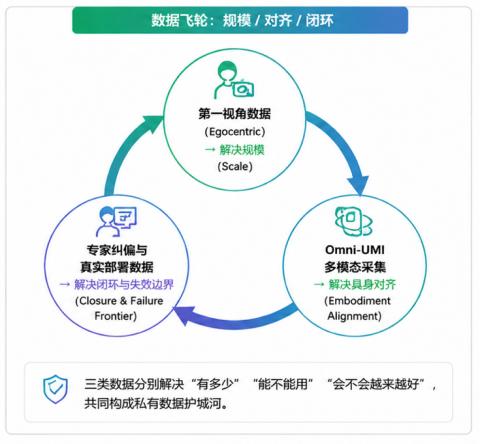
Data Thinking | Image Source: Sota Boundless
In terms of robot form, Sota Boundless will still adopt a more practical chassis - with - dual - arms solution in the early stage to facilitate rapid implementation.
Currently, Sota Boundless has reached cooperation intentions with European and American commercial giants, manufacturing and logistics groups, etc. Among them, the European supermarket scenario has the fastest progress. The company has signed a long - term framework agreement with a leading European supermarket group. The first stage will start with a POC; if the test passes, the order forecast from the other party is nearly a thousand units.
Hu Debo believes that the overseas market has a larger gap in robot labor, but there are not many available solutions. Especially in scenarios such as European and American supermarkets, logistics, and manufacturing, many positions have high labor costs, high repeatability, and difficulties in recruitment, and have not been fully covered by traditional automation. For robot companies, such scenarios have clear demands and it is easier to calculate the ROI.
03
Hu Debo's Second Venture Still Focuses on Globalization
The reason why Sota Boundless takes overseas commercial scenarios as the main battlefield from the beginning is also related to Hu Debo's personal experience.
Hu Debo is a 70s - born entrepreneur and a "veteran" who has fought hard in the global market for many years. In 1999, he joined ZTE and entered the communication industry. In 2001, he began to be responsible for overseas businesses in Europe, Russia, the Asia - Pacific region, etc. In 2006, he became the country representative of Huawei overseas and was deeply involved in the expansion of Huawei's high - end market in Europe.
This experience made him realize early on that the true globalization of Chinese technology companies is not just about selling products overseas, but about entering the local customer system and establishing long - term relationships of sales, delivery, service, compliance, and trust.
In 2015, Hu Debo predicted that "robot + AI" would become an important technological wave in the next few decades and turned to entrepreneurship in drones and underwater robots. During this period, he joined hands with Huawei HiSilicon to create a visual AI drone. The product entered dozens of countries, and he further accumulated experience in robot hardware, AI capabilities, and global channels.
In 2023, when the humanoid robot industry was just heating up, Hu Debo co - founded Kepler Robotics, focusing on bipedal humanoids, chassis with dual arms, and industrial scenarios. Since then, Kepler has gradually grown into one of the representative companies of humanoid robots in the domestic industrial scenario and completed a 100 - million - level Series A++ financing in April this year.
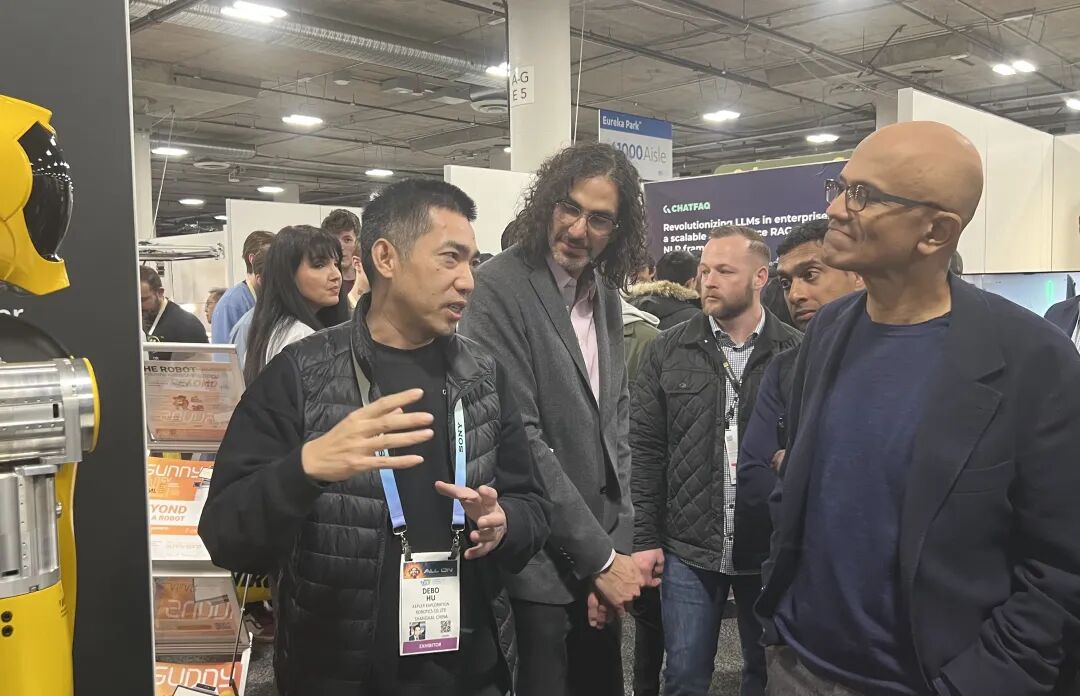
Hu Debo Communicating with Nadella | Image Source: Sota Boundless
This time, what Hu Debo wants to do is to bring physical native intelligent agents to every corner of the world through Sota Boundless.
In his view, when embodied intelligence truly moves towards commercialization, the advantages of Chinese companies lie not only in algorithms, nor in a single body, but in whether they can connect the mature hardware supply chain, physical intelligent brain, overseas real - world demands, and long - term delivery systems. The domestic robot hardware supply chain is strong enough, but most hardware companies do not have the ability to directly enter the overseas customer system; while overseas customers have clear demands for labor substitution, but lack truly mature, deliverable, and maintainable solutions.
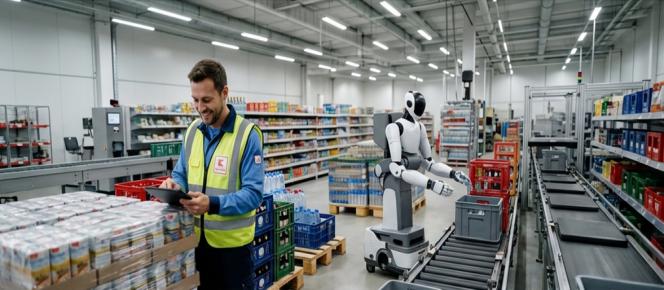
Supermarket Scenario | Image Source: Sota Boundless
What Sota Boundless wants to be is the connector in the middle: connecting the Chinese robot supply chain and embodied intelligence technology on one end, and real commercial scenarios such as European and American supermarkets, logistics, and manufacturing on the other end. It is not just about selling robots overseas, but about trying to reconstruct solutions around customer needs, complete deployment, establish a data closed - loop, and iterate continuously within the compliance framework.
This is also what Hu Debo calls the "global ecosystem" ability. For an embodied intelligence company, going global is not just a sales problem, but a systematic ability problem: where the customers are, how the scenarios are defined, how the hardware is adapted, how the operation and maintenance are covered, how the data is refluxed, and how privacy and compliance are handled. Each link will affect whether the robot can be truly scaled up and implemented.
From this perspective, Sota Boundless is not in a competitive relationship with other peers. Hu Debo compares physical intelligent AGI to Mount Everest: different companies may climb from different slopes, with the same goal but different paths.
As planned, Sota Boundless will demonstrate its complete brain capabilities this summer, including the world model, multi - modal VLA, and the Physica - Claw robot operating system, and run through the entire process of early commercial scenarios in the laboratory; by the end of the year, the company plans to conduct POC tests at European customer sites. The focus is not only on verifying whether a single scenario can run smoothly, but also on connecting the data, delivery, and compliance closed - loop after real - world deployment.