Japan had been dreaming of mechas for forty years, and Unitree has made that dream come true.
The day the news reached Japan, the most-shared sentence on social platforms was: "This should have been ours."
What made them say this was a video.
A Chinese man climbed onto a 2.8-meter-tall mech and sat in the cockpit. The 500-kilogram manned machine walked and transformed on the road.
His name is Wang Xingxing, the founder of Unitree Technology, and he is a post-90s generation.
For forty years, with Gundam, EVA, and Mobile Suit, "a person sitting inside a mech" has always been the most romantic and touching vision of the future depicted by Japanese anime.
However, the first person to actually sit inside was not in Japan, but in Hangzhou, China.
On May 12th, Unitree released the world's first mass-produced manned transformable mech, the GD01, with a starting price of 3.9 million yuan.
Ten years ago, Wang Xingxing built his first robotic dog with less than 20,000 yuan. Ten years later, Japan Airlines introduced Unitree's robots to carry luggage at its busiest airport.
A country that has been dreaming of a robot kingdom for forty years was beaten to the punch, and finally had to buy back the product.
01
Sitting in the Cockpit
The mech stood on the street. The cockpit cover opened. Wang Xingxing climbed up and sat inside.
There were no special effects, no acceleration. The whole process was filmed in real scenes.
The mech, with a total weight of about 500 kilograms after being manned, walked on two feet on the street and turned. Then, with one punch, the brick wall collapsed.
After a short pause, four legs unfolded from both sides of the torso and landed on the ground. It switched to the quadruped mode within a few seconds without any mistakes.
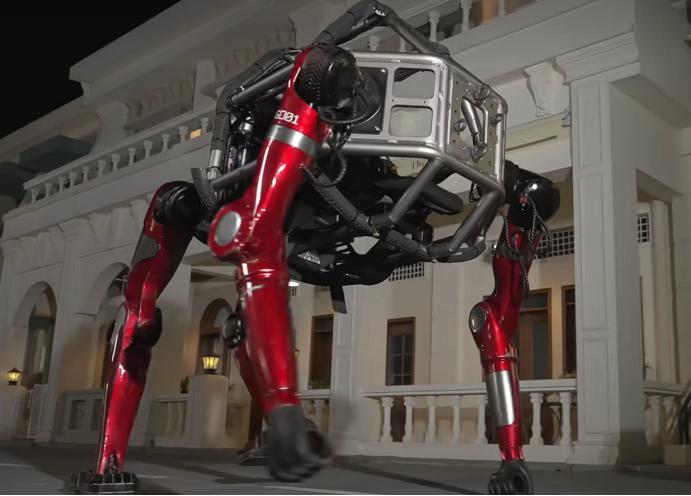
A Gundam pilot sitting in the cockpit is one of the most classic scenes in the history of animation. Forty years later, the first person to actually sit inside is from Hangzhou, China.
On May 12th, after the demonstration video of the GD01 was uploaded, the topic rushed to the top of the hot search list.
The most popular comment in the comment section was: "Oh no, China really has Gundams." The word "Gundam" didn't originally belong to China.
In 1958, the first mech anime, "Tetsujin 28-go", was born in post-war Japan. Since then, the imagination of humans remotely controlling giant robots has taken root.
In 1972, manga artist Go Nagai made a key invention in "Mazinger Z": allowing the pilot to sit inside the mech.
It was no longer remote control, but symbiosis.
In 1979, "Mobile Suit Gundam" pushed this concept to the extreme. The mech changed from a weapon to a belief, and the derivative "Gundam model" became popular all over the world. It is still one of Bandai's core revenue pillars.
For forty years, Japan has defined the world's entire imagination of mechs through anime and has never stopped building them.
In the 1970s, Waseda University developed WABOT - 1, opening the prelude to modern humanoid robots.
After that, Honda spent decades building ASIMO. It could play football and climb stairs, amazing the world.
Sony launched QRIO, which was flexible and amiable, and was once regarded as the starting point for the commercialization of humanoid robots.
However, the amazing performances in the laboratory have never been able to cross the threshold of commercialization.
In 2018, Honda announced the termination of the ASIMO research and development, citing the lack of a clear commercialization path. In 2020, SoftBank's Pepper was discontinued due to weak demand.
One by one, the star projects of Japanese robots quietly withdrew from the stage.
In most people's expectations, a manned mech was still just a dream. But Unitree pulled this timeline forward to 2026.
After the video of the GD01 was transmitted to Japan, the reaction of Japanese netizens was not amazement, but seven words after a moment of silence:
"This should have been ours." On social platforms, the messages were full of regret and unwillingness.
A country that defined the global imagination of mechs is now watching others turn the imagination into reality.
02
The Sofa is Too Short, the Feet Hurt
In 2013, 23-year-old Wang Xingxing was still a graduate student. At that time, he designed motors and wrote control algorithms by himself, and spent less than 20,000 yuan to build a quadruped robotic dog, the XDog.
This was almost the world's earliest technical solution for quadruped robotic dogs. Three years later, MIT open - sourced a similar robotic dog algorithm.
A graduate student, with an amount of money that wasn't even enough to buy a car, was three years ahead of the world's top laboratories.
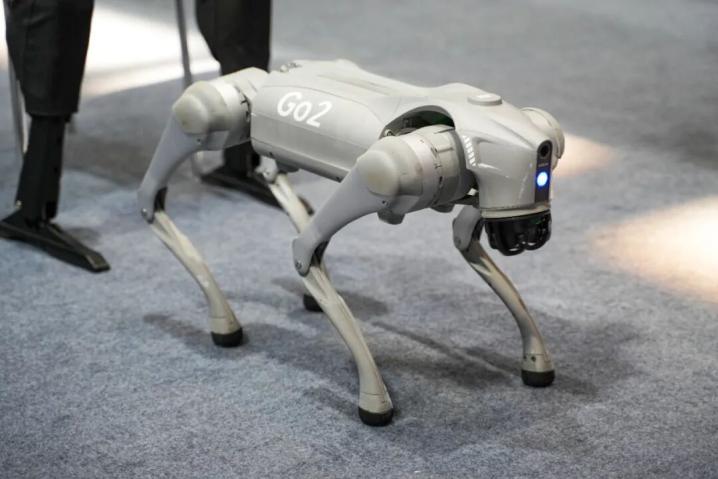
The XDog attracted 2 million yuan in angel investment. In 2016, 26 - year - old Wang Xingxing founded Unitree Technology and served as both the CEO and CTO.
But before that, he made a decision that puzzled those around him: he quit his job at DJI.
DJI offered him a high salary and a clear future, but Wang Xingxing couldn't understand why foreign robots were sold for hundreds of thousands or even millions of yuan.
After quitting, he had nowhere to live, so he slept on a friend's sofa. The sofa was too short, and after sleeping on it for more than a month, his feet always hurt.
He still remembers that experience vividly.
In 2017, at the World Internet Conference in Wuzhen, Zhang Peng, the founder of GeekPark, invited Wang Xingxing to a closed - door symposium. Those present included Lei Jun, Wang Xing, and Zhou Yuan.
Wang Xingxing brought his robotic dog prototype, Laikago, to prepare for a demonstration. When the robotic dog reached the threshold, it stumbled and crashed.
The room full of big shots fell silent. But Zhang Peng was still impressed.
He immediately flew to Hangzhou and had a conversation with Wang Xingxing for more than two hours in a garage in Binjiang District that didn't even have a visible house number and was full of parts.
A few years later, Wang Xingxing took the new - generation product, AlienGo, by car to a roadshow in Beijing. Since high - speed trains don't allow high - energy batteries, he took a more than ten - hour car ride.
In the Beijing office of Sequoia Capital, the AlienGo completed a somersault on the spot, and its price was only one - tenth of that of Boston Dynamics. Sequoia Capital issued an investment letter of intent on the spot.
During the same period, the Japanese robot industry across the Pacific was experiencing a different curve. Fanuc, a representative of Japanese industrial robots, saw its revenue in the Chinese market plummet by 49% in 2024.
The layout of collaborative robots was slow, and traditional advantageous fields were being eroded by Chinese manufacturers. The decision - making system couldn't keep up with the market speed.
On one side, a person was taking a more than ten - hour car ride with the product for a roadshow. On the other side, a giant was discussing in the meeting room why the Chinese market had shrunk again.
This is how the speed gap between the two worlds was widened.
In 2023, Unitree launched a humanoid robot project. Only three full - time employees were involved, and the hardware and software were directly reused from the quadruped robots.
Changing from four legs to two legs, a large number of control algorithms were already available. All the technologies accumulated from building robotic dogs over the years were finally realized.
The figures verified this speed: the revenue was 123 million yuan in 2022, 392 million yuan in 2024, and soared to 1.7 billion yuan in 2025. The proportion of humanoid robot revenue increased from 1.88% in 2023 to 51.53% in the first three quarters of 2025.
It changed from a side business to the main business.
In the 2025 Spring Festival Gala, 16 Unitree H1 humanoid robots took the stage to perform the yangge dance. After the Spring Festival Gala, the robots were out of stock and taken off the shelves, and the daily rental price rose to 15,000 yuan.
The technology in the laboratory became a topic in the living room. This leap took twenty years for Japan's ASIMO but was never completed.
On February 17th of the same year, in Beijing, at a symposium for private enterprises.
Ren Zhengfei, Wang Chuanfu, Liu Yonghao, and Lei Jun were sitting on the speaking platform. Wang Xingxing was the only post - 90s generation.
In 2017 in Wuzhen, the robotic dog stumbled and crashed in front of Lei Jun. In 2025 in Beijing, Wang Xingxing and Lei Jun were sitting in the same row.
03
Who Will Carry the Luggage?
Less than a year and a half after the symposium, a quieter signal appeared across the Pacific.
In May 2026, Japan Airlines officially announced a cooperation: introducing Unitree Technology's G1 and UBTECH's Walker E humanoid robots for a two - year ground service pilot at Haneda Airport.
The G1 is about 1.3 meters tall. Its movements are a bit clumsy but extremely stable. Its bionic hand pushes the airline containers onto the conveyor belt and occasionally makes gesture signals to the human ground service staff beside it.
This is the first time in the 75 - year history of the Japanese aviation industry that humanoid robots have been introduced to undertake ground service work. And the introduced robots are from China.
Japan Airlines didn't suddenly want to embrace technology. It had no choice.
Affected by the low birth rate and aging population, the number of ground service staff in Japan has decreased by 2,600 in four years, from 26,300 to 23,700.
Luggage handling and cargo transportation are extremely physically demanding and require shift work. Young people are increasingly reluctant to do this job.
Coincidentally, in 2025, Japan received a record 42.7 million tourists. In the first two months of 2026 alone, the number of tourists to Japan exceeded 7 million.
Haneda Airport has an annual throughput of more than 60 million passengers. Suzuki Miaki, the person - in - charge of Japan Airlines, admitted: "It is urgent to deal with the shortage of manpower."
The price of the Unitree G1 is only equivalent to the salary of a Japanese ground service staff for about four months.
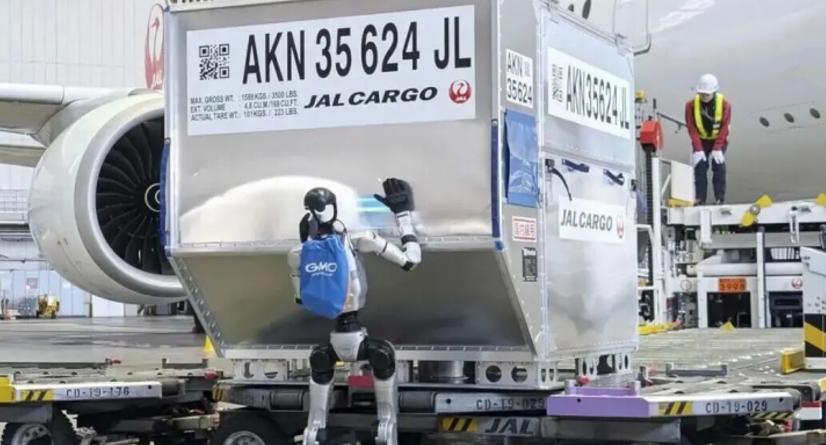
The investment in a few robots is less than the annual labor cost of one person.
It's not just Japan that can't bear it. K - Scale Labs, a Silicon Valley humanoid robot startup, successfully completed three rounds of financing, and its orders exceeded 2 million US dollars.
However, on the eve of mass production, founder Benjamin Bolt sent a farewell letter to investors: disbanded the team, refunded the full amount, and open - sourced all the technologies.
In his post - mortem, he frankly stated that Chinese humanoid robot companies are rapidly rising relying on the advantages of the local supply chain, and this advantage is unbeatable.
Japan has not tried to catch up.
In June 2025, Murata Manufacturing Co., Ltd. joined forces with institutions such as Waseda University to establish the "Kyoto Humanoid Robot Association", emphasizing "purely made in Japan". Four companies, including Renesas Electronics, subsequently joined.
The determination was great, and the slogans were loud. But when the first product, "Seimei", was being demonstrated at the release, its legs cracked on the spot.
"In the time it takes Japan to hold one meeting, China has completed 10 rounds of trial production and failure." This comment from an industry insider quoted by Japan's "Weekly Modern" needs no further explanation after the cracking of "Seimei".
Chen Yan, the executive dean of the Japan Enterprise (China) Research Institute, said: "When the Japanese mention humanoid robots, they first think of China, and may not even think of the United States."
There are structural reasons behind this change in perception.
Li Xiangming, a professor at Northeastern University in the United States, analyzed that Japan has done a lot of basic work in the field of humanoid robots, and China and the United States are developing on Japan's shoulders.
But Japan's industrial robot path has been too successful. It has become so successful that robots are equated with automated equipment in factories, and Japan has missed the early window for AI robots.
The software ecosystem is conservative, and the decision - making culture pursues stability. Japanese companies are used to "certainty improvement" and are not good at high - risk trial - and - error.
In the past, research and development was hardware - centered, and Japan was leading. Now, with the shift to AI - first, Japan has fallen behind.
On the "Humanoid 100" global value chain list of humanoid robots announced by Morgan Stanley.
China and the United States each account for 35 companies. Japan doesn't have an independent entry and is grouped with South Korea in the "Other Asia - Pacific Regions", with a total of 18 companies.
A country that once defined the global imagination of mechs is now having robots from other countries carry luggage at its busiest airport.
Japan taught the world to imagine mechs, and China taught the world to manufacture mechs.
When the birthplace of imagination starts to buy products from the place of manufacturing power, the narrative power of an era has been transferred.
This article is from the WeChat official account "NEXT Trend". Author: Shu Yi, Editor: Fang Yuan. Republished by 36Kr with permission.