The Game of Two Titans Amidst the Influx of Billions of Dollars: Two "Ways of Life" for DeepSeek and the Dark Side of the Moon
On May 7th and 8th, the Chinese large model industry released financing signals worth over tens of billions of dollars within 48 hours.
Dark Side of the Moon was the first to announce the completion of a new round of financing of approximately $2 billion, with a post - investment valuation exceeding $20 billion (about 135.8 billion RMB). Just one day later, sources revealed to multiple media outlets that DeepSeek is advancing its first external equity financing since its establishment, with a target scale of up to 50 billion RMB (about $7.3 billion). If this single - round financing, the largest in the history of domestic artificial intelligence enterprises, is successfully implemented, DeepSeek's valuation could reach 350 billion RMB ($51.5 billion).
Meanwhile, news of the nearly $2.5 billion financing of Step Star also spread rapidly in the market. The three financings together pushed this wave of capital up to the scale of tens of billions of dollars.
Five years ago, the valuation of Chinese AI startups was limited to the "10 - billion - RMB club." Now, a valuation of hundreds of billions of RMB has become the basic standard for leading players. The financing of DeepSeek and Dark Side of the Moon can truly mark a watershed in the industry, not only because of the amount of money but also because they reveal two completely different survival paths.
Dark Side of the Moon follows a typical path of high - level financing, rapid commercialization, and global expansion. Since its establishment over two years ago, it has cumulatively raised more than 37.6 billion RMB, the highest among domestic large - model startups. Its revenue structure has undergone a structural transformation from being dominated by C - end subscriptions to being driven by B - end APIs in the past six months. After the launch of the Kimi K2.5 large model, its overseas revenue has completely exceeded its domestic revenue. On the other hand, DeepSeek has shifted from a path of no financing, no commercialization, and no roadshows to a capital - based operation.
These two financings reflect the same underlying signal: the valuation narrative of Chinese large models is shifting from "technological ideal" to "strategic asset pricing."
Against the backdrop of tightened global GPU controls, over 10 billion downloads in the open - source community, and in - depth involvement of industrial capital, these two companies stand at the same crossroads. On one side is the market test of whether Chinese large models can truly achieve a commercial closed - loop. On the other side is the industrial bottom line of whether the process of computing power autonomy can support the continuous expansion of trillion - parameter models. Their financing stories are jointly rewriting the value anchor of Chinese AI competition.
Divergent Routes under the Open - Source Consensus: The Valuation Fork between Infrastructure and Capability Services
In the spring of 2026, the different technological route choices of DeepSeek and Dark Side of the Moon directly shaped the capital market's valuation logic for the two companies. The core of understanding this round of financing lies not in the number of parameters or the ranking of benchmark scores, but in the revenue structure and cost model that each of the two technological routes points to. This is the underlying framework for investors' pricing.
The preview version of DeepSeek V4 was launched on April 24th and open - sourced simultaneously. With its self - developed CSA + HCA hybrid attention architecture, it compressed the computing power requirement for a million - context to one - tenth of that of the previous generation. On the day after its launch, DeepSeek announced a 75% price cut, with V4 - Flash as low as $0.0029 per million tokens. This marks the official entry of large models into the era of million - token inclusive intelligence.
The valuation narrative revealed by these numbers is that DeepSeek is positioning itself as the infrastructure layer of large models. Open - sourcing means giving up direct monetization at the model level, and extreme price cuts mean using scale to achieve ecological binding.
The capital market's pricing logic for this model is benchmarked against operating systems or cloud platforms. That is, the open - source model is distributed for free, and the API is sold at a low price in large quantities. Ultimately, a long - term moat is built based on developers' tool - chain dependence and the value - added space of enterprise - level services. The growth rate of user scale and call volume can support the valuation more than short - term revenue figures.
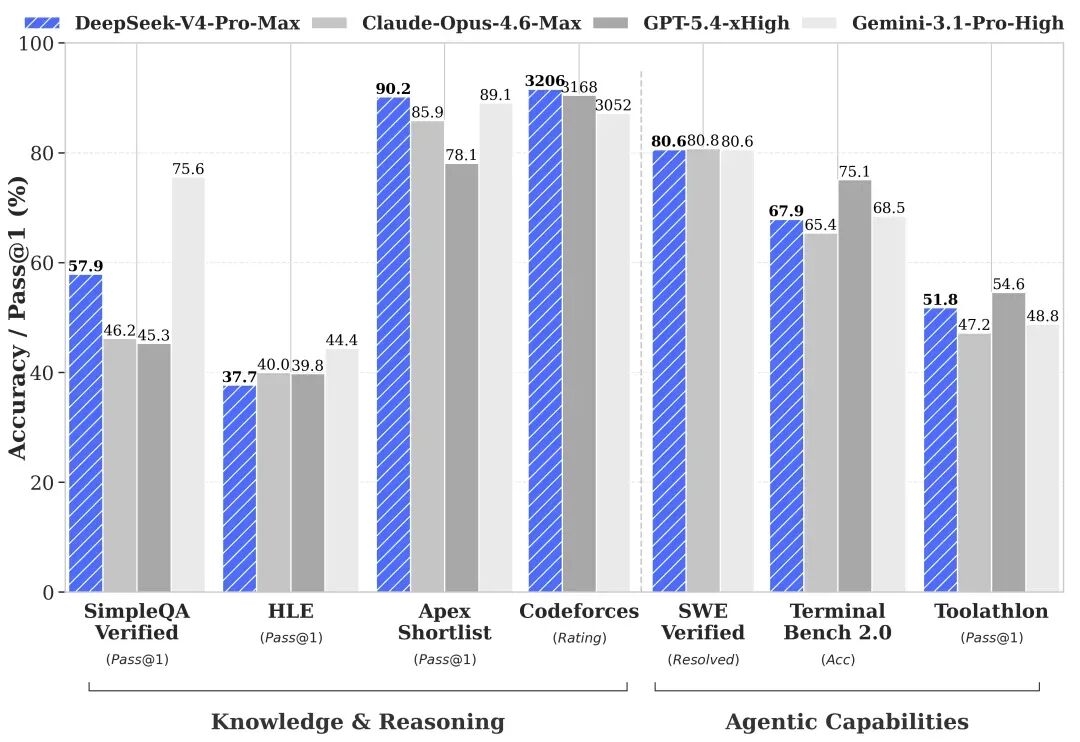
However, there is a price to pay for the "infrastructure" path. Open - sourcing means the continuous erosion of technological barriers. Competitors can distill, fine - tune, or even directly commercialize based on the open - source model. To maintain its leading position in the ecosystem, DeepSeek must always stay ahead in model iteration speed, and each iteration requires huge computing power investment.
Meanwhile, although the extremely low - price API strategy is very effective in user acquisition, the unit gross profit is compressed to a very thin range. Whether the scale effect can cover the fixed costs remains an open question.
The capital market is willing to give a high valuation to this model based on the implicit assumption that after the developer ecosystem is large enough, DeepSeek can achieve step - by - step monetization in value - added services such as tool - chains, enterprise - level deployments, and vertical industry solutions. Investors are betting that the classic Internet scenario of "enclosing the market first and then reaping the benefits" can be repeated in the large - model track.
The technological evolution of Dark Side of the Moon points to another set of valuation coordinates. After the release of the Kimi K2.6 model, the company reversed its previous price - cut strategy and implemented a structured price increase for the API. The impact on enterprise customers with high cache hit rates is relatively small, while the price increase for individual customers is significant. This price adjustment itself is a strong pricing signal, indicating that Dark Side of the Moon is shifting from "selling models" to "selling capabilities."
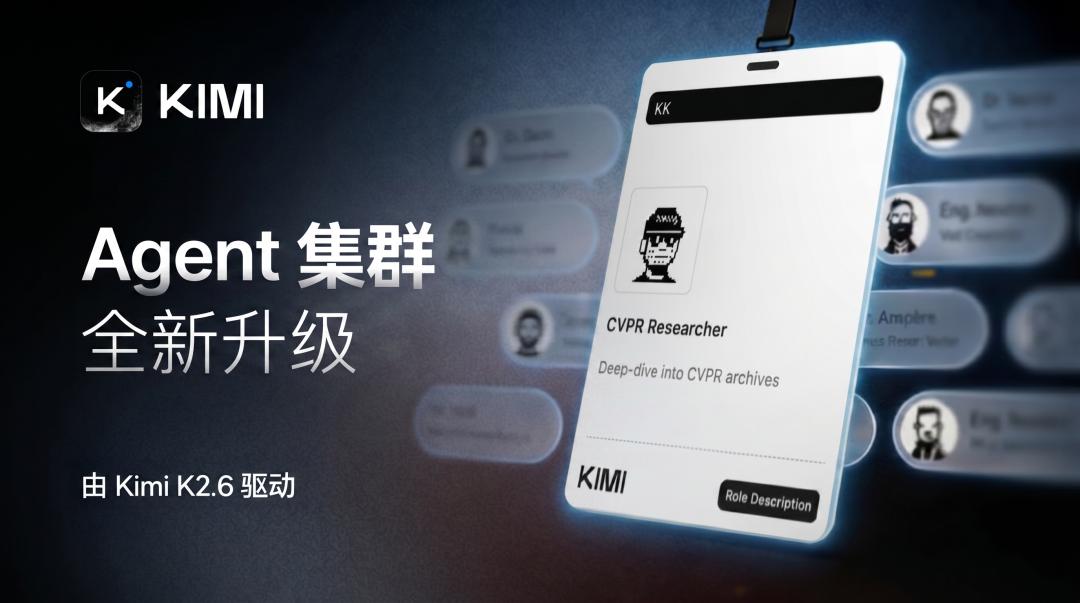
The K2.6 model uses a trillion - parameter MoE architecture, with 8 out of 384 experts activated per token, and is equipped with the MLA attention mechanism. It ranks first in the code and visual capabilities of global open - source models in the LMArena evaluation. However, what really supports the confidence in the price increase is its leap towards an Agent cluster. The K2.6 supports the collaboration of 300 Agent clusters, and its positioning has shifted from a single - dialogue model to a multi - agent scheduling system for complex engineering implementation.
This means that the commercial value of the model is no longer calculated based on token consumption but is priced according to the "execution results" of solving complex tasks. The capital market's valuation of this model refers to the premium logic of enterprise - level SaaS. Customers pay for business results. The stronger the model's capabilities and the more manual processes it can replace, the greater the pricing space.
However, the implementation of the Agent cluster highly depends on the digital foundation of enterprise customers and their willingness to reconstruct business processes. The delivery chain is much longer than a single API call, and the money - burning speed is much faster than that of pure - model companies.
From this perspective, the real valuation divergence in the future will occur at the application and ecological layers. Dark Side of the Moon's K3 is planning a MoE architecture with a scale of 2.5 trillion parameters, and the context length standard will be increased to about 1 million characters. However, due to computing power costs and operating expenses, whether it can be fully opened to users remains uncertain. DeepSeek, on the other hand, has greater initiative in price - cutting space due to the cost advantage brought by domestic computing power adaptation.
The key variable for whether this round of valuation can be accepted by the secondary market is which of the two models can ultimately find the optimal balance between revenue and cost.
The Co - evolution of the Computing Power Ecosystem: From Chip Adaptation to Commercial Closed - Loop
Now, the global large - model market is undergoing a structural reshuffle centered on "value density." According to data from Counterpoint Research, in the first quarter of 2026, the monthly active users of global large language models (LLMs) exceeded 3.8 billion, and the single - quarter revenue was about $20.7 billion.
The most notable signal is that Anthropic, with a market share of 31.4%, surpassed OpenAI's 29% to take the top spot, while its monthly active users are less than one - seventh of OpenAI's, and its average monthly revenue per user is as high as $16.20. This shows that scale is no longer the only yardstick for valuation. The ability to obtain higher commercial returns from each user is the key to determining market pricing power.
This trend is also reflected in Chinese leading AI companies. Investors are no longer simply paying for model parameters or user scale. They are more concerned about whether a company can establish a sustainable computing power cost - efficiency and commercial conversion closed - loop.
When the financing news first emerged in early April, DeepSeek's valuation was about $10 billion. Just one month later, this figure became $51.5 billion. Behind the sharp increase in valuation, DeepSeek was the first to run through an industrial closed - loop of "model technology optimization + domestic computing power adaptation." On the day of its release, the V4 series models completed full - stack adaptation with Huawei Ascend chips, and the inference latency was controlled within the 10 - ms level, which is the first time for a trillion - parameter MoE model.
More importantly, this adaptation is not a technical demonstration in the laboratory but directly supports a significant reduction in inference costs. While competitors are still relying on high - end NVIDIA GPUs to stack computing power, DeepSeek has achieved an equivalent or even better economic model with domestic chips.
For primary - market investors, this provides two very attractive narrative fulcrums. One is that the company has the ability to survive in an environment where high - performance chips are restricted. The other is that its cost structure allows for a more aggressive pricing strategy to capture market share.
According to reports, in this round of financing of DeepSeek, the National Integrated Circuit Industry Investment Fund intends to lead the investment. The entry of semiconductor - field investors is the pricing of this collaborative ecosystem between models and chips, which marks the formation of a real commercial synergy between algorithm companies and computing - power hardware companies.
Dark Side of the Moon's computing power strategy presents another industrial integration idea. The K2.6 model is equipped with a trillion - parameter MoE architecture, with 8 out of 384 experts activated per token, and it occupies a huge amount of video memory and inference resources.
The company's $2 - billion financing in this round is led by Meituan Longzhu, with participation from China Mobile, Shuimu Capital, CPE Yuanfeng, etc. As a domestic telecommunications giant, China Mobile has a national - scale computing power network and government - enterprise customer resources. Its entry as a strategic investor means that Dark Side of the Moon is deeply binding "model capabilities + operator computing power network." This cooperation model directly serves its B - end expansion. Specifically, the K2.6's support for the collaboration of 300 Agent clusters has a rigid demand for low - latency and high - stability computing power scheduling.
At the same time, the access to operator resources not only reduces the marginal cost of its large - scale serving but also paves the way for obtaining large customers in industries such as finance, manufacturing, and energy. In essence, through industrial capital connection, it integrates computing power costs, customer acquisition, and service delivery into a complete commercial chain.
Looking at the global context, this round of financing wave of Chinese large - model companies coincides with the moment when OpenAI's valuation narrative is facing challenges.
SoftBank originally planned to take out a $10 - billion loan using its OpenAI equity as collateral, but the lender was unable to determine its reasonable valuation and ultimately had to reduce the loan amount to $6 billion. OpenAI's revenue in 2025 was about $13.1 billion, and its growth rate is still considerable. However, its share in the coding and enterprise - level markets is being gradually eroded by Anthropic, and the traffic share of the ChatGPT web - end has dropped from about 86% a year ago to about 64% at the beginning of 2026.
This phenomenon reveals a harsh reality. Even for a global top - tier AI company, if it cannot continuously prove its value - conversion ability in core commercial scenarios, its high valuation may also face a liquidity discount.
For Chinese companies, the structural cost advantage achieved by DeepSeek through domestic computing power adaptation and the B - end commercial closed - loop built by Dark Side of the Moon with the help of the operator ecosystem are the core answers they are trying to present to the capital market in this round of valuation increase. It is not a grand narrative but real efficiency improvements and commercial return expectations at the industrial level.
Parallel Answers to Commercialization: The Art of Valuation Balance under High Revenue Growth
In the capital market, high - level financing and high valuation need to find corresponding anchor points at the revenue level. Otherwise, it is easy to fall into the valuation trap of "the larger, the less profitable." After the release of the two financing pieces of information, the most concerned question in the market always points in the same direction: What is the real - world gap between the two valuation figures of 350 billion RMB and 135.8 billion RMB and the current revenue scale of the two companies?
The commercialization process of Dark Side of the Moon is more transparent. The K2.5 model launched in January 2026 brought about a qualitative change in the company's revenue structure. Within nearly 20 days after the model's launch, the company's cumulative revenue exceeded the total for the whole of 2025. The ARR (Annual Recurring Revenue) exceeded $100 million for the first time in early March and further increased to over $200 million in April. Both the scale of paid - subscription users and the API call volume have been accelerating continuously.
By early February 2026, Dark Side of the Moon revealed in communication with investors that its overseas revenue had exceeded its domestic revenue. After the release of the K2.5, the global paid - user scale increased fourfold. Based on the current ARR of about $200 million, corresponding to a post - investment valuation of $20 billion, its ARR multiple is about 100 times.
For reference, the valuation multiples of OpenAI, Anthropic, etc. are about 20 to 60 times. Considering the high growth rate of Dark Side of the Moon's revenue and the incremental space for global expansion, the market has given a phased premium for a certain period.
DeepSeek's financial profile is very vague. As of April 2026, DeepSeek's monthly active users are about 135 million, but there is no sufficiently accurate revenue figure available to the outside world. The market expectation behind the 350 - billion - RMB valuation is that the company will achieve exponential revenue growth in the next few years and maintain a leading profit margin in the industry based on the cost advantage of domestic computing power. Once the revenue growth rate fails to meet this expectation, a valuation correction will be inevitable.
At present, the two financings of DeepSeek and Dark Side of the Moon are jointly creating a siphon effect on the industry's capital flow. Within two days from May 7th to 8th, three financings, including Dark Side of the Moon's $2 billion, Step Star's nearly $2.5 billion, and DeepSeek's 50 - billion - RMB financing, emerged one after another, and the Chinese large - model track released over tens of billions of dollars in funds.
As the industry has observed, the money is not flowing into the industry but towards the last few players. The higher the concentration, the less space is left for latecomers. In Q1 2026, the venture - capital transaction amount in the Chinese AI field reached 256 billion RMB, a year - on - year increase of as high as 52%. However, while the financing of leading companies is accelerating, mid - tier model companies are experiencing the longest liquidity winter.
This also means that the industry competition has shifted from a competition of "who can develop a good model" to an ultimate screening of "who can establish a sustainable commercial closed - loop and who can be embedded in the core industrial infrastructure."
In the past month, there have been frequent rumors in the market that Dark Side of the Moon is about to go public. If this is true, for Dark Side of the Moon, after completing the $2 - billion financing, it needs to prove to the market that its $20 - billion valuation can be recognized by the secondary market during the IPO window period. For DeepSeek, the 50 - billion - RMB first - round financing will determine whether it can maintain an independent ecosystem in the global large - model competition and complete the transformation from an "open - source laboratory" to a