Finding a way in the maze of 30 trillion cells, a MIT doctor founded a listed company after 7 years.
Text | Hu Xiangyun
Editor | Hai Ruojing
On May 13th, more than three months after the confidential submission of the prospectus, 37-year-old Lai Caida led Jitai Technology to list on the Hong Kong Stock Exchange. The stock price rose 170% at the opening and closed 127% higher on the first day of listing, with a market value of over HK$27 billion.
Behind this somewhat bookish chemical engineering doctor from the Massachusetts Institute of Technology (MIT) stand cornerstone investment institutions such as BlackRock, UBS, Guoxin Fund, and Hillhouse. The Hong Kong public offering was oversubscribed by 6,900 times.
It took Jitai Technology seven years from its establishment to its IPO. In 2019, Jingtai Technology internally prepared and incubated Jitai Technology, led by Lai Caida, who was the executive COO at that time. He has a deep relationship with Wen Shuhao, the co-founder of Jingtai Technology. Both of them graduated from MIT with a doctorate. Wen Shuhao once recommended to investors, "Chris (Lai Caida) is a bit like me, but his abilities are above mine." At that time, the valuation of Jingtai Technology was close to $1 billion.
Over the past seven years, the Chinese innovative drug track has experienced great ups and downs. In 2020, the market was fanatical, and a number of AI pharmaceutical companies that attempted to disrupt new drug molecular design with algorithms received financing. Just two or three years later, many star companies that were once at the forefront of the trend fell due to under - expected pipeline data and broken capital chains. And just when the industry was in a cold spell, the wave of new drug BD and the qualitative change in AI capabilities brought a warm breeze to the industry.
With such drastic cyclical changes, a single misstep could lead to failure. Lai Caida led the Jitai team to move from AI - based small - molecule dosage form optimization to the high - barrier targeted LNP delivery field, maintaining a financing rhythm of 1 - 2 rounds per year, and became the fastest - listed AI pharmaceutical company in China.
From returning to China to start a business and turning to the pharmaceutical industry, to introducing state - owned capital, dismantling the red - chip structure, and going to Hong Kong for an IPO, these survival decisions full of variables seem like "no - brainers" in Lai Caida's eyes. When the Boston investment circle reviews, they will compare Lai Caida with Shen Yichen, the founder of Lightelligence, and say, "He's amazing and has hardly made any mistakes."
Invest in an engineer to make drugs with AI
At first glance, Lai Caida's starting point for entrepreneurship has nothing to do with innovative drugs. Ten years ago, this MIT chemical engineering doctor was busy researching water treatment, hoping to separate surfactants and impurities from laundry wastewater to achieve water recycling.
As the leading investor in Jitai Technology's angel round, Fengrui Capital has continuously increased its investment in this startup dark horse for four consecutive rounds. Ma Rui, a partner at Fengrui Capital, still remembers a detail. To match the time difference in China, Lai Caida went to the laboratory at 5 a.m. and sat between two buckets to remotely show him the water treatment process. Although they didn't invest at that time, this "diligent and idealistic" young man left a strong impression on him.
Ma Rui met Lai Caida again through Wen Shuhao's introduction. Wen Shuhao's endorsement was one of the factors that impressed early - stage investors. What really made them willing to invest was Lai Caida's "ability to clearly explain the logic of AI - based drug development."
After chatting with Lai Caida, Fengrui Capital made an investment decision on the same day, "and then entered a long stage of competing for quotas." Gao Jiankai, a partner at Guanghe Venture Capital (formerly an assistant partner at Lightspeed China), also mentioned, "After the first chat, I really wanted to invest."
In 2020, although the AI - based drug development track was also popular, the model capabilities were limited, far from the current ability to design molecules such as antibodies. Many teams in the industry were still at the physical calculation level. They wanted to use AI to improve the efficiency of new drug R & D, but it was difficult to clearly answer investors' questions: "How accurate can the synthetic data from calculations be, and which R & D links can this accuracy lead to qualitative changes?"
After entering the AI - based drug development circle, Lai Caida chose the "delivery" link, that is, to enable drugs to reach the human body's lesions accurately and safely, so as to better exert their efficacy.
"Many people talking about AI - based drug development will say which targets they have chosen and how to use AI to do it faster and better from a technical perspective. But what he talked about was: through AI - based drug delivery, how many targets that were originally unable to be developed into drugs could have the potential to become drugs, and how valuable this was. Going further, in addition to small - molecule preparations, LNP (liposome) could also be used for drug delivery, especially for drugs (Modality) with extremely high delivery difficulty such as mRNA," Gao Jiankai recalled.
Traditional biochemists rely mainly on experience for dosage form and pharmacokinetics. The combinations they can think of are limited, while AI can greatly expand the search scope and discover many unexpected high - quality solutions. The implementation scenarios are mainly pre - clinical dosage form optimization or changing the dosage form of listed drugs (such as changing tablets to granules) to develop Class II new drugs with low cost and low risk.
Strictly speaking, in the early stage, doing "dosage form" was more like an application - level optimization and did not involve the iteration of the underlying core delivery technology. However, against the background of policies such as consistency evaluation and volume - based procurement, pharmaceutical companies are eager to "reduce costs and increase efficiency" and are willing to pay for it.
Gao Jiankai still remembers that when he investigated 4 or 5 pharmaceutical companies that cooperated with Jitai Technology in the early stage, they directly commented that "this method may pose a professional challenge to traditional formulation personnel."
A representative case is Jitai Technology's MTS - 004 project. It addressed the swallowing difficulties faced by patients with neurological diseases in China by changing the originally difficult - to - swallow capsules into instant - dissolving tablets. In 2025, this drug was licensed at a down payment of 100 million RMB and a milestone price of nearly 2 billion RMB during the Phase III clinical stage.
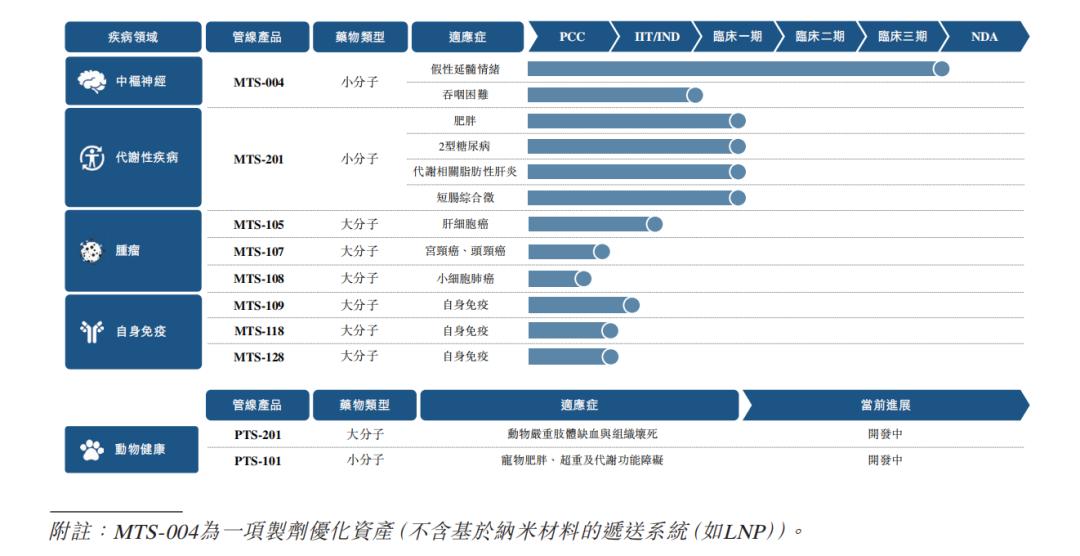
Picture description: Schematic diagram of Jitai Pharmaceutical's pipeline | Picture source: Jitai Pharmaceutical's prospectus
The verification of the BD transaction is a later story.
In the early stage, when there were no new targets, new drug clinical approvals, and trial data, Jitai Technology had few assets and achievements to show, but it still attracted technology funds such as Sequoia, Wuyuan, Lightspeed China, and Monolith to invest.
"Technology investors are good at judging the founder's ability and the potential for scale - up. They have witnessed the rise of giants such as Kuaishou, Pinduoduo, and ByteDance, and are very accurate in judging people and the ceiling of the track in the early stage. Pharmaceutical investors are better at assessing unmet clinical needs, the scientific risks of specific drugs, and the market space," Ma Rui believes that Jitai has now won the recognition of both types of investors. And the "decision - making ability" shown by Lai Caida in previous strategic decisions has not disappointed the investors who bet on "people."
Do LNP delivery and get on the "main table" of new drug R & D
If Jitai Technology only stayed at the dosage form optimization level, its end result might be an ordinary AI pharmaceutical company.
But this is a bit far from Lai Caida's dream. His idol companies are BioNTech and Alnylam, both driven by delivery technology. The former became famous during the COVID - 19 pandemic for its mRNA vaccine, and the latter developed the GalNAc delivery technology over nearly 20 years, which has made it the leader in the small nucleic acid drug field, supporting the company's annual revenue of $3 billion and a market value of $40 billion.
In the eyes of investors, this seemingly gentle and somewhat bookish CEO, whose work experience is not very rich, has a strong "aggressiveness" in building a "very powerful company."
A key turning point in Jitai Technology's seven - year development history was when he led the company to move from dosage form optimization to the more challenging LNP delivery field.
Around 2021 - 2022, the Jitai Technology team found that the AI modeling ability, high - throughput experimental platform, and in - depth understanding of the interaction of nanomaterials they had accumulated in small - molecule dosage form optimization could be transferred to the LNP delivery field, which has a broader market and more challenges.
In reality, many drugs with therapeutic potential (such as nucleic acid drugs) have large molecular sizes and unstable properties. If directly injected into the human body, they may degrade or be cleared by the immune system before reaching the lesions. Therefore, if drugs can be accurately "delivered" to the correct position in the human body, theoretically, one can master the key to the next - generation new drug R & D.
In other words, to some extent, the ceiling of delivery technology determines the ceiling of macromolecular biopharmaceuticals.
LNP, as a micro - nanovesicle assembled from multiple lipid molecules, is naturally suitable for encapsulating macromolecular drugs. It can rely on its own lipid biological properties to circulate stably in the human body, realizing the safe transportation and precise release of drugs in cells. That is, it safely packs the drug into its own "package," protects it during transportation in the blood, and then unpacks and releases it after reaching the target cells.
However, traditional LNP is mainly concentrated in the liver. To achieve precise targeting of the spleen, lungs, brain, and even solid tumors, the formula must be customized and optimized from scratch. The number of lipid molecular structures is huge, and the key parameters such as the molar ratio of components, micro - fluidic preparation process, and surface modification degree are highly coupled. Relying on traditional experimental trial - and - error exploration is like looking for a needle in a haystack.
For this reason, Jitai Technology built an AI nanodelivery large - scale model called NanoForge, self - developed a library of over ten million lipid molecules, used the AI model for virtual screening, quantum chemical calculation for fine optimization, and then verified and fed back data through high - throughput wet experiments to achieve "dry - wet closed - loop" iteration.
The more crucial step is that Jitai Technology upgraded this ability to the level of "precisely delivering to the right place."
Ma Rui introduced that Jitai Technology's delivery technology can be understood as "targeted LNP." The basic layer is a "concealed" package that does not favor a single organ and does not trigger the immune system. Instead, it hangs an "antibody navigation" on the surface of the package to guide the package to accurately identify specific immune cells or tumor cells through specific antibodies or ligands. For example, the CD8 antibody targets T cells, and the antibody against CD19 targets B - cell - related tumors.
In this way, Jitai Technology can design LNPs targeting different organs or cells: some go to the liver, some go to the lungs, and some can even cross the blood - brain barrier to reach the nervous system. "Just as SpaceX uses engineering capabilities to solve aerospace problems, Jitai uses AI, delivery, and nanomaterial technology to send the 'nano - rocket' to the human body's lesions."
This ability gives Jitai Technology the opportunity to sit at the main table of cutting - edge therapies such as nucleic acid drugs, in - vivo CAR - T, and gene editing.
When initially deploying LNP delivery technology, Lai Caida also faced a very tempting fork in the road: Should he split the LNP business and establish a separate company called "Ditai" for external financing? Ma Rui even offered an angel - round investment, but after careful consideration, Lai Caida rejected this plan.
Looking back, this decision was quite correct. In 2022, the capital winter came quickly, and the mRNA track cooled down rapidly after the pandemic. Even if it was split, it would be difficult to raise funds.
More importantly, in 2025, AI - based drug development passed the critical point of technological iteration. The capital market has a particular preference for "AI Native" biotech companies with clear implementation scenarios, deep data, and technological barriers (that is, the core assets and the most valuable pipelines are created by the new - generation generative AI). Keeping the LNP delivery technology within the company has undoubtedly become Jitai's barrier in terms of financing and listing.
The capital cycle fluctuates. The market has short - term hotspots and is also full of a lot of noise, "such as not investing in mRNA, not talking about AI - based drug development, doing molecular design instead of delivery, etc. But Chris often makes decisions based on the first - principles. I once suggested to him to acquire a molecular design team to complete the story of'small molecules + dosage form,' but he didn't waver and still focused on the core direction of 'AI + drug delivery.'" Ma Rui believes that this kind of determination is quite rare.
Control the valuation and over - allocate talents
This spring and summer, the AI for Science track has become popular again in the capital market.
Looking back at the eight rounds of financing before Jitai Technology's listing, it basically maintained a rhythm of 1 - 2 rounds per year. During the AI - based drug development boom four years ago, Jitai Technology's valuation also soared. Even after a round of financing ended, new institutions proposed to start the next round at double the valuation to compete for shares. When the market was cold, even though Jitai had enough cash reserves to maintain operations for three to five years, Lai Caida didn't stop the financing process.
"Chris is smart in that he will actively control the valuation whether the industry is on the upswing or downswing. In most cases, the leading investors he chooses are not the ones who offer the highest price, but those with high brand power and strong support for the company," an investor said.
This kind of concession of interests is also reflected within Jitai Technology. Many people in the industry commented that Lai Caida "is quite generous in terms of equity and salary for senior executives," which can attract talents.
In the early stage, through the connections in the Boston and MIT alumni circles, he invited Chen Hongmin, an academician of the US National Academy of Engineering, and Wang Wenshou, who is older and more experienced than him, to start a business together. In the later stage, the addition of Xu Wei, the former chief scientist of Roche and the former vice - president of Innovent Biologics, and Fu Chong, the former managing director of Haitong International, made up for the shortage of talents in traditional drug R & D and finance.
"Chris likes to 'over - allocate talents.' He is not satisfied with finding people who only match the company's current stage of development and always looks for talents for the next stage of development. For example, Xu Wei has strong abilities in formulating clinical R & D and pipeline strategies. Being able to persuade this industry veteran to join the company at that time is enough to prove his strong ability to attract talents," Gao Jiankai believes.
From the perspective of investors, Lai Caida has indeed made many correct business decisions: After realizing the cost and efficiency advantages of the domestic innovative drug industry in clinical trials and data generation, he resolutely returned to China from the United States to start a business. As an overseas returnee from Taiwan, he smoothly introduced state - owned capital and insurance funds in the later stage of the company's development; he moved the company's headquarters from Hangzhou to Beijing before listing; he dismantled the red - chip structure in advance; and he successfully went to Hong Kong for an IPO.
Ma Rui once asked Lai Caida why he could make these decisions, and he said they were all "no - brainers." But in Ma Rui's view, "These series of decisions are interrelated. A single misstep could lead to failure, but he has stepped on the right track every time."
After seven years, Jitai Technology has neither become a Biotech that "gambles its fate" on a single pipeline nor a mere AI concept stock that only tells stories. It has chosen a path that few people took at that time, and with engineering thinking, AI, and a group of smart people, it is turning the path of "AI - based drug delivery" into the main road.