Wang Xingxing from Unitree visited China Huaneng. Behind the intensive contacts between energy central state-owned enterprises and embodied intelligence, the coordination of computing and electricity is a deep integration of power and computing power.
YuJian Energy noticed that on May 11th, Wen Shugang, the Chairman and Party Secretary of China Huaneng Group, met with Wang Xingxing, the founder of Unitree Technology, at the headquarters of China Huaneng. The two sides exchanged views on aspects such as improving the intelligent level in the energy and power field and deepening the coordinated development of computing power and electricity.
This is not the first time that energy central state - owned enterprises have contacted robot companies. As early as last September, Hangzhou Power Supply Company of State Grid signed a four - party cooperation agreement with Unitree Technology, focusing on the direction of "power + embodied intelligence". Even earlier, the Hubei subsidiary of State Grid joined hands with Black Sesame Intelligence to promote embodied intelligent robots.
Behind these actions lies a forming main line: Power central state - owned enterprises are integrating computing power and electricity by introducing intelligent carriers such as robots. This is undoubtedly another revolutionary innovation in the industry.
The policy - making is also in full swing. On May 9th, YuJian Energy promptly reported on the "Action Plan for Promoting the Two - way Empowerment of Artificial Intelligence and Energy" issued by the National Energy Administration. At that time, the editor mainly analyzed the significant benefits of the policy for energy storage enterprises to promote the coordinated development of computing power and electricity, especially for AIDC solutions. More than 20 enterprises such as GoodWe, Sungrow, and Guoxuan High - tech have flocked in! Energy storage is no longer a backup. The new regulations of four departments have turned the computing power center into a new battlefield. However, there is a sentence in the action plan that is worth savoring, that is, taking energy to support the development of artificial intelligence and artificial intelligence to empower energy transformation as the main line to promote the efficient and economic coordination of power and computing power.
YuJian Energy believes that this meeting at this juncture is more like the first face - to - face connection between the representatives of the two parties after the institutional framework has been established.
01
Energy Meets Artificial Intelligence
No Longer "Who Supports Who"
The coordinated development of computing power and electricity was often narrowly understood as "the end of computing power is electricity" before, that is, because AI consumes too much electricity, power enterprises need to supply power to computing power centers. However, this logic is being broken now. The policy formulation has become "energy supports the development of artificial intelligence, and artificial intelligence empowers energy transformation". This means that AI not only consumes energy but also has to help the energy industry.
Data is strong evidence for this view. It is understood that in 2025, the electricity consumption of data centers in China reached 193.3 billion kWh, accounting for 1.9% of the total social electricity consumption, a year - on - year increase of 17%. After entering 2026, the momentum was even stronger, with a year - on - year increase of 46.2% in the first two months. A report released by Schneider Electric predicts that in a high - scenario situation, the electricity consumption of data centers may exceed 700 billion kWh in 2030.
What does such a huge electricity consumption mean? It is both a challenge and an opportunity for power enterprises. The challenge lies in that the load fluctuations brought by AI training and inference will impact the power grid; the opportunity lies in that AI can feed back to the power system - optimizing dispatching, fault prediction, and load regulation are all areas where embodied intelligence and robot technology can play their roles.
02
Power Central State - owned Enterprises Fully Embrace AI
Scenario Implementation Is No Longer Just on Paper
The actions of power central state - owned enterprises in AI are not just as simple as one or two order cooperations. As a leading comprehensive energy enterprise in China, Huaneng's installed capacity has exceeded 300 million kilowatts, and the proportion of low - carbon clean energy installed capacity has exceeded 56.6%. For an enterprise of this scale, the implementation of any AI application is enough to have an industry - level impact.
Huaneng stated in the meeting that it hopes to carry out joint innovation focusing on cutting - edge core technologies. YuJian Energy believes that this can be understood as Huaneng not only planning to purchase some robot products but also conducting joint research and development from the source of technology.
For a robot company like Unitree, to some extent, it is like using a super - large customer to conduct preliminary verification in its own field.
Actually, YuJian Energy noticed a series of actions of power enterprises moving towards artificial intelligence very early. Huaneng is not the first one to take the lead.
In November last year, NARI Technology announced that its subsidiary would cooperate with relevant universities to conduct in - depth research on the application of special robots in the industry, and promote the digital and intelligent transformation of the power system around the operation and maintenance model of "less - manned and unmanned operation". State Grid Information & Telecommunication Group took the lead in laying out the track of computing power and electricity coordination and constructed an integrated computing power and electricity coordination system of "cloud - network - edge - end".
State Grid also recently announced a procurement order worth 6.8 billion yuan internally, purchasing a large number of robotic dogs and humanoid robots. At that time, YuJian Energy's conclusion was that State Grid was not just buying a batch of robotic dogs to solve immediate problems but was laying out embodied intelligence as the next - generation power grid infrastructure. State Grid's 6.8 - billion - yuan procurement of robotic dogs and humanoid robots marks the first shot in the large - scale implementation of embodied intelligence in the power industry.
The action plan of the four departments clearly put forward specific paths and directions for scenario implementation on the basis of the actions of the above - mentioned enterprises. Coordinate the planning and layout of large - scale new energy bases and national computing power hubs, and promote the orderly gathering of computing power facilities in areas rich in new energy. This is not just about "using AI to optimize power", but should be understood as bundling computing power and electricity together directly at the planning and design stage.
As of the beginning of 2026, central state - owned enterprises have created more than a thousand AI application scenarios in key industries such as energy, manufacturing, and communication. Behind this is a huge amount of investment. Of course, this also fully shows that this wave of AI + energy transformation is not just chasing the trend but is a real main path.
03
The Particularity of Computing Power and Electricity Coordination
Allows Robots to Find an "Indispensable" Battlefield
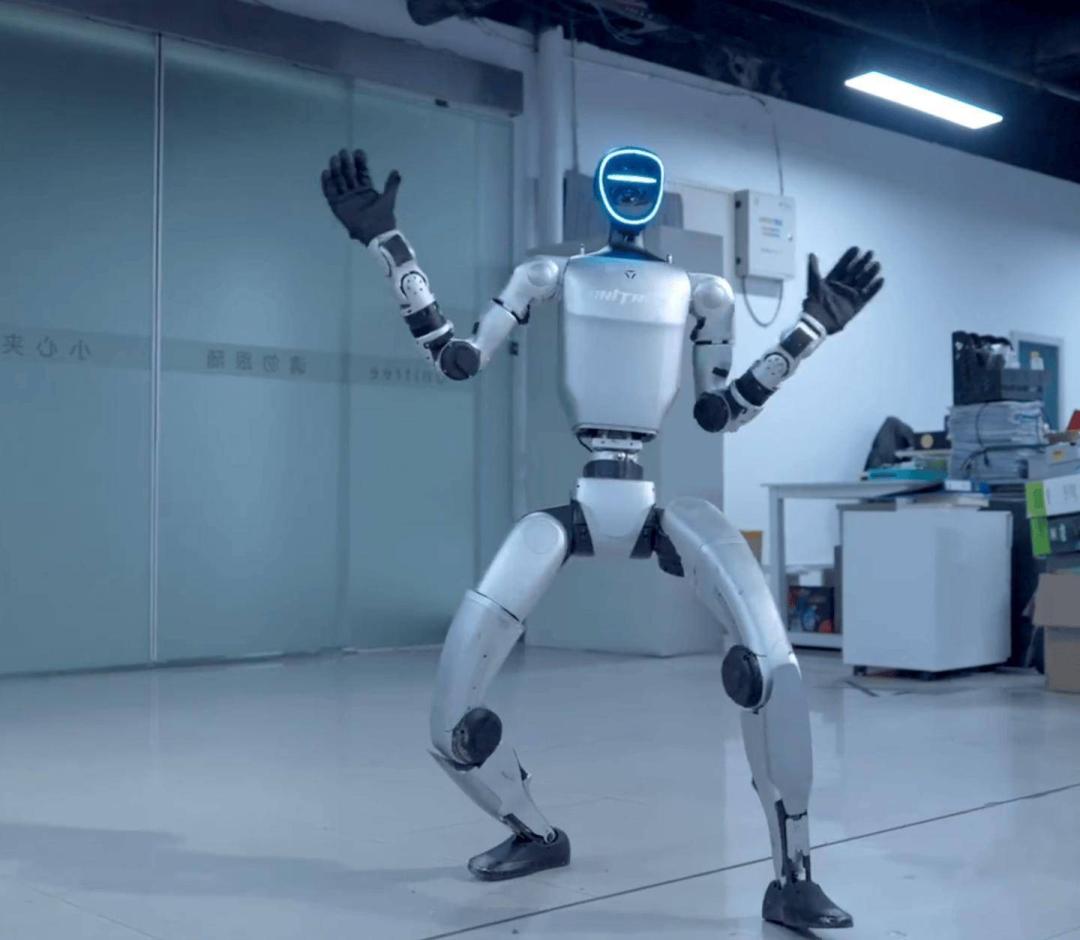
Unitree Technology's willingness to cooperate with Huaneng also has its own considerations. This enterprise, which is sprinting to become the first humanoid robot company listed on the A - share market, saw its revenue soar from 123 million yuan from 2022 to 2024 to 392 million yuan, and reached 1.7 billion yuan throughout 2025. The proportion of humanoid robot business revenue has increased from 1.88% in 2023 to 51.53% in the first three quarters of 2025, forming a dual - pillar with quadruped robots.
For Unitree, the implementation in industrial scenarios is crucial. The Unitree two - armed humanoid robot launched to the market at the end of April is priced from 26,900 yuan, with a battery life of about 1.5 hours. In theory, it can complete basic tasks such as clamping and handling in factories.
However, to truly implement it on a large scale and confirm the enterprise's profit points, it is necessary to find more rigid and irreplaceable usage scenarios, which is also the common dilemma faced by current humanoid robot enterprises. Scenarios such as inspection, operation and maintenance, and live - line work in the power industry precisely have this characteristic - many places are inaccessible to people, have a high risk factor, but someone must go.
There has even been a relatively mature relay practice in the power industry. State Grid Tianjin and State Grid Ruijia jointly developed a new - generation two - armed live - line distribution network work robot, which adopts a "human - machine collaboration" mode. The "tactile sense" of the two arms can already achieve real - time perception and precise control of the operation force. This case can, to some extent, show that the replacement of humans by robots in high - risk operation areas of the power industry is no longer a concept verification but is actually in use.
Here, it is necessary to add a very important knowledge point, that is, the biggest constraint in the development of humanoid robots to date is the data shortage. That is to say, if humanoid robots are to be intelligent enough and able to think, a large amount of data must be fed to the large - scale model. However, if they are not actually put into use scenarios, data cannot be generated in the laboratory, let alone the next - step data verification. The cooperation between Unitree and Huaneng provides the much - needed implementation scenarios and data accumulation for the R & D of Unitree robots.
Therefore, YuJian Energy believes that the meeting between Huaneng and Unitree is not just another hot news but a signal that the cooperation between robot companies and power companies in this vertical scenario is becoming closer. We also have reason to believe that the intelligentization of energy equipment is not just "icing on the cake" but a rigid need for power safety production and efficiency improvement.
04
A Two - way Demand Is Forming an Industrial Closed - Loop
Ultimately, why is the concept of computing power and electricity coordination widely concerned? YuJian Energy believes that the most exciting part is that it is a two - way drive.
On the one hand, AI needs a large - scale green power supply to maintain its high - energy - consumption operation; the action plan has clearly stated that it encourages computing power facilities to participate in green certificate and green power trading to increase the proportion of green power consumption. On the other hand, the volatility brought by the large - scale access of new energy to the power grid also needs AI to actively digest. Data centers, as adjustable loads, participating in power grid peak shaving and frequency regulation is moving from concept to operability.
For Unitree Technology, establishing a deep cooperation relationship with an established power central state - owned enterprise like Huaneng may be more far - reaching than selling how many robots in the consumer market. The energy industry has a very low tolerance for errors. Once a robot product can pass the strict inspection of the power industry, it is equivalent to getting a pass to enter the most hardcore industrial scenarios.
For Huaneng, finding a robot company that can provide both hardware products and independent core technologies also opens up a new path outside its internal technology route.
At the time when the top - level design of national computing power and electricity coordination has just been implemented, the meeting between the two companies jointly outlines a new industrial narrative: AI and power are no longer simply a supply - demand relationship but the integration and reorganization of technology and value through robots and intelligent systems.
Every link in this chain is looking for its own position. For robot enterprises, it is to gain the trust of the energy industry; for power enterprises, it is to run through the efficiency model of computing power and electricity coordination. These two things are happening simultaneously.
YuJian Energy will also continue to follow up on the next moves of the enterprises.
This article is from the WeChat official account "YuJian Energy", author: Wang Mengjiao. Republished by 36Kr with authorization.