The flying car didn't arrive, but Win32 is still alive. Microsoft CTO admitted in person that Windows 11 is still propped up by the "ancestral code" from the 1990s.
In 2026, the "future world" that many people fantasized about in their childhood has not truly arrived.
There are no flying cars, nor are there widespread lunar bases. However, one thing has tenaciously persisted - the Windows code written over 30 years ago still drives hundreds of millions of computers worldwide to this day.
Recently, Mark Russinovich, the Chief Technology Officer of Microsoft Azure, made a statement in an interview that caught the attention of a large number of developers. He publicly admitted that the underlying layer of today's Windows 11 is still built on the Win32 API that emerged in the 1990s, and this set of things remains the "cornerstone" of Windows to this day.
This statement made many programmers instantly emotional. After all, while many people complain about the "excessive legacy code" in Windows, they have to admit that Microsoft may really be unable to get rid of it.
"There should be flying cars in 2026, not Win32"
The incident originated from an interview video released by Microsoft's official developer account. During the interview, someone asked Russinovich a question full of a sense of the times:
"Did the Microsoft engineers in the 1990s ever think that Win32 would still be the core API of Windows in 2026?"
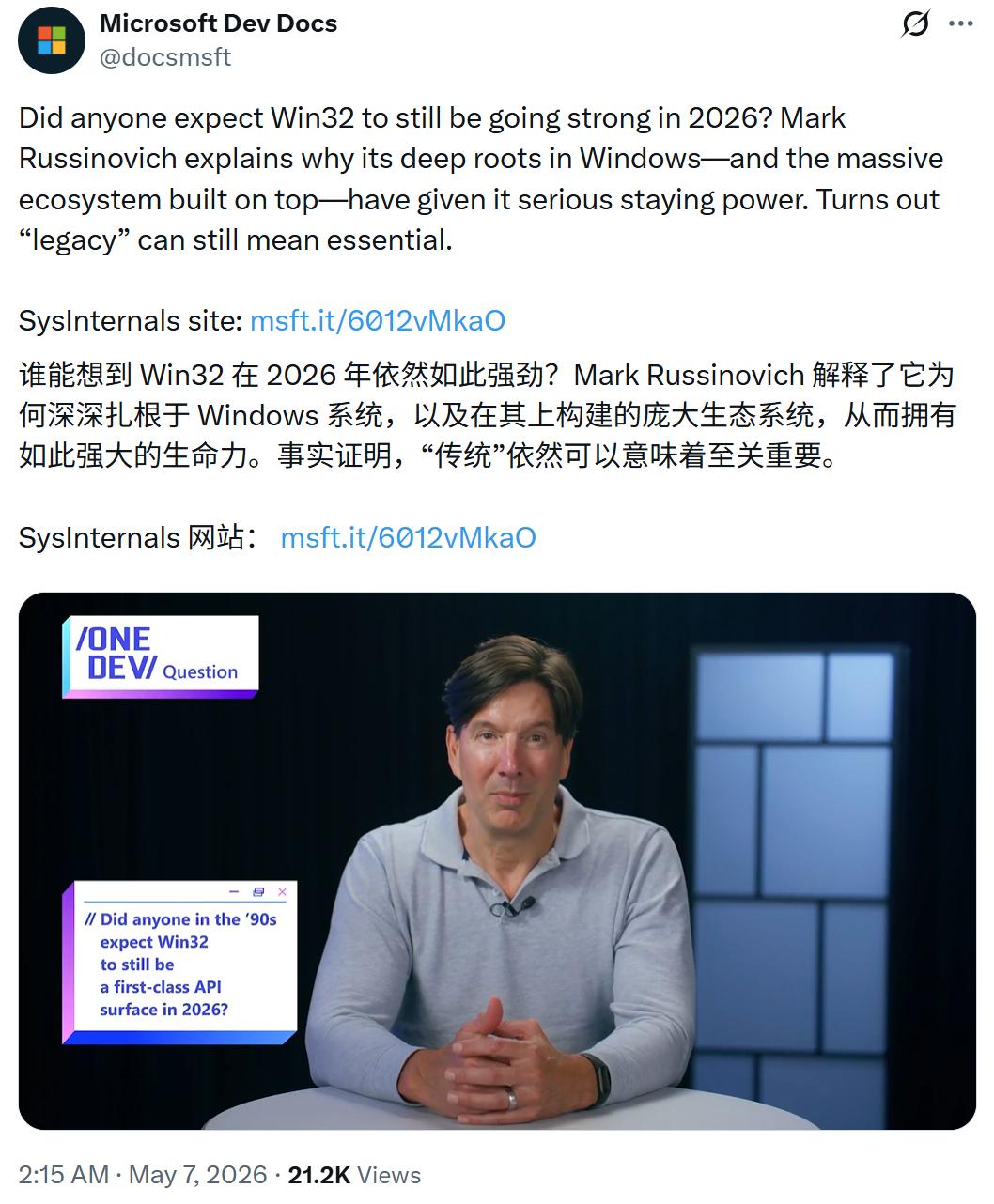
"No one would think so," Russinovich's answer was quite frank, and he even joked, "What we thought back then was that by 2026, humans should already have flying cars and lunar space stations, instead of still discussing Win32."
This statement quickly spread in the developer community because it revealed a reality that many people "know but easily overlook": today's seemingly modern Windows 11 is actually a typical "mixture of old and new."
You can see Fluent Design, Copilot, and AI features in the Start menu. But when you open the Control Panel, Device Manager, or even some system settings, you'll instantly feel like you've gone back to the era of Windows XP or even earlier.
This "sense of temporal and spatial disconnection" is essentially the trace left by the long - term evolution of Windows.
Why hasn't Win32 been eliminated yet?
In response to this, many people's first reaction might be: "Since it's so old, why doesn't Microsoft rewrite it?"
The answer is very realistic: because the entire Windows world is almost built on Win32. Russinovich said directly in the interview that a core reason why Win32 has survived to this day is that "too many applications and technology ecosystems are built on it."
Simply put, Win32 is no longer just an API, but the "foundation" of the Windows software ecosystem.
From enterprise office software to industrial systems, and then to various third - party desktop programs, a large number of applications deeply rely on the interface logic of Win32. Over the decades, the development tools, component libraries, driver systems, and software compatibility mechanisms formed around it have evolved into a huge ecological network. This is also one of the biggest differences between Windows and many modern systems.
In the era of mobile Internet, many platforms can force developers to migrate through "generational upgrades" - but Windows can't. Because what it faces is not millions of apps, but a huge amount of historical software assets accumulated over decades. Especially in the enterprise market, including industries such as banking, government, factories, hospitals, aviation, and energy, there are still a large number of traditional software that rely on Win32, and many systems have been running stably for more than a decade or even several decades.
For Microsoft, "compatibility" itself is one of the most core product values of Windows, and at the same time, it is also its biggest burden.
Actually, Microsoft has also tried to "start from scratch"
In fact, Microsoft has not failed to try to get rid of Win32. The most typical example is WinRT launched during the Windows 8 era.
At that time, Microsoft hoped to reconstruct the Windows API system with the help of WinRT and establish a more modern and unified new platform. In those years, Microsoft's thinking was very radical: Metro UI, UWP, Windows Store, ARM - based, touch - first... The entire strategy was trying to "redefine Windows."
But as we all know, WinRT did not ultimately replace Win32.
The reasons are very complex, but there are mainly several core issues. Firstly, in terms of compatibility, a large number of traditional desktop software cannot be directly migrated, and the capabilities of the new API are not complete enough. Secondly, in terms of the developer ecosystem, many developers found that the migration cost was much higher than the benefits. Coupled with the poor market feedback of Windows 8 itself, Microsoft finally had to readjust its direction.
As a result, a very interesting situation emerged: WinRT failed to "kill" Win32, but instead became another branch in the Windows ecosystem. Later, Microsoft successively launched UWP, WinUI, and Windows App SDK, but to this day, Win32 remains the most core foundation of the Windows desktop ecosystem.
The tools written in 1996 are even more important in 2026
From an engineering perspective, Windows is actually one of the most complex software systems in the world. It is not just an operating system, but also a compatibility platform spanning several decades.
Many developers tend to underestimate the difficulty of "backward compatibility." Take a simple example: if an enterprise software written in 2003 can still run normally on Windows 11 today, it means that Microsoft may have retained a large number of old interfaces, old behaviors, and even the compatibility logic of some historical bugs - because many old software "rely on bugs to run."
And the ability to run old software is extremely difficult in itself, and this is also one of the most important functions of Windows.
At the end of the interview, Russinovich also mentioned a "little Easter egg": some tools he wrote in 1996, such as Sysmon and ZoomIt, are not only still in use today, but are even "more important than ever" in 2026. Among them, Sysmon has become an important part of the Windows security system, and ZoomIt has also been incorporated into Microsoft PowerToys.
"Old systems will eventually be completely reconstructed," which has been a popular view in the technology industry in the past decade. However, the existence of Windows proves that truly successful large - scale systems are often not created by "starting from scratch," but rather evolve through continuous compromises between historical burdens, compatibility requirements, and new technologies.
Reference link: https://x.com/docsmsft/status/2052089975802368301
This article is from the WeChat official account "CSDN", and is published by 36Kr with authorization.