Sereact raises $110 million to bring embodied intelligence to real-world scenarios
At present, the embodied intelligence industry has become very popular, but the products of many companies still remain at the stages of demonstration videos, laboratory environments, and POC.
Currently, the relatively mature robot dogs and mainstream humanoid robots have only been verified in scientific research, teaching, and exhibition scenarios. There is still a long way to go before they can enter production - oriented scenarios where high - value can be more easily generated.
A German embodied intelligence company chose a path for the accelerated implementation of embodied intelligence from the very beginning. Since its establishment, its products have been operating in real production environments. Currently, it has top - tier corporate customers such as Austrian Post, BMW, Daimler Truck, and Mercedes - Benz.
This company is Sereact. It recently received a $110 million Series B financing, led by Headline, with participation from Bullhound Capital, Felix Capital, and Daphni. Old shareholders Air Street Capital (the leading investor in the seed round), Creandum (the leading investor in the Series A round), and Point Nine continued to follow - on invest.
In its earlier investment rounds, there were also angel investors with backgrounds in robotics and industrial automation, such as Oliver Cameron, the former vice - president of Cruise products and co - founder of Voyage, and Mostafa Elsayed, the CEO and co - founder of Automata.
An interesting statistic is that Sereact has deployed over 200 sets of Cortex systems, completing over 1 billion pick - and - place operations in real production environments, with only about one remote human intervention needed for every 53,000 pick - and - place operations on average.
What makes Sereact worthy of attention is that it put robots into the real world from the start, allowing them to perform specific tasks in warehouses and production lines, generate specific value, and accumulate real - world data.
An Embodied Intelligence System That Learns in the Real World
Sereact was founded in 2021. Its two co - founders, Ralf Gulde and Marc Tuscher, both graduated from the University of Stuttgart and previously conducted cross - research on robotics and artificial intelligence at the Institute for Machine Tools and Manufacturing Unit Control Engineering (ISW) of the university.
Ralf Gulde (CEO) focuses on research areas including reinforcement learning, robot manipulation, and the deployment of real - world robot systems; Marc Tuscher (CTO) specializes in deep learning, computer vision, and robot software systems.
The two jointly studied the combination of AI and robotics at the University of Stuttgart and finally commercialized this research path in 2021, founding Sereact.
Under their leadership, Sereact didn't start by developing general - purpose robots for open home environments. Instead, it chose specific, less "glamorous" but highly practical and valuable tasks in warehousing and manufacturing, such as picking, packing, returns processing, sorting, and inventory verification.
The warehousing environment is relatively closed, tasks can be clearly defined, KPIs can be quantified, and customers are willing to pay for efficiency. At the same time, real - world warehouses have numerous complex situations. These factors make warehousing not only a commercial scenario but also a high - density data field for training robots to understand the physical world.
One of Sereact's most representative early products is PickGPT. It is a robot Transformer model aiming to enable robots to pick and manipulate objects in real - world physical scenarios through natural language and visual understanding.
PickGPT addresses the first hurdle for robots to enter the field: interaction and deployment. Front - line employees can assign tasks to robots through voice or interfaces, and robots don't need to be retrained from scratch when facing new objects and tasks.
After PickGPT, Sereact advanced its technical roadmap to Cortex.
Cortex is a vision - language - action model, i.e., VLA. It aims to not only enable robots to "understand language" but also integrate vision, language, and action into a single system, allowing robots to perform tasks in real - world physical environments.
Sereact's judgment on Cortex comes from real - world warehousing operations: fulfillment centers have messy bins, long - tail SKUs, reflective packaging, flexible objects, occlusions, and abnormal placements. To generalize in such an environment, the model must be trained based on real - world operational data and combine visual perception, task understanding, and motion control.
Therefore, Cortex adopts a hierarchical design: first understand the task and visual scene, generate a 3D plan, and then adapt it to the control space of specific robots through the motion control module.
In 2026, Sereact continuously updated Cortex 1.5, Cortex 1.6, and Cortex 2.0 within a few months.
In simple terms, Cortex 1.5 solves failure recovery through policy patching; Cortex 1.6 makes the daily operation process learnable through process rewards; Cortex 2.0 enables robots to predict the future before taking action through a world model.
Cortex 1.5 addresses the distribution shift problem of the basic Cortex VLA in real - world deployment: although regular pick - and - place operations can be completed, robots lack stable failure - recovery capabilities when encountering edge cases such as rare postures, process bottlenecks, and object slippage.
It introduces "interactive reinforcement learning policy patching": when a robot fails at a certain node, a human operator provides a short error - correction demonstration through remote control. The system then absorbs this demonstration as a local policy update instead of retraining the entire model. The updated policy can also be synchronized to the robot cluster, allowing single - point experience to be reused across multiple deployment nodes.
Cortex 1.6 further reduces the reliance on human intervention by introducing PRO, i.e., the process reward operator.
In the past, many robot learning methods only considered the final result: success or failure. However, in real - world operations, a large amount of valuable information is hidden in the process, such as sliding, hysteresis, collision risks, abnormal force feedback, or partially correct actions completed before failure. PRO extracts continuous learning signals from real - world operations, enabling the daily operation process itself to be used for model optimization.
Sereact claims that in tasks such as pick - and - place, shoe - box opening, and returns processing, the success rate of Cortex 1.6 is approximately 98%.
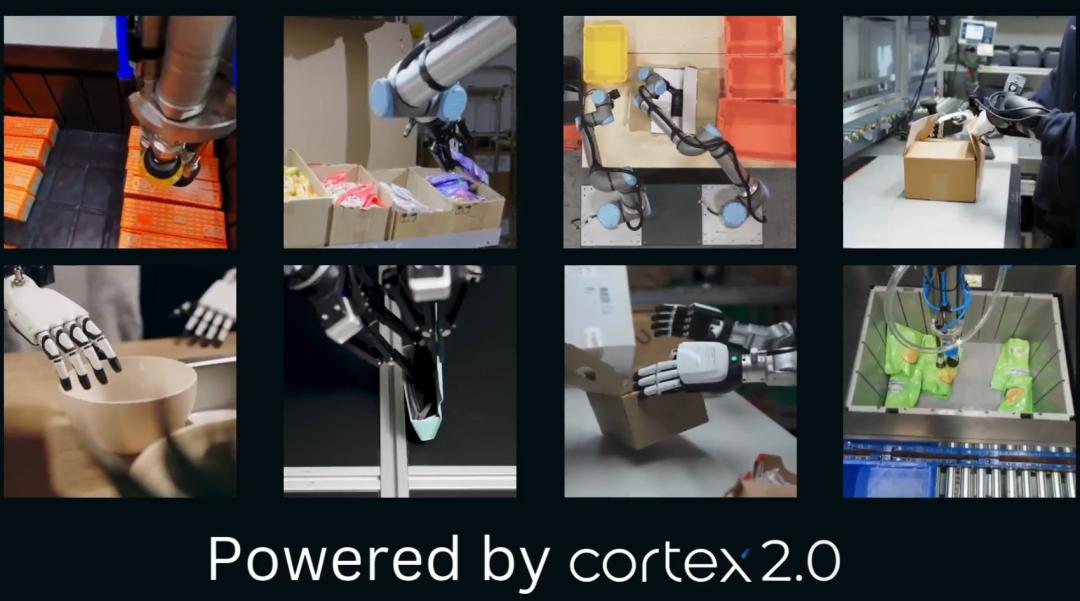
Image source: Sereact
The latest Cortex 2.0 transforms robots from reactive systems to proactive systems: from "see then pick" to "predict then act".
It combines the VLA model with a world model, enabling robots to generate multiple candidate trajectories based on the current state, predict the results, score them according to stability, risk, and efficiency, and only execute the optimal plan.
Put simply, previous robots were more like trial - and - error learners: they would retry if a pick failed, and if the strategy was wrong, they might fail repeatedly.
Cortex 2.0 allows robots to make judgments before taking action: whether an object will slip when picked, whether it will hit the box wall when placed, and whether it will get stuck after a few steps. This is especially important for long - range tasks such as packing, ingredient - set preparation, returns restocking, precise placement, and assembly, as small errors can be magnified in subsequent steps, leading to collisions, jams, or human intervention.
Returns processing is a typical example. It is far more complex than pick - and - place: robots need to continuously complete tasks such as scanning barcodes, unpacking, unfolding products, inspecting the condition, repackaging, and deciding whether the products should be restocked, refurbished, or discarded. Each step depends on the information from the previous step, and the state of the products is highly uncertain.
The value of Cortex 2.0 lies in enabling robots to predict the results before execution, adjust the product posture actively with the help of the Lens vision system to obtain a better inspection perspective, and then make decisions on product condition assessment and product flow. It advances robots from "being able to pick an object" to "being able to understand and manage a process".
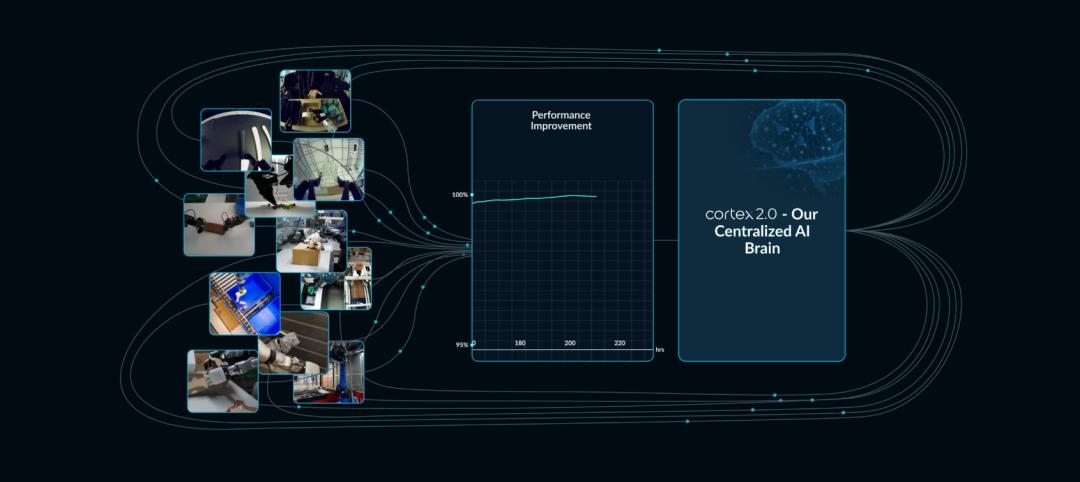
Image source: Sereact
What supports this evolution is Sereact's real - world learning closed - loop. The successful pick - and - place operations, failed attempts, and error - correction actions of robots at customer sites are all recorded together with visual observations, robot states, gripper force feedback, and final results for model updates. After new policies pass automated regression tests, they are pushed to the entire robot cluster.
The resulting data flywheel is: the more deployments, the more real - world interactions; the more data, the more stable the model; the more stable the model, the more customer sites it can enter.
This is also the most critical aspect of Sereact's approach. Simulations and laboratory demonstrations can verify the direction, but it is difficult to cover all the weights, frictions, reflections, occlusions, packaging deformations, and abnormal events in real - world warehouses. Truly reliable robot AI still needs to learn from real - world failures in production sites.
Embodied Intelligence Needs to Find High - Value Implementation Scenarios
Embodied intelligence has attracted a huge amount of capital. According to statistics from QbitAI Think Tank, the total financing amount in the Chinese embodied intelligence track in 2025 was approximately 55.4 billion yuan. Xiniu Data shows that the financing scale of the embodied intelligence track in Q1 2026 reached 24.373 billion yuan. The capabilities of hardware and software are also continuously improving, but the real threshold that the industry needs to cross is to enter production - oriented commercial scenarios and form a sustainable value closed - loop.
Embodied intelligence can only have a foundation for continued development of the entire ecosystem when it generates value in specific scenarios. Just as large language models have proven their value in scenarios such as coding and vertical agents, the popularity of Claude Code, "Lobster", and Codex this year, as well as the recent $950 million financing of Sierra, all show that high - frequency, verifiable, and paid - willing scenarios are often the first to complete commercial verification.
Therefore, embodied intelligence may not need to pursue open, complex, and human - like scenarios such as the home environment from the start. Home tasks are vague, safety requirements are high, user tolerance is low, and the business model is not clear. In contrast, closed scenarios for production and fulfillment have clearer task boundaries and easier - to - calculate value.
This is similar to autonomous driving: fully autonomous driving on open roads is still very difficult, but ports, mines, and closed parks have generated value earlier. Embodied intelligence may follow a similar path, first completing some tasks in high - frequency, controllable, and measurable scenarios to form deployment, data, and revenue.
The entrepreneurship in embodied intelligence in China has been very active. The key in the next stage lies in large - scale verification in offline scenarios. China has a huge manufacturing system, logistics network, and industrial supply chain. These scenarios are complex enough and have clear commercial value, making it easier to form a continuous closed - loop.
Whoever can stably send robots into these scenarios first may be the first to build the data flywheel of embodied intelligence.
This article is from the WeChat official account “Alpha Startups” (ID: alphastartups), author: Discovering Extraordinary Entrepreneurs. It is published by 36Kr with authorization.