Exclusive Interview by Yingke | After Securing the Largest Single-round Funding in the Industry, YU Yinan Says It's Only the First Step of a Long March
Author | Qiu Xiaofen
Editor | Yuan Silai
Yu Yinan seems to be an adventurer who can always catch the emerging trends in advance.
He is always in pursuit of something newer and more exciting, and even had some romantic imaginations in the early days. After graduating with a doctorate, instead of entering the academic circle and leading a stable life like many of his peers, he plunged into the Internet wave. In 2015, at the invitation of Yu Kai, who said, "Let's work on AI chips together?", he followed Yu Kai and joined the founding team of Horizon Robotics as the 001 employee. In the following years, Horizon Robotics gradually grew into one of the most attention - grabbing technology companies in the international autonomous driving field and went public on the Hong Kong Stock Exchange in 2024, becoming the largest IPO on the Hong Kong stock market that year.
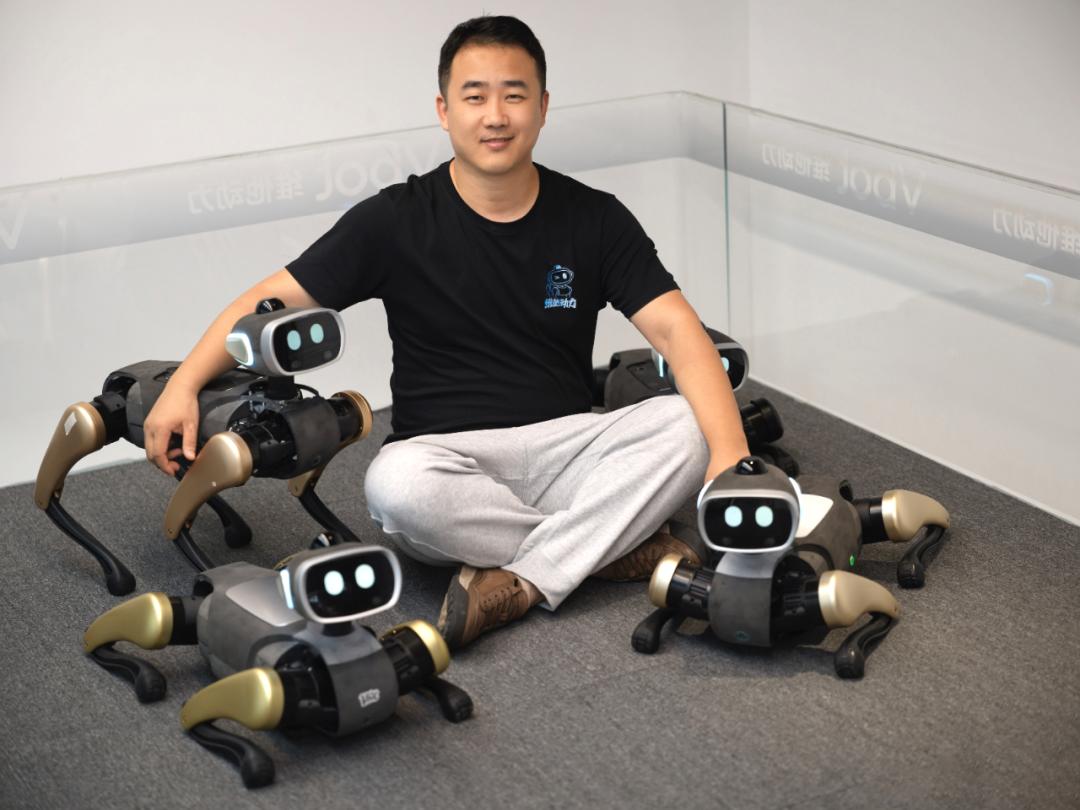
At the end of 2024, he left Horizon Robotics and founded "Vita Dynamics", hoping to transfer the capabilities accumulated in the autonomous driving field over the past decade to consumer - grade robots.
(Image source: Company)
Yu Yinan has a sense of the "Jianghu" that is not common among intellectuals. In the later stage of Horizon Robotics, he was in charge of supply chain, sales, finance, etc. After starting his own business, he has to take an overall view of the situation, and decisiveness and firmness have become his inherent qualities.
He is leading Vita Dynamics through one milestone after another. Hard Kr has exclusively learned that "Vita Dynamics" recently completed a Pre - A round of financing worth 500 million yuan, jointly led by Orient Fortune Capital, Huatai Zijin, and Fosun RZ Capital. Shangqi Capital under SAIC Group and Minghui Zhiyuan also participated in the investment. Old shareholders such as Cathay Capital, Capital Today, Hillhouse Ventures, Yingce Capital, BV Baidu Ventures, and Borui Capital continued to invest. This is also the largest single - round financing in the consumer - grade embodied intelligence field.
In addition to the financing, "Vita Dynamics" has also started mass production and delivery. Its first product, the "Vbot Super - intelligent Robot Dog", officially started delivery on May 8th, and the first batch of 500 products have rolled off the production line. In addition to introducing the quadruped robot dog into the family scenario, "Vita Dynamics" is also starting the product R & D of humanoid robots.
Zhao Zhelun, the co - founder of "Vita Dynamics", told Hard Kr that more than 1,500 users will receive their products in May. By June, the production capacity will increase to over 2,500 units, further accelerating the product delivery to reserved users.
Along with the progress of mass production and delivery, the offline channels are also being set up simultaneously. According to Hard Kr, "Vita Dynamics" has completed the first - batch layout of the offline experience network. The experience stores in Raffles City in Shanghai's Changning District and Solana in Beijing have opened. In the future, it will continue to enter well - known large - scale retail spaces across the country, including JD Mall, Sam's Club, Z·Pilot Black Technology Experience Space, etc.
Yu Yinan has a clear judgment on the industry. He told Hard Kr that it is expected that in 2027, domestic household robots with preliminary practical value will emerge. However, he is by no means blindly optimistic. "We believe that the long march of embodied intelligence has only just begun, and the industry is far from reaching a stable state. Whether it is the product form, technical route, or application scenario, they are all evolving rapidly."
In this process, "Vita Dynamics" chooses to make small and fast steps. "It won't pursue a perfect 100 - point product from the start, but first create a 60 - point product and iterate quickly." Their next core work will be carried out in three directions: the R & D of the full - size humanoid robot body with both movement and task capabilities; the R & D of the world model covering general operation and movement capabilities; and the R & D of the embodied intelligence operating system with the Agentic OS architecture to enable the robot to have a rich application ecosystem and serve various living spaces such as family, business, and office.
Before this financing, Hard Kr had a conversation with Yu Yinan, the founder and CEO of "Vita Dynamics", and Zhao Zhelun, the co - founder. The following is the interview transcript (slightly edited):
The users of household robots highly overlap with new energy vehicle owners
Hard Kr: What is the current order and delivery situation of your first product, the Super - intelligent Robot Dog?
Zhao Zhelun: Since its release, the total number of orders for the Vbot Super - intelligent Robot Dog has exceeded 8,000 units. We have jointly built an exclusive production line with Huaqin and are still in the process of ramping up production. Currently, about 500 units have rolled off the production line. It is expected that 1,500 units will be delivered in May, and the production capacity will climb to 2,500 units per month in June. The monthly production capacity can reach over 4,000 units when the production line is at full capacity.
Hard Kr: What is the customer profile of these current orders? What are the general purchase demands?
Zhao Zhelun: We found that our user profile highly overlaps with that of the previous generation of new energy vehicle owners. They are mostly middle - class families with children, aged between 30 and 45, who own cars such as Li Auto, NIO, Tesla, BBA, and Porsche.
The core purchase motivation is family companionship. Secondly, as an AI innovation product, it allows children to come into contact with cutting - edge technology. They also value its novelty of being able to be taken outdoors. The robot dog is currently the only embodied intelligence product that can be easily taken outdoors for interaction. All our current orders are from the domestic market.
Hard Kr: This year, the industry has collectively turned to C - end commercialization, but you targeted the family scenario from the beginning. What new challenges does C - end mass production and delivery pose compared to B - end, and how did you specifically address them?
Zhao Zhelun: The biggest challenge is that C - end users have much higher requirements for product quality, reliability, and experience than B - end users, while the entire robot industry chain is extremely immature. We hold our consumer - grade robot dogs to the standards of the automotive industry and have taken some measures to address the challenges of the three major systems.
First, in terms of the mechanical system, we have significantly improved the durability standards of the joint motors and the body. The goal is for the robot dog to remain quiet, smooth, and free of gear looseness and abnormal noises after being used for 500 - 1,000 kilometers, which requires us to re - define the precision and lifespan of the components.
Second, for the energy system, to meet the long - range needs of families, we have completely re - engineered the electronic and electrical architecture, eliminated the battery - swapping structure in the industrial scenario, and adopted a highly integrated computing platform, thereby freeing up space to accommodate a larger battery and achieving a 5 - hour battery life.
Third, in the intelligent system, we have integrated a complete autonomous driving - level computing platform and sensors for the robot dog, making it an autonomous intelligent agent that does not rely on a remote control.
Hard Kr: You may be one of the earliest companies to truly bring embodied intelligence products into real family living spaces and start forming a closed - loop of large - scale user feedback. Compared with the traditional path of "first creating a demo and then validating the scenario", how will your data flywheel operate?
Yu Yinan: We divide it into two steps. The first step is the "cold start", where we first create a product with basic operational capabilities that can be sold. The second step is to build a self - learning system of "learning in practice".
When a large number of robots operate in real scenarios, they will explore their ability boundaries. The "boundary data" at the edge of success or failure is the most valuable. We will screen this data on the edge side, upload it to the cloud for secondary processing, use it to train a better new model, and then push it to all robots through OTA. This cycle continues to drive the continuous evolution of capabilities.
Hard Kr: This year, the industry is all breaking through the data barrier. How will you specifically define and screen the data useful for model evolution? How much data is needed to achieve the scaling law?
Yu Yinan: We pursue "high - quality" and "high - divergence" data. High - quality means the key data that can reflect success or failure, and high - divergence means the data should come from diverse scenarios. I think simple repetitive data or data that cannot be processed at all has very low value. Currently, there is a rough consensus in the industry that it may require data with a divergence of millions of hours to achieve good generalization ability. Simply piling up the data volume is meaningless.
Hard Kr: I understand that the robot dog is just a transitional product form, and the ultimate goal is to expand to the humanoid form. What's your judgment on the form?
Yu Yinan: We believe that a complete embodied intelligent agent needs general interaction, movement, and operation capabilities, but the specific form should be determined by the scenario. In the industrial scenario, a fixed robotic arm is often sufficient; in the commercial service scenario, the interaction ability with people is more emphasized; while in the family scenario, it is the most complex. The robot not only needs to move but also adapt to various real - world environments such as stairs, carpets, and desks and chairs. We start with the quadruped form because it is easier to enter the family first, but in the long run, to complete more complex family tasks, it still needs to evolve towards a humanoid structure.
Currently, what we are actually doing is building a platform - based robot operating system and a core component ecosystem, and then equipping different forms according to different scenario requirements. The family is just our first entry point, and in the future, we will expand the robots to all spaces that serve people.
Hard Kr: Recently, the robot industry has been trying to use the mature technologies of the consumer electronics and automotive supply chains to empower the new robot industry. You have been focusing on mass production and delivery recently. Have you noticed this trend? For example, will you try simulation testing?
Zhao Zhelun: We use a lot of simulation testing, such as verifying algorithms and gaits in a simulated environment before hardware design. However, I think simulation cannot completely replace the physical world. For example, we once had an aluminum structural part. In the simulation, its strength could reach 1,000 kilograms, but the actual die - cast part had internal bubbles due to the process, and its strength was only 100 kilograms. This also reveals that engineering details such as material technology are blind spots in simulation, and problems must be discovered and solved through repeated trial production and testing.
Household robots with practical value will emerge in 2027
Hard Kr: This year, both in Silicon Valley and in China, people are talking about the story of "robots entering families". But before last year, people generally thought that this scenario would not be realized so soon. How did this change happen? When do you think robots will enter families?
Yu Yinan: The family itself is the scenario with the largest market scale, and this is also an inevitable result of technological progress. Because of the breakthroughs in multiple technologies such as world models, whole - body motion control, and dexterous manipulation globally, people have seen the possibility. I think around 2027, household robots with real practical value will start to appear. They will no longer just demonstrate their capabilities but will be able to continuously provide high - quality services in some family scenarios. In the future, the market scale of household robots will expand exponentially with the complexity and length of the tasks that robots can handle.
Hard Kr: There are many companies in the field of family companion robots now, but it seems that their products are becoming a bit homogeneous. What do you think is the core competition point, and what are they competing for?
Yu Yinan: I think the competitive barriers are stage - specific. In the short term, the core is to compete in speed to see who can complete R & D, mass production, and acquire the first - batch users faster. In the long run, it is to compete in technological depth (such as patent accumulation), brand reputation, product quality, and the user stickiness established thereby, that is, the switching cost for users.
Hard Kr: You are currently researching and developing full - size humanoid robots. In terms of technology, what are the synergistic and different parts between the large - scale humanoid robot and the existing quadruped robot dog?
Yu Yinan: The technological synergy between humanoid robots and robot dogs is very high. In terms of hardware, more than half of the joints, computing platforms, batteries, sensors, structural materials, and suppliers can be completely reused.
In terms of software, the operating system, electronic and electrical architecture, communication protocols, etc. are almost 100% reusable. In terms of algorithms, the higher - level parts have a higher reuse rate, such as the world model and the visual - language model. The only different part is the motion control part at the lowest level, which is strongly related to the specific body form and needs to be re - adapted. It's like a "brain" can be adapted to different "bodies".
Hard Kr: What will be your key R & D work in the future?
Yu Yinan: First, it is the R & D of the full - size humanoid robot body with both movement and task capabilities; second, it is the R & D of the world model for integrated hands and feet, covering general operation and movement capabilities; finally, it is the R & D of the embodied intelligence operating system with the Agentic OS architecture to enable the robot to have a rich application ecosystem and serve various living spaces such as family, business, and office.
Hard Kr: A major event in the industry this year is the mass production of Tesla's third - generation humanoid robot. What impact do you think this will have on the industry? Will it have some impact on the industry?
Yu Yinan: I think this will be a super - event that defines the industry trend. Just like when Tesla Model 3 entered China, it will greatly educate the market, unify the industry's understanding, and tell everyone what the "right way to play" is. However, I don't think it will disrupt us. Instead, just like how Tesla drove the development of Chinese electric vehicle brands such as NIO, Li Auto, and XPeng, it will drive the entire industrial chain and ecosystem to develop at an accelerated pace, attracting more funds and talents to enter this track.
Hard Kr: In recent years, there have been assertions of bubbles in the industry and the industry is about to cool down. What's your view?
Yu Yinan: The so - called "industry cooling" statement has actually existed for several years, but we believe that the long march of embodied intelligence has only just begun, and the industry is far from reaching a stable state. The listing of robot companies this year will actually be a major positive for the industry. Just like the listing of large - model companies this year, it will stimulate more capital to pay attention to and invest in this track, prospering the entire ecosystem rather than causing the so - called "capital siphoning".
Image source on the homepage | Provided by the company
Typesetting | Fan Xinya