Jensen Huang's Message to the Class of 2026: Don't Panic, AI Puts Everyone on an Equal Footing | Full Text of the Speech
This might be one of the most prestigious, most intense, yet also the most "anti - anxiety" graduation speeches in recent years.
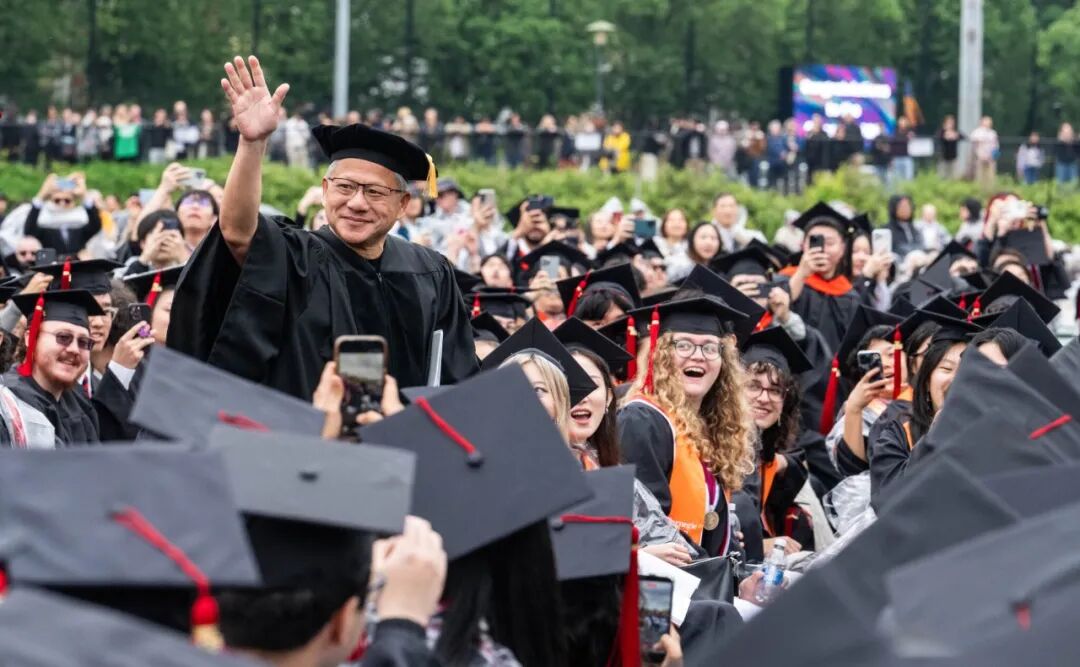
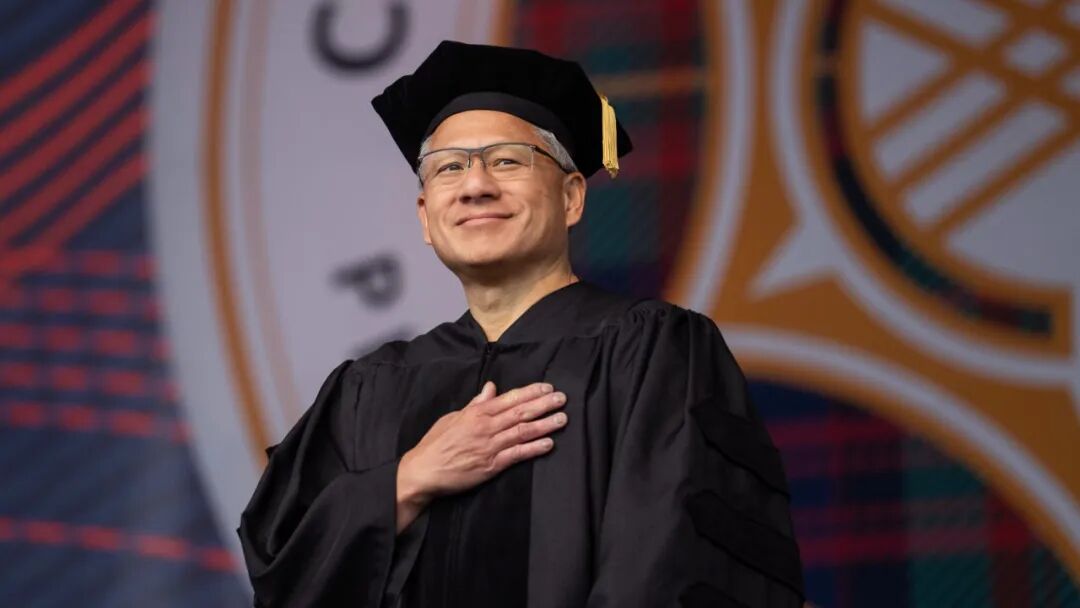
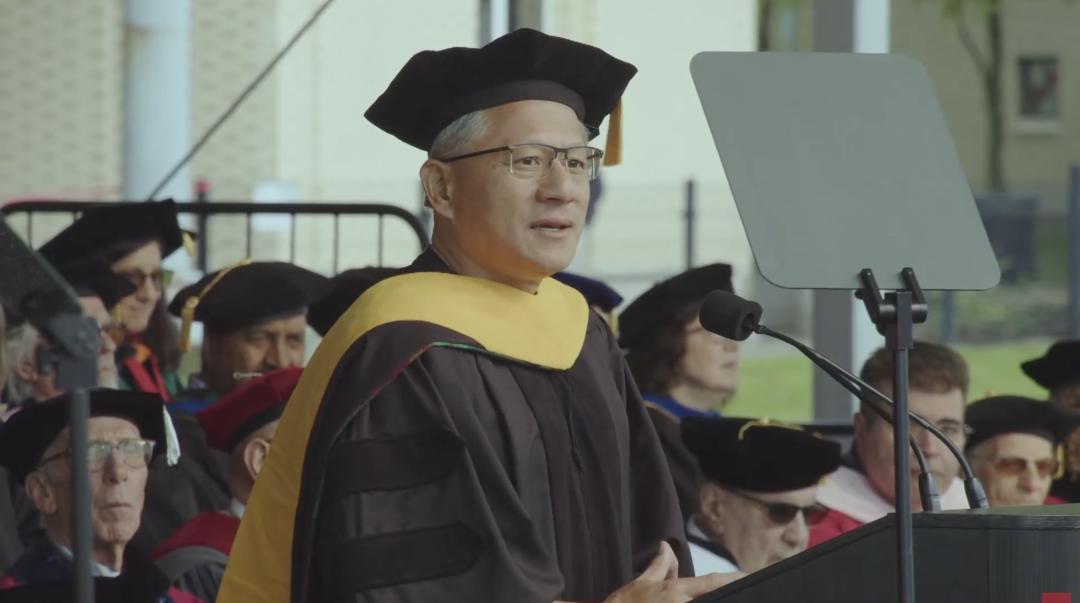
Just today, at the 2026 graduation ceremony of Carnegie Mellon University (CMU), Huang Renxun, also known as the "Leather - jacketed Blade - wielder" with a net worth approaching $186 billion, stepped onto the podium and received an honorary doctorate in science and technology.
Seated in the audience were the Class of 2026, about to enter society. The world they face is extremely fragmented. On one hand, there's NVIDIA's trillion - dollar computing power empire and the booming AI bull market; on the other hand, the unemployment rate among fresh graduates has hit a new high, and the panic of "AI taking jobs" has spread to every job - seeking group.
This year, a dozen large companies have openly blamed AI for their layoffs. Anthropic CEO Dario Amodei warned that AI could eliminate 50% of entry - level white - collar jobs. Elon Musk threw out the terrifying prediction that "there's a 20% chance of human extinction." The whole society's fear of AI is spreading to these young people who have just received their diplomas in various ways.
Among those who have created this anxiety, many are CEOs of comparable status to Huang Renxun. Earlier this month, he directly lashed out in a podcast, saying that such predictions "are not helpful" and that these people develop a "God complex" after taking the CEO position, thinking they know everything.
After criticizing his peers, Huang Renxun stepped onto the CMU graduation stage today.
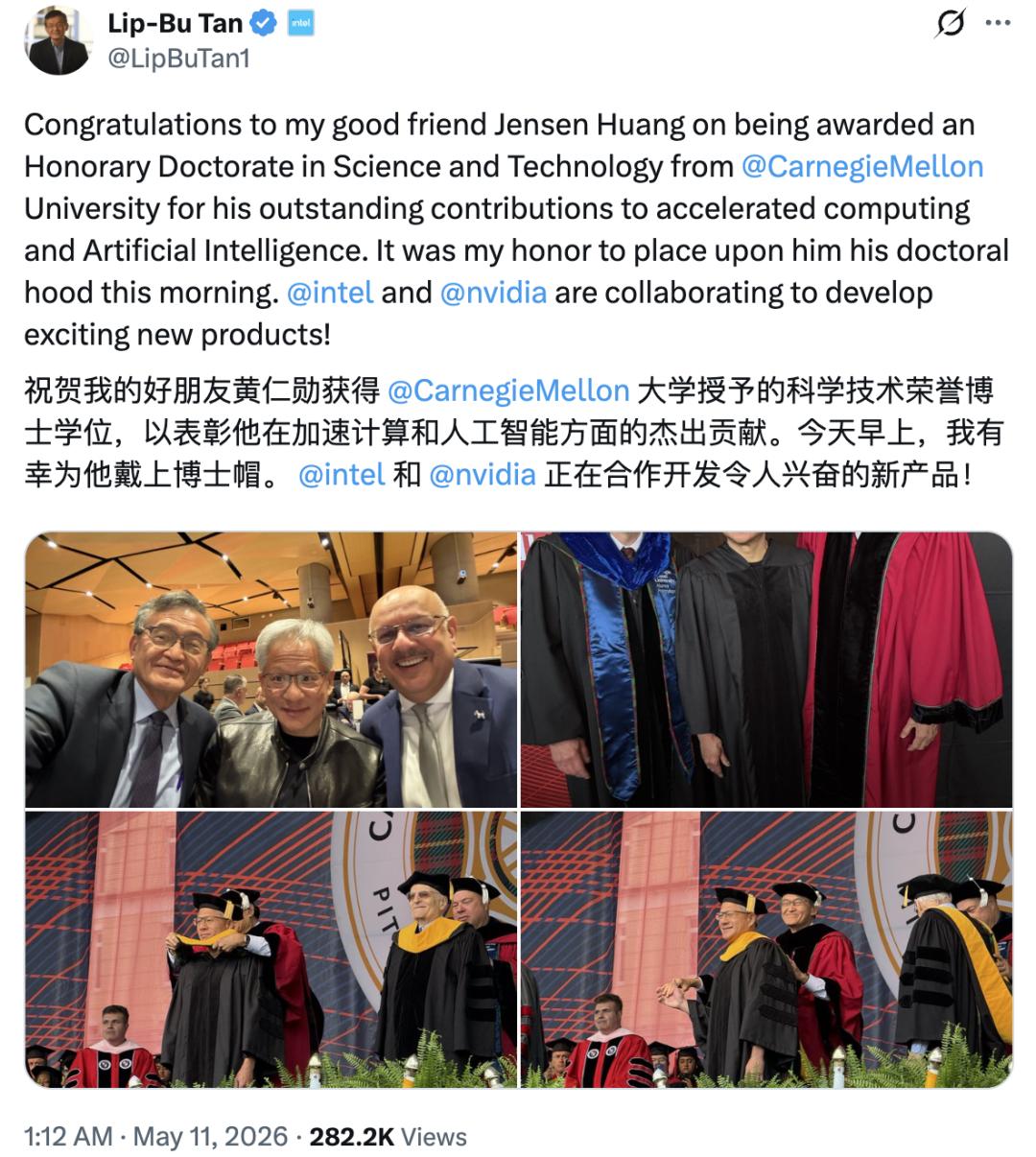
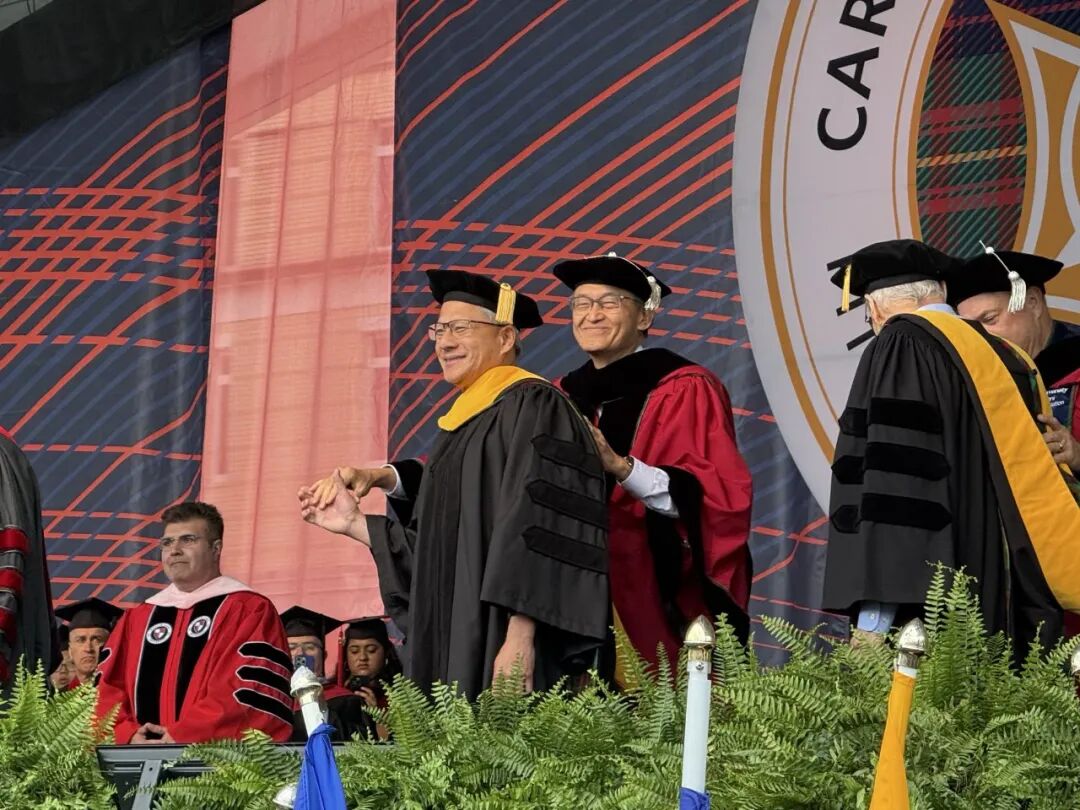
It's worth mentioning that at the graduation ceremony, Intel CEO Chen Liwu personally draped the honorary doctor's stole over Huang Renxun. After the ceremony, Chen Liwu publicly congratulated him and casually revealed that the two companies are collaborating on a "highly anticipated new product."
Instead of talking about the grand narrative of AI, he told the story of taking a plane to a coal - mining town in Kentucky at the age of 9, being woken up by his mother at 4 a.m. to deliver newspapers, washing dishes at Denny's, and apologizing to the Sega CEO and pleading with him not to withdraw the investment. He said it was "one of the most difficult things" he had ever done.
From a dishwasher to the head of a trillion - dollar empire, Huang Renxun's speech on stage is obviously not to serve up a clichéd success - formula soup. Instead, he's using his own experience to let these young people, scared by AI, in on a secret: the start of any new era is never fully prepared, and you don't need to be all - capable from the beginning.
AI is overturning the computing rules of the past few decades. Old experiences are no longer absolutely useful, and everything is being reshuffled. For young people who have just received their diplomas and have no baggage, this is actually a good thing. Because they don't have to struggle in the old tracks that have been occupied by predecessors. Instead, they, like everyone else, are once again on the same starting line.
In this regard, looking at the students in the audience, he said, "Put your hearts into your work. Create something worthy of your education, your potential, and those who believed in you before the world did."
Video link 🔗:
https://www.youtube.com/watch?v=dRaNmHmTJzs&t=5783s
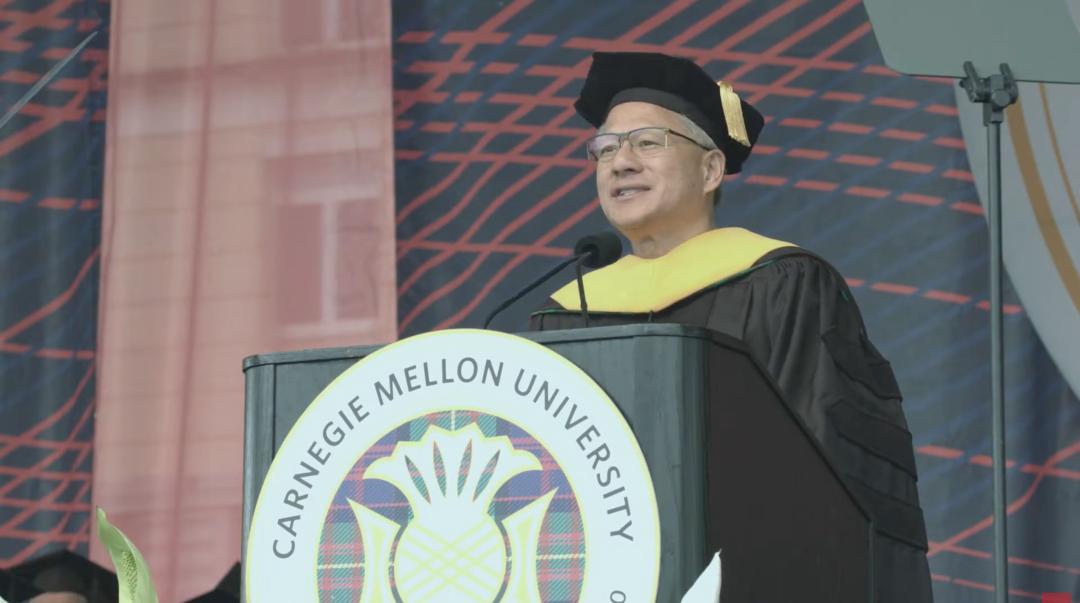
Here is the original text of Huang Renxun's speech:
President Jehanian, members of the board, faculty, distinguished guests, proud parents and families, and most importantly, the Class of 2026 of Carnegie Mellon:
Thank you for awarding me this extraordinary honor. It means a great deal to me to be at Carnegie Mellon, one of the world's top universities. This is one of the few places that truly invent the future. Today is a day of pride and joy, a day when your dreams come true, but this day is not just yours. Your families, teachers, mentors, and friends have supported you all the way here.
Before we talk about the future, please thank them. This day is also theirs. Graduates, please stand up, and stand up with me. Come on, everyone. In particular, turn to your mothers and wish them a happy Mother's Day.
For you, this is another step in life. But for her, this is a moment when her dream comes true. Please remember this.
CMU students are like robots, executing one instruction at a time. Seeing you graduate, seeing you... Okay, everyone, pay attention. I have something important to tell you: Seeing you graduate from one of the world's top universities, this is also her moment. My parents are also extremely proud of me. My journey is also their journey. I am the result of their dreams coming true. Like many of you here, I am a first - generation immigrant.
My father had a dream of raising his family in the United States. When I was 9 years old, he sent my brother and me to the United States. We ended up at a Baptist boarding school in Oneida, Kentucky, a coal - mining area, a small town with only a few hundred people. Two years later, my parents left everything behind and came to the United States to be with us. They came here with almost nothing.
My father is a chemical engineer. My mother worked as a maid at a Catholic school. She woke me up at 4 a.m. every day to deliver newspapers. My brother helped me get a job as a dishwasher at Denny's, which I thought was a major career promotion at that time.
I went to Oregon State University. When I was 17, I met my wife, Lori. I was the youngest in school. We were sophomores and lab partners. She was 19.
An older woman? I beat the other 250 guys in the class and won her heart.
We've been married for 40 years. We have two wonderful children, both of whom work at NVIDIA. When I was 30, I founded NVIDIA with Chris Malachowsky and Curtis Priem, two outstanding computer scientists.
We wanted to build a new type of computer, one that could solve problems that ordinary computers couldn't. We had absolutely no idea how to start a company, raise funds, or run NVIDIA. I just thought, how hard could it be? It turned out to be really, really hard.
Our first technology didn't work at all, and we were running out of money. Once, I had to fly to Japan to explain to the Sega CEO that the technology they commissioned us to develop couldn't be realized, ask to cancel the contract we couldn't fulfill, and then ask them to continue paying. Without that money, NVIDIA would have disappeared in an instant. It was very embarrassing, very humiliating, and one of the hardest things I've ever done.
And Sega's CEO, Mr. Irimajiri, said yes. I learned early on that being a CEO isn't about power, but about the responsibility of keeping the company alive. I also learned that honesty and humility can sometimes be met with generosity and kindness, even in the business world. We used that money to restructure the company and invented new chip and computer design methods in a desperate situation, which are still in use today.
For 33 years, NVIDIA has reinvented itself again and again. Every time, we'd ask: How hard could it be? And every time, we'd find that it was harder than we thought. But through these experiences, we learned never to see failure as the opposite of success. Every failure is just a moment to learn, a moment to stay humble, and a moment to temper character. The resilience forged in setbacks gives you the strength to start again. Today, I'm one of the longest - serving CEOs in the tech industry.
NVIDIA is a career I've built with 45,000 outstanding colleagues and is my life's work. Now, it's your turn to pursue your dreams, and there couldn't be a better time. My career started at the beginning of the PC revolution. Your careers are starting at the beginning of the AI revolution. I can't imagine a more exciting time to start a career, a better time to start your life's work. AI started right here at Carnegie Mellon University.
In the past 24 hours, I've heard countless AI jokes here. Carnegie Mellon is one of the true birthplaces of AI and robotics. In the 1950s, researchers here created the Logic Theorist, widely regarded as the first AI computer program. In 1979, Carnegie Mellon established the Robotics Institute. I visited it this morning. This morning, I visited the Robo Club and the first academic institution fully dedicated to robotics.
AI has completely reshaped computing. I've witnessed every major computing platform change: mainframes, PCs, the Internet, mobile, and the cloud. Each wave built on the previous one, each expanded the accessibility of technology, and each changed industries and society. But the change that's about to happen is greater than any before. Computing is undergoing a complete reset. Since the invention of modern computing, such a change has never occurred.
For 60 years, computing has worked the same way: humans write software, and computers execute instructions. This paradigm is over. AI has reshaped computing: from human coding to machine learning, from software running on CPUs to neural networks running on GPUs, from executing instructions to understanding, reasoning, planning, and using tools. A new industry has emerged, with the mission of mass - producing intelligence.
Since intelligence is the foundation of every industry, every industry will change. For many, AI brings uncertainty. When people see AI writing software, generating images, and driving cars, they naturally wonder: What's next? Will jobs disappear? Will people be left behind? Will this technology become too powerful?
Every major technological revolution in history has brought both opportunities and fears. When society embraces technology with an open, responsible, and optimistic attitude, we expand human potential far more than we diminish it. So, first and foremost, we must clearly recognize that:
AI, which is the automation of understanding, reasoning, and problem - solving, is one of the most powerful technologies humans have ever created. Like every transformative technology before, it brings both great hope and real risks. It's the responsibility of our generation not only to advance AI but also to advance it wisely. Scientists and engineers have a profound responsibility to advance both AI capabilities and AI safety, as do policymakers.
Policymakers have the responsibility to establish comprehensive safeguards to protect society while still allowing innovation, discovery, and progress to continue. History shows that societies that choose to avoid technology cannot stop progress; they simply give up the opportunity to shape progress and benefit from it.
So the answer is not to fear the future but to guide it wisely, build it responsibly, and ensure that its benefits reach as many people as possible. We shouldn't teach people to fear the future. We should engage with the future with optimism, responsibility, and ambition.
Currently, only a small fraction of the world's population knows how to write software. But now, anyone can use AI to create useful things. A shop owner can create a website and grow their business; a carpenter can design a kitchen and offer new services to customers. AI can write code. For the first time, everyone becomes a programmer. For the first time, the power of computing and intelligence can truly reach everyone and bridge the technological gap. Like electricity and the Internet, AI will require trillions of dollars in infrastructure investment.
This is the largest - scale technological infrastructure construction in human history and a once - in - a - generation opportunity for the United States to re - industrialize and restore its building capabilities. To support AI, the United States will build chip factories, computer factories, data centers, and advanced manufacturing facilities across the country. AI gives the United States the opportunity to build again. Electricians, plumbers, steelworkers, technicians, and construction workers, this is your time.
AI is not just creating a new computing industry; it's creating a new industrial era. Supporting these new infrastructures requires a huge amount of energy, but it's also driving one of the largest energy infrastructure investments in generations, promoting the modernization of the power grid, expanding power production, and accelerating the development of sustainable energy. Yes, AI will change every job, but the tasks of a job and its purpose are not the same. Many tasks will be automated. Some jobs will disappear, but many new jobs and entirely new industries will also be created.
Software coding tasks are increasingly being automated, but with the help of AI, software engineers can expand the search scope of solutions to tackle more significant challenges. Radiological image analysis is increasingly being automated, but with the help of AI, radiologists will be elevated to a higher level to better diagnose diseases and care for patients.
AI won't replace people's goals; it will amplify people's abilities. That's why even though AI writes more code and analyzes more images, the demand for software engineers and radiologists continues to grow. AI is unlikely to replace you, but someone who uses AI better might. So, here's a good thought experiment:
Do we want our children to be enhanced by AI or left behind by those enhanced by AI