Electric vehicles are in a configuration competition, not even sparing a single piece of glass.
In the early days of the new energy vehicle competition, the focus was on features like refrigerators, color TVs, and large sofas. However, as the industry became more competitive and these so - called high - end configurations were brought down from the original price range of 300,000 yuan to the 100,000 - yuan price band, those once - proud configurations could no longer command a high price and no longer seemed so high - end.
So later, many car manufacturers continued to develop within the limited interior space of cars. For example, in terms of seats, the ventilation and massage functions, which were originally only available in luxury cars and required optional installation, have almost become standard features. Moreover, they have gradually extended to more functions such as massage, physiotherapy, and even foot heating and SPA.
Take the audio system as an example. In the past, most cars had only four speakers, and as long as they could play sound and let you listen to the radio, it was sufficient. Now, cars without at least 20 speakers seem substandard, and power outputs of two or three thousand watts are quite common.
Regarding intelligence, both the intelligent cabin and intelligent driving are competing in terms of accumulating chips and computing power, and vying for a high position on the rankings. No one wants to fall behind in this highly competitive industry. Regardless of the final user experience, at least they aim to outperform their competitors on paper.
Now, it seems that there are no more configurations to compete over. However, smart businessmen always find a way. For instance, they've set their sights on a piece of glass.
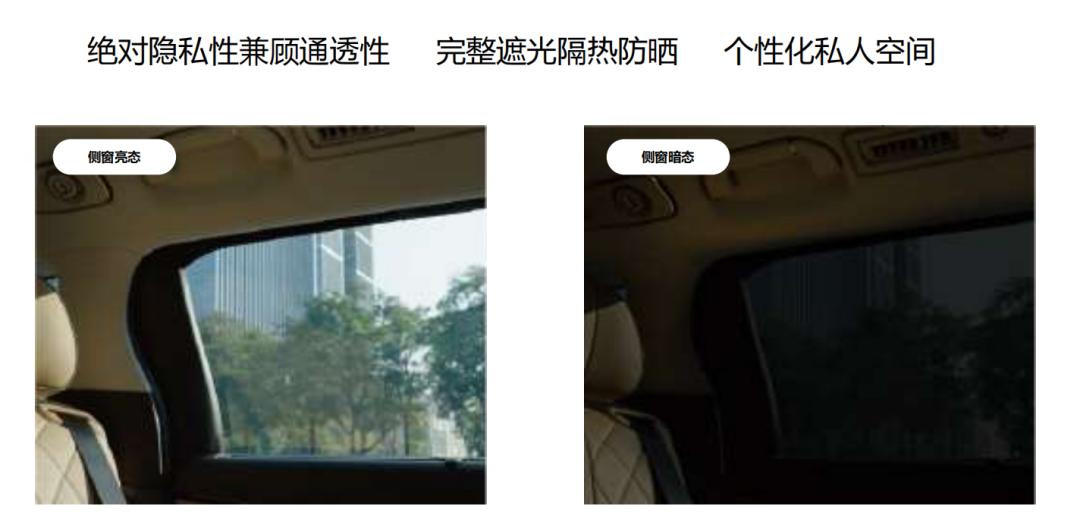
This month, several upcoming models, such as the NIO ES9, XPeng GX, and the new - generation AITO M9, all flagship models, have all chosen electrically - dimmable privacy glass as their core competitive advantage.
From color - changing sunroofs to rear - side windows that can instantly transform into private compartments; from two - level switching to stepless dimming, zone - control, and simulated Venetian blind effects, a piece of glass that used to only serve to block wind and rain has now evolved into a "super - intelligent carrier" that combines sun protection, heat insulation, privacy, quietness, a sense of technology, and emotional value.
It's a simple matter that could be solved with a curtain. Why, then, do many new - force car manufacturers consider it a high - end and leading selling point? Perhaps some ordinary consumers don't understand, or even fail to comprehend this.
But there are always some ways of putting it to make it sound high - end. For example, it's not just about piling up configurations. Instead, it has become an evolution spanning a century, a revolution sweeping across the entire industrial chain, and an experience reconstruction led by Chinese brands.
From different perspectives, both sides seem to have their points. However, one thing is for sure: those in the business of automotive glass films and car window - tinting shops are really in trouble.
01
The Evolution of an Automotive Glass
Several pieces of automotive glass, which seem unremarkable and can hardly be considered as configurations, often go unnoticed by consumers. However, researching the development history of automotive glass reveals some very interesting stories. Over more than a hundred years, it has made a three - stage leap from being a "wind - blocking tool" to a "safety barrier" and then to an "intelligent interaction panel", which is also equivalent to the evolution history of automotive safety and comfort.
In 1904, cars were first equipped with windshields. At that time, it was just an ordinary flat glass, and its only function was to block wind and sand. However, it was fragile and dangerous. After breaking, the sharp fragments would fly everywhere, becoming an important source of secondary damage in accidents, thus being called the "deadly glass". At this stage, the glass only addressed the issue of "existence", without any consideration for safety.
In 1919, the Ford Model T began to widely use laminated glass. With a PVB film sandwiched between two layers of glass, it wouldn't shatter into flying fragments and cause harm to people when broken, thus completely ending the history of glass fragments causing injuries and laying the foundation for modern automotive safety glass. By 1938, tempered glass was introduced. Through heat treatment, its strength was increased several times. When broken, it would form small, blunt - angled particles smaller than 5mm, further enhancing the safety of side windows and rear windshields.
In the following decades, the combination of laminated and tempered glass became the industry standard, and the core mission of glass has always revolved around safety.
However, with the upgrading of consumption, glass has started to take on more functions. For example, double - laminated glass can improve NVH and in - car quietness, and coated glass can achieve heat insulation and block ultraviolet rays. Glass has changed from being a so - called "safety part" to a comfort - enhancing configuration. Just as Xiaomi mentioned in the first - generation Xiaomi SU7, "No one has solved the problem of car sun protection in 140 years." Since other cars are afraid of sun exposure after purchase, car owners naturally go to apply sun - protection films on the glass.
So, whether it's a pre - installed configuration or a post - installed function, in essence, automotive glass is still a passive component without the ability to actively adjust.
What truly brought about a qualitative change in automotive glass is electrochromic technology. This technology can adjust the light transmittance under the action of an electric field and selectively block heat radiation. For example, the Ferrari Superamerica convertible sports car in 2005 and the intelligent cabin windows of the Boeing 787 airliner in 2008 were among the early practical applications of this technology in the industry.
Subsequently, with the iteration of material technology, it has gradually been popularized in high - end automotive panoramic sunroofs. In 2016, a team from the Massachusetts Institute of Technology made a key breakthrough in the field of new electrochromic materials, significantly improving the color - changing response speed, energy - saving, and light - and heat - blocking performance, laying a technical foundation for the large - scale upgrading of scenarios such as energy - saving building glass and high - end automotive sunroofs.
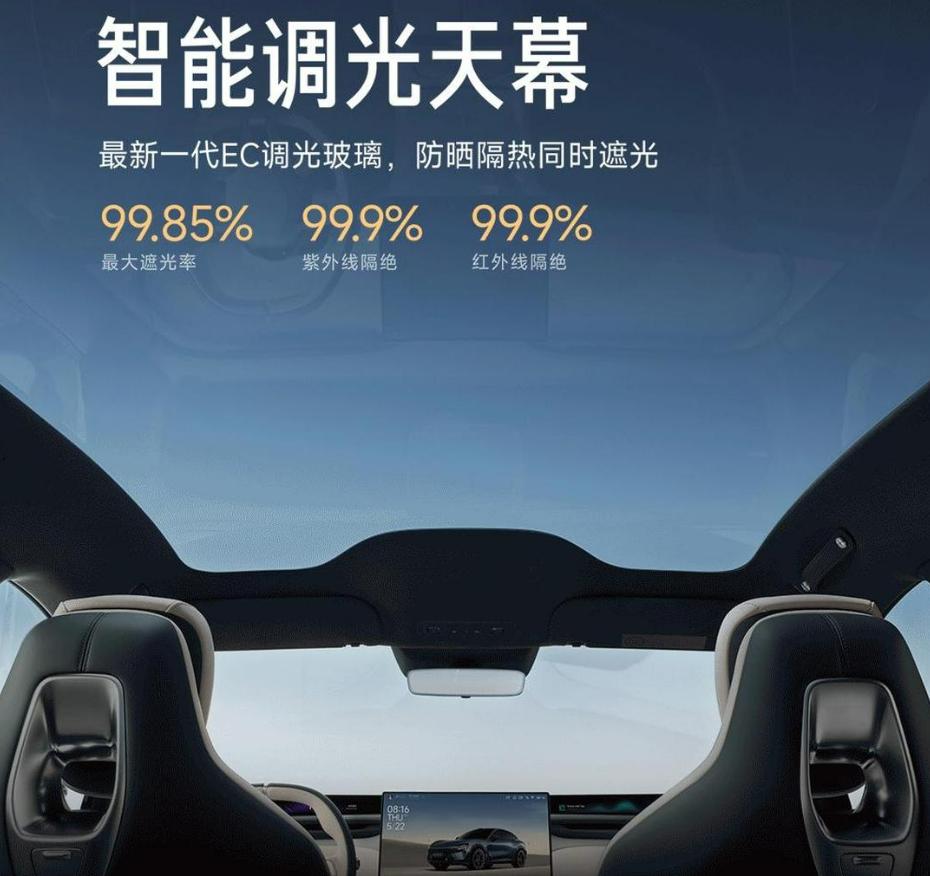
In 2021, Optics Interactive Technology provided EC electrochromic sunroofs for the ZEEKR 001, marking the official entry of intelligent dimmable glass into the large - scale mass - production stage. By the end of 2025, Optics Interactive Technology's EC electrochromic technology had developed to its third generation, becoming the world's largest supplier of vehicle - grade EC color - changing sunroofs/glass. It has supplied over 300,000 sets in total, covering more than 20 mainstream models such as NIO, BYD, Xiaomi SU7, and Audi, and has gradually expanded to the application of side - window glass.
Today, LC dye - liquid - crystal side windows represented by the XPeng GX and NIO ES9 have also started to appear. With a response speed reduced to the 0.1 - second level, a light - blocking rate close to 100%, and independent zone - control, the glass has completely evolved into an active intelligent interaction terminal, and a piece of glass has completed a complete transformation from the mechanical era to the intelligent era.
02
The Intelligent Cockpit Needs Smarter Glass
We always believe that everything exists for a reason. The emergence and boom of color - changing or intelligent glass in the automotive industry are the inevitable result of the resonance among the electrification trend, cockpit competition, and user pain points.
After all, when competition in power, range, large screens, audio systems, and seats has reached its peak, car manufacturers have to focus on more subtle user experiences. Glass happens to address three major essential needs. For example, in terms of sun protection, color - changing sunroofs can solve the problem of excessive sun exposure in ordinary electric cars. In terms of privacy, some high - end executive cockpits, business reception, and rest scenarios indeed require automotive glass that allows light in but keeps people out of sight. Although other cars can have window - tinting, at least the original - factory quality is safer, more environmentally friendly, more beautiful, and odor - free.
Color - changing glass was first applied to sunroofs. Since the battery in pure electric cars is placed on the chassis, the vehicle height is reduced, and traditional sunroofs take up headroom. Therefore, panoramic sunroofs have become the only solution. They bring many advantages such as a sense of transparency, large space, and low wind resistance. However, they also bring a fatal problem: they get too hot in the sun!
Taking Tesla's large - scale popularization of sunroofs as an example, early sunroofs could only block ultraviolet rays but not infrared rays. In summer, the interior of the car would be scorching hot, and the passengers' heads would feel hot, which became the biggest complaint from users. Users had no choice but to apply window - tinting or install sunshades, which were cumbersome, cheap, and ruined the aesthetic appeal.
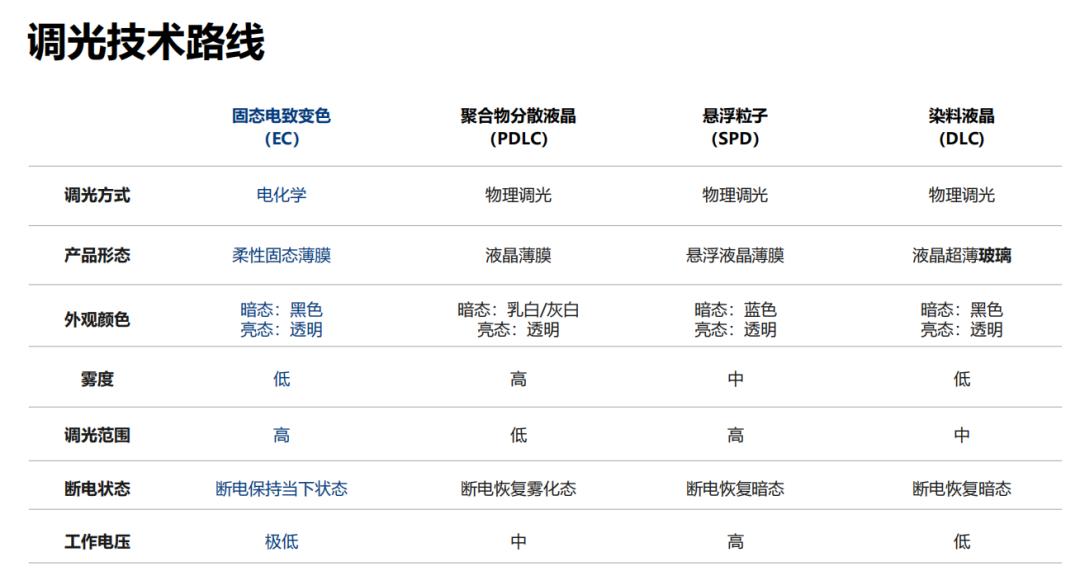
Pain points are opportunities. Chinese car manufacturers, in collaboration with the supply chain, have identified the opportunity and provided a solution: electrically - dimmable glass that can actively change color and insulate heat. Based on different technical routes, these glasses can be divided into two major camps: EC and LC.
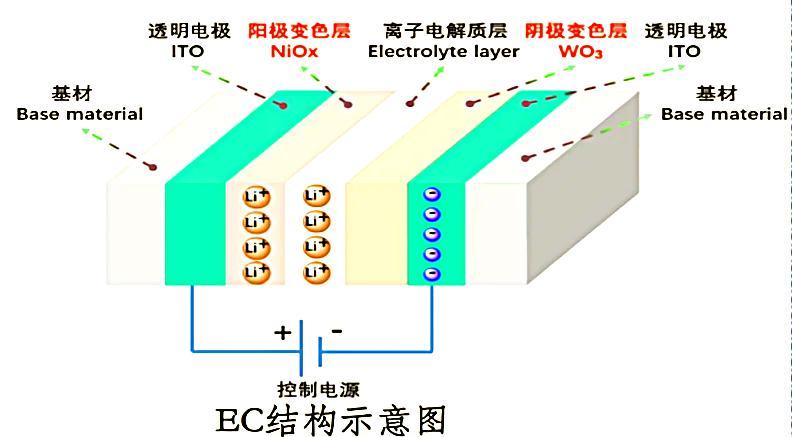
First, there is EC electrochromic glass, which is the optimal solution in the sunroof field. Its principle is based on ion migration and redox chemical reactions, similar to the charging and discharging process of a battery to change color, but it takes a certain amount of time to change. This type of color - changing glass can maintain its state when the power is off, save energy, be made into large - curved shapes, and achieve stepless dimming. In terms of performance, it can achieve a maximum light - blocking rate of 99.6%, block 99.99% of ultraviolet rays, and block 97% of infrared rays.
The other type is LC dye - liquid - crystal glass, known as the king of side - window privacy. Its principle is to control the arrangement of liquid - crystal and dye molecules through an electric field, resulting in a purely physical change. Its advantages are instant switching within 0.1 seconds, complete black - out privacy, and zone - control. The NIO ES9, XPeng GX, AITO M9, and Zunjie S800 mentioned at the beginning of the article are representative models using this technology. Of course, similar to the color - changing sunroof, the first application was also on the ZEEKR 009 Glory model.
So, a clear industry pattern is emerging. The intense competition is turning what used to be post - installed, modified, or window - tinted requirements into pre - installed standard features. This is the case with dashcams, power - operated doors, aviation seats, and ambient lights, and the same goes for dimmable glass.
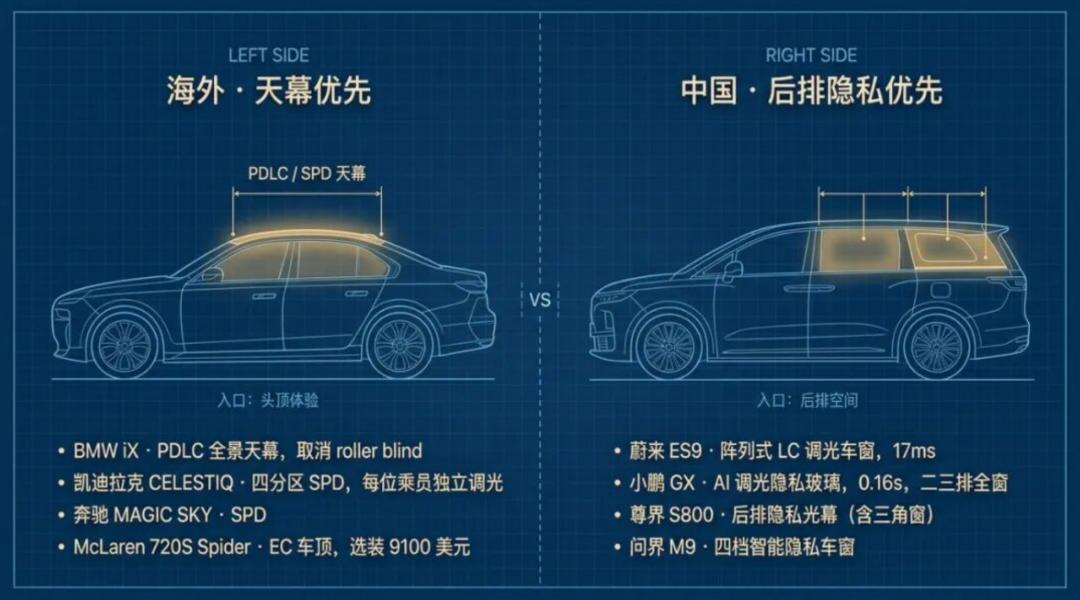
Putting it nicely, this is about pre - emptively enhancing the user experience, solving all the problems, costs, and hassles that users would encounter after buying a car. Putting it bluntly, it's about grabbing the business of the downstream industrial and ecological chains. After all, car manufacturers need to make profits and try every means to increase the price of cars.
Anyway, Chinese technology and the Chinese supply chain are transforming China's car - manufacturing technology from simple car - building to "space - building", and the right to define the cockpit has been completely transferred. So, under the concept of the intelligent cockpit, glass is no longer just glass; it has become the control switch for cockpit scenarios. During commuting, it can be transparent and bright, providing a wide view; during rest, it can turn completely black with one click, ensuring quietness and privacy; in business situations, it can achieve zone - dimming to avoid interference; in summer, it can block heat sources and reduce the load on the air - conditioner.
From sun protection for sunroofs to privacy for side windows; from EC technology to the LC solution; from post - installation window - tinting to pre - installed standard features, Chinese brands have redefined the value of automotive glass through intense competition, marking a higher - level stage of automotive competition.
In the future, intelligent glass may continue to evolve, for example, in terms of photovoltaic power generation, virtual reality, display integration, and even all - around sensing... However, no matter how the technology iterates, the underlying logic will always remain the same: centering on the user, maximizing the user experience, and pre - emptively solving all the troubles. This is the ultimate answer to China's intense automotive competition.
Ultimately, it depends on whether consumers are willing to buy.
This article is from the WeChat official account "Automotive Community" (ID: iAUTO2010), written by Du Yuxin and published by 36Kr with authorization.