A crucial battle for the wafer fabs
Scaling semiconductor manufacturing processes from pilot production to high-volume manufacturing (HVM) is one of the most critical and complex transition phases in the semiconductor lifecycle, and it is also the stage where most processes are truly validated. During the pilot production phase, the goal is to prove the effectiveness of the process. Engineers operate under controlled conditions, adjusting parameters in real-time and solving problems. Although there is a certain degree of variability, it can be effectively controlled due to low production volume and strict supervision.
However, this model cannot handle large-scale production.
In HVM, the key lies in whether the process can remain stable over thousands of wafers, multiple devices, and longer production cycles without continuous intervention. This transformation is less about increasing production volume and more about building a system that can absorb various variabilities without reducing yield. Although these challenges are common in the semiconductor manufacturing field, they are particularly prominent in wet processes (such as post-chemical mechanical polishing cleaning (PCMP)) because fluid behavior, pollution control, and material interactions directly affect yield and device reliability.
The following discussion will be based on the experience of large-scale production of these systems, where the gap between pilot validation and HVM performance is particularly obvious.
Pilot Validation and Variability
One of the most common reasons for the failure of large-scale production is the misunderstanding of pilot success. In the pilot environment, the focus is on verifying whether the process is effective, confirming the process chemistry, achieving an acceptable defect rate level, and producing functional devices under controlled conditions.
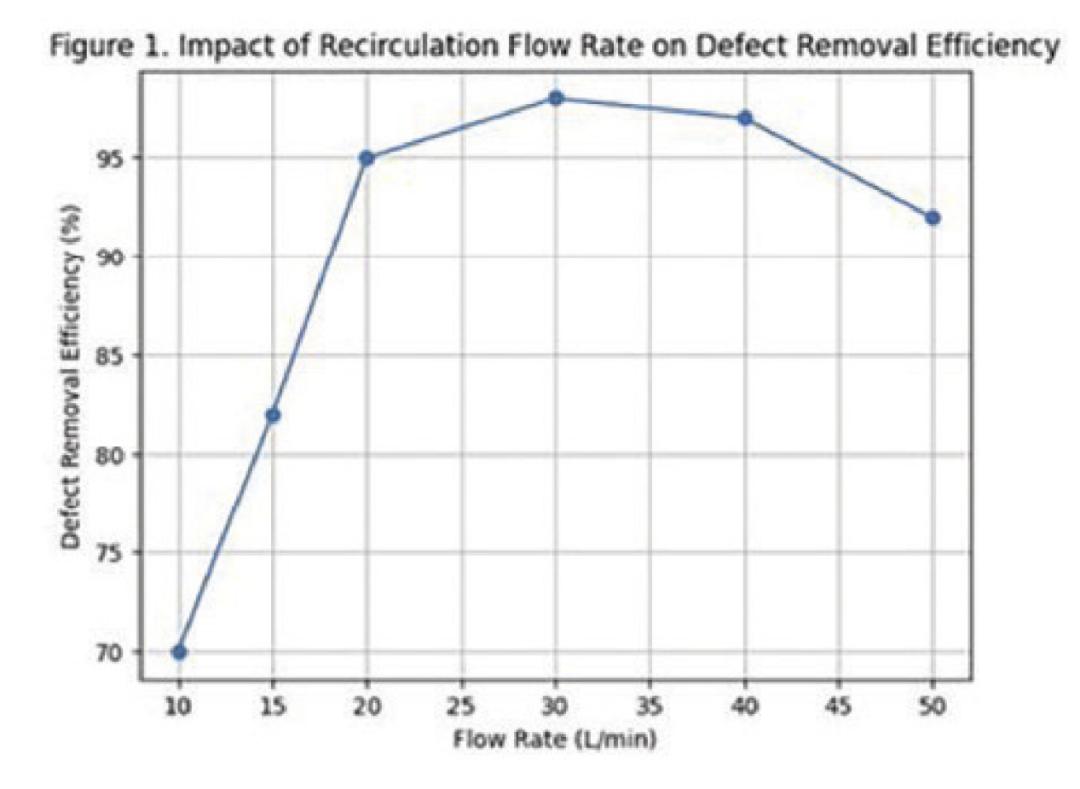
Figure 1. Relationship between mixed flow rate and defect removal efficiency
Below approximately 15 L/min: Cleaning effect is unstable due to poor mixing
Optimal flow rate range (20–40 L/min): Defect removal efficiency > 95%
Above approximately 45 L/min: The surface will be damaged due to shear-induced effects
The pilot environment cannot fully reflect the performance of the process under various variabilities in the actual production environment. Differences in raw materials, mold differences, and process drift during long-term operation can usually be ignored or strictly controlled during the R & D stage, but they become significant in large-scale production.
For example, in the post-chemical mechanical polishing (CMP) cleaning (PCMP) process, even trace metal contamination at a concentration of one part per billion can introduce reliability risks, such as dielectric breakdown and corrosion. Therefore, if the process design cannot handle the variabilities and pollution control during continuous operation, a process that performs well in the pilot stage may fail in the HVM stage.
As production scale increases, variability becomes the main factor affecting yield. In the pilot stage, parameters are regarded as fixed targets. In the high-volume (HVM) stage, these parameters become statistical distributions:
Film thickness uniformity
Critical dimension deviation
Defect density
The goal shifts from achieving the nominal value to controlling the deviation range. In wet processes such as PCMP cleaning, fluid delivery and mixing behavior have a significant impact on process performance. Experimental data shows that process performance is highly sensitive to the circulation flow rate, as shown in Figure 1.
This reveals a key large-scale reality: Increasing production volume without re-optimizing process conditions will introduce new failure modes.
Pollution and Tool Matching
As variability increases, pollution problems are more difficult to isolate and gradually evolve into system-level problems. In the pilot environment, pollution is usually regarded as a discrete problem. After detecting abnormal particles or metal peaks, the source is traced, repaired, and then production continues.
This method fails in high-volume production.
In large-scale production, pollution is rarely related to a single event. It is embedded in the system through multiple consecutive raw material sources, storage tanks, distribution loops, filtration systems, and tool interfaces. Even low-concentration pollution from these links may persist and accumulate on thousands of wafers.
This is particularly crucial in PCMP and other wet processes. Trace metals or particles introduced upstream are not always removed downstream. Instead, they circulate in the system, increasing the probability of deposition on the wafer surface and directly leading to defects and reliability failures.
Therefore, pollution control in high-volume production is not just a reaction to abnormal situations. It requires the design of the entire system to minimize the generation, transmission, and accumulation of pollutants. This includes closed chemical delivery systems, elimination of dead ends in pipelines, multi-stage filtration, and continuous online monitoring.
This transformation is fundamental: Pollution is no longer a problem to be repaired but a problem to be eliminated from the system design.
In the pilot production line, processes are usually developed on a small number of devices and often under strictly controlled conditions. Any deviation can be quickly identified and corrected. However, this assumption does not hold in large-scale production.
In large-scale production, the same process flow must run on a complete set of devices, and no two devices have exactly the same performance. Small differences in temperature uniformity, fluid dynamics, chamber conditions, or hardware wear can lead to measurable changes in process output. A process flow that seems stable on a single device may be unevenly distributed on multiple devices.
Therefore, tool matching is crucial. Fabs rely on a golden device baseline, cross-device calibration, and advanced process control (APC) to ensure consistent performance. Even so, due to usage and maintenance cycles, device performance will still drift over time and require continuous monitoring and adjustment.
The increase in production capacity adds another layer of complexity. As the number of wafers increases, device conditions change, heat distribution changes, consumables age, and process behavior may exceed the initial expected range.
The process flow verified under pilot production capacity usually needs to be re-optimized under HVM load.
At high volumes, process deviations are not caused by a single device but by the interaction between multiple devices running simultaneously. Controlling this deviation is crucial for maintaining yield.
Yield and Scaling
The combined effects of variability, pollution, and tool differences are ultimately reflected in yield performance. In high-volume production, yield is not a static indicator that can be achieved and locked but needs to be continuously managed by controlling defect mechanisms and process stability.
At advanced process nodes, yield loss is rarely caused by a single major problem. Instead, it is the result of the combined action of multiple factors such as particles, metal pollution, residual films, and surface interactions caused by the process, which are usually distributed across multiple steps and tools. The difficulty lies not only in detection but also in correct attribution. Online detection can identify the number of defects, but if the underlying mechanisms are not understood, optimization efforts often focus on the wrong variables.
In wet processes (such as PCMP cleaning), this distinction becomes particularly important. Some defects that seem to be related to particles may originate from fluid behavior rather than solid pollution. Microbubbles introduced through mixing or pumping can adhere to hydrophobic surfaces and burst during the drying process, leaving residues that are identified as defects. If these mechanisms are not correctly identified, simply improving filtration or increasing material purity may not solve the real root cause of yield loss. Therefore, improving yield is less about reducing the total number of defects and more about isolating and controlling the main mechanisms causing variability.
In addition, the transition from pilot production to large-scale production is not just about improving individual process steps but about integrating a system that remains stable under continuous production conditions. In the pilot production environment, performance mainly depends on local process optimization under controlled conditions. In large-scale production, performance depends on the interaction effect between processes, devices, materials, and control systems. Variability introduced at any interface can spread throughout the system, and this spread is often difficult to detect.
Material differences can affect process sensitivity, tool differences can amplify small deviations, and feedback delays can extend the time required to correct problems. These interactions, rather than any single parameter, often determine the overall manufacturing performance.
The scaling development of semiconductor cleaning and chemical systems highlights a consistent pattern. The purity level acceptable in the R & D stage may become a limiting factor in the production stage, which not only affects yield but also the long-term reliability of devices. Filtration and fluid handling are usually regarded as auxiliary functions but actually become the main process control means directly affecting defect rate and repeatability. The way chemicals are mixed, delivered, and regulated is as important as the formulation itself. At the same time, the speed of problem detection and correction is also crucial. During the capacity ramp-up stage, even a small delay in feedback can have a significant impact on yield, so the rapid integration between metrology, engineering, and manufacturing is crucial.
Design for Scaling
Scaling cannot wait until the process development is completed. A process verified under idealized pilot conditions often becomes unstable once exposed to the real production environment.
To avoid this, development needs to consider the actual production situation from the beginning. This includes verifying the process at actual production capacity, considering the variability of materials and devices, and building a control strategy while defining the process. If these elements are introduced too late, the capacity ramp-up time will often be extended, and it will be more difficult to stabilize the yield.
As semiconductor manufacturing moves towards angstrom-level technology, the tolerance for variability continues to decrease. Smaller feature sizes increase the sensitivity to pollution and process drift, while more complex material systems introduce more interactions that must be controlled. As a result, the performance of the manufacturing environment depends on closer integration between systems and faster, more adaptable control. The error tolerance is reduced, and maintaining stability under production conditions becomes the main limiting factor.
Scaling is the key point for the process to transition from successful development to manufacturability. What determines the superiority of a technology is not whether the process is effective under controlled conditions but whether the process can operate stably and continuously across different tools, at different times, and at different production scales. This stability ultimately determines whether a technology can be applied to large-scale production.
*Disclaimer: This article is originally written by the author. The content of the article represents the author's personal views. Semiconductor Industry Watch republishes it only to convey a different view and does not represent Semiconductor Industry Watch's approval or support for this view. If there are any objections, please feel free to contact Semiconductor Industry Watch.
This article is from the WeChat official account “Semiconductor Industry Watch” (ID: icbank). Author: KAUSHIK KRISHNAN. Republished by 36Kr with authorization.