On the Eve of the Clearance of Large Models
Written by | Huahua, Ban Jun
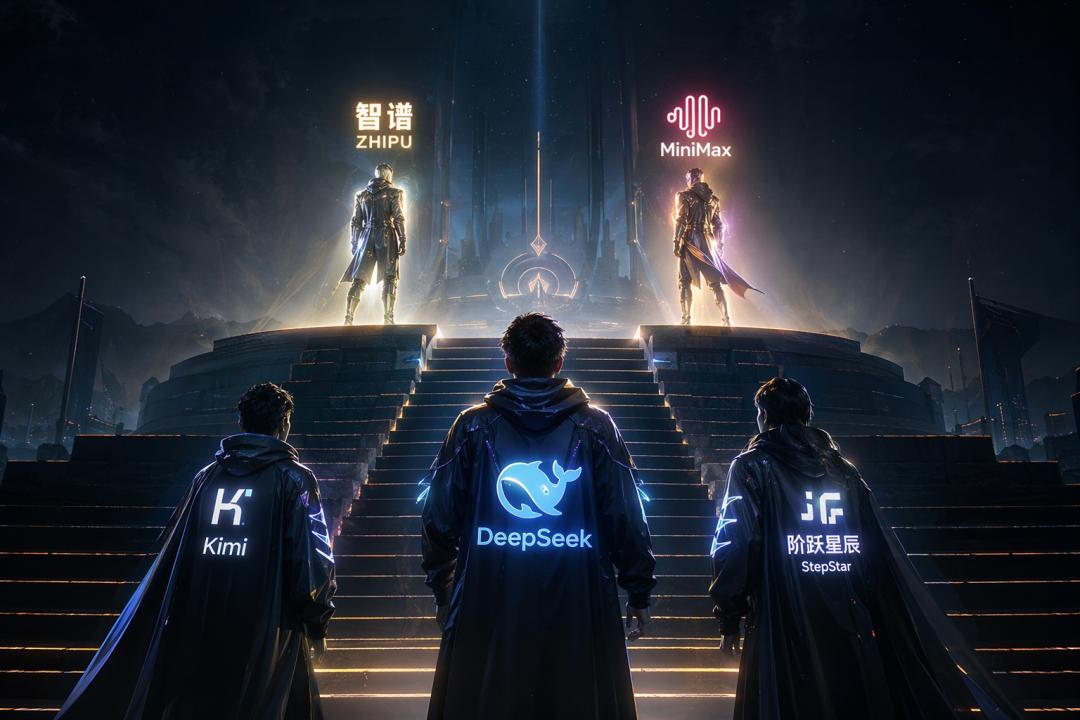
In the past week, the Chinese large model industry has suddenly entered an almost crazy state of financing.
Kimi completed a $2 billion financing round, with its valuation exceeding $20 billion.
Jieyue Xingchen was reported to be close to completing nearly $2.5 billion in financing. At the same time, it is accelerating the dismantling of its red - chip structure, and its Hong Kong IPO is entering the final sprint stage.
DeepSeek first announced that it is accepting external financing, with the participation of the national large - scale fund, pushing its valuation range up to $45 - 50 billion.
Three companies attracted more than $7 billion in funds within three days. This is no longer just an additional investment to make good things better. It's more like a collective rush to grab future survival quotas.
On the surface, this is the hottest time for the large model industry.
But the truly dangerous industries are often the hottest ones.
When capital no longer spreads evenly and puts all its chips on the last few leading players, the industry may seem extremely prosperous, but in fact, it has entered the eve of a market clearance.
The sharp rise of Zhipu and MiniMax after their listings has gradually made everyone realize:
There may not be much time left for independent large model companies.
I. Models are becoming commoditized
In the past two years, the biggest consensus in the large model industry was that there was a huge generational gap in model capabilities.
GPT - 4 was once out of reach. As long as a startup could get a little closer in a certain dimension, such as long - text processing, reasoning, multi - modality, or Agent, capital was willing to offer a very high premium.
Everyone believed that the capability gap would form a long - term barrier.
But the situation changed in 2026.
Long - text processing is no longer scarce. Reasoning ability is no longer scarce. Multi - modality is no longer scarce.
After DeepSeek V4 brought the open - source capabilities close to or even on par with GPT - 4 or newer versions, the industry truly realized for the first time that model capabilities themselves might be easier to catch up with than everyone thought.
There are still differences between Qwen, DeepSeek, Gemini, Claude, and GPT - 5.5, but it's hard to form a generational crush anymore.
Models are becoming commoditized.
Once commoditization occurs, the capital market will re - ask a question: What's left besides the model?
So the narrative of the entire industry suddenly changed.
In 2023, all companies were talking about having stronger models, more parameters, better reasoning, and longer context. Now they start talking about controlling the terminals, binding the industrial chain, having user entrances, and possessing national - level strategic value.
This transformation marks that the large model industry has officially entered the stage of territory occupation from a technological competition.
The data from the capital market has already reflected this.
During the "Hundred Models War" in 2023, the number of domestic large model companies emerged exponentially. According to data from Yibang Power, in that year, the six emerging large model companies collectively raised more than 6 billion RMB, accounting for more than half of the total early - stage financing of domestic large models. In 2024, it was even more crazy. There were 168 financings of over 100 million RMB in the global large model industrial chain, with a total financing amount of over 400 billion RMB.
The six emerging large model companies collectively raised at least 20 billion RMB throughout the year, and the single - deal financing records were constantly being refreshed.
Then came 2025. The situation took a sharp turn for the worse.
According to reports from the investment community, AI model - layer companies only completed 22 investment deals throughout the year, with a total disclosed amount of 9.4 billion RMB, a 52.9% decrease from 2024. The proportion of large model financing in the total AI investment dropped sharply from 51% in 2024 to 14%. Only three companies, Zhipu, MiniMax, and Yuezhianmian, had single - round financings of over 2 billion RMB.
The number of companies that could get funding dropped from 100 to less than 10. The elimination rate exceeded 90% in two years.
So when we see three financings totaling $7 billion concentrated in this week in May 2026, its meaning is clear. The money is not flowing into the industry but to the last few players.
The larger the financing, the higher the concentration. The higher the concentration, the smaller the space left for the later - comers.
II. The music hasn't stopped, but there aren't enough seats
The crazy rise of Zhipu and MiniMax after their listings had a far - reaching impact on the entire industry. It established a reference for the value of domestic large models in the secondary market.
Once this reference standard is established, all unlisted companies are facing a race against time. If they don't complete their valuation during the current window, once the market gets tired and the prices correct, their primary - market valuations will be instantly shattered.
The window wasn't opened by you. It was propped open by the pioneers. If you don't jump in, it will close.
Jieyue Xingchen plans to submit its listing application in the Hong Kong stock market before the end of June and complete the listing by the end of the year. It has already dismantled its red - chip structure. The joint - stock system reform was completed in April. All the pre - listing steps were compressed and completed within a few months.
Kimi's ARR increased from $100 million to $200 million within a month. Investors voluntarily disclosed this figure to the media, which is extremely rare in the primary market. Usually, a company only allows its core financial indicators to be made public when it is preparing for the next round of financing or a listing sprint.
This kind of eagerness to "prove itself" shows that the primary market no longer believes in pure imagination. They want to see cash flow and the certainty of exit. (Extended reading: Kimi doesn't lack money. What it lacks is DeepSeek)
DeepSeek has never accepted external financing before. Now, the national team has entered the picture.
Although the three companies seem to be doing different things, their underlying logic is exactly the same: lock in their identities, lock in their valuations, and lock in their exit channels. Do it while the window is still open.
III. Becoming more expensive but less valuable
Why exactly now? Why can't we wait?
The reason lies in the economic model of the large model industry, which is exposing an increasingly fatal contradiction.
On the cost side, GPU clusters, inference computing power, long - context processing, multi - modality, and Agent, each new capability is consuming cash.
But what's really scary isn't training. It's inference.
Training is a one - time investment. Inference costs increase in sync with the user scale. Each token, each call, and each Agent task corresponds to real GPU consumption.
In the era of mobile Internet, the more users a platform has, the more money it makes. In the AI era, the more users a model company has, the poorer it may become.
For WeChat, adding one more user hardly increases Tencent's marginal cost. For Douyin, adding one more user means one more advertising slot. For Doubao, adding one high - frequency user means continuously increasing inference expenses. (Extended reading: The more users, the poorer ByteDance)
Large model companies naturally need continuous financing capabilities. However, the money in the primary market cannot be supplied infinitely.
The reason why listing has suddenly become extremely important is not just about exit. More importantly, it means getting a public capital channel for long - term financing.
This is what all independent model companies are really anxious about today.
The revenue side is even more brutal.
DeepSeek has truly brought price war into the large model industry. High - performance, open - source, and extremely low prices have been achieved simultaneously for the first time.
This is a devastating blow to the entire industry. The profit margin in the API market has been directly compressed.
The entire industry suddenly realizes that model capabilities may not be the scarcest thing. What's truly scarce is the ability to continuously burn money, the ability to bear long - term losses, and the ability to withstand price wars.
And startups naturally can't match the giants in these aspects.
The scary thing about giants isn't their models. It's their cross - subsidy ability that startups will never have. ByteDance can offer Doubao for free for a long time because its advertising business provides continuous financing. Recently, Doubao planned to start charging because it couldn't bear the cost, which shows how crazy the money - burning is.
Tencent can promote Yuanbao at a low price because its game and social media businesses are still profitable. Startups' models have to learn to support themselves.
Giants compete with their ecosystems. Startups compete for survival.
There is also a change that many people haven't realized yet.
In 2023, when capital invested in large models, it was essentially buying "possibilities".
Because everyone believed that as long as they could create the next GPT - 4, they might redefine the Internet. So at that stage, financing was still based on the founder's background, the technical team, model capabilities, and imagination space.
But today, capital is looking at a different set of things.
It starts to ask whether you have cash flow, a terminal entrance, an ecological binding, and whether you can survive the next price war.
This means that the financing logic of the large model industry has started to shift from venture capital to infrastructure investment.
Venture capital believes in the future. Infrastructure investment only believes in the survival rate.
Once the industry enters the infrastructure stage, capital will naturally concentrate on the leading players. Because the infrastructure industry never needs too many players.
IV. A sense of déjà vu with the "Four Little Dragons"
This scenario isn't playing out for the first time.
Around 2018, the "Four Little Dragons" in the AI vision track, SenseTime, Megvii, CloudWalk, and Yitu, went through almost the same plot: crazy financing, sky - rocketing valuations, and record - breaking rounds. Everyone believed that the AI era had arrived.
What happened later?
Tencent, Alibaba, and Huawei entered the market comprehensively. AI vision became a standard feature in cloud services. The technical premium of independent companies evaporated instantly, and they couldn't achieve large - scale commercialization. In the end, they experienced long - term under - performance and silence after their listings.
Today, the large model track is entering the same stage. The difference is that this time the stakes are higher, the money - burning speed is faster, and the giants' crushing is more direct. ByteDance's annual investment in AI may exceed the total financing of the entire "Six Emerging Large Model Companies".
The global capital is telling the same story. In the third quarter of 2025, the total financing scale of global AI startups reached $97 billion, of which nearly 46%, about $44.6 billion, was concentrated on no more than five leading basic model companies such as Anthropic and xAI.
Entering 2026, the financing of leading model companies has further accelerated and reached a new level:
OpenAI completed a $122 billion financing round in March, with a post - investment valuation of $852 billion; Anthropic completed a $30 billion Series G financing round in February, with a valuation of $380 billion, and then immediately launched a new round of pre - IPO financing of about $50 billion, aiming for a target valuation of $900 billion.
Capital is concentrating on the leading players with unprecedented intensity, and mid - tier companies are experiencing the longest liquidity winter.
This trend also holds true in China. In 2025, the proportion of large model financing in the total AI investment dropped from 51% to 14%, but the top three companies took the vast majority of it. The money didn't disappear; it just stopped being evenly distributed.
Moreover, the elimination speed is much faster than the previous generation. It took nearly a decade for the mobile Internet to go from the "Hundred Group Buying War" to the monopoly of Alibaba and Tencent. The large model industry may only need three years to go from the "Hundred Models War" to market clearance.
A year ago, Baichuan Intelligence was one of the companies most similar to China's OpenAI. Wang Xiaochuan almost appeared in every large model discussion. Today, it rarely appears at the center of financing news. Lingyi Wanwu was once a star startup team, and Li Kaifu publicly announced "All in AI". But the industry is discussing less and less about whether it can enter the next round.
The large model industry doesn't need a company to have backward technology to eliminate it. It just needs the capital window to close first.
V. Three paths, three bets
Today's large model startups have diverged into three completely different routes.
DeepSeek chooses to become a national - level technological asset.
Its $45 billion valuation doesn't entirely come from commercialization but from the strategic significance of its technological barriers. Its leading position in algorithm efficiency makes it a national - level reserve. The entry of the national large - scale fund shows that its positioning has gone beyond the scope of commercial competition. Its risks lie elsewhere, such as a fragile organizational structure and the loss of several core researchers.
Jieyue Xingchen chooses to bind the hardware industrial chain. Core players in the consumer electronics industrial chain, such as Huaqin, Longcheer, OmniVision, and ZTE, have collectively invested in it.
Yin Qi, the chairman of Jieyue Xingchen, has a clear logic. The capabilities of basic models will eventually be leveled. The real moat lies in who can embed the model into the terminal supply chain, making it impossible for competitors to replace you without replacing the entire chain. By the end of 2025, 42 million mobile phones were pre - installed with its model, covering 60% of top - tier brands. The importance of these numbers lies not in the scale but in the depth of embedding.
Kimi chooses user scale and speed. Its ARR increased from $100 million to $200 million within a month, and both paid subscriptions and API usage increased simultaneously. But its problems are also the most acute. Its monthly active users dropped from a peak of 36 million to 8.33 million, and ByteDance's Doubao, with 350 million monthly active users, has an absolute advantage. The API price in the B - to - B market has also been undercut by DeepSeek.
Kimi's product is still excellent. But being an excellent product is no longer enough.
The three companies have completely different routes, but they have one thing in common: None of them is talking about making the best model in China anymore. Everyone is talking about the position they have occupied.
VI. The end of financing isn't expansion
Why did