Apple bets on AirPods for its AI hardware debut. Is the era of "fake AI" in AI earphones coming to an end?
In February this year, Apple CEO Tim Cook revealed at an internal all - staff meeting that the company was developing a "new category of products" driven by artificial intelligence. This statement didn't attract much attention at that time because everyone thought he was talking about smart glasses.
However, Apple's first bet is actually a pair of smart earphones with active sensing capabilities.
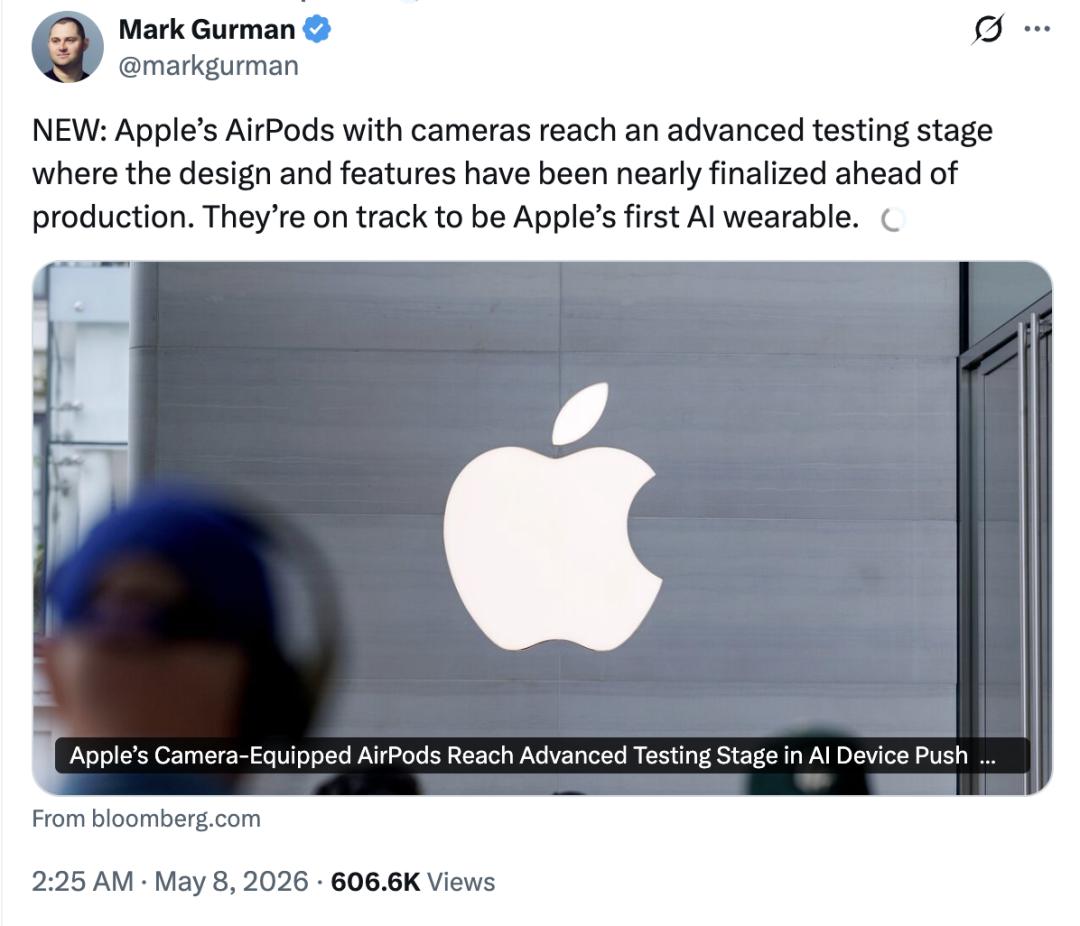
On May 8, 2026, Bloomberg reporter Mark Gurman confirmed that the new AirPods equipped with cameras have entered the DVT (Design Verification Test) stage. Apple employees have been using them internally, and it is expected to be released as early as this autumn along with iOS 27. The research and development of this product can be traced back four years ago, much earlier than this round of AI hardware boom.
In the past two years, the AI hardware track has never been quiet, but there are few products that truly change the user experience. This is especially true for the earphone category - it is the device that modern people wear for the longest time in their daily lives, but it has never really become the real foothold for AI. What the H90 tries to answer is a question that has troubled the industry for a long time - to what extent should the combination of AI and earphones go?
Maybe the timing is just right. The computing power of edge - side chips and the context ability of large models have matured simultaneously in 2026. The two hard constraints that restricted AI earphones in the past are loosening. Apple's entry is likely to become the turning point for this category to move from concept to real implementation.
Apple's First Show of AI Wearables
Has Been in the Works for Four Years
According to Mark Gurman, the research and development of this product can be traced back four years ago, much earlier than this round of AI hardware boom.
It is worth noting that the cameras equipped on the new AirPods are not the usual ones. According to multiple sources such as MacRumors, Apple has built - in miniature infrared cameras, which are more similar to the Face ID array of the iPhone. It doesn't take photos or record videos, but scans the environment around the wearer, extracts spatial depth, object contours and motion states, and provides real - time situational data to Siri.
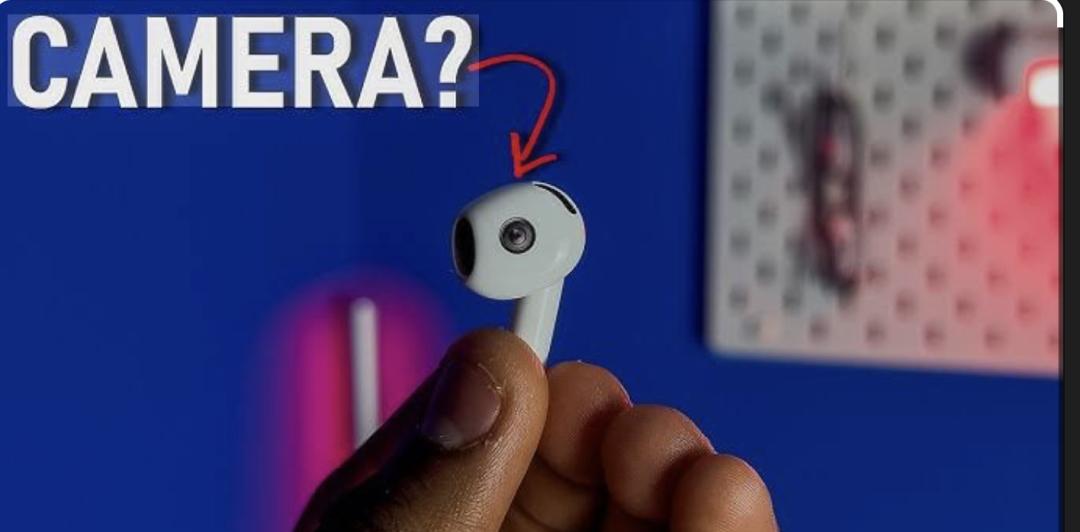
This set of data is sent to the new - generation H3 chip, and edge - side AI inference is completed on the earphone itself without relying on the cloud throughout the process. In the words of 9to5Mac, this is not "the earphone version of Visual Intelligence", but a brand - new environmental perception architecture.
Apple named this set of capabilities "ambient intelligence". Its operation logic is different from all existing voice assistants: Siri no longer waits for you to speak, but continuously senses your environment and actively intervenes when it judges that you need help. This interaction mode of "appearing actively and disappearing without a trace" is something that voice assistants have never truly achieved in the past 10 years.
The H90 is just the first step in Apple's wearable device layout. According to reports from Bloomberg and LA Times, Apple is also promoting two other AI devices at the same time: smart glasses codenamed N50, which are planned to start mass - production at the end of 2026 and be officially released in 2027; and an AI pendant that can be clipped on a shirt or worn as a necklace, with a built - in always - on camera and microphone.
The three products share the same logic: instead of replacing the iPhone, they build a multi - modal perception network around the human body, allowing Siri to truly have "eyes" for the first time.
On the same day that Gurman's report was released, supply - chain news poured cold water on this plan: Some production lines of the H90 project have been "dissolved on the spot", and the direct reason is the compliance pressure from EU privacy regulations. The strict restrictions of GDPR on the processing of biometric data and the EU court's judgment in December 2025 requiring the obligation of immediate notification when passively collecting data in public places are almost impossible to implement in reality.
However, most analysts believe that this suspension is more like an adjustment in rhythm. The hardware research and development of the H90 has advanced to the DVT stage, and it is unlikely that Apple will let four years of efforts go to waste. A more reasonable judgment is that it is waiting for a clearer signal from the regulatory level.
Double Support from Local Chips and Large Models
AI Earphones May Bid Farewell to "Pseudo - Intelligence"
In the past two years, AI earphones have seemingly presented a prosperous scene, but a closer look is inevitably disappointing. A large number of products under the banner of "AI earphones" have emerged in the market. Their core functions are almost only translation and meeting transcription. Some manufacturers have also piled up gimmicks such as AI fitness guidance and constellation divination, but they are just "moving" mobile phone functions to the earphone end via Bluetooth. The real edge - side AI capabilities are almost completely absent, and only basic voice wake - up can be achieved locally.
The reason why AI earphones have always remained at the "pseudo - intelligence" level stems from the double constraints of hardware and software. At the hardware level, the battery capacity of earphones is measured in milliwatt - hours, and the computing power of mainstream chips is less than 1% of that of mobile phones, which simply cannot run any decent local large models.
The more fundamental limitation lies in software: the voice interaction of most current AI earphones still stays in the linear logic of "instruction - response", unable to understand vague expressions and multi - round conversations, and the context is almost broken between two rounds of conversations. Users must remember fixed instructions, and even a slight deviation will lead to non - recognition. Such AI earphones are essentially just a fancier voice remote control.
With the simultaneous breakthroughs in hardware and software, this situation began to change in 2026. Driven by Apple's demonstration effect, real AI earphones are expected to be fully implemented.
At the hardware level, the bottleneck of local computing power is being broken. The H3 chip specially developed by Apple for the H90 has achieved local AI inference of visual and audio multi - modal data.
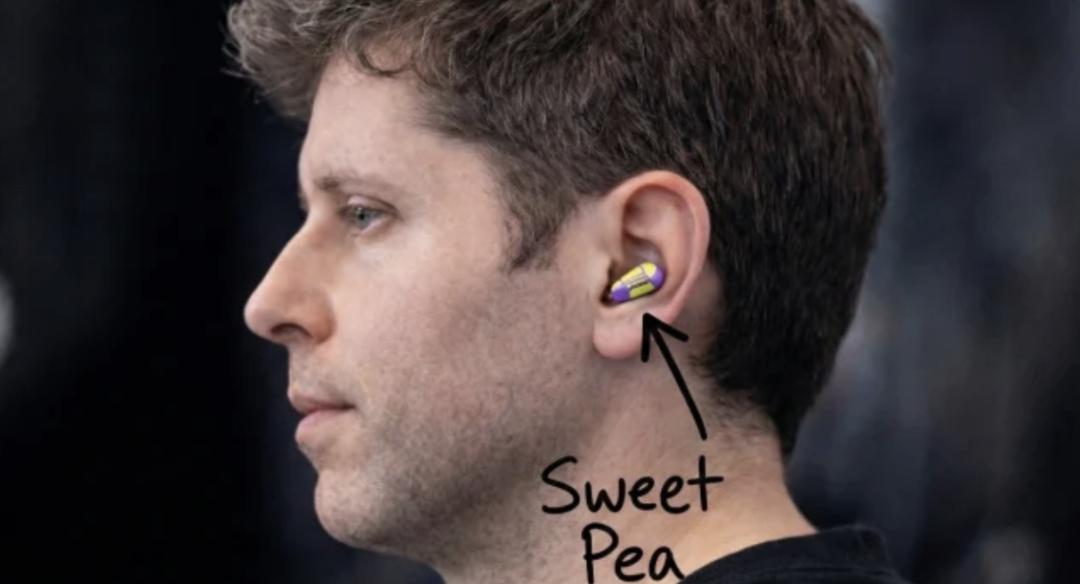
In May 2025, OpenAI acquired the design company LoveFrom co - founded by former Apple chief designer Jony Ive for about $6.5 billion. According to multiple supply - chain sources, the first product of their cooperation, codenamed "Sweet Pea", is very likely to be a smart earphone focusing on AI interaction. It will be equipped with a custom - made 2nm - process chip, aiming to achieve local processing of AI tasks on the earphone itself, and is planned to be released in the second half of 2026.
Apple and OpenAI, from different paths, point to the same judgment: the real independence of AI earphones must be established at the chip level.
At the software level, the maturity of large - model capabilities is rewriting the upper limit of voice interaction. The context understanding window of current mainstream large models can now accommodate a complete meeting or a continuous conversation, rather than the one - question - one - answer instruction - based interaction. Huawei's FreeClip 2 has supported Doubao voice wake - up since January 2026, allowing "Xiaoyi" to give way to third - party large models at the interaction entrance. This is an honest admission that the single - system AI assistant can no longer meet users' needs in terms of naturalness of conversation.
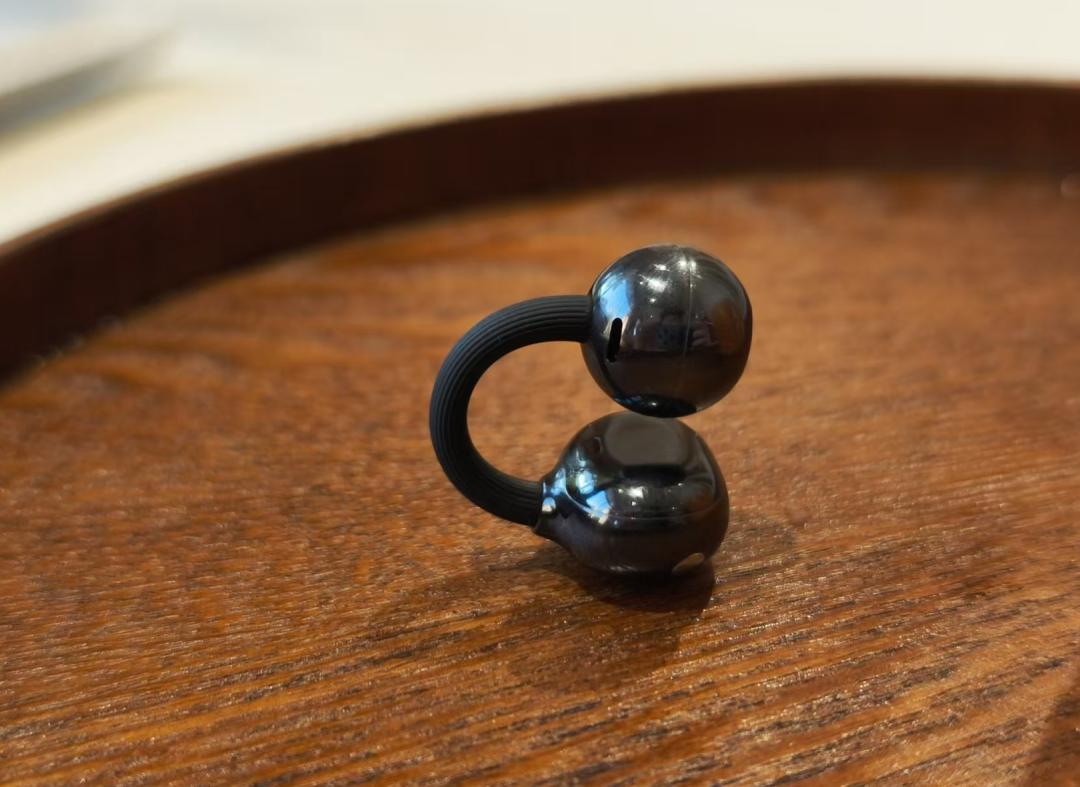
The double breakthroughs in hardware and software have made several clear evolution directions for AI earphones in 2026.
From "audio collection" to "environmental holographic perception". The infrared camera of Apple's H90 gives the earphone the ability to actively perceive the physical space for the first time - not just to hear sounds, but to understand the scene. The Timekettle W4 series approaches the same direction from the acoustic dimension: the hybrid bone - voiceprint and air - conduction sound - pickup architecture can distinguish the orientation and identity of the conversationalists and achieve accurate translation by roles.
The expansion of the sensor dimension has gradually transformed the earphone from a single - function audio device into a terminal with the ability to perceive the surrounding world.
From "mobile phone peripheral" to "portable AI hub". When the edge - side computing power is truly implemented, the relationship between the earphone and the mobile phone will be fundamentally reconstructed. In the future, the earphone will be a terminal capable of independent perception, independent reasoning, and independent response, and the mobile phone will degenerate into an optional data - supplement source. OpenAI's high expectations for "Sweet Pea" are based on this judgment: once the earphone becomes an independent AI terminal, its usage frequency and user stickiness will far exceed any previous wearable devices.
From "passive response" to "active perception". The logic of traditional voice assistants is: the user issues an instruction, the AI executes it, and it ends. What the new - generation AI earphones pursue is that the AI continuously senses the user's state and scene, appears actively when needed, and completely disappears when not needed.
Apple's "ambient intelligence" is the clearest expression in this direction - Siri no longer waits for you to speak, but actively intervenes when it judges that you need help. Jony Ive's design philosophy has always advocated that "technology should be invisible", and OpenAI's "Sweet Pea" also points to this ultimate state. This is not just a design choice for a single product, but a critical point that the entire track is crossing.
According to data from The Business Research Company, it is estimated that the global AI earphone market will reach $7.42 billion in 2026 and $17.34 billion in 2030. The core driving force for growth is shifting from the technical label of "built - in large model" to real and tangible scene value.
Earphones and Glasses Compete for the AI Hub
Domestic and Foreign Big Companies Place Bets on Two Fronts
When AI earphones start to evolve from mobile phone peripherals to portable AI hubs, a bigger question emerges: in the territory of wearable AI, are earphones and glasses in a competitive or a complementary relationship?
The smart glasses track experienced a real explosion in 2025: Omdia data shows that the global shipment of AI glasses reached 8.7 million units, a year - on - year increase of 322%, and Ray - Ban Meta accounted for about 85.2% of the market share. The domestic market was also bustling in 2026, with Doubao AI glasses and Qianwen AI glasses entering the market one after another, and Baidu, Xiaomi, and Huawei also disclosing their respective plans.
Even so, glasses still have their structural limitations: about 60% of adults around the world don't need to wear glasses daily, and wearing a pair of smart glasses is an additional habitual burden; the "feeling of being monitored" caused by devices with cameras in public places has continued since the Google Glass era.
In contrast, earphones are one of the electronic devices that modern people wear for the longest time. Voice is also the most natural output end of AI capabilities - there is no need to look up at the screen, take out the phone, or change any ongoing actions. When you are walking, glasses require you to shift your sight from the road to the lenses; earphones can deliver information to you in the most unnoticeable way at any time.

For this reason, almost all companies that bet on smart glasses are also deeply involved in the layout of smart earphones. ByteDance is a typical representative of "earphones first": its first AI wearable was the Ola Friend earphone released in October 2024. In July 2025, it integrated the Doubao simultaneous - interpretation large model 2.0, which can achieve real - time simultaneous interpretation in complex scenarios such as exhibitions and negotiations. The basic version of the Doubao AI glasses was not launched until the first quarter of 2026, and the high - end version will be available at the end of the year, with a time difference of 18 months between the two.
Alibaba has adopted the strategy of "glasses first, earphones follow". In March 2026, it released the Qianwen AI glasses, which feature "what you see is what you get" visual interaction and deeply integrate Alibaba's ecological applications. The Qianwen AI earphone is planned to be released within this year, focusing on voice assistants and content ecosystems. Different from ByteDance, Alibaba has clearly proposed a three - terminal cooperation strategy of "glasses + earphones + rings", with clear division of labor and complementary scenarios among product lines.
Of course, earphones also face challenges. Battery life is the first hurdle: continuous environmental perception and AI reasoning consume a large amount of power. After turning on all - day environmental perception, the current battery technology can only support less than 4 hours.
Privacy is the second hurdle and also the area where the regulatory pressure is most concentrated at present. The constant presence of the earphone's microphone and continuous data collection by sensors naturally touch on privacy - sensitive areas. In the EU, this pressure has been embodied in regulatory constraints: the strict restrictions of GDPR on the processing of biometric data and the EU court's judgment in December 2025 requiring the obligation of immediate notification when passively collecting data in public places - this is also the direct reason why Apple's H90 has encountered compliance obstacles in Europe.
Even in the relatively relaxed US market, users' vigilance against continuous collection of private conversations by AI devices is also common. How to find a balance between environmental perception and privacy protection that users can truly accept is a question that all AI earphone manufacturers need to answer.
However, these challenges do not change the common judgment of big companies: glasses and earphones are not in a mutually exclusive competition, but two complementary entrances in the perception dimension.
Neither of them is the end, but different paths to the same goal - to make AI completely jump out of the screen and integrate into the human physical world with the lowest perception burden.
The end - game of this competition is not that one device beats another. Instead, when the capabilities of earphones and glasses are mature enough and their cooperation is smooth enough, users will find that they no longer need to take out their phones. That moment is when AI truly completes the "transition from the screen to reality".
References:
[1] Apple's first AI hardware is in trouble even before its release, ifanr
[2] The earphone track in 2025: AI functions fizzle out, translation earphones rise, and front - line players engage in a close - range fight, Lei Technology
This article is from the WeChat official account "AI Value Officer", author: Xingye, editor: Meiqi, published by 36Kr with authorization.