AI starts to take over the "spiritual refuge" of young people
Written by | Guobaoyou
Cover source | Unsplash (AI-assisted image expansion)
The May Day holiday is over, but the "post-holiday syndrome" of office workers has not subsided.
Facing the never-ending messages in the work group and the endless PPT revisions, office worker Guoguo opened a mini-game called "I Fired My Boss" in the Lingguang APP while slacking off.
The boss's favorite PUA lines popped up on the screen: "You have to trust my judgment" and "All your current efforts will pay off." She clicked frantically. Accompanied by the sound of falling gold coins, she experienced the thrill of beating up the boss and getting rich overnight in the cyber world.
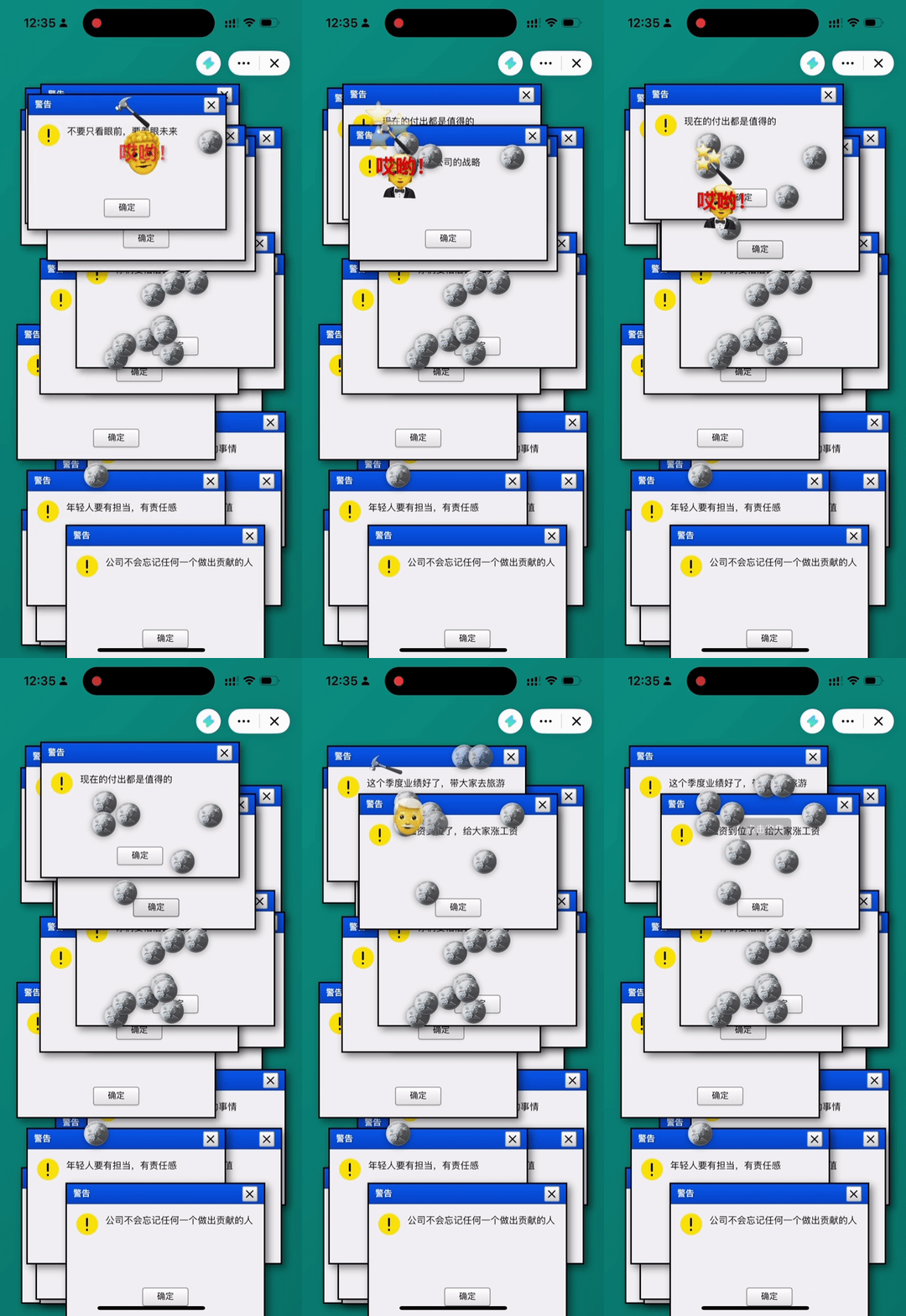
"I Fired My Boss"
This app that made Guoguo "come alive" for a short time was not developed by a professional team. Instead, it was casually "crafted" in 30 seconds for free on the Lingguang APP by a netizen @Erxunlaoren who was also tortured by work.
This generation of young people even calculate carefully when it comes to venting their emotions. Because emotional value is becoming a clearly priced business - a 69-yuan "healing blind box" may very likely turn out to be a dud; a 50-yuan "listening service for your troubles" for half an hour will probably only get you a "hug" emoji and perfunctory platitudes from the customer service; a 298-yuan online tarot reading might even make you spend another 399 yuan to buy a string of lucky crystals.
Netizen @Xianyudawang hit the nail on the head: "Things that should be free are inexplicably 'priced', and in the end, we have to 'pay a price' to get them back."
Moreover, what you buy with money may not bring you relaxation but could be a rip-off.
So, some young people have decided to break out of the consumption trap. Since asking for emotional support from the outside world is both expensive and perfunctory, they'd rather do it themselves. They turned to AI and started to precisely customize zero-cost emotional remedies for themselves and others.

Real-life socializing is too expensive. It's better to "go crazy" with AI
Sharing your feelings in the real world often comes with hidden social costs.
If you vent to your friends, you're afraid of becoming their emotional burden. If you express your feelings on your WeChat Moments, you're worried about being screenshot by your colleagues. If you seek comfort from your elders, you'll probably get a lecture like "Young people should endure hardships."
Some people choose to turn off their social switch and pour out their emotions to AI.
Facing the oppressive work environment full of "office vibes", young people started to "go crazy in the cyber world". Someone created a small app called "SHIT APP" on the Lingguang APP, where they typed out all the unreasonable revision requests from clients, the empty promises from the boss, and the blame-shifting from colleagues on the screen. Then, accompanied by the sound of flowing water, they watched them being flushed down the drain. The creator said that the core of this app is - "You don't have to get better right away. Just flush away this mess in front of you first."
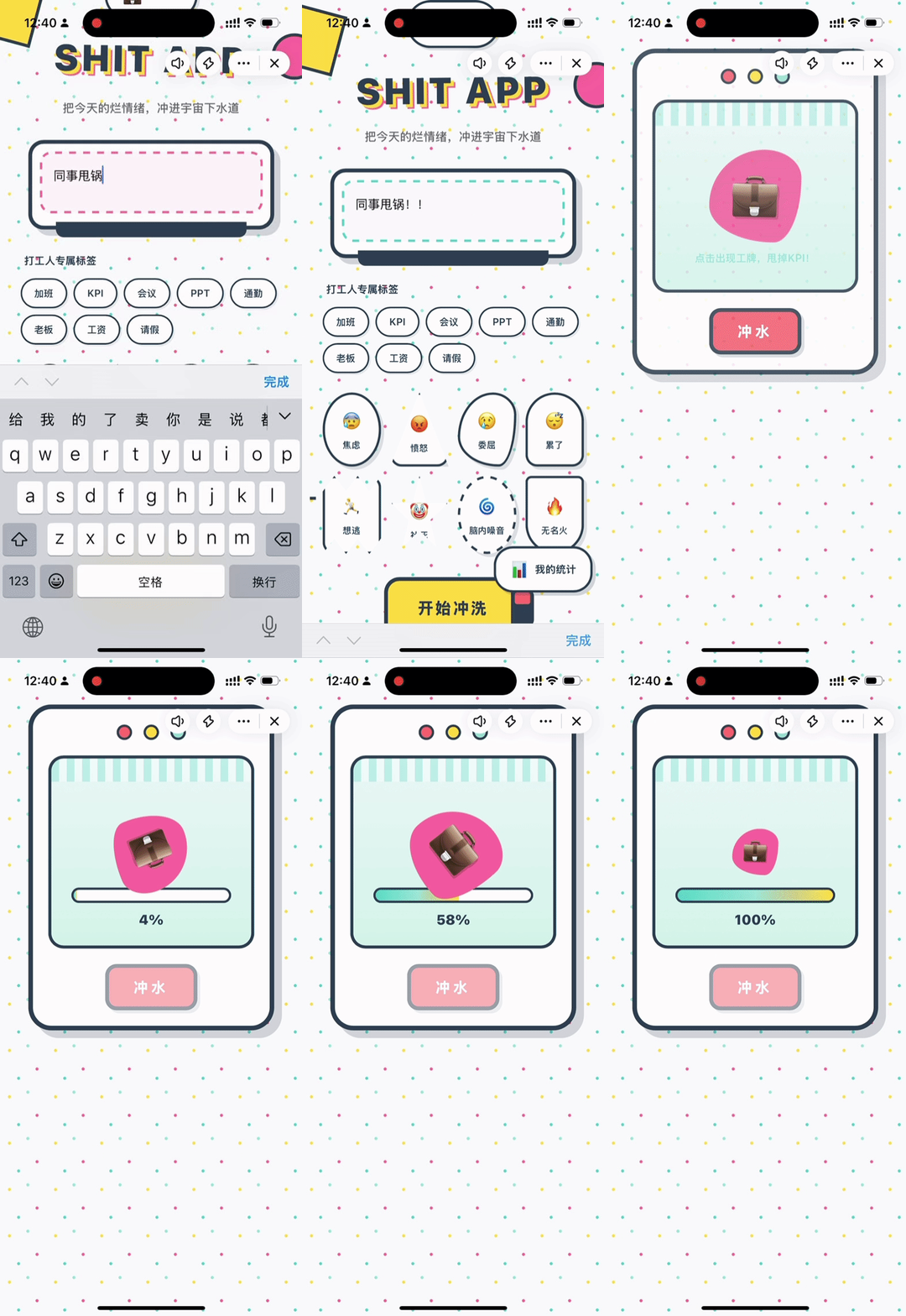
"SHIT APP"
Some people are also proficient in using prompt words to customize AI characters that best fit their current mental state.
When being tortured by the client to the point of collapse, someone created an "absolutely protective and unconditionally supportive sarcastic bestie"; when feeling down at night, someone would open a "gentle mother" chatbot; even after the open-source project "colleague.skill" became popular on GitHub, someone made an "ex.skill" - you just need to provide the chat records, QQ messages, Moments screenshots, and photos of your ex, along with some personal subjective descriptions, and you can generate an AI clone of your ex, making the AI simulate your ex's tone and say those familiar words...
For 22-year-old graduate student Yan Boqiang, he didn't want AI to give the same old "hug" responses.
During the preparation for postgraduate recommendation, the long-term academic pressure made Yan Boqiang want to give up several times and even be a bit self-destructive. "Maybe I shouldn't take this path. I might as well go to work or take the postgraduate entrance exam." But he couldn't tell his friends or parents. He didn't want to spread negative emotions and make them worried, and it was also difficult for them to empathize with him.
So, he created a flash app called "Mood Island" on Lingguang and specifically customized an "abstract sarcastic version". No matter how crazy you go, the elegant penguin on the screen won't comfort you gently but will directly retort. When you say, "I'm so tired. I don't want to pursue postgraduate recommendation anymore," it will say, "Are you sure it's not because you're just not good enough? Everyone has moments of wanting to give up. It's just that others hide it, and you're too honest."
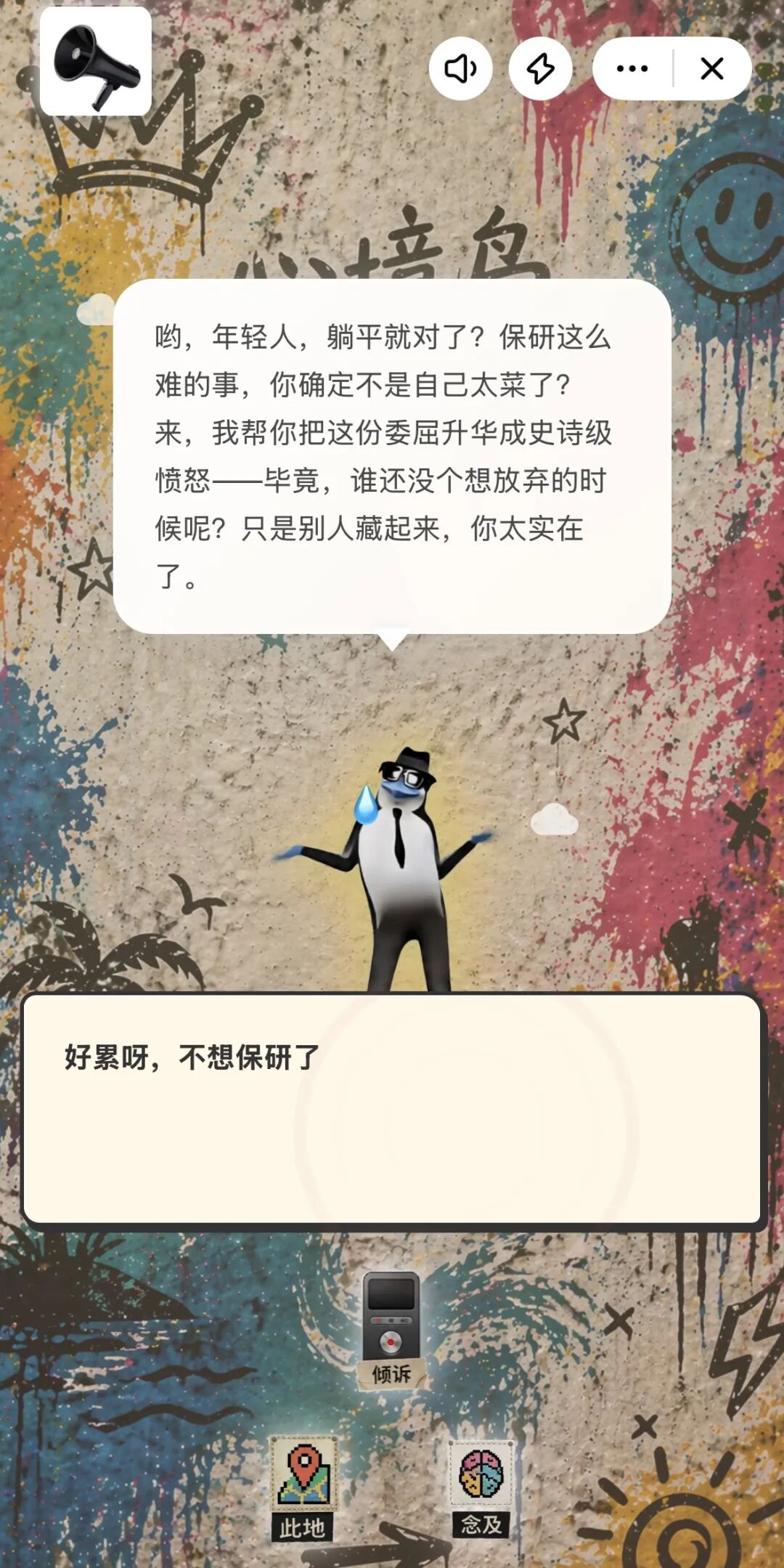
"Mood Island - Sarcastic Version"
This kind of straight talk under the guise of abstraction miraculously relieved his daily tension.
Venturing in the AI world doesn't require you to watch anyone's face, and you don't have to worry about not getting a response. Young people have finally found a place where they can break down at any time without explanation, take off their social burdens, and complete emotional self-rescue.

In an uncertain world, let AI be a reliable support
Emotional venting can only bring a short moment of relief. In an environment full of uncertainties, young people have many confusions that have nowhere to go. Their hearts are extremely eager for a certain "spiritual support".
In the past, they placed this support in metaphysics. They bought lucky bracelets, went to temples to burn incense, and had tarot readings. The "Electronic Wooden Fish" APP once ranked second on the overall APP download list, and the "Einstein's Brain" priced at 50 cents sold 70,000 copies on Taobao in half a year.
Now, young people are using AI to customize "cyber deities" for themselves at zero cost.
Someone created a "Worship Guan Gong" app on Lingguang. Whether it's for an upcoming performance appraisal or going to the hospital to check the medical report, they can take out their phones and sincerely worship at any time, believing that sincerity will be rewarded; someone else made a "Tarot Revelation". When being tortured by work to the point of going bald, it will timely give an oracle: "The goal has been achieved. Now you can rest"; when feeling confused about the future, it will tell you, "New opportunities are coming"...
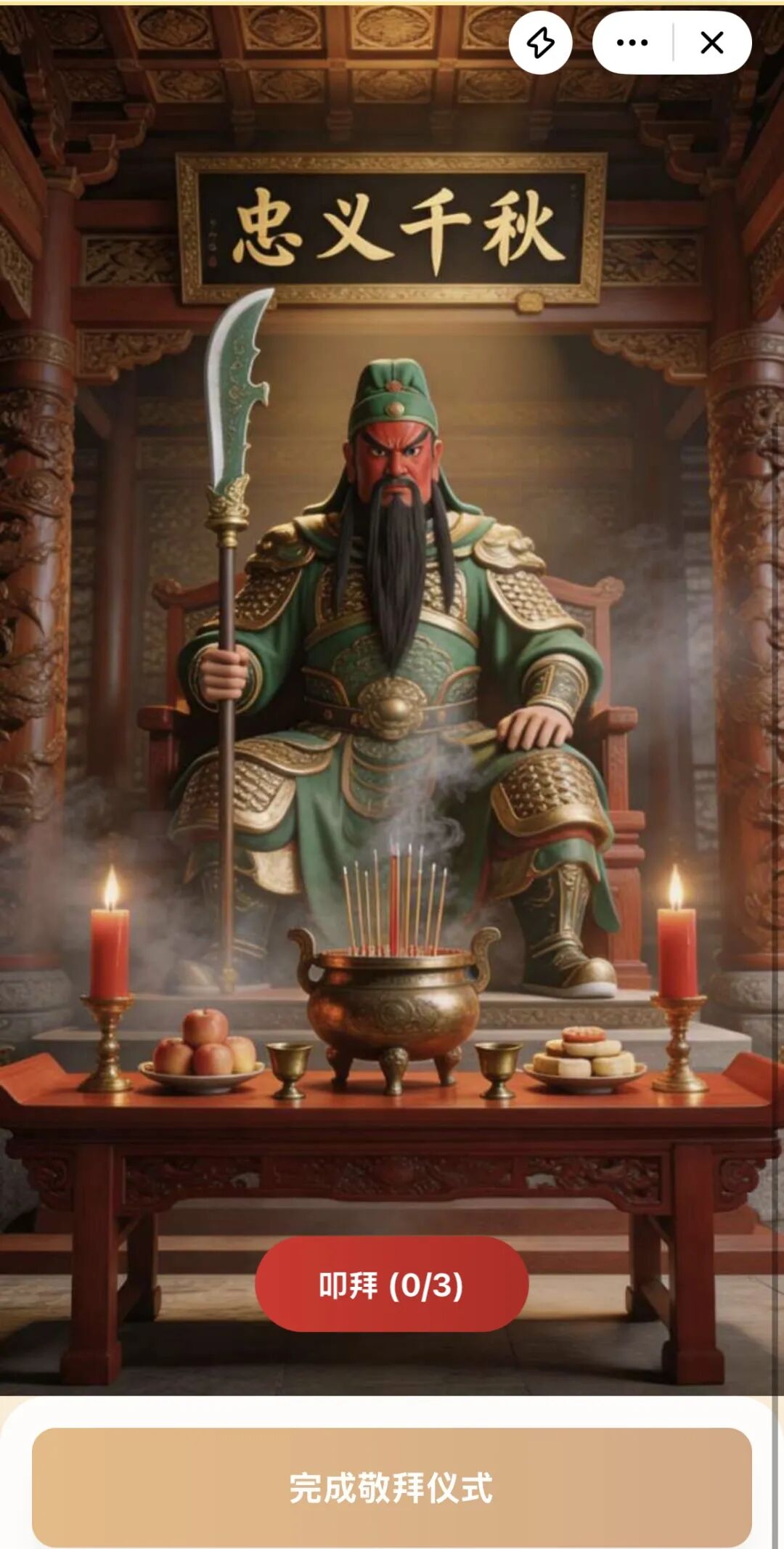
"Worship Guan Gong"
This zero-cost metaphysics has become an indispensable psychological placebo for young people.
But young people who are indecisive don't only turn to metaphysics. They also seek help from practical and hardcore tools.
A netizen had an argument with her husband over a piece of meat and sent the details to AI, asking AI to judge who was right; when the tech blogger @Woniudekejibiji found that when his friends asked him to judge who was right in a quarrel, no matter which side he favored, he would be labeled as "unobjective" and might even offend one of them. So, he created a "Did I Do Wrong?" scoring station with less than a hundred words of prompt words, leaving the right to judge right from wrong to AI.
The netizen @Guanxingdexiuyu, who was exhausted by "even an upright magistrate finds it hard to settle family feuds", simply created a "Family Dispute Judge" on Lingguang. Both the plaintiff and the defendant state their grievances, but the clever part is that this judge "doesn't judge who wins or loses but only offers a 'make-up package'". When a boy and his girlfriend are at a deadlock over the rotation of housework, the "AI Bodhisattva" will even privately send a message: "It's really recommended that you stop insisting on the so - called fair rotation. If you frame it as showing concern for her, she'll be more likely to accept it." @Guanxingdexiuyu said that this is like a cyber version of the neighborhood committee aunt. But different from the real - life aunts who like to smooth things over, the AI judge doesn't judge right or wrong but only offers a way out.
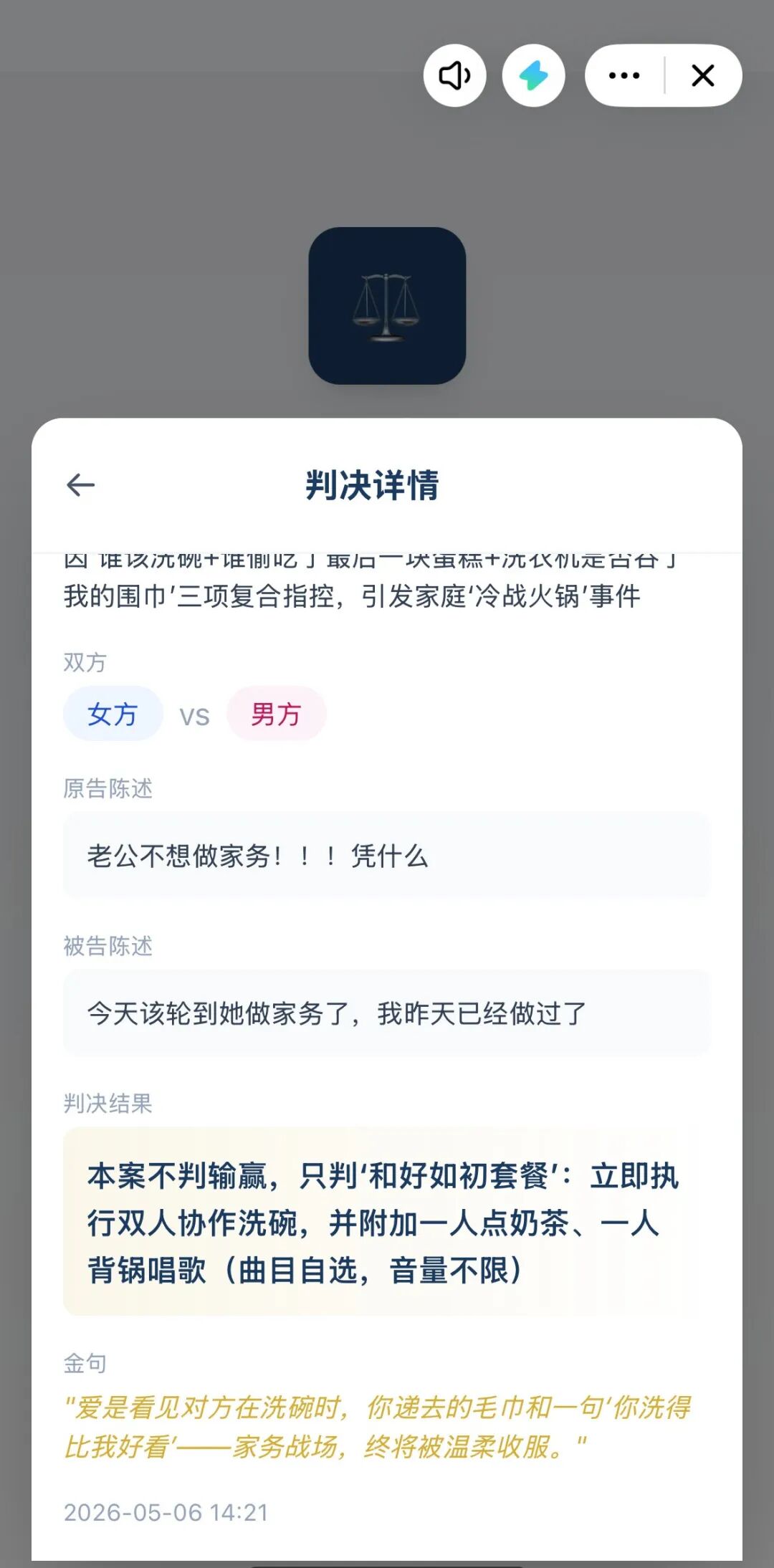
"Family Dispute Judge"
@Lingguangxiaohuixiang made a "Boyfriend's Get - Out - of - Jail - Free Card" specifically for coaxing girlfriends. It not only analyzes the girlfriend's face shape and recommends photo - taking angles but also comes with a whole set of complimenting lines to help you avoid your girlfriend's soul - searching questions. It also emphasizes, "If you can't take good photos, it's all the app's fault."
As a mother of two children, Ms. Han from Nantong, Jiangsu, wants to provide this kind of certainty to more women.
She noticed that many women on social media post questions about women's rights, and the high number of likes also reveals that they "may not know some knowledge that is helpful for their rights". So, she created a flash app called "Her Compass" on Lingguang to provide decision - making guidance for women in various aspects such as dowry, betrothal gifts, property distribution, and career. It also has a built - in knowledge base of women's rights and judicial cases, protecting women's rights in this way. "Your choices define who you are," she said.
Some people are also using AI to connect an external "cyber brain" to themselves and establish order in their daily lives full of variables.
@Jacky's AI Growth Diary, who always feels like having a "brain fog", created an app called "What was I about to do?" on Lingguang to gradually retrieve the just - lost memories; @kiki, who always spends two hours struggling in front of the suitcase before going out, made a "What to Bring for Travel?" list generator for herself, enabling mindless packing.
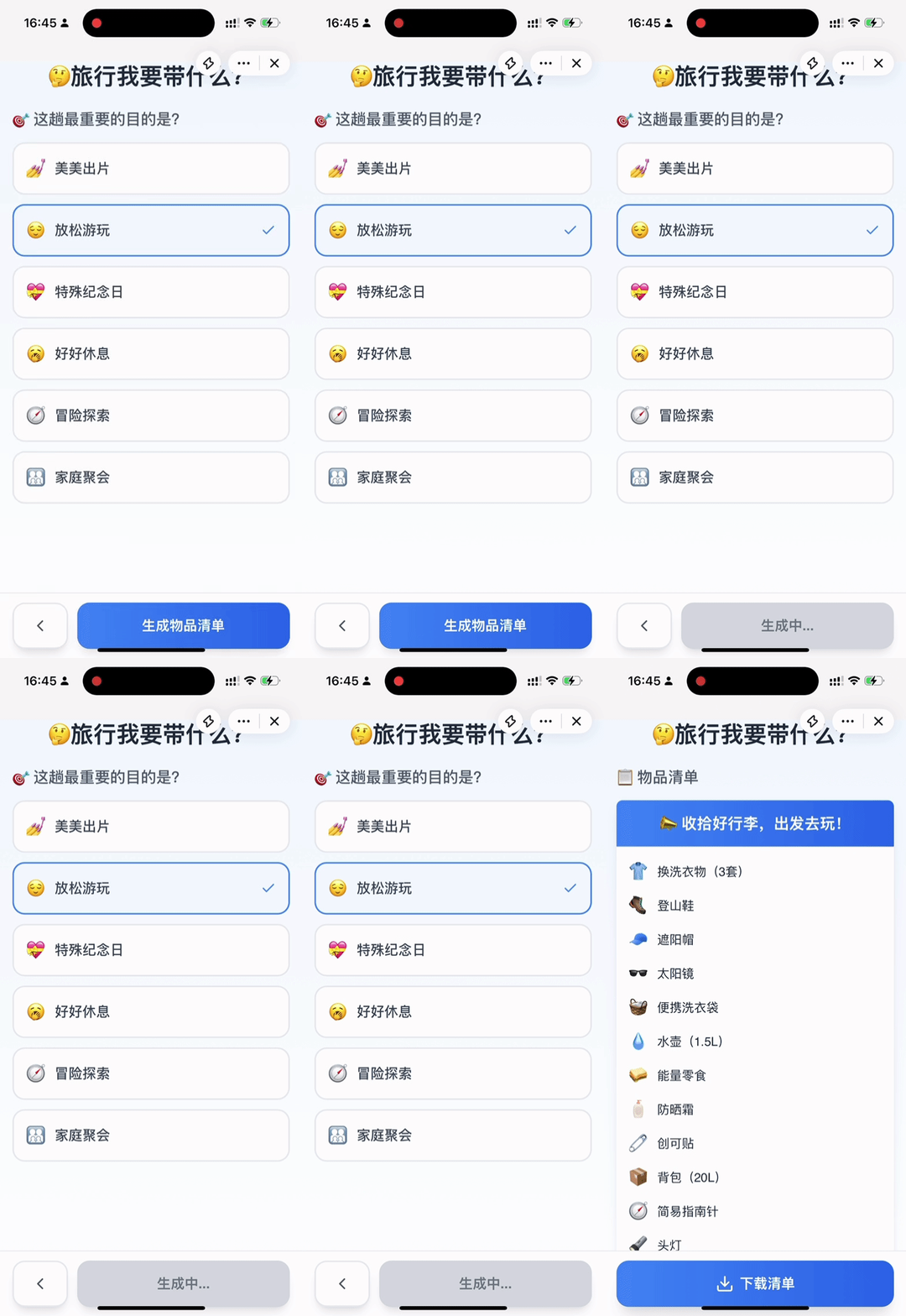
In addition to daily trivial matters, young people have also "radically improved" their learning methods. Someone created "GuaCiShe" to learn English while gossiping; someone made "Kitchen Notes" to turn nutrition knowledge into daily talk; someone else made "Mysteries of Nature" to learn natural knowledge like drawing cards... They named this way "Painless Brain - Building". They use AI to lock in a certain return of "reaping what you sow".
These seemingly small and fragmented needs are forming a huge universe. According to the data of the Lingguang App, in the Lingguang community, more than 30 million such flash apps created by ordinary people have emerged. They are like tiny "digital patches", precisely fixing every bug in real life.
Young people are using AI to resolve the confusions and contradictions in life. In the face of uncertainties, they have set up reliable coordinates for themselves with their own hands.

In a parallel universe, "raise yourself again" with AI
In addition to chatting and creating apps, AI - generated content (AIGC) has also become an important tool for young people to build their spiritual world at low cost.
When feeling down, someone uses AI to draw a surreal and grotesque illustration; when feeling lonely, someone makes their cat talk in a short video; when getting tired of the same old life, someone writes a few outlines and lets AI directly generate a micro - drama that suits their taste, full of healing feelings or exciting moments.
But young people aren't satisfied with this. They are starting to focus on deeper psychological pain points and use AI to reshape their lives.
Psychologist Pete Walker once mentioned in "It's Okay Not to Forgive" that children who have suffered trauma have many unmet development needs, and the main goal of re - parenting is to meet these needs. Some people sign up for a variety of interest classes in adulthood to make up for the childhood lack of interests. Some people get braces or have myopia surgery after achieving financial freedom to meet those unvalued needs from childhood.
Another group of young people, who can't be the protagonists of cool stories in real life, use AI to rewrite their life scripts.
19 - year - old girl Luo Yi studied in a fourth