An 18-year-old high school student used AI to discover 1.5 million unknown celestial bodies, and the first generation of ChatGPT natives graduated.
Just now, OpenAI launched a page called "ChatGPT Futures".
There are a total of 26 young people (or teams). Each person (or team) will receive a $10,000 bonus, plus access to cutting - edge models.
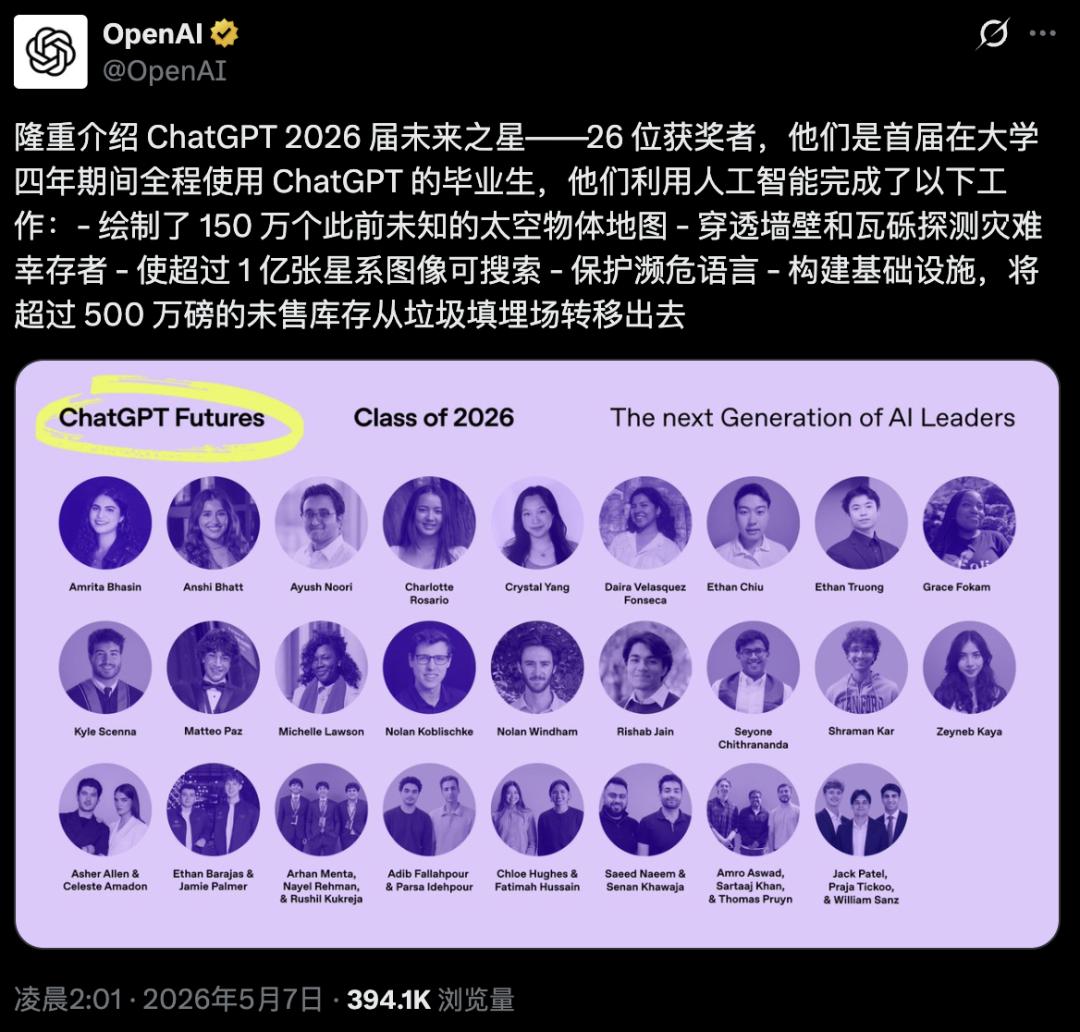
Among them, the most eye - catching name is Matteo Paz.
In March last year, he was still an 18 - year - old high school student. He developed a machine - learning algorithm to process nearly 200TB of data and about 200 billion rows of records accumulated from more than a decade of infrared sky surveys by NEOWISE. He marked and classified 1.9 million infrared variable source celestial bodies, of which about 1.5 million were potential new discoveries that had not been previously recorded.
His paper was published in the "Astronomical Journal".
In March this year, he won the top prize in the Regeneron Science Talent Search.
According to the description of Caltech (California Institute of Technology), this is "a local high school student achieving a breakthrough at Caltech".
And Paz is just one of the 26 selected individuals.
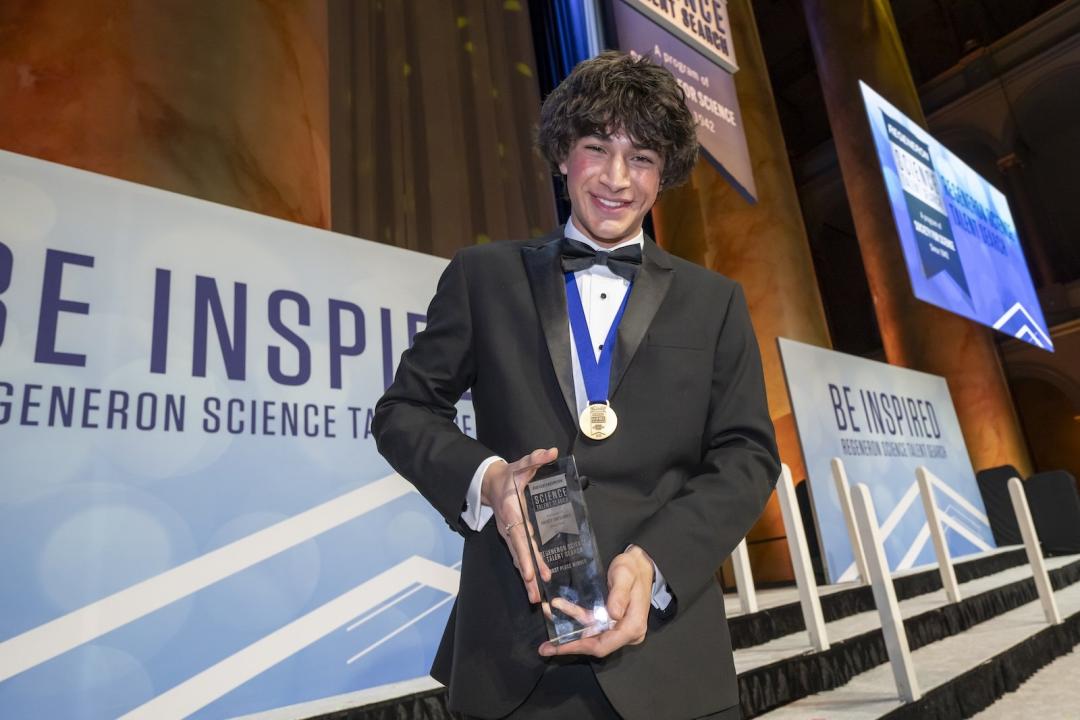
On March 11, 2025, 18 - year - old Matteo Paz held the top - prize trophy of the Regeneron Science Talent Search at the award ceremony. He won the award for discovering 1.5 million unknown celestial bodies with an AI algorithm.
On the same list, there are also -
18 - year - old Crystal Yang: She developed a learning game of "listening instead of seeing" for 200,000 visually impaired students;
19 - year - old Anshi Bhatt: Her anti - fraud system has helped 18,000 people avoid online scams;
25 - year - old Amrita Bhasin: The logistics system she built has diverted more than 5 million pounds of unsold inventory from landfills
...
Among the 26 projects, from astronomy to disaster relief, from medicine to agriculture, from the education of blind children to the financial management of street vendors in South America, none of them is "writing papers with ChatGPT". They are all looking at difficult problems that in the past could only be tackled with seniority, institutional support, and sufficient funds.
AI enables them to think boldly and take action, which was unimaginable for the previous generation of young people.
"The first generation of ChatGPT natives" has graduated
The class of 2026 is the first group of graduates who have had "ready access" to ChatGPT throughout their entire college experience.
Although "ready access" does not mean "total dependence", it is enough for AI to reshape the learning and living styles of a generation.
About three and a half years ago, in the fall of 2022, the freshmen of the class of 2026 entered college. More than two months later, on November 30, ChatGPT was launched. Their college years have since been tied to ChatGPT, and "the first generation of ChatGPT natives" was born.
Before the first semester of their freshman year ended, there was an AI on their desks that could write code, find literature, and talk about any topic.
Among these 26 individuals (or teams), there are 18 - year - old high school students and research groups formed across different schools. They are not all labeled as "graduating students", but they are all samples of this generation of young people.
The "ChatGPT Futures" launched by OpenAI this time is not only about awarding bonuses but also about setting an example for "outstanding young people in the AI era".
They "use AI to see what humans can't see"
What are the "first generation of ChatGPT natives" doing with AI?
Let's first look at three of the most representative projects.
The first is Matteo Paz's project.
He is dealing with all the data accumulated from a decade of sky surveys by NEOWISE, a retired NASA infrared sky - surveying telescope.
In the words of Paz's tutor, Davy Kirkpatrick: "This table has nearly 200 billion rows, recording every detection we've made in the past decade."
With 200 billion rows and nearly 200TB of data, it is impossible to go through it manually. This is the kind of work that AI can do but humans find difficult.
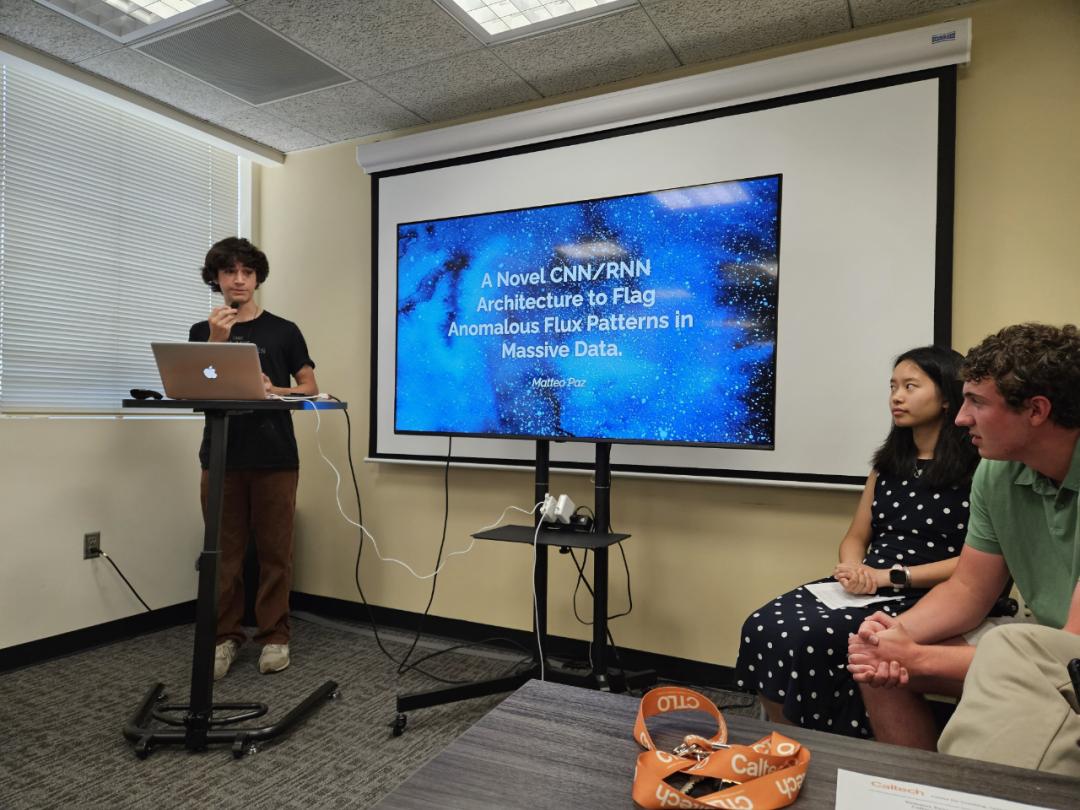
In 2023, Matteo Paz presented the initial results of his AI astronomy project at the Caltech Summer Research Connection seminar.
Paz wrote a machine - learning algorithm called VARnet and went through the entire table, marking 1.9 million infrared variable source celestial bodies, of which 1.5 million were brand - new discoveries that no one had recorded before: supermassive black holes, newborn stars, supernovae...
For this work, Kirkpatrick originally only hoped to "find a few variable stars and tell the astronomy community that there are still treasures in this data".
As a result, Paz created a complete catalog for the entire data set: 1.9 million variable source celestial bodies, divided into ten major categories, all archived.
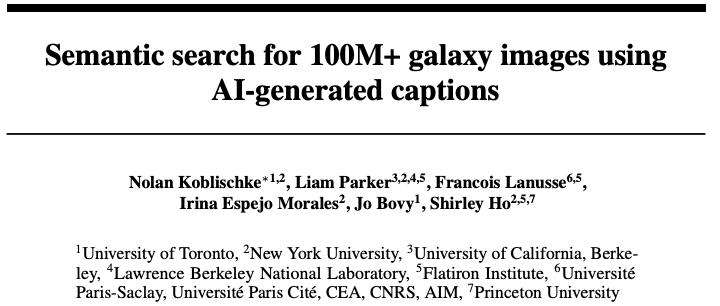
The second project is called AION - Search, and its manager is Nolan Koblischke.
His goal is to make 140 million galaxy maps "searchable by natural language".
Traditional astronomical image retrieval either relies on image similarity or predefined categories. If you want to find "spiral galaxies with signs of merger" or "suspected gravitational lenses"? Sorry, you have to train a special classifier first.
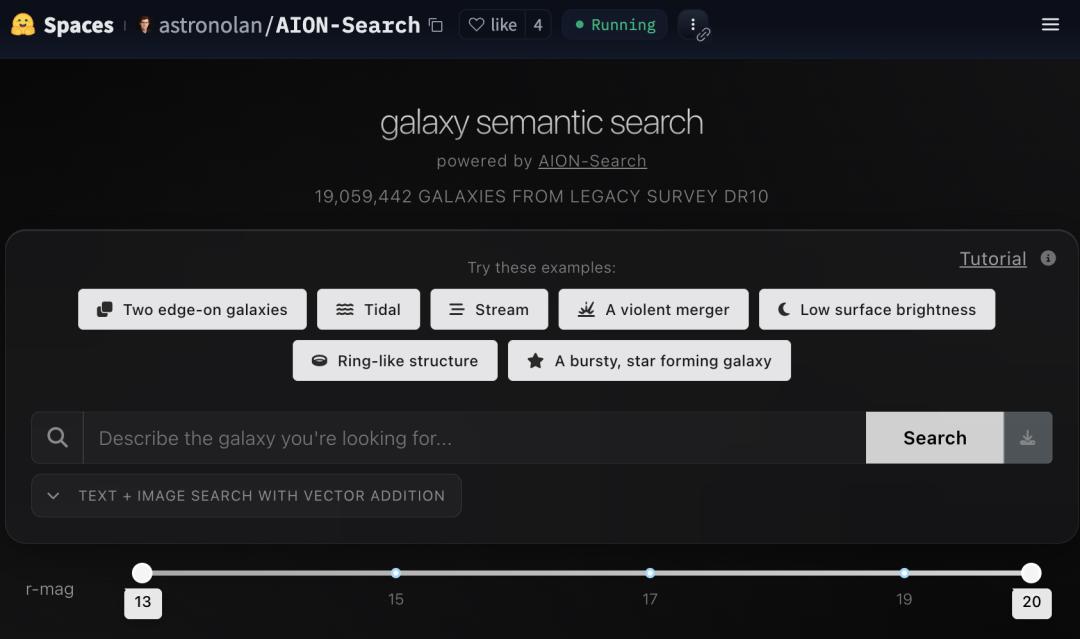
The public demo interface of AION - Search supports natural - language retrieval. The paper says the system can be extended to 140 million galaxy images. https://huggingface.co/spaces/astronolan/AION - Search
Koblischke's approach is as follows: First, let GPT - 4.1 - mini automatically write text descriptions for 275,000 galaxy maps (costing $150); then, use contrastive learning to train a shared retrieval space for images and text; finally, extend it to 140 million maps.
How effective is it?
Gravitational lenses are the rarest targets in galaxy data, accounting for only 0.1% of the entire database: it's like finding 1 photo out of 1,000.
If you use the traditional image - similarity algorithm to search, almost all of the top 10 results are wrong. With AION - Search, a significant portion of the top 10 results are correct.
The industry uses an indicator called nDCG@10 to measure "how accurate the top 10 results are ranked".
AION - Search gets 0.180, while the traditional method only gets 0.015: this is more than a ten - fold improvement in retrieval effectiveness.
Phenomena that astronomers previously had to manually search for among hundreds of thousands of images can now be found using natural language.
The third project is called WiFind.
The WiFind project is developed by Nayel Rehman, Arhan Menta, Rushil Kukreja, and Aayush Tendulkar. It uses AI to process WiFi signals, attempting to penetrate walls and rubble to find survivors in disaster areas.
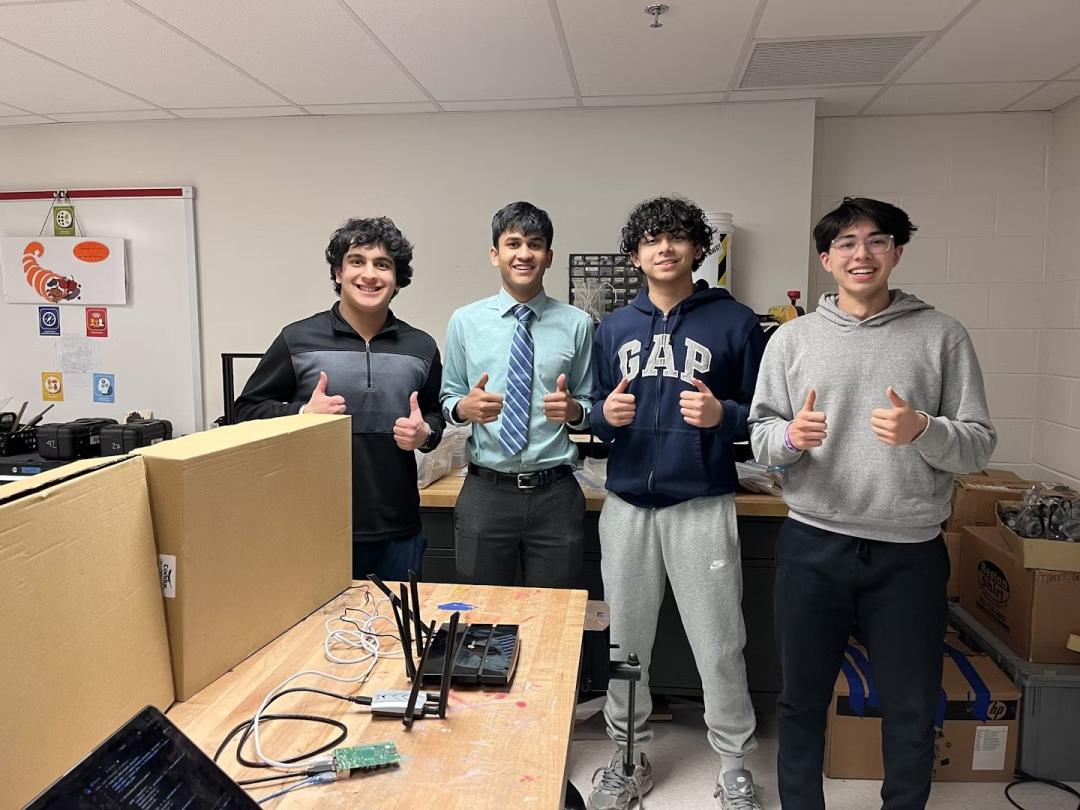
The members of the WiFind project team
WiFind is currently a project that won an award at the Conrad Challenge and was presented in a Springer conference paper. It is still in the prototype stage and is not a deployed disaster - relief system.
But its concept is very novel: WiFi routers are everywhere in the world, and each one is a potential "life detector".
There is also Zeyneb Kaya using AI to protect endangered languages; Amrita Bhasin's project diverting more than 5 million pounds of unsold inventory from landfills for reuse...
The common feature of these 26 projects is not "writing papers with AI" but "using AI to tackle things that humans can't handle".
26 names, not just about celestial bodies and rescue
If you look at the entire list, you will see a more three - dimensional picture:
The 26 selected individuals (teams) are from more than 20 universities and institutions, including MIT, Stanford, Harvard, Oxford, Berkeley, Yale... The list basically covers the top - tier research institutions in North America and the UK.
OpenAI divides them into three categories: Creators who develop products, Explorers who conduct research, and Advocates who promote and popularize.
Celestial discovery, galaxy search, and disaster - area rescue are just the three most concentrated directions.
Among the remaining projects, some are developing learning - assistance tools to relieve the pressure on their peers; some are translating mental - health materials into the native languages of ethnic minorities so that psychological counseling is no longer limited to the English - speaking world; some are developing barrier - free functions for disabled students so that classrooms are no longer exclusive; and some are using AI to identify fraud information to prevent the elderly from being deceived.
24 - year - old Kyle Scenna from Waterloo is an entrepreneur. When talking about ChatGPT, he said: "I never thought that the distance from discovering a problem to implementing a solution could be so short."
20 - year - old Michelle Lawson is studying at Smith College. She said: "I've always believed that as long as you have the right support and resources, you can achieve everything you imagine. AI has made this a reality for me and thousands of others."
23 - year - old Nolan Windham is already the AI director of a well - known hedge fund. He said: "The exciting thing is that this is just the beginning."
When it comes to AI, their common point is that AI has increased the things they can do.
This is the biggest difference between this generation of "AI natives" and the previous generation:
They have regarded AI as the default infrastructure, an indispensable part of their learning and life, just as the previous generation of Internet natives regarded "Wi - Fi".
The threshold has not disappeared, it has just shifted
Since high school students can make astronomical discoveries, many people may have an optimistic illusion that AI has truly flattened the threshold of scientific research.
But it's too early to make such a judgment. Let's first look at Paz's complete resume.
In the summer of 2022, when he was still in high school, he entered Caltech's Planet Finder Academy.
In 2023, he participated in Caltech's six - week Summer Research Connection project, with Davy Kirkpatrick, a senior astronomer at IPAC, as his research tutor.
Paz completed the "Math Academy" program in the Pasadena school district in middle school: he completed AP Calculus BC in the eighth grade. Calculus, which ordinary high school students encounter in the 12th grade, he mastered before the age of 14.
In other words, Paz is not "an ordinary high school student plus ChatGPT". He is "a high school student who has advanced to college - level mathematics, has had a top - notch Caltech tutor for two years, and can directly access IPAC's computing resources", plus AI.
https://arxiv.org/pdf/2512.11982
The paper on AION - Search, which makes 140 million galaxy maps searchable by natural language, also mentions its limitations:
VLM may miss subtle astronomical structures and bring the biases of GPT - 4.1 - mini into the system. The entire method works in the astronomical field because manually labeled data such as those from Galaxy Zoo have been used as training materials by GPT.
What AI finds are mainly phenomena that astronomers already knew how to label before.
And WiFind, which uses WiFi signals to penetrate rubble to find survivors, is still just a prototype and not a deployed rescue system in earthquake - stricken areas.
AI has flattened the "threshold of repetitive labor", but it has not flattened "taste, judgment, and long - term training".
The key point of Paz's story is not that AI enables any high school student to do astronomy, but that a high school student who was going to make an astronomical discovery anyway advanced this by ten years.
The threshold has not disappeared; it has just shifted from "whether you can do it" to "whether you can think of it".
Reference materials:
https://x.com/OpenAI/status/2052086313797705954
This article is from the WeChat official account "New Intelligence Yuan", written by New Intelligence Yuan and published by 36Kr with authorization.