36Kr Exclusive | A Tsinghua-affiliated AI Infra manufacturer has completed hundreds of millions of yuan in financing, reconstructing the computer system architecture with GPUs at the core
Author | Qiao Yujie
Editor | Yuan Silai
Yingke has learned that Beijing Rongxin Zhiyuan Technology Co., Ltd. (hereinafter referred to as "Rongxin Zhiyuan") recently completed an angel-round financing of hundreds of millions of yuan. This round was jointly led by Beijing Green Energy and Low-carbon Industry Fund and SAIF Partners. Follow-on investors include Shunxi Fund, Fuhua Capital, Malata Group, Yangtze River Capital Innovation Investment, Tsinghua Alumni Fund, Plum Ventures, etc. Yunxiu Capital participated in the company's seed-round investment previously and continued to follow on in this round. It also serves as the long-term exclusive financial advisor.
Amid the AI wave, the demand for computing power has skyrocketed, and the bottlenecks of the traditional CPU-centric architecture have become increasingly prominent: the CPU has become the core limitation for data scheduling and interaction, the communication efficiency between GPUs is insufficient, and memory cannot achieve unified address-space sharing, resulting in relatively low overall computing-power utilization.
Shi Xu, the founder of Rongxin Zhiyuan, graduated from the Department of Electronic Engineering at Tsinghua University and has years of experience in chip design and the AI field. When interviewed by Yingke, Shi Xu said, "In actual deployments, a typical AI server configuration requires multiple CPUs to coordinately schedule a small number of GPUs. As the scale expands, the number of CPUs also needs to increase synchronously, leading to a significant rise in system complexity and cost. This shows that the traditional architecture is difficult to adapt to the computing needs of the AI era."
Based on this, Rongxin Zhiyuan proposed an AI computing system centered around GPUs - the AGC (AI computer system with the GPU as its Core) architecture. This architecture breaks the traditional CPU-centric model, making the GPU the core computing unit of the system, while the CPU is transformed into a peripheral control component.
Through this reconstruction, the ratio of GPUs to CPUs (G:C) in the system can be increased from the traditional approximately 2:1 to 20:1 or even 32:1, significantly unleashing the computing-power potential of GPUs.
At the system level, the AGC architecture further solves the problem of memory consistency, supporting a single operating system to manage up to 64 GPUs uniformly, achieving global address-space sharing, and avoiding cross-node data copying. This significantly improves the overall efficiency in scenarios such as large-model training and inference.
This system innovation is not a single-point optimization but involves a full-stack reconstruction, including multiple levels such as BMC management, switching systems, communication protocols, inference frameworks, and connectors.
Shi Xu introduced that in terms of core technology implementation, Rongxin Zhiyuan has carried out systematic innovation around computing-power stability and utilization efficiency. At the hardware monitoring level, the company has self-developed an AI BMC system, upgrading the traditional polling mechanism from 3 - 5 seconds to microsecond-level response. It can immediately trigger frequency reduction or hibernation strategies when risks such as abnormal GPU temperatures occur, thereby significantly improving system security and overall energy efficiency.
In terms of reliability design, in traditional eight-GPU servers, once a single GPU fails, the entire machine often needs to be shut down for maintenance, resulting in a long recovery period and high cost. Under the AGC architecture, a single machine can achieve redundant design for up to 20 GPUs. Combined with the self-developed hybrid memory technology, the system can build a hybrid storage space of approximately 10TB to cache the KV Cache of healthy GPUs in real-time. Once a GPU fails, the system can quickly schedule redundant GPUs to take over tasks under the rapid response of the AI BMC and directly access the original data through the unified memory address space, achieving seamless connection during the computing process.
Based on this mechanism, Rongxin Zhiyuan can achieve "hot-swapping without interrupting tasks" (GPU RAID) in case of GPU failures, reducing the maintenance time from approximately 2 hours to about 1 minute and significantly reducing operation and maintenance costs.
In terms of interconnection, Rongxin Zhiyuan has launched the Blue Link optical interconnection solution, replacing traditional laser optical modules with Mini LED/MICRO LED. It has higher stability in high-temperature environments, while achieving higher bandwidth density and longer transmission distances, breaking through the physical limitations of copper cables in terms of bandwidth and distance.
In terms of ecological strategy, Rongxin Zhiyuan emphasizes openness and compatibility. Shi Xu introduced that since its solution significantly reduces the dependence on CPU performance, it can be adapted to domestic CPUs such as Loongson, Phytium, and Hygon, and is also compatible with products from mainstream GPU manufacturers, thus building a more open computing ecosystem. Compared with some closed systems that only support self-developed chips, this approach has stronger industrial synergy capabilities.
Meanwhile, the company took the lead in initiating the RISC-V Intelligent Computing System Ecosystem Alliance, uniting upstream and downstream manufacturers in the industrial chain as ecological partners. Through in-depth cooperation and patent sharing, it promotes the standardization of relevant technologies and the large-scale implementation of domestic products.
In terms of products, Rongxin Zhiyuan has formed two product systems. One is the K series, which emphasizes flexibility. It is compatible with all PCIe standard GPU cards globally, targeting private deployment scenarios, taking into account both flexible configuration and data security. The main models include K2 (desktop with two GPUs), K4 (with four GPUs), K10 (with ten GPUs), and K20 (with twenty GPUs).
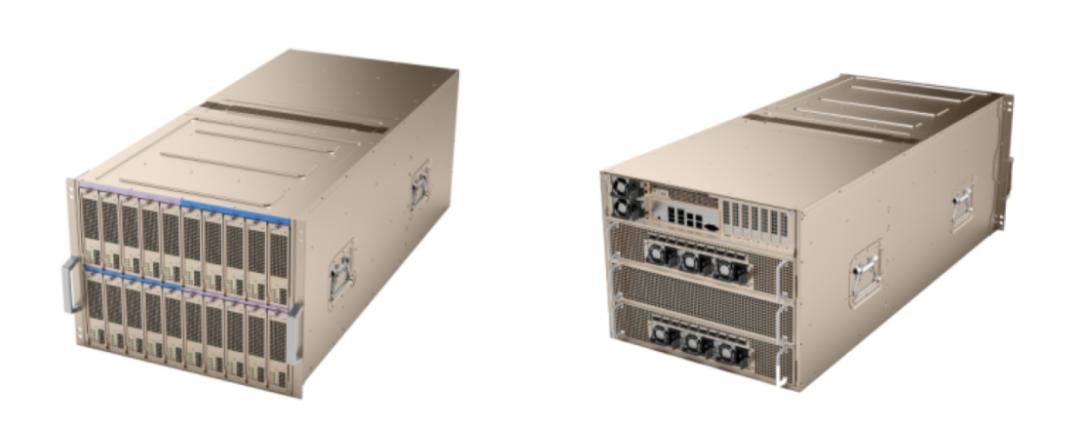
Example of K20 product (Source/Enterprise)
The other is the AGC series, which emphasizes extreme performance. It achieves higher computing-power density and system efficiency through customized modules, covering various open forms such as air cooling, liquid cooling, and mobile types. It supports multiple specific GPUs. Representative models include AGC 64F (64 GPUs with air cooling), AGC 64L (64 GPUs with liquid cooling, providing 21P computing power and 3T video memory), AGC 32F (32 GPUs with air cooling), AGC 16F (mobile with 16 GPUs), and AGC 2 (workstation with two GPUs).
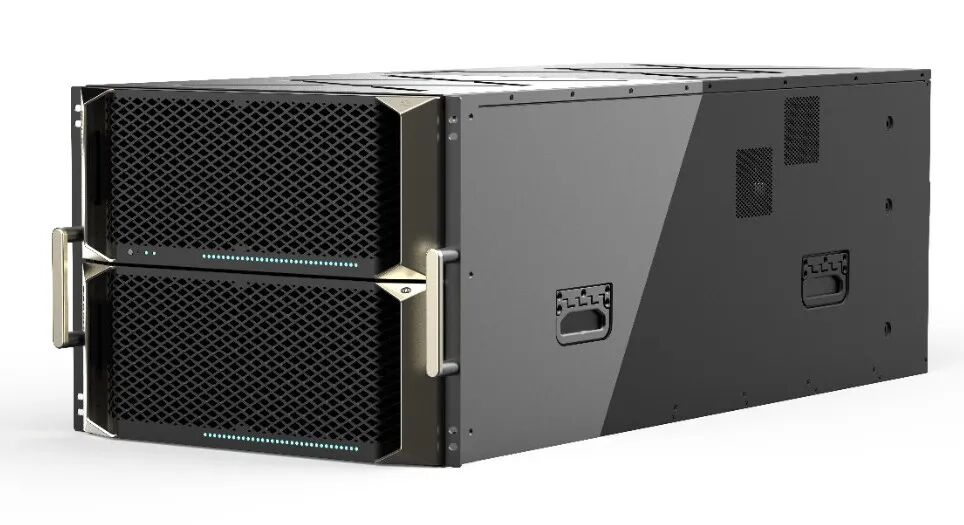
Example of AGC 64F product (Source/Enterprise)
In terms of business model, the company adopts a dual-path strategy of "direct sales of its own brand + OEM cooperation". It has cooperated with multiple complete-machine manufacturers and promoted its solutions to the market in a joint form. At the same time, the company has launched a sub - brand, Upchanger, jointly created with the Central Academy of Fine Arts, focusing on niche scenarios such as art and rendering.
The following are excerpts from the interview (some content has been edited):
Yingke: Why is Rongxin Zhiyuan's AGC architecture very friendly to domestic GPU cards?
Shi Xu: The traditional CPU-centric architecture highly depends on CPU performance and the ecosystem. In actual deployments, it is difficult to effectively combine domestic CPUs with the mainstream GPU system. Due to limitations in data exchange capabilities and system bottlenecks, it is difficult to implement a truly "domestic solution". The AGC system elevates the GPU to the core of the system, significantly reducing the performance dependence on the CPU, enabling domestic CPUs to play a role in the system and being compatible with domestic GPUs, thus opening up a domestic path at the practical engineering level.
Rongxin Zhiyuan's concept is more like Android. We are very open, compatible with mainstream computing chips globally, and emphasize industrial synergy and scale expansion capabilities. In this open system, not only can complete-machine manufacturers flexibly combine hardware solutions, but upstream GPU, CPU, and connector manufacturers also have a broader market space. In essence, the AGC provides a "connection platform" that allows products from different manufacturers to operate collaboratively in the same system and continuously optimize performance and cost structure as the system evolves.
Yingke: How do you define Rongxin Zhiyuan?
Shi Xu: We are more like "NVIDIA without making GPUs". We hope to define new computing standards and architecture paradigms in the AI era, enabling intelligent computing to enter every industry, every enterprise, every family, and every individual. Currently, we are also members of the Artificial Intelligence Standards Committee of the Ministry of Industry and Information Technology.
The establishment of any computing system cannot be separated from the collaborative promotion of industrial alliances. Behind the traditional x86 general computing system is a long - term ecosystem jointly built by Intel, AMD, Microsoft, and a large number of hardware manufacturers. The AI computing targeted by AGC also requires a new industrial cooperation network. To achieve this goal, Rongxin Zhiyuan is uniting multiple parties, including GPU manufacturers, CPU manufacturers, complete - machine manufacturers, connector and device manufacturers, and model companies, to jointly promote the implementation and evolution of this system. Currently, it is organizing and initiating the AGC Architecture Ecosystem Alliance. In the future, based on the AGC architecture, it will further promote the implementation of new domestic intelligent computing standards and ecosystems.
Views from Investors
Beijing Green Energy and Low-carbon Industry Fund stated: "With the arrival of the AI Agent era, the consumption of computing - power costs will gradually shift from training to inference. In the future, the computing - power consumption of inference will be greater than that of training. The cost - performance ratio and compatibility of a single AI server will become the core competitiveness of computing - power enterprises in the future. At the same time, the bottleneck of domestic computing power is restricted on the one hand by the GPU manufacturing process and single - card performance, and on the other hand by the IO transmission bottleneck and the performance of domestic CPUs. Rongxin Zhiyuan masters multiple core software and hardware technologies, builds a new - generation AGC computing system, reduces the requirements for CPU performance, can be adapted to mainstream GPUs at home and abroad, and improves the actual effective performance. In addition, it is also developing multiple new - generation technologies to effectively solve the computing - power transmission bottleneck. We believe that as Rongxin Zhiyuan's products and technologies continue to iterate, in an era of surging AI computing - power demand and urgent domestic - substitution needs, Rongxin Zhiyuan will continuously drive industry innovation and empower the development of the domestic AI industry."
Jiang Chihua, the managing partner in charge of the technology track at SAIF Partners, stated: "The physical dividends of Moore's Law are inevitably reaching their peak. As industry data shows, in the decade before 2022, the computing performance of a single chip had achieved a leap of over 1000 times. However, as semiconductor processes approach the physical limit, the growth rate of pure hardware performance has significantly slowed down in recent years. In the current era of the 'Token factory' centered around large models, the evolution of chip manufacturing processes alone can no longer support the exponential explosion of computing - power demand. The key to breaking the deadlock lies in the architectural subversion at the computing - system level. This is also the core logic for SAIF Partners to firmly lead the angel - round investment in Rongxin Zhiyuan. The Rongxin team has forward-lookingly broken away from the traditional pattern of hardware stacking and proposed the AGC computing system centered around GPUs, completely breaking the traditional bottleneck centered around the CPU for scheduling. They are not only making single - point optimizations but have achieved memory consistency at the system level and global address - space sharing, and have carried out a full - stack reconstruction of software and hardware from the underlying optical interconnection to BMC management. We have always been committed to finding underlying innovators who can define the future. Rongxin Zhiyuan is reconstructing the AI Infra standards suitable for the future. We look forward to the system - level generational subversion of Rongxin standing out in the current competition of computing - power infrastructure, truly accelerating the full - scale arrival of the AGI era with extreme computing - power utilization and high scalability."
Wu Shihong, the managing director of Plum Ventures, stated: "The AGC architecture developed by Rongxin Zhiyuan reconstructs the AI computing system centered around GPUs, completely breaking the traditional CPU - centered bottleneck, significantly improving computing - power density and GPU utilization, and perfectly adapting to mainstream domestic GPUs. It is a key link in the domestic substitution of computing - power infrastructure. Currently, the products have quickly been verified by the market, and the commercialization progress has exceeded expectations. We are very much looking forward to the Blue Link optical interconnection solution being launched into the market as soon as possible. The founding team is a golden combination of typical technology leadership, in - depth industry experience, and commercialization capabilities, with both technical depth and implementation capabilities. It has accurately positioned itself in the track, has a clear competitive advantage, and strong growth potential. We are long - term and firmly optimistic about the development potential of Rongxin Zhiyuan in the AI Infra field!"
Gao Chao, the founding partner and CEO of Yunxiu Capital, stated: "Against the backdrop of many systematic bottlenecks in current computing - power growth, Rongxin Zhiyuan has opened up an innovative path for domestic intelligent computing with its disruptive AGC architecture and complete - machine solutions. While enabling GPUs to exert greater computing - power efficiency, the company's products also take into account cost advantages and flexible applicability, initiating a new paradigm for the innovation of China's AI computer system architecture. Yunxiu Capital firmly supports the company's team in doing difficult but correct things and firmly believes that the company will become an important breaker of the deadlock in China's computing - power innovation solutions."