Strange phenomenon: A group of talented CTOs have quit their jobs and gone to write code at major AI companies.
An unusual scene is playing out in Silicon Valley: Multiple CTOs of unicorn companies have resigned and returned to large tech companies to work as programmers.
This large tech company is Anthropic.
This scoop was revealed by the former CTO of one of the companies.
Henry Shi was the former CTO of super.com. He joined Anthropic last October and serves as the Chief Technology Advisor.
A few days ago, he posted on X, listing the CTOs who, like him, jumped from unicorn companies to Anthropic to work on the front - line of technology.
Why are these CTOs willing to take a "demotion"? For money? For their ideals?
01 Don't Want to Miss the AI Revolution
Let's first hear what Henry Shi himself has to say.
The super.com he used to work for is a low - cost hotel reservation website that also offers various services to help people save money (such as credit card cashback, shopping discounts, cash advances, etc.).
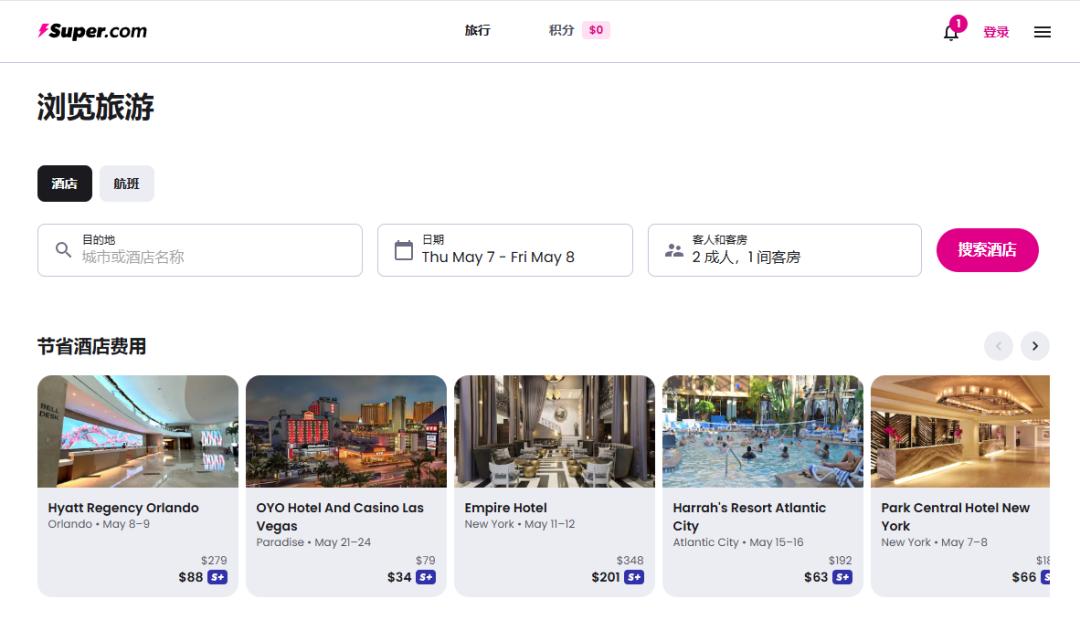
The webpage of super.com
During his eight - year tenure, super.com received over $150 million in financing. It grew from scratch to an annual revenue of over $200 million, an annual GMV of over $1 billion, and more than 50 million users, and was profitable in multiple revenue business lines.
After bringing the company onto a stable track, he began to look for a new direction in life.
Super.com was one of Anthropic's earliest customers. Henry Shi witnessed their growth step by step, and their model capabilities evolved every month.
When ChatGPT was released in November 2023, he vaguely realized that this might be the starting point of the most important technological revolution since the birth of the Internet.
How could he be involved in this AI revolution? There were two options at that time: becoming a VC or starting a new business.
He rejected both options: He could become a VC at any time, and as he was still young, he wanted to do something more ambitious. If he started an AI application business, in essence, he would just take someone else's model and put a nice interface on it. The next API update from OpenAI or Anthropic might put him out of business.
He mentioned that an entrepreneur spent several months developing a prototype for a complex problem, making slow progress. But after the release of Claude Opus, a single prompt solved his entire application scenario.
What if he went to work for one of the large model manufacturers directly? Being closest to the model means being closest to AI.
Henry Shi is very familiar with Ben Mann, the co - founder of Anthropic (one of the earliest authors of the GPT - 3 paper), and they often communicate.
During one conversation, Mann believed that "economic AGI (meaning small - scale general artificial intelligence)" would probably occur between 2027 and 2028 and provided the logical reasoning.
Henry Shi decided to join Anthropic: If AGI really arrives in 2027 or 2028, he will be in the most cutting - edge AI laboratory, sitting in the front row to witness it all. And even if it doesn't happen in the end, he will at least truly understand why it didn't happen and where the real ability boundaries of AI are.
Either way, it's extremely worthwhile for Henry Shi.
In 2025, he quit his position at super.com and went to work at Anthropic. While others are chasing after model capabilities outside, he is defining model capabilities from the inside.
02 Amplify One's Own Abilities
Let's take a look at the other CTOs who went to Anthropic as ordinary technical members. What kind of people are they?
Mike Krieger, the former CTO of the well - known Instagram, was in charge of technology and product engineering when Instagram's user scale grew from a few million to 1 billion monthly active users.
Peter Bailis, the former CTO of Workday, a cloud - based financial management and human capital management software company. Bailis is an expert in data analysis and became a professor in the Computer Science Department at Stanford University at the age of 25.
Bryan McCann is the CTO of the AI search company You.com and is also a well - known natural language processing (NLP) researcher in the Silicon Valley AI circle.
Niki Parmar is the CTO of the agent company Adept AI. She is one of the eight authors of the paper that proposed the Transformer architecture.
If Henry Shi hopes to witness AGI, what are the other smart minds aiming for by giving up management positions and going to Anthropic to write code?
"The core is that after AI coding, one person can do the work of a team. Many things no longer need to rely on a large number of execution personnel, so it doesn't make much sense for them to stay in startup companies."
Chen Qiuwu, the CTO of Kouding Intelligence, told Pencil News that those who can work as CTOs in Silicon Valley unicorn companies have very strong technical abilities but weak execution abilities. They choose to start a business to have a team to cooperate with them. Now that they can do it on their own, they have the impulse to go solo. "Moreover, in many Silicon Valley startup companies, CTOs don't necessarily have much say. Many times, they can't do what they really want to do."
Why are they willing to go to the front - line at Anthropic?
"Anthropic is itself a global technology high - ground. In such a place, the value of an individual can be amplified extremely. They can actually figure out this equation." Chen Qiuwu said that these CTOs know that when their architecture, design, and acceptance abilities are combined with Anthropic's AI coding abilities, the output value will be multiplied or even exponential.
Chen Qiuwu gave an example of Kouding Intelligence. "I'm currently working on a project for a large company. Many projects are actually done by me, together with Claude and AI coding models. The original Redis QPS was only 60,000, and I increased it to 6.5 million."
Li Yachong, the founder of Grapevine Technology, told Pencil News that many CTOs with strong technical abilities are willing to return to the front - line to work, but they couldn't do it in the past. AI coding has made it possible.
"In the past, CTOs spent most of their time on management: replicating their abilities to the team, making the team stronger, conducting project reviews, and even career planning. Then there were architecture selection and process standardization. It's very different from working on the front - line. It's extremely difficult for a CTO to return to the front - line. Now, it's much easier for them to manage AI."
Besides personal value realization, money is also a very realistic factor.
These people, from either unicorn companies or companies acquired by giants, have very high annual salaries and equity, if not astronomical figures.
However, compared with the potential benefits brought by Anthropic, that's not much.
According to the blogger Ken Qi, who is an entrepreneur in Silicon Valley, in his blog post, the basic annual salary of senior MTS at Anthropic ranges from $300,000 to $405,000. With stock options and performance bonuses, the annual total package can easily exceed $1 million. That's not bad.
More importantly, Anthropic's valuation is rising rapidly. There are reports that it is advancing a new round of financing of $50 billion, with a valuation aiming for $900 billion (about 6 trillion RMB). Ken Qi calculated: "For early - stage core technical employees, the potential future benefits of their equity far exceed the lifetime income of most CTOs of small and medium - sized unicorn companies."
Previously, Pencil News also reported that the salaries offered by top large - model companies to ordinary researchers are comparable to those of football and basketball superstars. (Click on "The AI Talent War: Fresh Doctoral Graduates with an Annual Salary of $5 million")
03 The Spring of Tech Fanatics
Will the same thing happen in China in the future?
No way. Multiple technical personnel and entrepreneurs gave the same answer to Pencil News.
"First of all, it's impossible in terms of salary. Chinese companies have a heavy management hierarchy, and the salary increase brought by the management system can account for 50% - 60%. The salaries of execution personnel are actually not high, and the incentives are relatively poor." A technical personnel who has worked in multiple top large companies for many years told Pencil News.
Secondly, there is no shortage of front - line workers in China. "Even if you are the CTO of a star startup company, you may not get any special treatment when you go to a large company. People value your management ability more than your front - line working ability." This technical personnel explained.
In addition, he also mentioned that many foreign veteran programmers still have strong technical skills as they age. "In China, many programmers' skills decline after the age of 35 or 36."
Chen Qiuwu reminded that what is more worthy of reference in China when CTOs return to the front - line is how "one - person companies and super individuals" can rise under the ability of AI coding.
"This matter essentially means that 'human + AI' has replaced the past pure - human organizational structure. When a large amount of code is generated by models, execution ability is no longer the most core issue. The most fundamental thing is how the CTO's abstract ability can be amplified by AI." He predicted that when AI coding is powerful enough, a CTO with a few engineers and marketing personnel can have the capabilities of a 100 - person company today.
Chen Qiuwu also judged that this wave of talent flow in Silicon Valley may be behind the change of the entrepreneurial paradigm in the AI era.
"In the past, products were in the lead. Because many things could be done by piling up manpower. For example, Douyin and Kuaishou built their infrastructure step by step through group - army operations. But the AI era is different. Technology starts to lead the direction again. Product managers understand user needs better, but they may not know how far technology can develop in the next step. It's actually CTOs and technical personnel who can really deduce the 'second, third, and fourth steps' of (large models)."
04 Conclusion
The scene happening in Silicon Valley is actually not unfamiliar.
Back then, when Southern Metropolis Daily was founded, many deputy editors - in - chief and chief reporters from other media gave up their good treatment and came to No. 289, Guangzhou Avenue Middle, just to be ordinary reporters/editors, because Southern Metropolis Daily provided a broader and more responsible platform, enabling them to make reports that influenced the social process. At the same time, it marked the beginning of the golden age of the Chinese media industry.
Now, are CTOs going to Anthropic to write code a sign that the golden age of American AI is coming?
This article is from the WeChat official account “Pencil News” (ID: pencilnews). Author: Honest. Reposted by 36Kr with authorization.