The "Four Little Dragons of AI" have a valuation exceeding one trillion.
The combined value of China's "Four AI Dragons" has reached one trillion yuan.
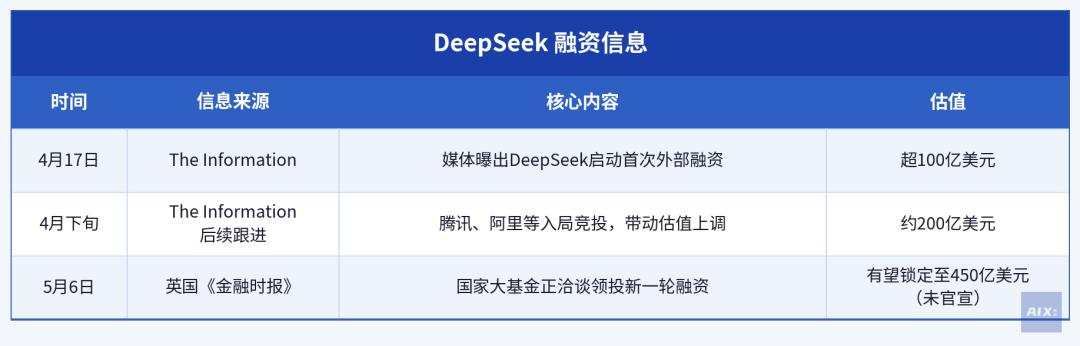
At the beginning of May, the Financial Times reported, citing sources, that DeepSeek's valuation in its latest round of financing was set at $45 billion, led by the National Integrated Circuit Industry Investment Fund. In early April, news of DeepSeek's financing first emerged, with an estimated valuation of over $10 billion. Based on this, its valuation has increased 4.5 times in just one month.
Since Zhipu and MiniMax went public on the Hong Kong Stock Exchange in early January 2026, their stock prices have increased by 7 times and nearly 4 times respectively. Their latest market values are HK$434.7 billion (about 377.5 billion yuan) and HK$257.3 billion (about 223.5 billion yuan) respectively.
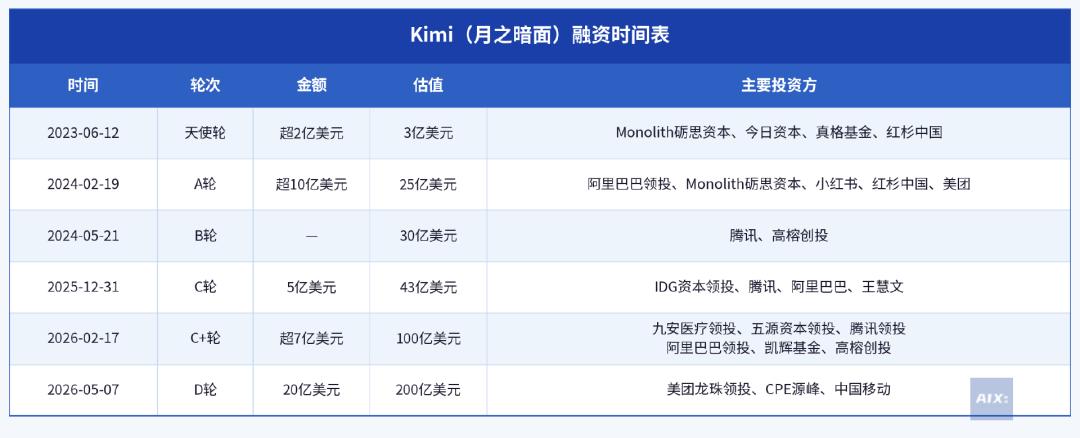
The valuation of Kimi in the primary market has exceeded $20 billion (about 136.2 billion yuan). According to LatePost, Kimi's parent company is about to complete a new round of financing of $2 billion (about 13.6 billion yuan), led by Meituan Longzhu, with China Mobile, CPE and other investors participating. Longzhu alone invested over $200 million. Kimi has raised over 37.6 billion yuan in total.
If we add DeepSeek's valuation of $45 billion (about 306.5 billion yuan) to the other three companies, the combined valuation of China's "Four AI Dragons" has exceeded one trillion yuan. Ranking from high to low, they are: Zhipu, DeepSeek, MiniMax, and Kimi.
It should be noted that DeepSeek's valuation is from primary - market negotiations, Zhipu and MiniMax's values are the fluctuating prices in the secondary market, and Kimi's is the post - investment valuation of a new round of financing. Even so, Zhipu, the highest - valued, is nearly three times that of Kimi, the lowest - valued. What logic is the market using to price these large AI model companies?
01. Why is there such a large valuation difference?
First of all, it's clear that the market is not pricing them based on revenue. If ranked by revenue: Zhipu (2025 revenue: 724 million yuan) > MiniMax (2025 revenue: $79.038 million, about 560 million yuan) > Kimi (about 200 million yuan) > DeepSeek. The revenue ranking doesn't match the valuation ranking.
Investors who follow AI companies say that the valuation multiples of US AI companies change with their development stages. For high - growth companies, the market is willing to give extremely high price - to - sales (P/S) premiums (97 - 145 times), essentially paying for "definition power" and "high growth". When the business model stabilizes, the valuation logic switches to the "cash - flow pricing" of 27 - 44 times price - to - earnings (P/E) ratio.
There are two parallel pricing systems.
One looks at financial indicators: revenue, profit, gross margin, and ARR growth rate. This logic becomes dominant after a company's revenue reaches a certain scale and its business model stabilizes. Traditional software companies and SaaS companies are basically priced according to this system.
The other looks at whether a company can set standards and become infrastructure. Investors are buying the probability of a company "becoming a definer". The US capital market has tasted the benefits of this logic. Microsoft defined the PC entrance, Google defined the way of information organization, and Apple defined the mobile ecosystem. Once a company becomes a definer, the returns are exponential. So a large part of the valuations of OpenAI and Anthropic today is an early bet on this "ecosystem control power", priced by P/S.
Using this logic to look at China's "Four AI Dragons", it makes sense.
DeepSeek can reach a valuation in the 300 - billion - yuan range without publicly disclosing its revenue because it is currently the most potential "definer" among the four. V3, R1, and V4 have established a technical brand in the global open - source community. The adaptation of the V4 model to domestic chips (Huawei Ascend 950PR chips) has opened up the path of "independence + open source + adaptation to domestic computing power". Although companies like Meituan are also training trillion - parameter models from scratch using domestic chips, DeepSeek has a first - mover advantage in domestic chip adaptation verification, industry standard co - construction, and open - source ecosystem implementation.
Image source / pexels
Zhipu ranks second, using a mixed pricing method of cash - flow and definition power. On the one hand, it has the highest revenue, a clear business model (mainly B - to - B/G - to - B), and some verifiable financial indicators: over 240,000 paying developers, 9 out of the top 10 Internet customers are using its services, and the call volume increased after the API price increase. This belongs to the category of "cash - flow pricing". On the other hand, the market currently accepts its positioning as the "Chinese version of Anthropic". Therefore, there is a premium for "definition power" in its valuation.
MiniMax ranks third, relying on relatively solid financial performance: its revenue is higher than Kimi's, and its overseas revenue accounts for over 70%. Its gross margin has increased from 12.2% to 25.4%. Based on the full - year revenue in 2025, the P/S multiple exceeds 500 times, far exceeding the cash - flow pricing logic. The market is betting on its potential for non - linear growth as a C - to - C AI entrance. However, the star company Character.ai, which focuses on C - to - C companionship, also told a similar story, and the market has seen the ceiling of this path.
As for Kimi, the industry estimates its 2025 revenue at 200 million yuan. After the release of the K2.5 model, its ARR doubled in one month (exceeded $100 million in early March and over $200 million in April). Coupled with the technical brand it has established in long - text and in - depth reasoning scenarios, the primary market is willing to price it based on the possibility of it being the "Chinese version of ChatGPT entrance", with a P/S of about 100 times.
The mismatch between revenue and valuation rankings is essentially because the four companies apply different valuation logics. DeepSeek gets a strategic premium beyond pure commercial valuation; the market prices Kimi and MiniMax based on the possibility of them becoming C - to - C AI entrances; Zhipu has both logics, with cash - flow as the foundation and an additional valuation premium for industry definition power.
The above - mentioned investors emphasized that the large - scale implementation of this "definition power pricing" in the domestic capital market is itself a landmark change. In the past few years, the mainstream primary market was more accustomed to valuing based on financial indicators. DeepSeek's technological breakthroughs and the listings of Zhipu and MiniMax have opened up the valuation space for large AI models. Now, the National Integrated Circuit Industry Investment Fund leading the investment in DeepSeek means that large models have been elevated to a strategic level comparable to chip manufacturing.
02. How did the valuations skyrocket collectively step by step?
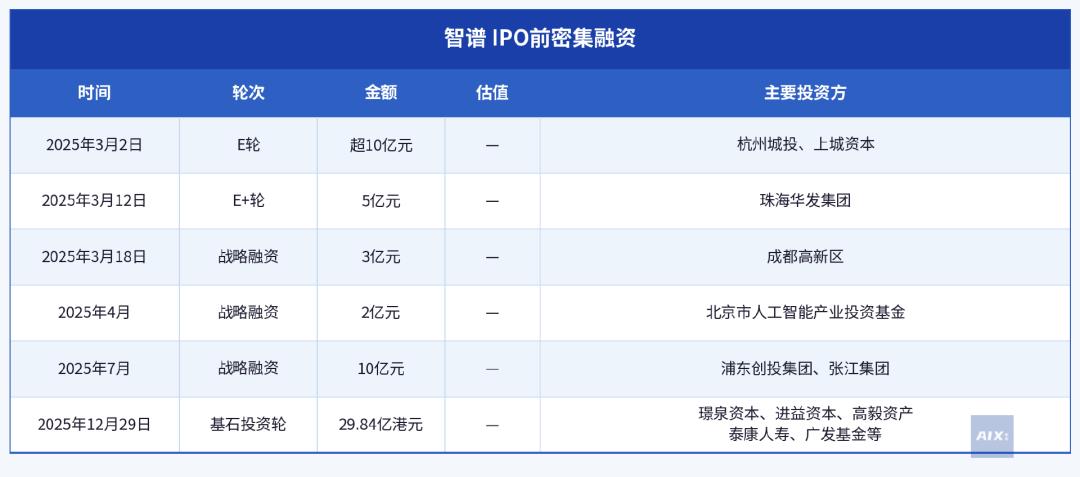
When Zhipu submitted its prospectus for the Hong Kong Stock Exchange in December 2025, its valuation was set at 24.38 billion yuan. At the IPO, its issue market value exceeded HK$51.1 billion. Four months after listing, its market value reached HK$434.7 billion, about 16 times its pre - IPO valuation. This significant increase was due to several factors that successively pushed up the pricing method.
First is the technological aspect. In early 2025, DeepSeek R1 was released, and for the first time globally, people believed that Chinese AI companies could develop models of the same level as their US counterparts with only one - tenth of the training cost. This directly influenced the judgment of the primary market, and the other "dragons" were re - evaluated along with it.
Meanwhile, the Hong Kong Stock Exchange window opened. Policy relaxation (the 18C special technology chapter lowered the market - value threshold to HK$4 billion) and a strong year in the overall capital market (the Hong Kong Stock Exchange's IPO fundraising scale in 2025 was about $36 billion, a four - year high) created conditions for large AI model companies to go public. After Zhipu and MiniMax were listed and were well - received, primary - market investors were more willing to increase their bets, which indirectly helped raise Kimi's valuation.
Third is the entry of the National Integrated Circuit Industry Investment Fund. In the past, the fund mainly invested in manufacturing - end companies like SMIC. This time, leading the investment in DeepSeek is the first direct investment in an AI model company. This signals that in the context of potential computing - power limitations, China needs independent model companies that do not rely on NVIDIA or US cloud services.
Silicon Valley giants are also raising the ceiling. OpenAI's latest post - investment valuation has reached $850 billion, and Anthropic is conducting a new round of financing with a target valuation of $900 billion. In this reference framework, the combined valuation of China's "Four AI Dragons" of one trillion yuan is not overly aggressive.
However, definition - power pricing is essentially an option. Whether the option can be realized depends on subsequent performance.
Character.ai is a frequently cited example. The company's valuation once reached nearly $5 billion. But later, its user growth stagnated, and its monetization failed. Eventually, it was acquired by Google for $2.5 billion. It took less than a year from its peak to the acquisition.
China's AI track has also just gone through a reshuffle. At this time last year, the industry was still talking about the "Six AI Tigers". Now, the group has split. Among them, Baichuan Intelligence and Lingyi Wanwu have withdrawn from the general large - model competition due to high pre - training costs and the impact of open - source models, and have shifted to the medical vertical and B - to - B services respectively. The pre - investment valuation of Jieyue Xingchen in the Pre - IPO round is in the range of $5 - 6 billion, which is no longer on the same level as the "Four Dragons".
The four remaining companies either have a strong technical brand (DeepSeek), a viable commercialization path (Zhipu), or products that users are willing to pay for (MiniMax, Kimi).
But being on the list is just an entry ticket. JPMorgan Chase calculated this window period based on the example of Cambricon: Cambricon was once the only pure AI chip target on the A - share market. Then, Moore Threads, Muxi, Birenz, and Suiyuan were successively listed. Although Cambricon's performance improved quarter by quarter, its market value still shrank by 20% - 30%. Simply put, once there are competitors for the "unique" story, the premium will naturally be discounted. JPMorgan Chase's conclusion is that the scarcity window of "the only way to invest in China's AI" is about 6 - 12 months.
03. Next step: Compete for computing power and scenarios
Beyond the valuation competition, the four companies are currently stuck on two issues: how to use computing power cost - effectively and whether they can make money from scenarios.
The computing - power issue is whether the total cost of training and inference can be covered by token revenue. The four companies have come up with different solutions.
Zhipu screens customers at a high price to maintain gross margin. When it released GLM - 5 in February this year, the API price increased by 30% compared to the previous generation: 6 yuan per million token inputs and 22 yuan per million token outputs. When GLM - 5.1 was released in April, the price was raised by another 10%.
After the price increase, Zhipu's pricing is higher than that of DeepSeek V3, Kimi K2 series, and MiniMax M2, and is relatively high in the domestic market. Although it is still far from Claude Sonnet 4.6, it follows the same high - price route as Anthropic.
MiniMax adopts an Internet - style approach similar to "claiming territory first and then building". Its M - series models, from M1 to M2.7, are all open - source, which has quickly built a developer ecosystem. To lower the threshold, it reduces inference costs through the MoE architecture and model iteration. The API price of M2.7 is 1 yuan per million token inputs and 4 yuan per million token outputs, which is relatively low in the domestic market. MiniMax's logic is to attract developers and users first and then monetize through scale and stickiness.
DeepSeek looks for opportunities in the architecture. The V4 model has made changes in the architecture, reducing the long - text caching cost to 2% of the traditional solution. It has a tiered pricing system. Li Kefeng, CEO of Shushi Technology, commented: "This is not the optimal technical route, but the optimal solution in a constrained environment." In the case of insufficient computing power, Chinese engineers choose to use more complex system designs to make up for hardware deficiencies.
Kimi takes a fourth approach: algorithm compensation, mainly through software innovation. That is, the Muon optimizer (doubling the training token efficiency), the Kimi Linear architecture (reducing the long - context KV cache by 75% and increasing the decoding speed by 6 times), and the PrfaaS pre - filling architecture (enabling the scheduling of trillion - parameter models across data centers without relying on extremely expensive dedicated networks) to replace hardware resources. Zhang Yutong, co - founder and president of Kimi, calls it "competing with algorithms rather than computing power". Leo, an AI industry practitioner, said that there is a ceiling for algorithm compensation. Relying on in - depth optimization of a single link to save computing power will eventually reach its limit.

Image source / pexels
The four companies have different approaches to computing power, but the homogenization is more obvious in terms of scenarios.
Although there are still differences in each company's model matrix and long - term strategy, in Leo's view, Agent and Coding are two inevitable battlefields. "Especially when facing traffic dividends like OpenClaw, several domestic manufacturers have adopted similar short - term tactics, with synchronized product release rhythms