5-axis linkage directly inserted into the brain, Musk's big move: Valued at $9 billion, more than 20 people have been implanted.
Neuralink's 5-axis linkage surgical robot directly inserts into the deep part of the brain, and the last engineering barrier of the whole-brain interface is collapsing.
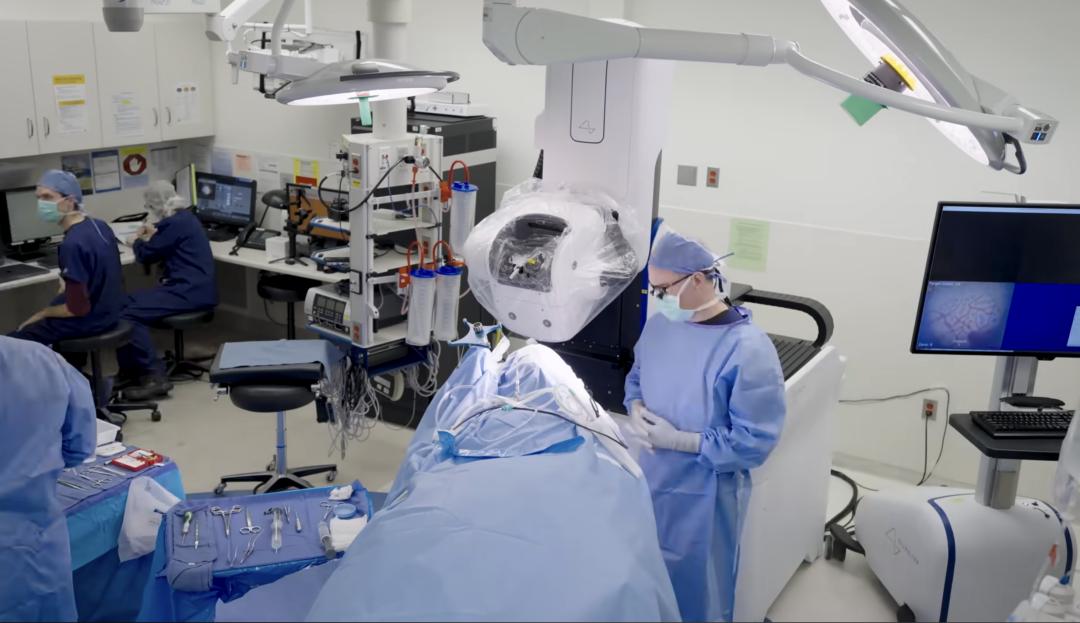
Under the operating lamp, a living person's brain is slightly pulsating, like an uncoagulated jelly, but it trembles with each heartbeat.
A white robotic arm is hovering above it, slender, calm, and completely devoid of temperature.
The needle tip descends.
In 1.5 seconds, an electrode is implanted. The needle tip rises, moves horizontally, and descends again. In another 1.5 seconds, another electrode is implanted.
A total of 1,024 electrodes are sewn one by one into the pulsating jelly by this machine at the rhythm of a sewing machine.
Each electrode is thinner than a human hair. The landing point of each electrode is accurate to the micron level, and each electrode precisely bypasses the capillary vessels as dense as a spider's web - touching one would cause bleeding.
The neurosurgeon standing beside doesn't take any action throughout the process. He can't do it.
And the precision required by Neuralink is at the 10-micron level. So, Neuralink built a robot.
Now, this robot has evolved to the second generation:
Eight cameras work simultaneously, and the OCT optical scanning system provides real-time perspective of the brain tissue structure. The 5-axis linkage system enables the robotic arm to reach almost any area of the brain from any angle and depth.
The first-generation robot took 17 seconds to implant one electrode. The second generation only takes 1.5 seconds.
The speed is increased by 11 times. And this is not a laboratory demo. It is a surgical machine that has already performed operations on 20 real human brains.
Musk's goal this time is to create a universal neural interface to help solve any diseases originating from the brain.
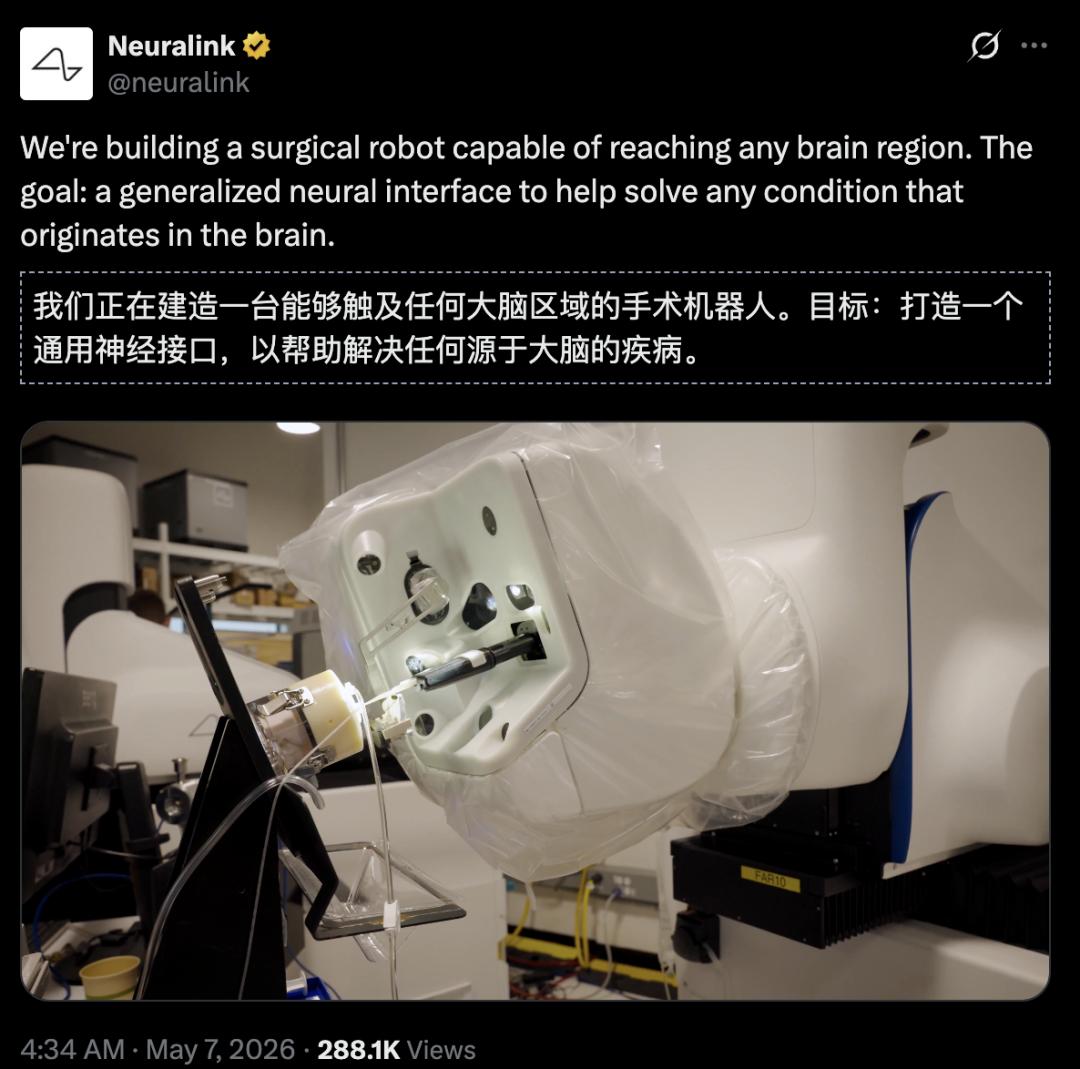
The "sewing machine"-style high-frequency implantation, a micron-level dance on the jelly
Neuralink internally calls this robot the "sewing machine": the needle punctures repeatedly at a high frequency, "sewing" flexible electrodes one by one into the cerebral cortex.
This is how it works.
Imagine a transparent bowl filled with jelly that is slightly pulsating.
You are required to take a flexible thread ten times thinner than a hair and sew it in. The requirement is: you can't break any tiny bubbles, and the needle landing point must be accurate to the micron level.
Why must flexible electrodes be used?
Because the brain is in this state: it pulsates, trembles, and slightly shifts.
After long-term implantation, a rigid electrode is like a steel needle buried in tofu, cutting the surrounding nerve tissue with each pulsation.
Flexible electrodes solve this problem. They are like extremely thin threads that sway with the brain tissue without harming anything.
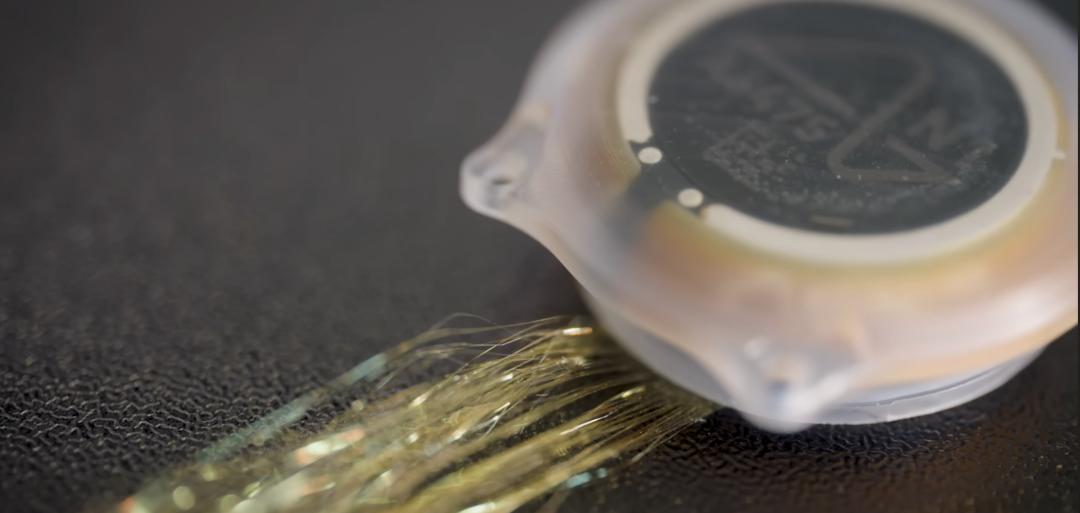
One electrode every 1.5 seconds. 1,024 electrodes. One N1 implant. All are independently completed by the robot, while the human surgeon stands beside and watches.
The end of the scalpel may be because the speed of biological evolution can no longer keep up with the iteration of industrial parameters.
The "real-time map" of eight cameras, making the whole brain "fully accessible"
The most dangerous thing during the operation is to touch a blood vessel.
Neuralink's solution: eight high-definition cameras from different angles, combined with the OCT (Optical Coherence Tomography) system, construct a three-dimensional map of the brain's blood vessels in real-time during the operation.
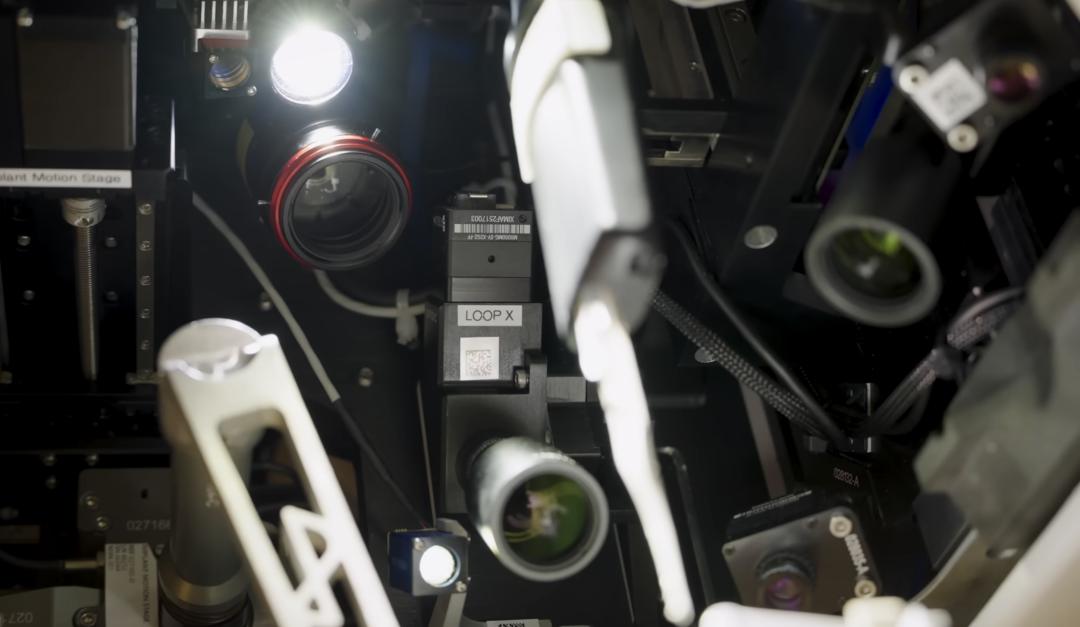
The principle of OCT is similar to that of ultrasound, but it uses light. It can penetrate 1 - 2 millimeters below the surface of the brain tissue and mark the position of each capillary vessel.
The robot's AI system calculates the optimal insertion path for each electrode in real-time based on this map - avoiding all blood vessels and precisely hitting the target neurons.
What if a blood vessel that was not detected before suddenly appears on the preset path during the insertion process?
The robot re-plans the path within milliseconds.
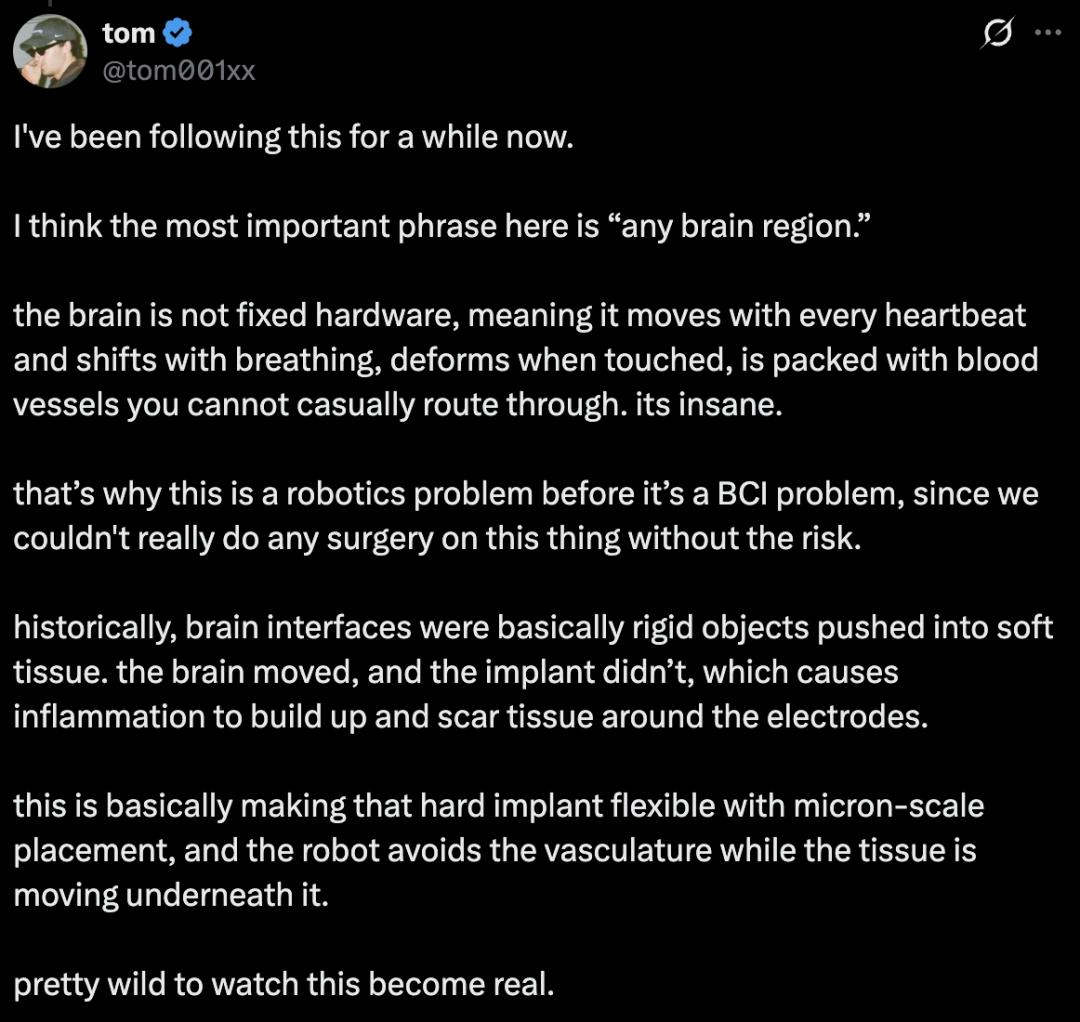
In essence, Neuralink makes the rigid implant flexible through micron-level positioning, and at the same time, the robot avoids the blood vessel system when the tissue moves.
Tom, a netizen who has been following this project, said bluntly, "It's amazing to see all this become a reality."
What's more noteworthy is another engineering breakthrough: in the past, the dura mater (the tough outer membrane that protects the brain) had to be removed during the operation, but now the robot directly pierces through it.
This one-word difference means less trauma, lower infection risk, and faster recovery.
This is the key fulcrum of Musk's "LASIK-like" vision - he wants to make brain-computer interface surgery as simple as excimer laser refractive surgery: enter the door, sit down, take a nap, and leave.
Theoretically, it can reach 99% of the human brain structure
The first two generations of implants could only cover the surface of the cerebral cortex. What can the surface do? The motor cortex. It helps paralyzed patients control the cursor, play games, and draw CAD with their minds.
It's already quite shocking, but this is just the "surface" of the brain.
The 5-axis linkage system of the second-generation surgical robot breaks through this ceiling.
Five degrees of freedom mean that the robotic arm can cut into the brain from almost any angle and reach the deep area more than 50 millimeters below the cortex.
Neuralink says that this means 99% of the human brain structure is within reach.
What does this mean?
The motor cortex controls the limbs and is located at the top of the brain. The visual cortex processes images and is at the back of the head. The language cortex controls speech and is on the side. And high-level functions such as emotions, memory, pain perception, and decision-making are all buried deep in the brain.
In the past, Neuralink could only reach the motor cortex. Now, theoretically, the motor, visual, language, emotional, and memory areas - all are accessible.
This is the term that Neuralink shouts out: "Universal neural interface". It's not just a device for treating paralysis, but a platform that can reach all brain diseases.


20 living people, from browsing the web to flying drones
Technical indicators are boring, but the performance of the subjects is chilling.
As of early 2026, about 20 patients have successfully received Neuralink implants.
The first volunteer, Noland Arbaugh, can lie in bed and play "Mario Kart", browse the web, and play "Civilization VI" with his "mind", just like an ordinary player in the digital world. The only difference is that his input device is his brain.
The second subject, Alex Conley, goes a step further: he starts to directly control drones and robotic arms with his thoughts.
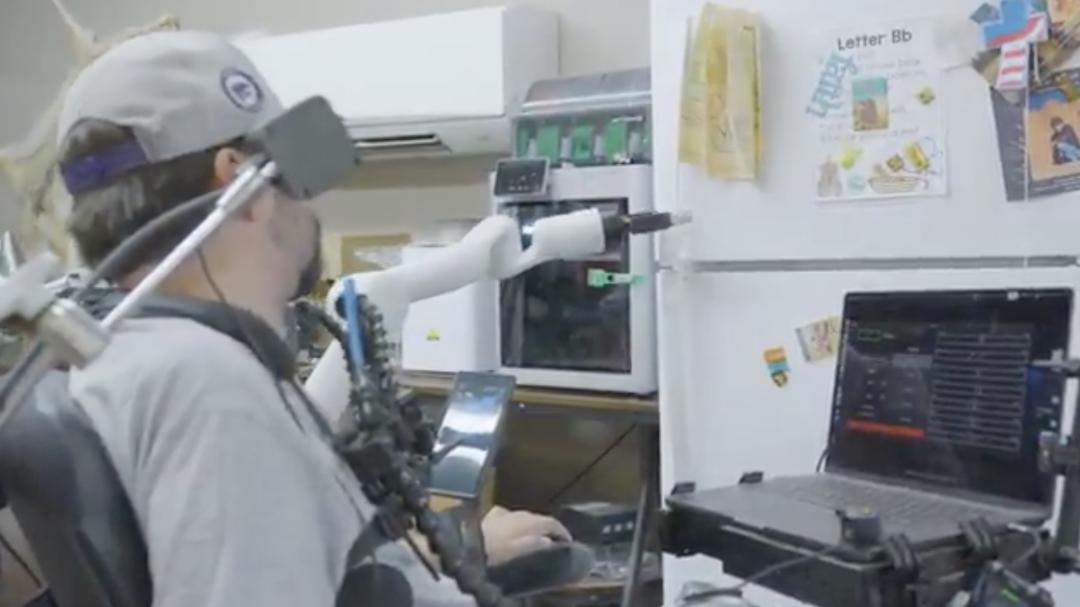
This is a critical breakthrough.
The output of the brain-computer interface has officially evolved from "clicks in the digital world" to "interactions in the physical world".
When thoughts are no longer limited to the cursor on the screen but become mechanical hands that can grab objects and rotors that can fly, the "body boundary" defined by humans collapses.
This also explains why Neuralink has not made large-scale profits yet, but its valuation has soared to $9 billion - the latest round of financing was $650 million.

Investors are not betting on a medical device but on the mass production possibility of a human "evolutionary plug-in".
Being able to insert electrodes into any position in the brain doesn't mean we know what to do at that position.
The signals from the motor cortex have been decoded quite well - when you imagine moving your fingers, the N1 can read it and convert it into actions on the screen.
But what about the visual cortex? Currently, only extremely low-resolution light-sensing stimulation has been achieved. There is a scientific gap between making a blind person see a blurry bright spot and truly "seeing the world". The neural coding of the language cortex is even more complex. Emotions and memory? Humans themselves haven't even figured out what the physical basis of these functions looks like.
The hardware has outpaced science. The precision, speed, and coverage of the surgical robot are no longer bottlenecks.
The bottleneck is: our understanding of our own brains is not enough.
The "Moore's Law" of neurons
Neuralink has made a bold analogy: the number of neurons involved in human-machine interaction is following an exponential curve similar to Moore's Law.
The first-generation N1 has 1,024 channels. The goal for 2027 is 10,000. By 2028, it will exceed 25,000.
The more channels there are, the richer the neural signals read, and the greater the communication bandwidth between the human brain and the machine.
Musk has calculated that the current information output rate of humans is less than 1 bit per second. Typing, speaking, and gesturing are essentially squeezing the explosive parallel computing in the brain into a pitifully narrow serial channel.
What if the bandwidth is increased to several megabits per second? Several gigabits per second?
Then it's not just about treating diseases.
Reference materials:
https://x.com/neuralink/status/2052124938442526936
https://x.com/neuralink/status/2050311303294562645
https://www.youtube.com/watch?v=KO53gwuqZUQ
This article is from the WeChat official account "New Intelligence Yuan", author: New Intelligence Yuan. It is published by 36Kr with authorization.