A flexible tactile sensor company founded by a Stanford postdoctoral fellow has received over 100 million yuan in financing, and low-cost tactile gloves will be mass-produced | Exclusive report by Yingke
Author | Huang Nan
Editor | Yuan Silai
Yingke learned that Tujian Technology (Beijing) Co., Ltd. (hereinafter referred to as "Tujian Technology") recently completed Pre-A and Pre-A+ rounds of financing, with a cumulative amount of over 100 million yuan in the two rounds. The investors include Lenovo Star, Huakong Fund, Yuanhe Puhua, Yuanhe Holdings, Hongtai Fund, etc. The funds will be mainly used for core technology R & D, expansion of product matrix such as full - body tactile sensors for robots, tactile gloves, and tactile data collection toolchains, and upgrading of the production system to accelerate market - oriented implementation and verification.
Tujian Technology was founded in January 2020. It focuses on the R & D and manufacturing of stretchable multi - modal flexible electronic skin and embodied tactile perception systems, as well as the development of tactile data collection toolchains and model establishment, and promotes the implementation of technology in scenarios such as embodied intelligence, intelligent cockpits, healthy living, and emotional companionship. The company has two headquarters in Beijing and Shenzhen respectively, and established a cutting - edge technology exploration center in Silicon Valley, the United States. It has completed the construction of a 2000 - square - meter R & D center and an automated production line and put them into operation.
Lai Jiancheng, the founder and CEO, has long been focused on the research in the field of flexible electronic skin materials, devices, and system integration. He once conducted post - doctoral research in the laboratory of Academician Bao Zhenan at Stanford University in the United States, and has successively led several national and provincial - ministerial key projects such as the first batch of disruptive technology innovation projects of the National Key R & D Program of the Ministry of Science and Technology.
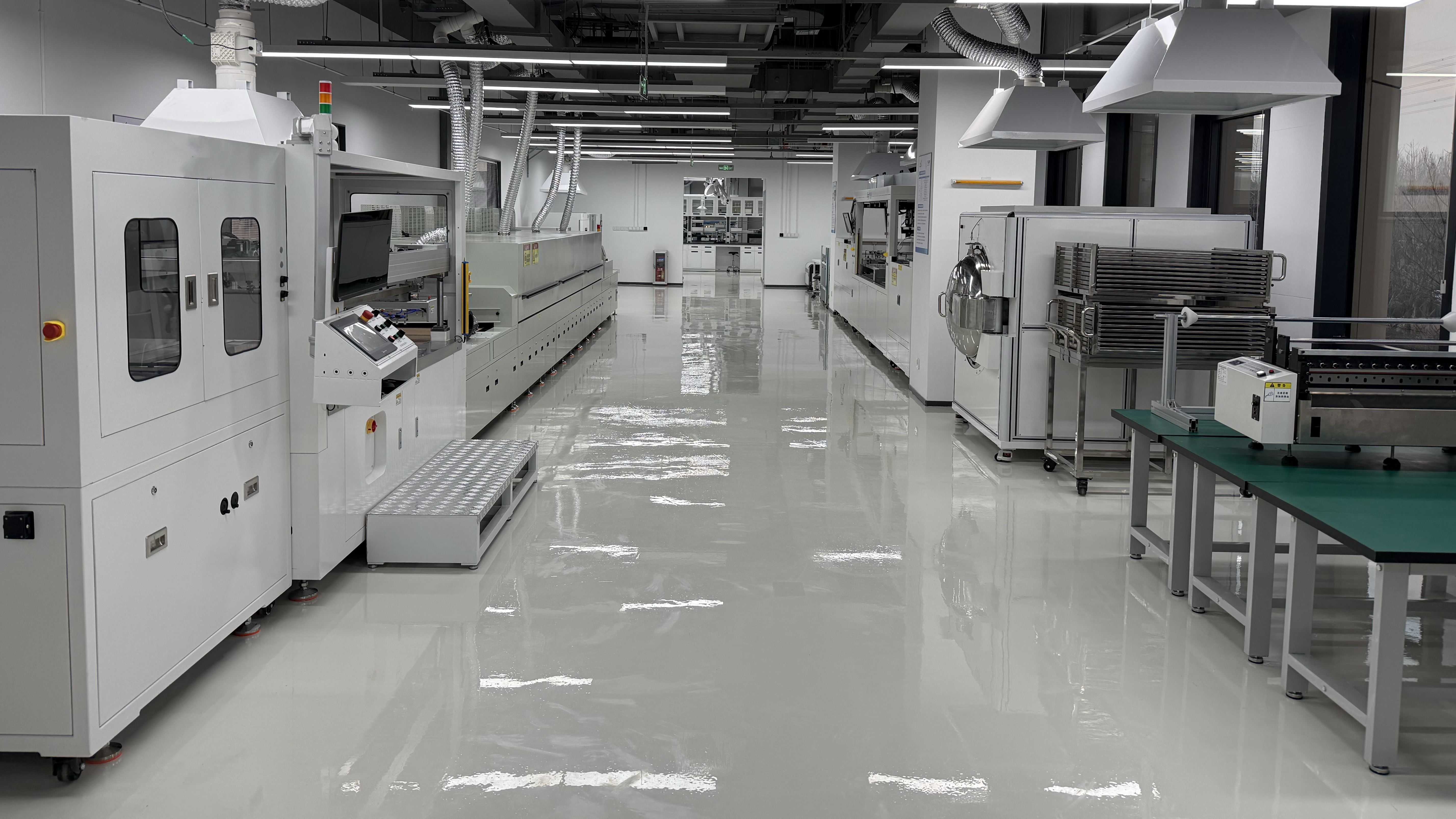
Tujian Technology's automated production line (Source: Company)
The global tactile sensor market is expanding rapidly with the development of embodied intelligence. According to the measurement of Verified Market Research, the global overall tactile sensor market scale exceeded 15 billion US dollars in 2024, and it is expected to exceed 35 billion US dollars by 2031, with an annual compound growth rate of about 12.8%. Among them, relying on the explosion of emerging scenarios such as humanoid robots, intelligent equipment, and medical health, the flexible tactile perception track has witnessed high - speed growth, with an annual compound growth rate of 35%.
Specifically at the technical route level, the classification of tactile sensors usually has two dimensions. According to the sensing principle, the mainstream solutions include resistance, capacitance, piezoelectricity, triboelectricity, optical/visual, magnetism, etc. Different principles determine the sensitivity, range, and response speed of the sensors. According to the material and structural form, they can be roughly divided into four categories: rigid silicon - based/ceramic arrays, semi - flexible substrate arrays, fabric - based, and intrinsically stretchable elastomers.
Among them, the four paths of different material structures have their own advantages and disadvantages. Rigid arrays have high accuracy, but it is difficult to fit the complex curved surfaces of robot bodies and dexterous hands; semi - flexible substrates solve some bending problems, but they cannot be bent and still lack intrinsic stretchability, and are prone to failure in dynamic deformation scenarios; although the fabric solution is soft and breathable, it is limited by density, accuracy, temperature drift, and waterproofness.
In contrast, intrinsically stretchable materials are generally considered to be a cutting - edge direction that is more in line with the characteristics of bionic skin and the "first - principles", which has also become the differentiated route that Tujian Technology focuses on.
Tujian Technology has independently developed a series of flexible material systems that can stably maintain electrical properties under high - stretch conditions. The stretchability exceeds 100% and can fully recover. The bending radius is less than 1 millimeter, and it can adapt to various irregular non - developable curved surfaces, effectively solving the pain points of traditional flexible devices that are "non - stretchable" or "fail once stretched".
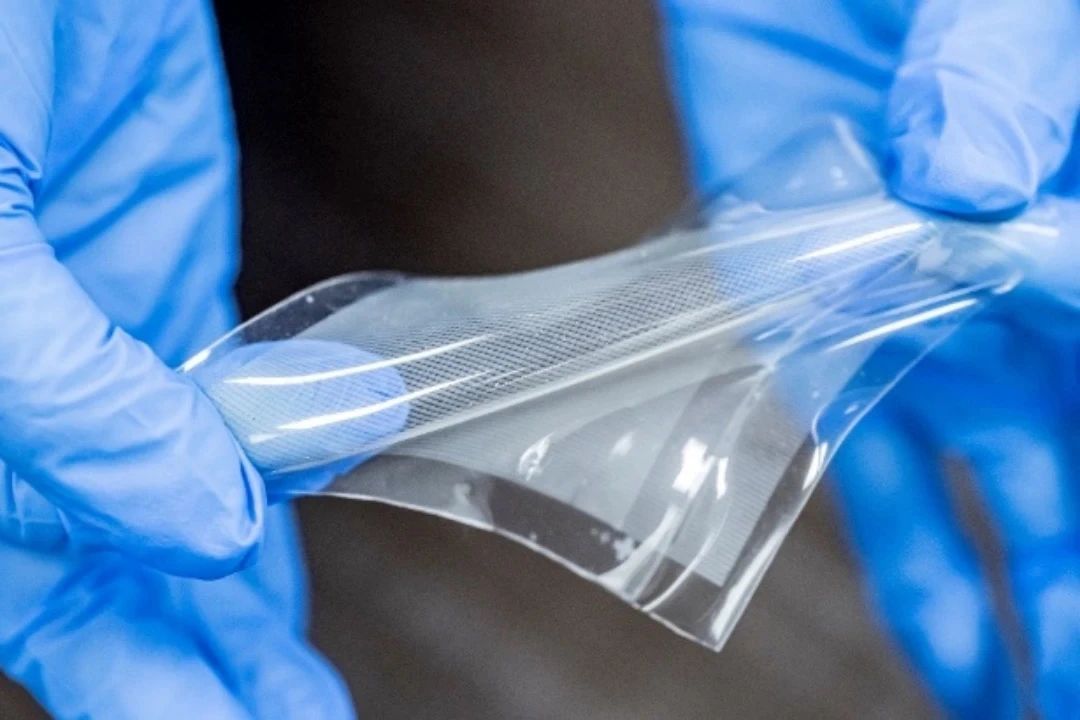
The electronic skin developed by Tujian Technology (Source: Company)
On the basis of innovative materials, the company has also integrated a multi - modal sensor array on its single - chip electronic skin. The standard product can integrate 400 sensors per square centimeter. Through the topological structure design of multi - modal sensors, it can realize the perception of multi - dimensional information such as pressure, temperature, shear stress, surface texture, and proximity sense. This perception system has a unique "proximity sense" ability, that is, the sensor can sense the approach of an object up to 20 centimeters away before it touches.
This also means that an embodied intelligent robot equipped with Tujian Technology's tactile solution can not only judge "whether it touches" but also predict "is about to touch" in advance, and distinguish rich tactile information such as material, texture, temperature, and sliding direction, which is crucial for human - machine interaction safety and anti - collision. For example, when the equipment turns or a child approaches, the robot can brake in advance to improve safety; it also has wide applications in the field of intelligent vehicle safe driving.
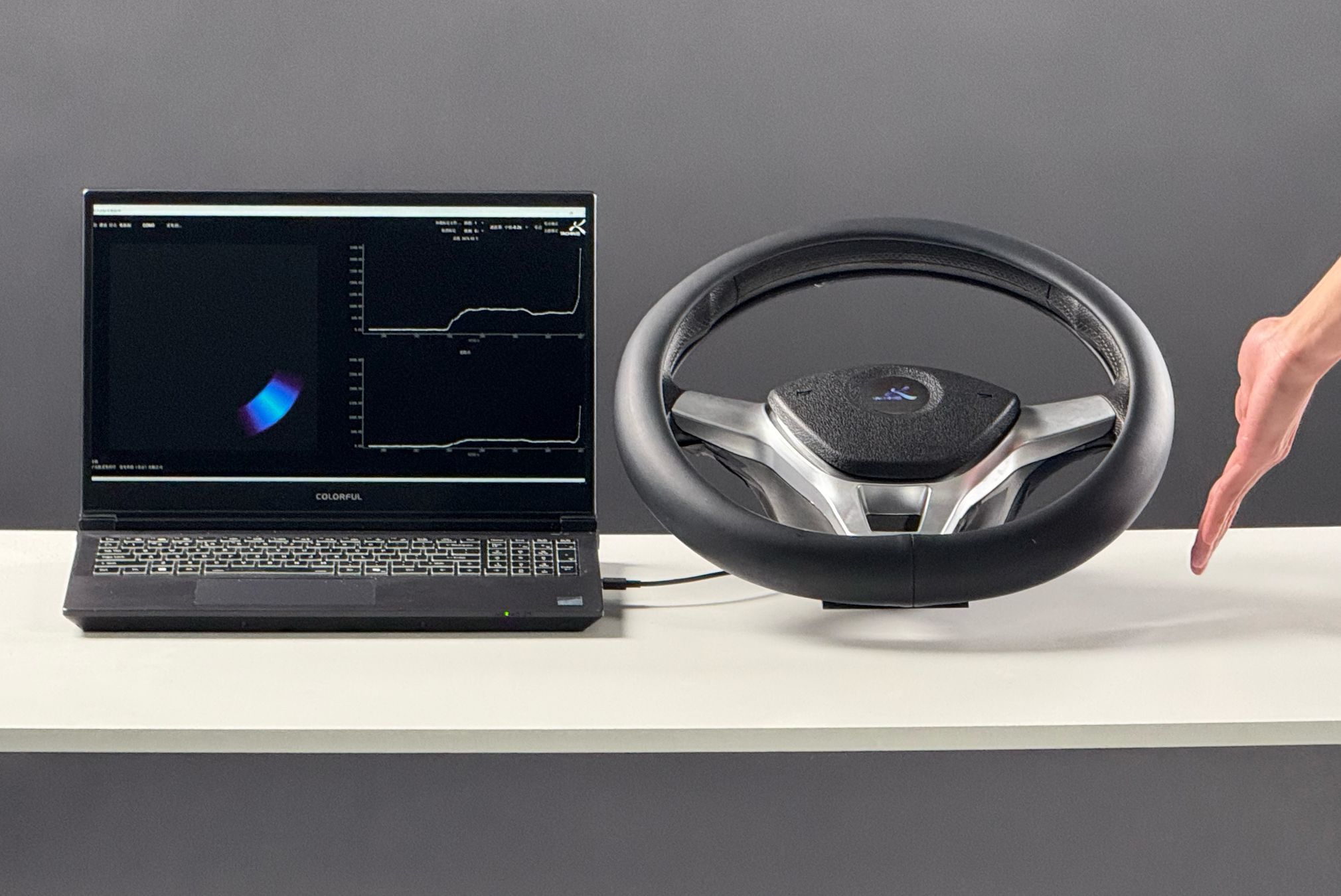
The steering wheel equipped with Tujian Technology's tactile solution (Source: Company)
"Human skin itself is a stretchable, multi - modal perception network," Lai Jiancheng, the founder and CEO of Tujian Technology, told Yingke. "Based on this bionic starting point, we choose to directly reproduce the underlying logic of biological touch from the material end. This integrated design of'material + device + system' gives the sensor natural advantages in terms of thinness, sensitivity, and multi - modal integration, which is a competitive barrier that is difficult to cross for traditional solutions by simple stacking."
Based on this technology base, Tujian Technology has formed three major product matrices in the field of embodied intelligence, namely full - coverage tactile sensors for dexterous hands, full - body tactile sensors for robots, and a tactile glove data collection system, constructing a complete tactile perception ecosystem from materials, devices to system integration.
These three types of products are not independently arranged. The dexterous hand and full - body tactile sensors for robots are for real - time perception and interaction on the robot side, while the tactile glove is for data collection and model training on the human operation side, jointly forming a closed - loop system of "human teaching data collection - robot tactile execution feedback - model continuous optimization".
In terms of dexterous hands, Tujian Technology has previously reached cooperation with several leading industrial parties, and some have entered the stage of mass delivery. Full - body tactile sensing is a more imaginative direction. The company cooperates with leading embodied enterprises and OEMs to try to cover the entire body of embodied robots with a thin - film tactile perception layer to improve their perception and control capabilities. With full - body tactile sensing, the robot can sense the force on each part of its body and dynamically adjust its posture to make operations more stable.
The tactile glove data collection system is Tujian Technology's core standardized product in 2026. This system integrates touch and vision. The wearer can enter real work and life scenarios to collect operation data for training robot models. Compared with fixed data collection factories, the gloves can be deployed on a large scale at low cost. Currently, the company has obtained cooperation intention orders from several manufacturers.
Different from traditional motion capture, force - feedback gloves, or external data collection solutions, Tujian Technology's tactile gloves emphasize high - density, low - interference collection of the real contact process. The number of hand tactile units is larger, and a multi - point tactile perception network can be formed in key areas such as fingertips, finger pads, and palms to capture tactile changes in fine operations such as grasping, pinching, pressing, sliding, and rubbing. At the same time, the system can effectively distinguish "real contact" from "empty grasping actions", avoiding mislabeling invalid actions as effective operation data, which is particularly crucial for improving the quality of tactile data.
In terms of data, the tactile gloves not only collect the movement trajectory of the human hand, but more importantly, collect the continuous relationship between "action - contact - force - slip - object feedback". Vision can analyze the position, shape, and scene semantics of objects, but it is difficult to directly determine whether the contact is stable, whether the grasping is slipping, whether the force is too large, and whether the operation is completed. Tactile data complements the key closed - loop information in the interaction between the robot and the physical world, enabling the robot to learn how humans adjust the force, posture, and action rhythm according to the contact state in real operations.
Based on the large - scale real - interaction data collected by the tactile gloves, Tujian Technology hopes to further build a tactile - visual fusion data set and toolchain for robot operation tasks, providing a basic data foundation for embodied intelligent model training.
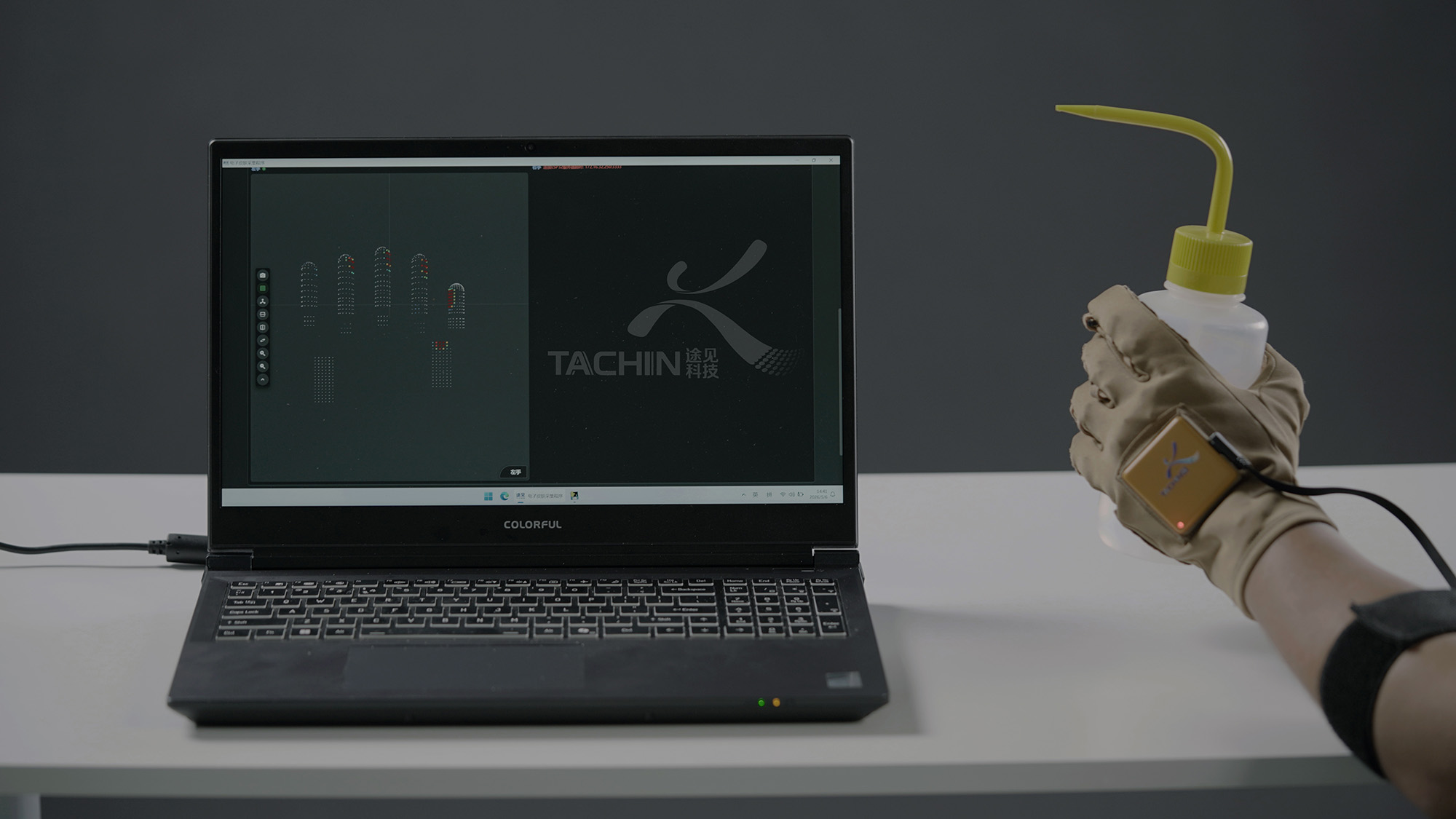
Tujian Technology's tactile glove data collection system (Source: Company)
Lai Jiancheng told Yingke that Tujian Technology will focus on upgrading the multi - scenario adaptation ability in the future, accelerate the mass production and delivery of products, and establish a large - scale supply chain system. In terms of scenarios, the company will continue to focus on embodied intelligence, consumer robots, smart medical care, and automotive electronics as the core tracks, continuously expand the domestic and international markets, and promote the implementation of flexible electronic skin technology in more terminal scenarios.
Currently, the competition in the field of general robot bodies has reached a white - hot stage, and tactile perception, as the "last millimeter" core barrier, is taking shape at an accelerating pace. For embodied intelligence, what is truly scarce is not just the sensor hardware itself, but high - quality, scalable tactile data strongly related to real - world physical interaction.
From data collection to real - time interaction, from dexterous hands to the whole robot body, from vertical industries to general service scenarios, flexible tactile sensors are gradually evolving from an optional solution to a new technological origin. Tujian Technology attempts to build a complete link from perception hardware, data collection to model training through the two - way layout of electronic skin on the robot side and tactile gloves on the human side, making touch the underlying operating system for robots to understand and operate the physical world.