The "Seven Little Dragons" of humanoid robots: Who can really sell products, and who is just telling stories?
In 2026, humanoid robots "went crazy".
Yushu Technology's IPO application was accepted. Galaxy Universal Robotics raised 2.5 billion yuan in a single - round financing, breaking the industry record. Qianxun Intelligence's valuation exceeded 10 billion yuan in two years. Xinghai Tu secured 2 billion yuan in a Series B+ financing... Data shows that in the first quarter of 2026, the cumulative financing in the domestic embodied intelligence field was approximately 20 - 30 billion yuan, and the overall financing enthusiasm far exceeded that of the same period in 2025.
In April, the list of financing continued to grow. Zhongqing Robotics, Digua Robotics, Qianxun Intelligence, and Xingdong Jiyuan successively announced large - scale financings of hundreds of millions of yuan. According to incomplete statistics, from April 3rd to April 9th, the financing amount of the robotics sector ranked second among all tracks.
Among these companies being frantically sought after by capital, seven companies, namely Yushu Technology, Zhiyuan Robotics, Leju Robotics, Zhongqing Robotics, Galaxy Universal Robotics, Songyan Power, and Jiasu Jinhua, have been called the "Seven Little Dragons of Humanoid Robots" by some industry insiders due to their recent outstanding performances. They have received intensive financing in the past two years, with each company's valuation exceeding 10 billion yuan. Behind them stand leading investors such as Sequoia Capital, Hillhouse Capital, Meituan, as well as CATL and BYD. They have both sufficient funds and good stories.
However, upon closer inspection, these seven companies are actually fighting completely different battles: some establish a first - mover advantage through shipment volume, some wait for the market to explode with technological barriers, some focus on hardware refinement, and some bet on the general - purpose brain. Although they all carry the name of "humanoid robots", their business logics, technological positions, and potential risks are significantly different.
Through the differences in their valuations, technologies, and commercialization processes, we can glimpse the real face of this industry on the verge of explosion. At present, there is no recognized successful path for humanoid robots. However, it is clear that in the future, the competition in this industry will gradually shift from technology demonstrations to real large - scale applications.
01. Who are the "Seven Little Dragons of Humanoid Robots"?
The term "Seven Little Dragons of Humanoid Robots" is similar to the "Six Little Tigers of AI" in the large - model track back then. It is a group of leading enterprises in this track evaluated by the market in a short period based on technological reputation and financing scale.
Based on the opinions of multiple industry insiders, the screening criteria mainly include three aspects:
The valuation exceeds 10 billion yuan, and a single - round financing of over 1 billion yuan has been completed in the past 12 months, or the company has initiated an IPO;
There is strategic investment from leading manufacturing industries (mainly automobile companies), and there are actual cooperation cases;
The core product is full - size humanoid robot, and there is an annual shipment volume of over a thousand units either publicly announced or statistically verified by third - parties. Some can even achieve large - scale commercial delivery in at least one vertical scenario.
According to the above three criteria, seven companies, namely Yushu Technology, Zhiyuan Robotics, Leju Robotics, Zhongqing Robotics, Galaxy Universal Robotics, Songyan Power, and Jiasu Jinhua, were selected.
By comparing these seven companies, we can draw three conclusions.
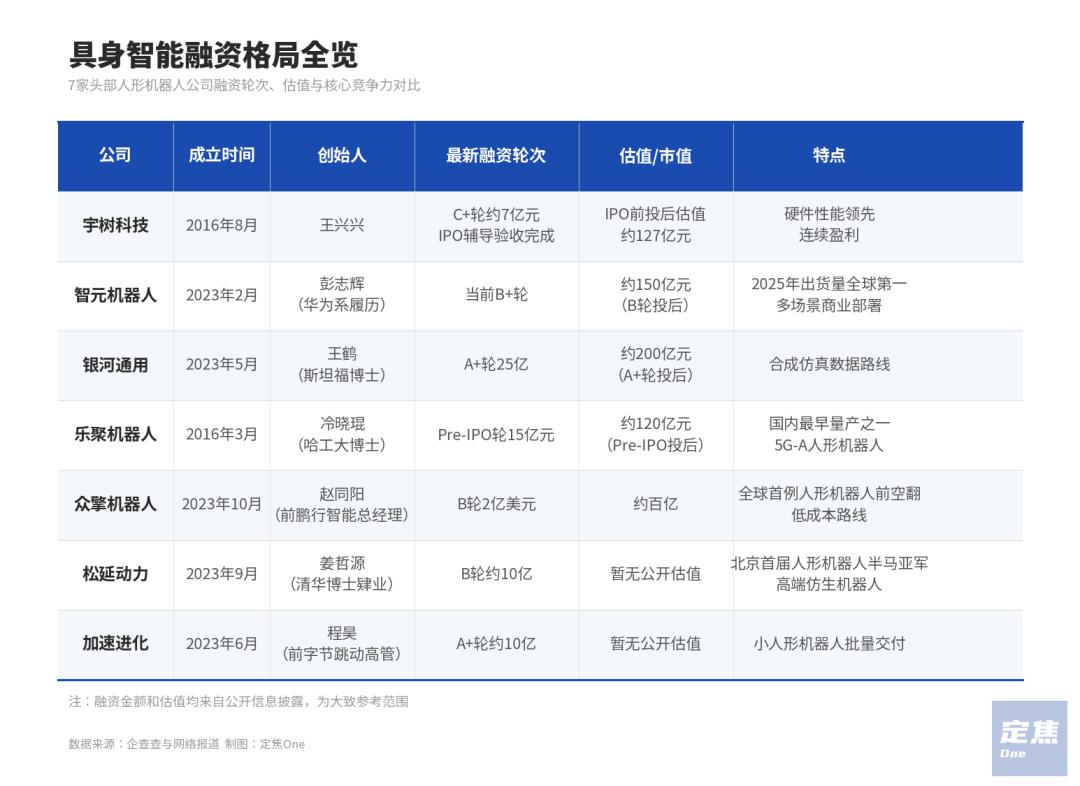
First, although all seven companies are in the leading position, there is a large gap in their valuations, and the valuation is not entirely proportional to the shipment volume.
Galaxy Universal Robotics has the highest valuation, reaching 20 billion yuan (3 billion US dollars), but it has not yet achieved large - scale shipments. This is mainly because it focuses more on the research and development of the humanoid robot brain. The industry generally believes that whoever runs through the "general - purpose brain" first will take the largest share in the future larger market.
The valuations of Yushu, Zhiyuan, and Leju range from 12 to 15 billion yuan. They either have deep roots in the industry for many years or have a large market scale. They have certain advantages in shipment volume. For example, both Yushu and Zhiyuan shipped over 5,000 units in 2025, and Leju has completed the IPO tutoring and acceptance.
The valuations of Jiasu Jinhua, Songyan Power, and Zhongqing are around 10 billion yuan, mainly due to their respective unique product routes. Jiasu Jinhua's "small humanoid" robots are popular in the market. Songyan Power's bionic robots appeared on the 2026 Spring Festival Gala. Zhongqing is a powerful player with its own advantages.
Second, the main customers of the seven companies are still mainly in the scientific research and education fields, and industrialization is the common next step.
The seven companies have covered multiple fields such as consumption, industry, scientific research, and education in application scenarios, but the structure is not balanced. Scientific research and education are the most stable and highest - proportion basic market. The more imaginative consumer market and industrial scenarios are still in the early stages of verification and development.
Taking Yushu, which has the most detailed public disclosures, as an example, in the first three quarters of 2025, scientific research and education customers contributed 73.6% of the humanoid robot revenue, while industrial applications only accounted for 9%. Although the other companies have not publicly disclosed detailed data, industry insiders generally reflect that the orders in the industrial scenario are not yet large - scale, which is also the goal that the entire industry needs to overcome in the next step.
Third, profitability is rare.
Among the seven companies, only Yushu has clearly achieved annual profitability. It turned a profit in 2024, and its net profit after deducting non - recurring items reached 600 million yuan in 2025. The other six companies are either in a loss state or have not disclosed their financial status. Relying on financing to survive is a common reality.
However, some investors point out that in the early stage when the industry pattern is not yet established, the technological route and market share are more critical than short - term profitability. Losses often come from high R & D investment and capacity expansion. As long as the shipment volume and the number of customers continue to grow, the current losses are acceptable.
02. Ranging from a few thousand to 690,000 yuan, different robot routes
After talking about the overall situation of the Seven Little Dragons, let's take a look at their respective product and technological routes, which determine how far they can go.
From the current strategic and commercial progress, these seven companies can be roughly divided into two categories: the mass - production faction that establishes a first - mover advantage through shipment volume, and the technology - driven faction that waits for the market to explode with technological moats.
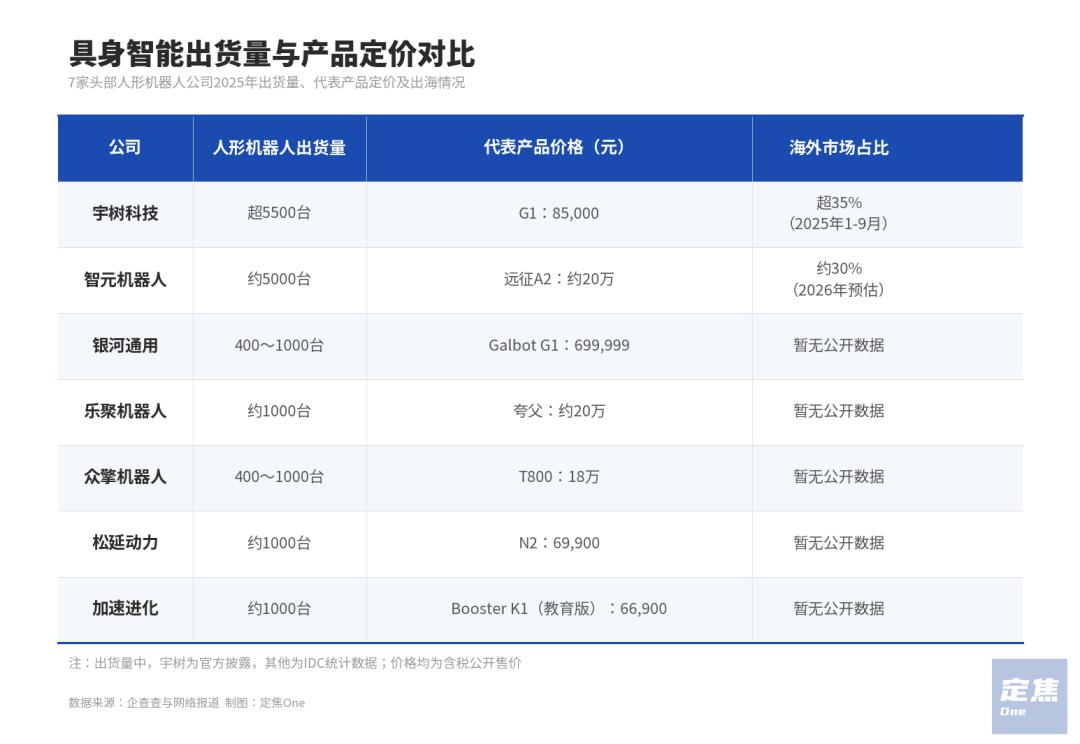
The two fastest - growing companies in the mass - production faction are Yushu and Zhiyuan. Public data shows that the two companies sold over 10,000 humanoid robots in total in 2025.
In 2025, Yushu Technology actually shipped over 5,500 humanoid robots, with an annual revenue of 1.708 billion yuan, a year - on - year increase of 335%, and a gross profit margin of 60%. This is a rare achievement in the industry.
What supports this achievement is the cost advantage accumulated by founder Wang Xingxing through years of in - depth work in the field of motion control: the cost control of joint modules and power systems allows Yushu's G1 to be priced at 99,000 yuan, opening up a new market while competitors are still selling at prices of seven or eight hundred thousand yuan.
Zhiyuan's approach is different from Yushu's. It shipped over 5,100 units in 2025 and exceeded the cumulative mass - production of 10,000 units in March 2026. However, Zhiyuan emphasizes that it is not in a mass - production competition. "What really matters is whether the robot can meet the sustainable needs of customers in real scenarios."
This may be understood as that Zhiyuan wants to provide a complete scenario - based solution. In terms of order composition, Zhiyuan has won a procurement order of 78 million yuan from China Mobile, and its layout in industrial scenarios such as the automotive and logistics industries is more advanced than Yushu's.
Although the shipment volume of Zhongqing Robotics is far lower than that of Yushu and Zhiyuan, it is still an important force in the mass - production faction.
Its full - size general - purpose humanoid robot T800 is priced from 180,000 yuan, and the lightweight robot PM01 is priced at 88,000 yuan. As of January 2026, its annual framework order amount has exceeded 500 million yuan, and its business scenarios cover three core fields: patrol inspection, guided tours, and industrial manufacturing. Zhongqing's CEO Zhao Tongyang has publicly announced a mass - production schedule. 2026 is a crucial year for the acceleration of commercialization, and the company has prepared a production capacity of four or five thousand units. The mass - production target from 2027 to 2028 is set between 30,000 and 50,000 units.
Yushu, Zhiyuan, and Zhongqing choose to increase the shipment volume and establish a market advantage before the industry matures.
The other option is to prioritize technology.
Galaxy Universal Robotics is the most representative one. Its product price is higher than the industry average. The Galbot G1 is close to 700,000 yuan, and it has not yet achieved large - scale shipments, but its valuation is the highest among the Seven Little Dragons, about 3 billion US dollars.
Behind this contrast is the market's bet on its technology.
Galaxy Universal Robotics wants to develop a "general - purpose brain". It chooses to reconstruct the robot's control system with an end - to - end VLA large model, conducts large - scale pre - training with simulation data, and then fine - tunes it with a small amount of real - world scenarios. This approach has stronger generalization ability (referring to the ability of the robot to "draw inferences from one instance" in new, unseen scenarios and tasks) and theoretically can support a robot to switch between different scenarios.
However, investing a large amount of funds in "intelligent" R & D also means that the speed of large - scale mass production is bound to be slow.
The special feature of Songyan Power lies mainly in its bionic robots, which is an area not yet explored by the other companies among the "Seven Little Dragons of Humanoid Robots". At the 2026 Spring Festival Gala, five of Songyan Power's robots collaborated with actress Cai Ming in the sketch "Grandma's Favorite". The robot resembling Cai Ming became an overnight sensation as soon as it appeared on stage.
To achieve a highly realistic expression restoration, Songyan Power installed up to 32 drive motors in the limited space of the bionic robot's head to reproduce Cai Ming's expressions as naturally as possible. In addition, making the bionic humanoid robot "speak" is also a major challenge. Not only does the mouth need to move, but each pronunciation also needs to match the mouth shape at the character level. Songyan Power's method is to use its self - developed Audio to Face voice - driven algorithm to increase the expression control frequency from 10 Hz to 60 Hz, thus eliminating the jerky feeling of facial movements.
Different from most humanoid robot companies that mainly promote full - size humanoid robots (similar in height to humans), Jiasu Jinhua focuses on the "small humanoid" robot track, that is, robots with a short stature and a round head.
The company adopts a combination of "platform + open - source tools + ecosystem" and targets the developer, competition, and education markets, trying to open up a market route. To enable more developers to participate, its product Booster K1 has opened up the underlying hardware and toolchain, and at the same time, it has freely provided one - stop development tools and embodied development video courses. It has been rated by industry insiders as one of the "smoothest - developing and most stable - running" platform products on the market.
Leju, established in 2016, is the oldest among the seven companies. It started with educational robots and later gradually expanded to humanoid and logistics scenarios. Its greatest advantage lies in its engineering capabilities and supply - chain accumulation. The localization rate of the core components of its full - size humanoid robot "Kuafu" series has increased to over 90%, and the localization rate of some components even exceeds 95%.
Currently, the speed - oriented companies focus on increasing volume first, and the technology - oriented companies focus on occupying positions first. There is no right or wrong in these two approaches for now, and they all need time to be verified.
03. Beyond the excitement, each has its own challenges
Financing and valuation form the glamorous side of humanoid robots, while the other side is the challenges that the industry must face directly. If we ignore the latter, we cannot get a complete picture of the "Seven Little Dragons of Humanoid Robots".
First, the technology is far from reaching the ceiling.
Currently, most of the actions and tasks that humanoid robots can demonstrate are specific settings in structured environments. This means that few humanoid robots can independently handle the randomness and complexity in real factory environments.
The key to solving this problem lies in the "Sim - to - Real gap". Data from the Elephant Research Institute shows that the training success rate of large models in the simulation environment drops by about 40% when transferred to real unstructured scenarios, and the success rate in real scenarios is less than 30%. Therefore, tasks trained only with simulation data are likely to fail in real environments.
Second, the commercialization path of humanoid robot companies is not clear.
The immaturity of technology directly affects monetization. Who will buy humanoid robots? Why do enterprises want to buy them? How long is the investment - return cycle? So far, no humanoid robot company can give accurate answers to these three questions. More than one industry insider has revealed that even though some humanoid robots have entered factories, the implementation process is quite time - consuming: factories need to readjust the industrial chain according to the robots and invest a large amount of funds. They believe that it will take at least three to five years to recover the cost and replace human labor.
Overall, the situations of the seven companies at this stage are also significantly different.
Yushu and Zhiyuan are in a relatively better situation. Yushu has become the only profitable company in the industry by virtue of cost control and first - mover advantage, with a healthy cash flow. Zhiyuan ranks high in terms of shipment volume and has made breakthroughs in industrial - scenario orders, with a clearer commercialization path. Both have built moats through large - scale mass production.
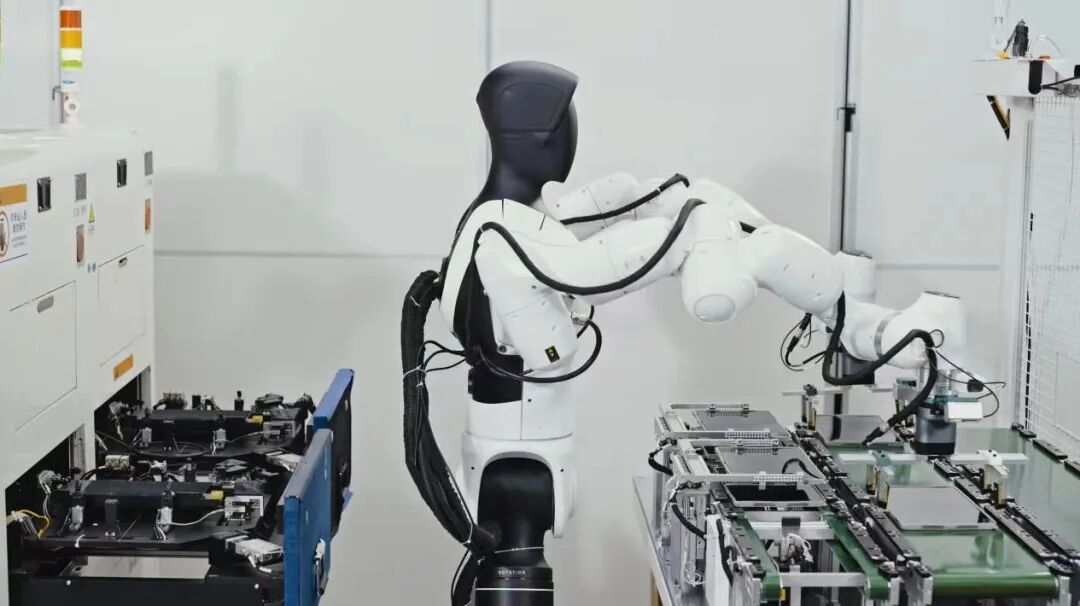
Image source / WeChat official account of Zhiyuan AGIBOT
Zhongqing and Jiasu Jinhua are facing key tests. Zhongqing has large - scale orders and a clear mass - production plan and is in the climbing stage from technology verification to large - scale delivery. The implementation of its production capacity in 2026 will determine its success or failure. Jiasu Jinhua has experienced rapid growth in the niche market but needs to prove to the market that "small humanoid" robots also have sufficient market space and commercial value.
The challenges faced by Galaxy Universal Robotics, Leju, and Songyan Power are relatively more severe.
Some industry insiders