Has Anthropic Tripled Its Revenue but Still Trapped in a "Money-Burning Black Hole"? Unraveling the Computing Power Stranglehold and Monetization Anxiety Behind Anthropic's Financial Data
God Translation Bureau is a compilation team under 36Kr, focusing on fields such as technology, business, the workplace, and life, and mainly introducing new technologies, new ideas, and new trends from abroad.
Editor's note: Can tripling the revenue save the cash flow? When coding agents outperform in efficiency, they hit the wall of lithography machine production capacity and the power grid. The restrictions on computing power and the wave of price hikes are on the way. This is not just a loss crisis for AI labs; ultimately, every user may have to foot the bill. This article is from a compilation.
At the end of last year, a new AI frenzy kicked off. This time, the spotlight is on "coding agents."
People began to claim that programming has entered a new era, and such clichés are endless.
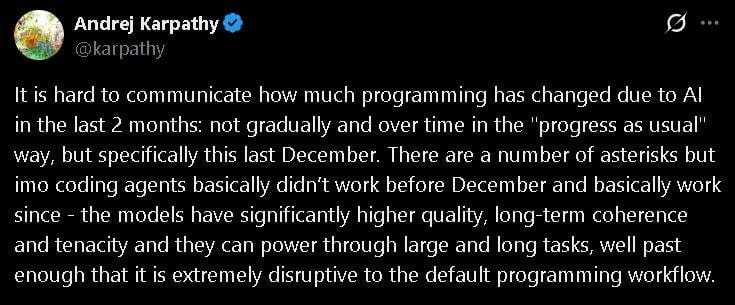
It's hard to describe how much AI has changed programming in the past two months: This change is not the kind of "gradual" normal progress, but specifically refers to the just-passed December. Although there are still some preconditions and limitations (asterisks), in my opinion, coding agents were basically unusable before December, and have been basically competent since then - the quality, long-term coherence, and resilience of the models have all been significantly improved. They can tackle large and long-term tasks, and their performance is enough to have a subversive impact on the default programming workflow.
A few months later, we no longer just have verbal claims. We have the data. And these data show that something extraordinary is happening in the market.
Coding agents are the first AI products that users are willing to pay for on a large scale and continuously because they can directly improve work efficiency. Although it's still too early to claim that enterprises are comprehensively replacing the entire business process with agents, the growth rate of computing power demand has exceeded anyone's construction speed.
Next, I'll talk about why the current situation is different from the past, why no one is prepared for it, and some of my personal insights.
The data speaks for itself
OpenAI and Anthropic may go public soon. That's why they are eager to show how amazing their revenue growth rate is.
This amount is extremely large.
Anthropic's revenue has tripled since the beginning of the year. You know, it's already a large company. Usually, the larger the scale, the more difficult it is to maintain the same growth rate. So this performance is really amazing.
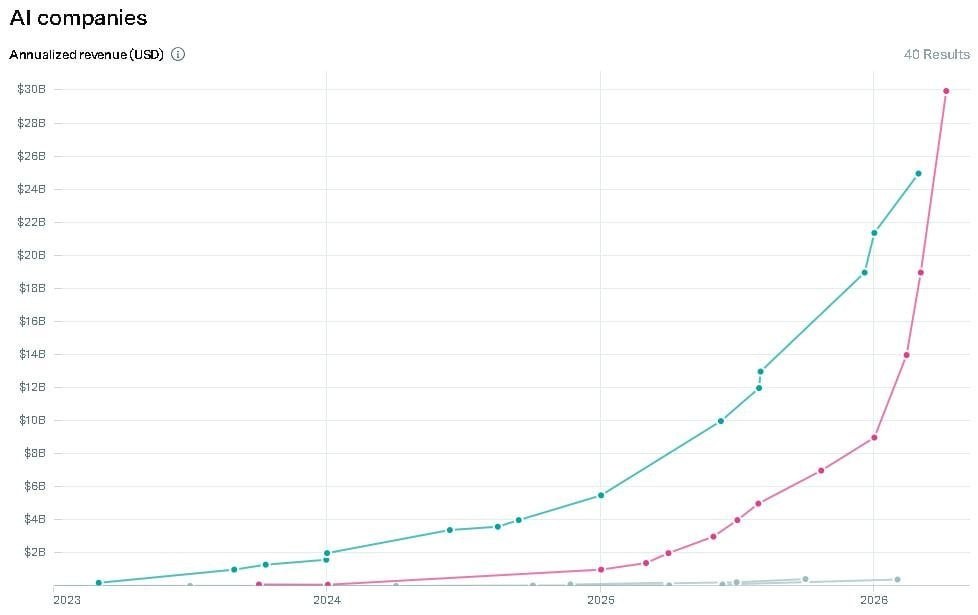
The left is OpenAI's annualized revenue, and the right is Anthropic's annualized revenue.
Even in the past prosperous periods, no one could achieve such data (of course, there is a precondition, see below). Zoom during the pandemic, Google when it just went public, or Coinbase which made a lot of commissions during the cryptocurrency boom. These companies were only one-fifth to one-tenth the size of Anthropic at that time and were in special circumstances, but their growth rates were still slightly inferior!
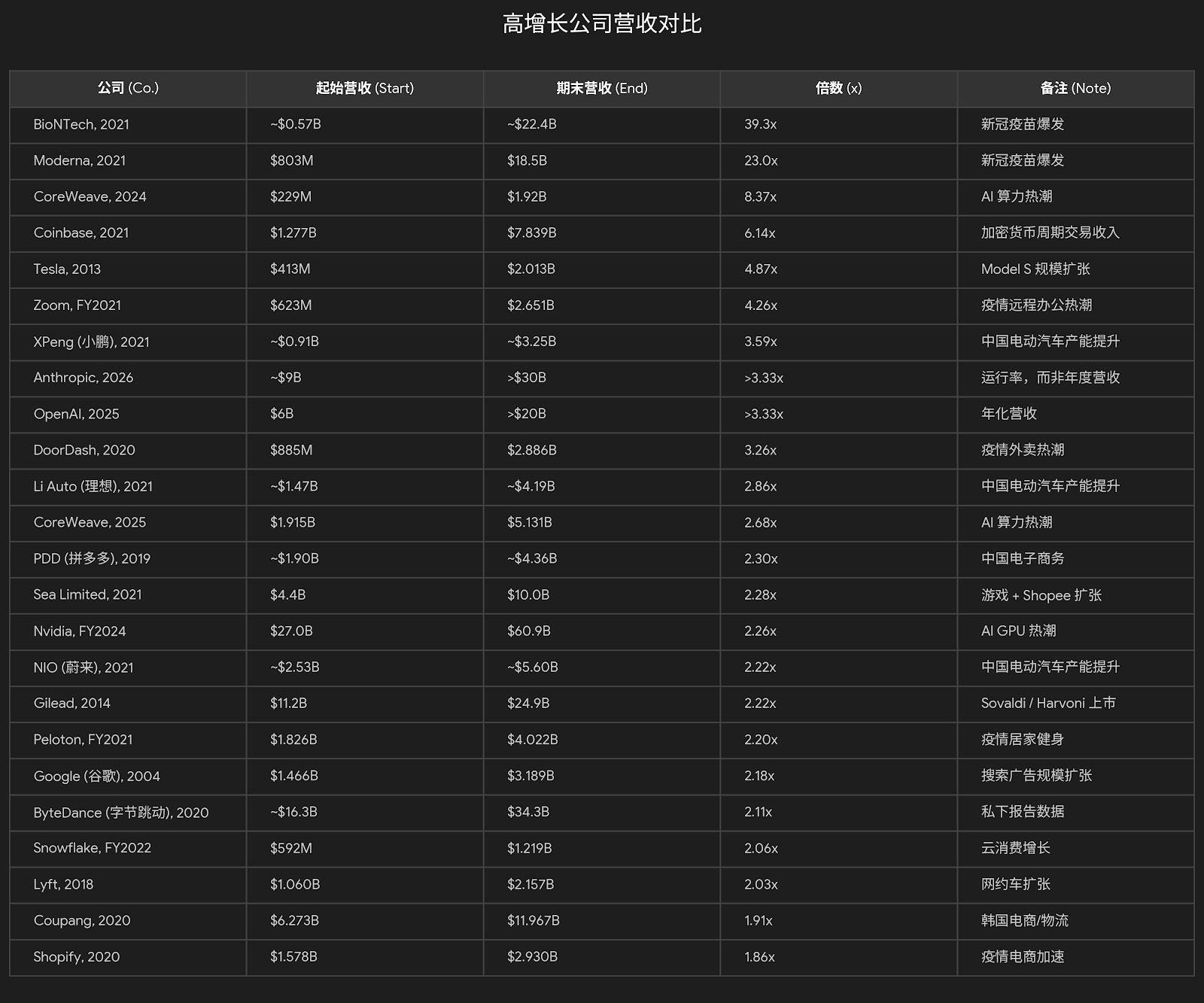
The years with the fastest growth of large companies. Only established companies are counted. Compare the revenue at the beginning and the end of the year.
Preconditions: First, vaccine manufacturers during the pandemic also performed remarkably; second, Anthropic's data is a prediction for the whole year based on early data, and their statistical caliber is slightly different from that of OpenAI. But these don't affect my conclusion, that is:
Real investment is the most reliable indicator of the real demand for "agent systems."
Last year, when a large group of people suddenly found that ChatGPT could generate cool pictures, this popularity didn't translate into substantial revenue.
Meanwhile, in just January, the proportion of Claude Code submissions in GitHub's public repositories soared from 2% to 4%. If this sounds insignificant, remember that this is just a one-month change, and Codex, Copilot, or Devin aren't even counted. Dylan Patel predicts that by the end of this year, Claude's proportion will exceed 20%.
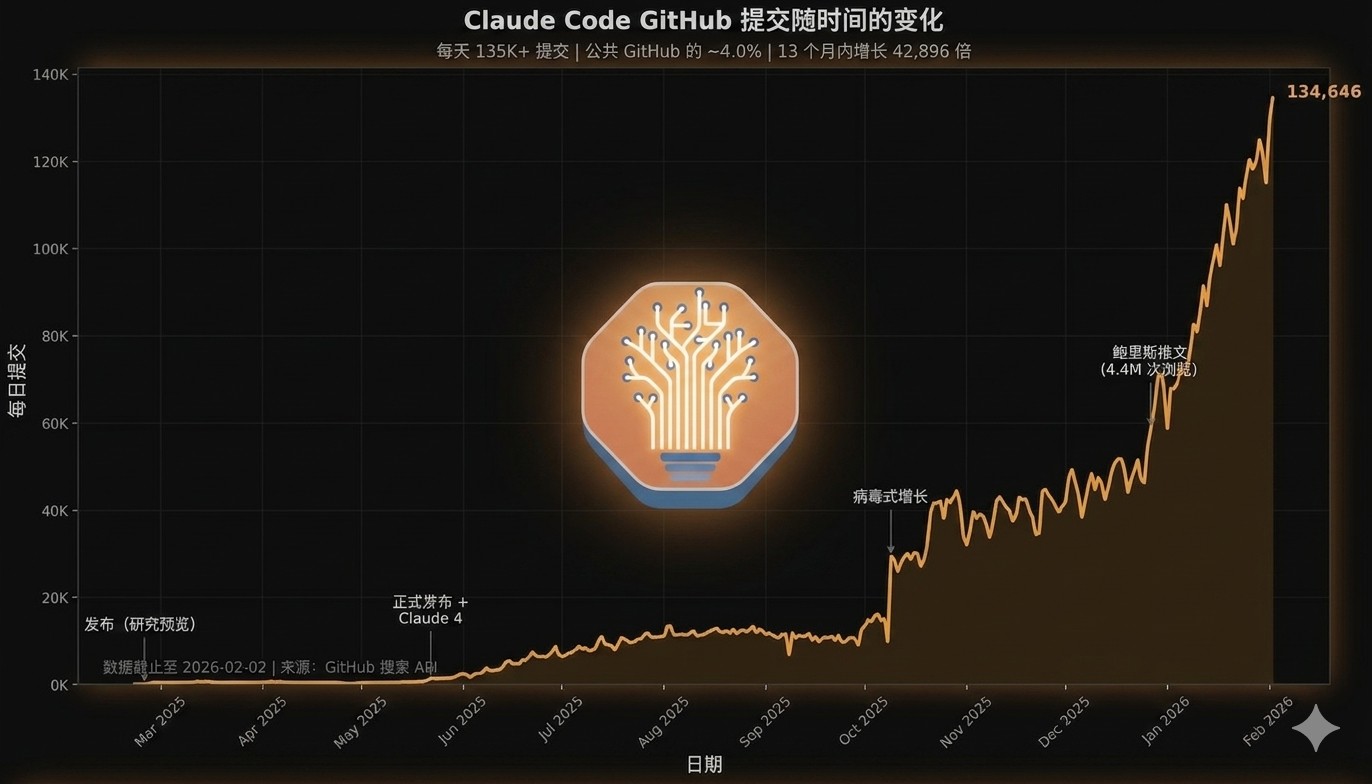
Claude submissions on GitHub.
Even though a monthly subscription fee of $100 can only automate a small part of the work, compared with a programmer's salary, it's a drop in the bucket. For an ordinary developer with a daily salary between $350 and $500, if the subscription service can handle the simplest and most mechanical 10% of the work, the return on investment (ROI) is as high as 10 to 30 times.
There are still many points in this view that are open to discussion.
I can even list the flaws in my logic myself.
The revenue is indeed increasing, no problem. But from a business model perspective, these labs are still in the red. They have sufficient motivation to create hype to attract companies with the highest risk tolerance. Most of the current paying users are early enthusiasts, not large enterprises. And enthusiasts' enthusiasm often comes and goes quickly, and many bubbles burst like this.
Agents are not stable and still make random mistakes. Once something goes wrong, who will take the responsibility? Since formal enterprises value reliability more, agents can't replace humans yet. Moreover, if you stop recruiting junior engineers, where will the future senior engineers come from?
Agents can currently only handle a small number of specific tasks. Even if writing code becomes faster, product delivery is still limited by requirements gathering, architecture design, code review, testing, and the stakeholder video conferences and compliance processes that we "hate."
But I think that at a certain point, you have to make a choice and take a side, even if there is no definite conclusion.
The "finish line" can be postponed indefinitely. There was a time when reasoning ability was unthinkable for machine learning models; the same was true for high-quality image generation or voices that don't sound like robots. No one used to believe that machines could learn to play Go. You should understand what I mean.
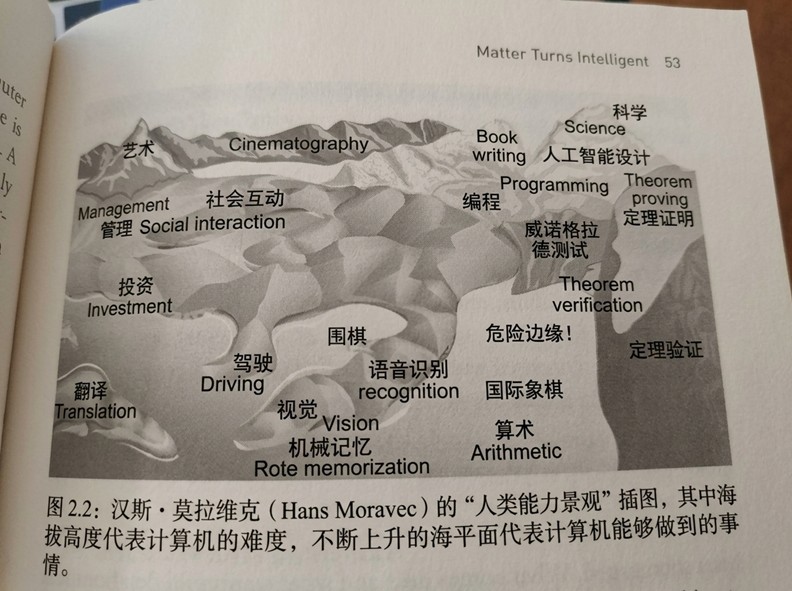
Quoted from the analogy in Max Tegmark's "Life 3.0": Computers gradually learn to handle more and more difficult tasks. As time passes, there are fewer and fewer things they can't do. It's like a flood gradually submerging a map from low to high.
Ilya Sutskever often mentioned an internal joke when he was at OpenAI: Feel the AGI.
He was one of the first to firmly believe that deep learning would gradually change human life. Indeed, there are still many unknown areas, but everything is moving in that direction, and that's the key. Everyone feels "that moment" at different times. When a neural network completes the work you usually need to handle manually, the feeling is very wonderful.
In the ten years of paying attention to neural networks, I've experienced such moments countless times. Therefore, I no longer care whether it's a bubble; I only care about how the water level rises.
Personally, I have enough evidence to show that agents can already complete valuable work that companies are willing to pay for.
Moreover, there is still a lot of room for demand growth. Agents are usually not ready-to-use. You need to adapt to them, and those who react the fastest and are the most curious always do the best. Others will gradually catch up.
And...
The industry is not ready
To make the discussion about the "industry" less abstract, I divide it into three levels.
AI labs: Responsible for developing models (OpenAI, Anthropic, DeepMind).
Hyper-scale cloud service providers: Responsible for building data centers (Google, Amazon, Microsoft, Meta).
Chip manufacturers: Responsible for producing chips (Nvidia, TSMC, ASML).
At each level, these companies are feeling scared.
Netizens are keen on discussing bubbles. It turns out that these companies themselves are well aware of the existence of bubbles. To avoid bankruptcy, each company is brewing its own coping strategy.
Dario Amodei once said that he formulates the company's plan based on a pessimistic revenue forecast. Ironically, only three months into this year, their performance is already 1.5 times higher than the pessimistic forecast, and even the optimistic forecast has been left behind.
Dwarkesh asked him straightforwardly in an interview: Why? Dario really believes that AI has great prospects. He wrote a long paper depicting the "nation of geniuses in the data center." However, he doesn't want to bet everything on this future.
Dario thinks it's risky because there is a cash flow gap in the business model.
His idea is this: They provide neural network services to users, pay the hardware holders for inference fees, and make profits through subscriptions and APIs. Meanwhile, they invest huge amounts of money in the research and development of next-generation models, which won't generate revenue in the next one or two years.
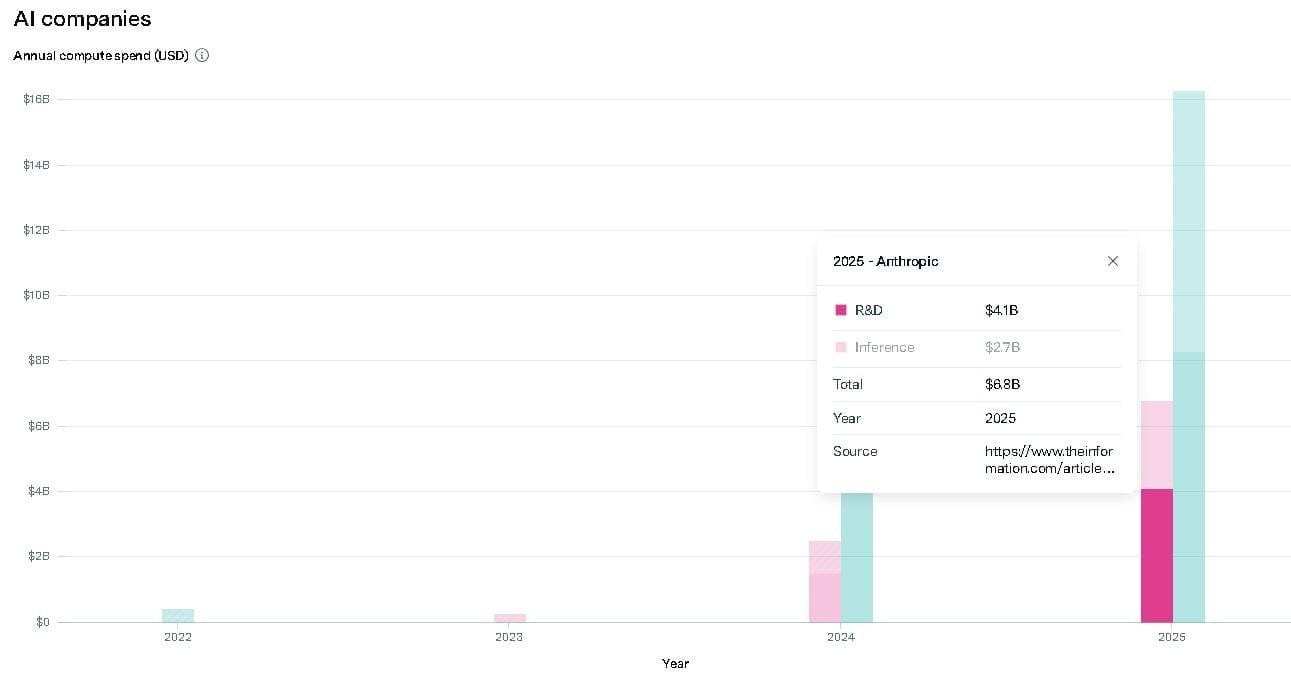
Annual computing power expenditure of AI companies. They often spend more than half of their revenue on research and development.
You not only have to balance the income and expenditure but also balance the investment in future growth. If you invest a large amount of money and the expected growth doesn't appear, you'll be in big trouble.
Anthropic has been operating in this model for a full three years, with a tenfold growth every year. Dario originally thought that this growth would end in 2026 because the larger the company, the more difficult it is to maintain growth, and it will slow down one day.
What he didn't mention in the interview is that their profit margin growth is lower than expected. The cost is growing several times faster than planned.
Dario said that he wants to achieve profitability in a few years. To do this, they need to increase the profit margin, which means slowing down the growth pace and adopting a conservative investment strategy, only investing in the most efficient projects.
This logic makes sense, but it's not easy to slow down. It seems that they will triple again this year, but the resources to support this growth can't keep up.
Anthropic doesn't have enough computing power to support so many core users.
They rent GPUs from cloud service providers. But they can't just walk into a data center and ask for an increase in capacity because the owners of the data centers are also facing the risk of bubbles, so the computing power capacity is all booked in advance.
To make Anthropic earn $30 billion, someone has to invest $80 billion in infrastructure and hope to get the money back in a few years.
Amazon will invest about $200 billion this year, Google $180 billion, Meta $125 billion, and Microsoft $105 billion. This is exactly paving the way for creating trillions of economic value in the next few years.
And if this value fails to materialize, the risk of a cash flow gap will follow.
The entire industry is a long value chain. Each link in this chain tries to lock in expectations through contracts to reduce its own risk. But this reduces the ability of the entire chain to respond to emergencies, such as the sudden rise of coding agents.
Therefore, labs encounter new bottlenecks every year. And the bottlenecks keep moving upstream, towards the links far away from the end-users. Because the risks upstream are higher and the flexibility of the contracts is worse.
New bottlenecks are encountered every year
In 2023, everyone was scrambling to buy GPUs. More specifically, TSMC's factories didn't have enough advanced packaging (CoWoS) production capacity. In 2024, it was the shortage of HBM memory required for these modules. In 2025, the GPU supply improved, but the construction of data centers was limited by the power supply. And in 2026, it turns out that even if you have power generation equipment, the US power grid can't deliver electricity to the data centers on demand.
1 - Memory
Modern models have a greater demand for memory than ever before. As I mentioned earlier, enterprises invest hundreds of billions of dollars in infrastructure every year, and about 30% of it is spent on memory.
And they have to buy expensive HBM instead of cheap DDR because high bandwidth can reduce the waiting time of GPUs when processing data.
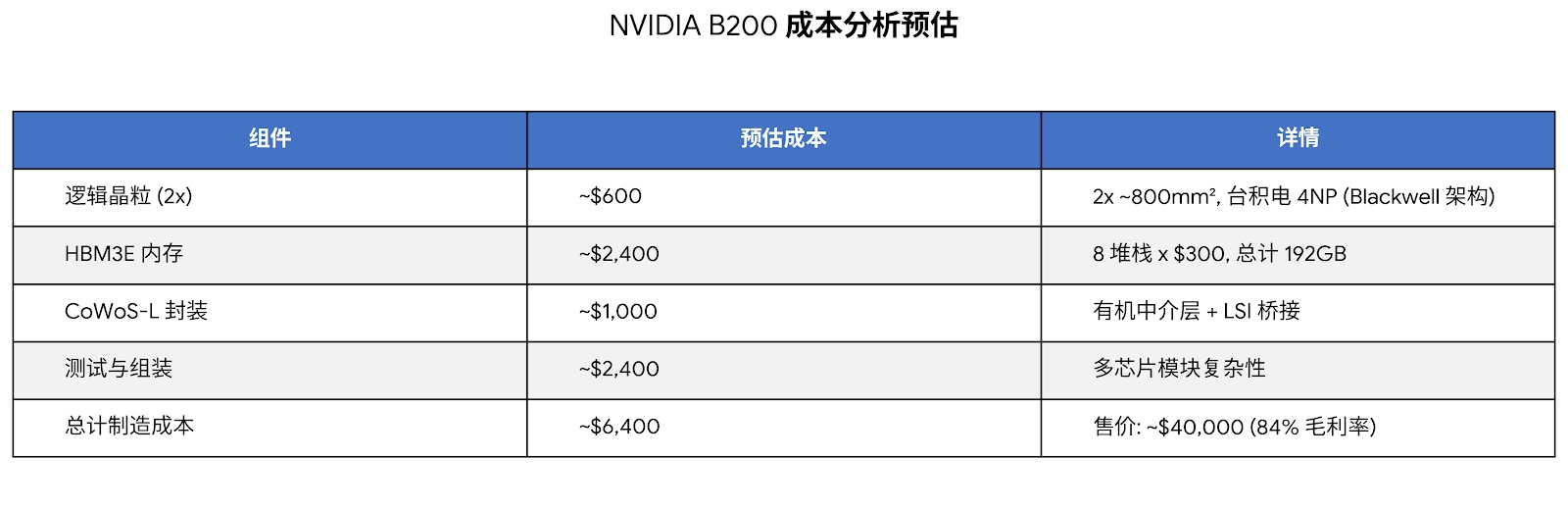
*It turns out that memory is the most expensive part of a GPU.*
The memory price may continue to rise unless someone can find a way around it. It's not surprising if the price doubles or triples because SK Hynix and Samsung control 90% of the market. And the demand for memory is still growing.
2 - Energy and data centers
xAI has proven that data centers can be built very quickly.
But their power consumption is comparable to that of a small city. When such a behemoth suddenly appears in an area within half a year, the local power grid simply can't bear the load.
Sur