Earning 30 billion from Apple annually, Lens Technology still wants to break away from Apple
Nearly at the same time when Tim Cook is about to bid farewell to his 15 - year tenure as Apple's CEO, another quiet "farewell" is taking place deep within Apple's supply chain.
Lens Technology, once one of the "Big Three in the Apple Supply Chain," is trying to break free from its long - term and deep - seated tie with Apple.
In April 2026, in Yizhuang, Beijing, a robot named "Lightning" dashed across the finish line first, winning the championship of the second Robot Half - Marathon:
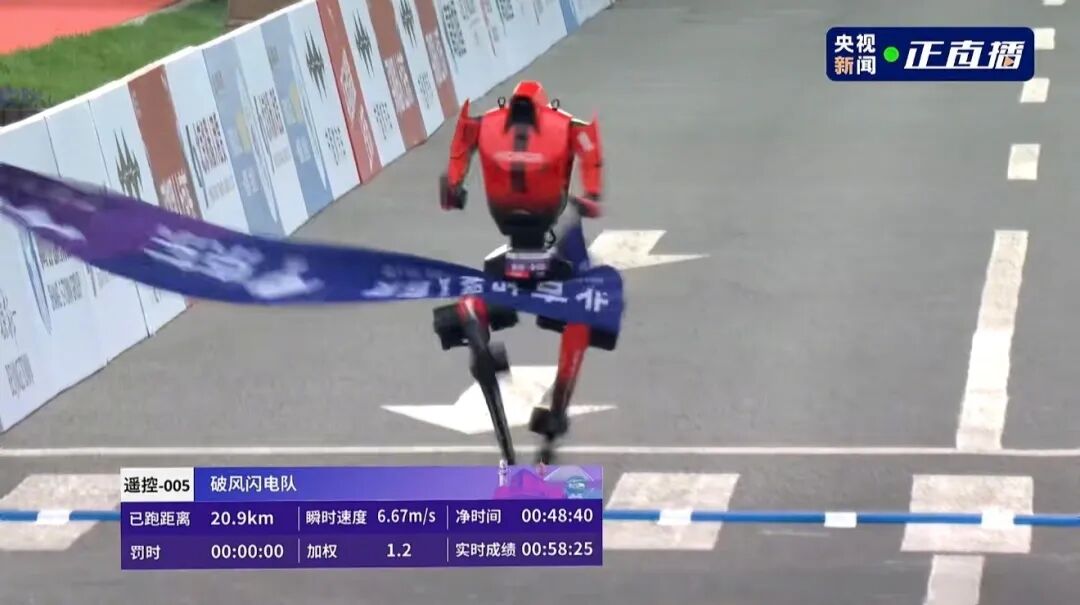
Not many people noticed that on this championship - winning robot, as many as 132 core metal structural components were from Lens Technology, which started its business by making glass for iPhones.
Some netizens joked that it would have been better if this half - marathon had been held a few days earlier.
Because shortly before the robot "Lightning" crossed the finish line, Lens Technology released its latest financial report: In the first quarter of 2026, the company suffered a loss of about 150 million yuan. On the day after the release of the financial report, the prices of its A - shares and H - shares both tumbled by more than 13%.
The capital market is obviously not satisfied with this report card.
But for Lens Technology, this small loss may not necessarily be real bad news.
After all, in the 2025 annual report, the subsidiary "Lens Intelligence," which undertakes businesses in robotics, AI, and even commercial spaceflight, had achieved a revenue of 1.03 billion yuan and made a profit for the first time.
The former "King of Mobile Phone Glass" and the emerging "Robot Supplier" form two completely different faces of the same company.
They are like a slowly unfurling scroll: One end represents the era of the Apple supply chain with a deep tie to Apple; the other end represents the future of robotics and new hardware, which is not yet fully formed but full of imagination.
And what unfolds in the middle is a long - drawn - out farewell.
"The Queen of Touch Screens"
In 1993, Apple set up an office in Beijing and made its first systematic attempt to enter the Chinese market. In the same year, 2,163 kilometers away in Shenzhen, Zhou Qunfei founded Hengsheng Glass.
This choice was related to Zhou Qunfei's first job.
In the 1980s, she worked on the assembly line for watch glass polishing at the Aoya Optical Factory in Shenzhen. She was a typical migrant worker moving south at that time. Therefore, in the early days of her entrepreneurship, Zhou Qunfei still started with watch glass.
The turning point came in 2001. That year, she received her first order for mobile phone panels from TCL and boldly replaced the commonly used but fragile acrylic material with scratch - resistant glass. This choice was later regarded as the starting point of the "Glass Screen Era" in the mobile phone industry.
In 2003, Zhou Qunfei invested with her technology and equipment and officially established Lens Technology. In the following years, there was a rapid leap in technological capabilities. In 2004, Lens Technology mastered the coating process and passed the strict impact test, helping Motorola V3 solve the industry problem of ink peeling off.
After that, orders from international manufacturers such as Nokia, Samsung, and Sony came one after another. Lens Technology began to grow from a processing factory into an industry leader in the mobile phone industry chain.
What really changed the company's fate was three years later, in 2007.
In this year, Steve Jobs released the first - generation iPhone. Initially, this product was designed with a plastic panel, but it was soon changed to a glass screen. Jobs was pursuing a "thinner and more wear - resistant" large glass screen. However, at that time, almost no manufacturers in the world could achieve this.
And Lens Technology, which had already been subcontracting screen production for several mobile phone manufacturers, came into Apple's view.
In the Changsha factory, Lens Technology and the Apple team jointly tackled key problems. After three consecutive months of repeated experiments on key processes such as hot bending, ink, and precision machining, they finally made the glass screen used in the first - generation iPhone. From this moment on, Lens Technology officially entered the "Apple Supply Chain."
After that, as the cooperation with Apple deepened, the product range of Lens Technology expanded from the initial screen glass to the appearance glass, back covers, and camera lenses of devices such as the iPhone, Apple Watch, Mac, and Apple Vision Pro.
Meanwhile, the performance of Lens Technology also grew rapidly. From 2009 to 2015, the revenue of Lens Technology soared from 890 million yuan to 17.2 billion yuan, with an average annual growth rate of more than 50%.
In 2015, Lens Technology was listed on the Growth Enterprise Market of the Shenzhen Stock Exchange, and its market value quickly exceeded 100 billion yuan. Zhou Qunfei's personal wealth once reached 50 billion yuan, making her the richest woman in China, and she also earned the title of "The Queen of Touch Screens."
The company was listed alongside Luxshare Precision and Goertek as the "Big Three in the Apple Supply Chain."
However, the title of "giant" has never been a free lunch. Lens Technology knows better than anyone the feeling of 'prospering with Apple and declining with Apple'.
Being Led by the Customer
To this day, Apple remains Lens Technology's largest customer.
According to the company's 2025 financial report, Apple accounted for up to 45% of its revenue, contributing 33.491 billion yuan in revenue to Lens Technology.
In terms of the business structure, businesses related to smartphones and computers still account for 82.63%, and consumer electronics remains the absolute core.
The high - level dependence on Apple also has a real impact on the performance trend of Lens Technology.
In the first quarter of 2026, Lens Technology turned from profit to loss. On the surface, the most direct impact came from the exchange rate: The depreciation of the US dollar led to the company's financial expenses changing from a net income of 73.51 million yuan in the same period last year to a net expenditure of 252 million yuan. Coupled with the valuation loss of about 59.5 million yuan from forward foreign exchange settlement and sales, it became the key variable for the profit turning negative.
As the largest overseas customer, Apple's business is naturally denominated in US dollars. Every fluctuation in the exchange rate will be magnified and transmitted to Lens Technology's income statement. In other words, Lens Technology is not only tied to Apple's sales volume but also, to some extent, tied to the US dollar cycle.
This "binding relationship" has been manifested many times in past cycles.
In 2016, shortly after its listing, Lens Technology suffered an 11.56% decline in revenue, which was due to the lower - than - expected sales of the iPhone 7; in 2019, as the demand for the iPhone 11 weakened, the company's revenue growth rate also dropped from 16.94% in the previous year to 9.17%.
Becoming a "giant in the Apple Supply Chain" means standing at the center of the global consumer electronics industry chain; on the other hand, it also means inevitably resonating with the product cycle of a single customer.
After realizing this, Lens Technology began to actively "de - Appleize."
After the proportion of Apple's business reached a peak of 71% in 2022, Lens Technology significantly accelerated its diversified layout and strengthened its cooperation with domestic manufacturers such as Huawei and Xiaomi.
By 2023, the proportion of Apple's revenue had dropped to 57.8%, and further dropped to 49.5% and 45% in 2024 and 2025 respectively, reaching the lowest level since 2015.
The problem is that de - Appleization solves the problem of "over - concentrated customers" but does not really solve the problem of "over - concentrated business tracks" - No matter which mobile phone brand it is, Lens Technology is still essentially serving the same industry: consumer electronics.
In the first quarter of 2026, Xiaomi, an important second - tier customer of Lens Technology, provided a more direct example.
According to Counterpoint data, Xiaomi's global smartphone shipments in this quarter declined by 19% year - on - year, the largest decline among the top five global mobile phone brands; in the Chinese mainland market, Xiaomi's shipments, as counted by Omdia, also dropped from 13.3 million units in the same period last year to 8.7 million units, a year - on - year decline of 35%.
For an upstream supplier like Lens Technology, for every mobile phone less sold, the order flexibility, inventory rhythm, and capacity utilization rate in the supply chain will all be under pressure.
Lens Technology also mentioned in its first - quarter report that the decline in current revenue was mainly due to the decrease in revenue from smartphones and computers.
From Apple to Xiaomi, from single - dependence to multi - binding, Lens Technology seems to be dispersing customer risks, but in fact, it is still locked on the same track.
Because no matter who the customer is, the real variable that determines its performance fluctuations is always the same: the cycle of the consumer electronics industry itself.
Under pressure, Lens Technology saw this truth earlier than the market. So, a long - prepared turn has quietly begun.
And the most eye - catching sign of this turn is the championship - winning "Lightning" robot on the Yizhuang track.
Looking for a Second Spring
The company that undertakes this turn is "Lens Intelligent Robot Co., Ltd.", a subsidiary of Lens Technology.
This company was actually established as early as 2016, but for a long time in the past, it was more like a quietly operating backup option.
Starting from 2025, with the sudden rise in the popularity of embodied intelligence, Lens Technology began to significantly accelerate its layout in the three emerging tracks of robotics, AI servers, and commercial spaceflight.
Behind this is Lens Technology's 20 - year technological precipitation in the field of precision manufacturing, which has just caught up with the upsurge of the robotics industry. The financial report shows that Lens Technology currently has the ability to independently develop and deliver in batches core robot components such as joint modules and dexterous hands.
Its customers are not limited to Honor. It is reported that Lens Technology is deeply involved in the production, assembly, testing, and control of key components such as the joint modules and DCU controllers of the Lingxi X1 humanoid robot under Zhipu Robotics.
In fact, betting on emerging tracks and seeking new business growth has become a common choice for many giants in the Apple Supply Chain.
According to the performance forecast of Luxshare Precision, in the first quarter of 2026, its net profit attributable to the parent company increased by more than 20% year - on - year. Against the background of the pressure on the consumer electronics business, new businesses related to AI have become the core driving force for growth, which also confirms the feasibility of migrating manufacturing capabilities to new tracks.
Goertek's first - quarter report also confirms this trend: Its revenue was 18.659 billion yuan, a year - on - year increase of 14.44%; the net profit attributable to the parent company was 503 million yuan, a year - on - year increase of 7.28%. Goertek said that businesses such as acoustic precision components, intelligent hardware subcontracting, and VR/AR were the main driving forces for growth.
These companies that once grew rapidly around Apple are now transforming their manufacturing capabilities for serving Apple into general capabilities for the next - generation hardware.
However, compared with consumer electronics, the growth rhythm, profit structure, and industrial pattern of robotics, AI, or AR/VR are completely different from those in the smartphone era.
For companies in the Apple Supply Chain, the new track is not only a technological extension but also a comprehensive reshaping of the customer structure, delivery rhythm, and even risk - bearing capacity.
For Lens Technology, robotics may not be the end but just a direction.
From glass to robots, from Apple to Zhipu, what changes are the customers and products, and what remains unchanged is the consistent logic: Find the next person willing to pay for you and serve him well.
It's just that this time, the difficulty has increased by an order of magnitude.
The scale dividend of consumer electronics is ebbing, and it will take time for the new tracks to mature. Although the general capabilities of precision manufacturing have been polished for many years, there is still a long verification period and uncertainty in the process of completely transforming from an "Apple Supply Chain Supplier" to an "Embodied Intelligence Platform."
Lens Technology's farewell is destined not to be easy.
This article is from the WeChat official account "Jinjiao Finance", author: Chester. Republished by 36Kr with permission.