Utime Technology Completes Hundreds of Millions in Series B2 Funding, Expands from L4 Vision Autonomous Driving to Humanoid Robots, Building a Data Flywheel | Exclusive Report by 36Kr
After the first quarter, the financing boom in the embodied intelligence industry continues.
36Kr learned that "YouShi Technology", a company focusing on L4 low-speed autonomous driving, announced the completion of a Series B2 financing round worth hundreds of millions of RMB. This round of financing was led by Qianhai Ark, with multiple funds under Qianhai Mother Fund participating, along with eight investment institutions such as Kunling Capital and Houtian Capital.
Before this, "YouShi Technology" had completed six rounds of financing:
· In June 2018, it received a seed round of millions of RMB led by PNP China, with Beijing HSBC Investment and Financing, Beijing Golden Seed, and Shanghai Pingyang Fuhui following the investment.
· In July 2019, it obtained an angel round of tens of millions of RMB led by Inno Angel, with Chixing Venture Capital following the investment.
· In October 2020, it received tens of millions in Series A financing from Global Brain, Inno Angel, Chixing Venture Capital, PNP China, and Pingyang Fuhui.
· In July 2022, it got tens of millions in Series A+ financing from Haier Capital, Jinmao Capital, and Weiyi Capital.
· In January 2023, it received tens of millions in Series A++ financing from Lingyi Venture Capital and Houtian Capital.
· In July 2024, it completed the Series B1 financing round, invested by Chixing Venture Capital and Global Brain, with the amount in the tens of millions level.
Founded in 2018, "YouShi Technology" focuses on achieving L4 autonomous driving through computer vision, replacing the application of traditional multi-line lidar in the low-speed driving field. As of now, "YouShi Technology" has deployed thousands of "YouShi Carts" in high-traffic scenarios such as domestic and overseas business districts, pedestrian streets, subway stations, and airports, matching the performance of Starship, an overseas leading autonomous delivery company founded in 2014.
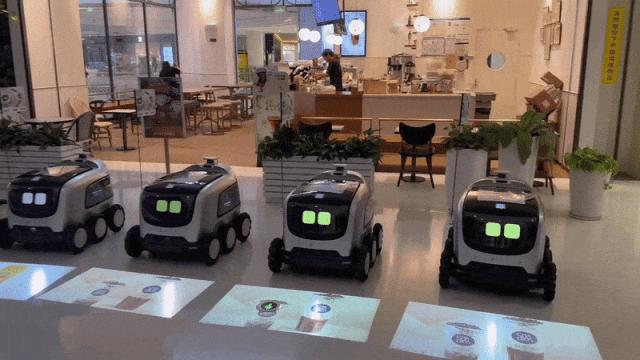
Lin Peisen, the CEO of "YouShi Technology", said: "In the humanoid robot track, YouShi uses L4 visual autonomous driving as the foundation, validates the robot's general navigation and interaction capabilities through high-traffic scenarios, and then transfers them to the humanoid robot platform. This logic is similar to Tesla's idea of extending from FSD (Full Self-Driving) to the humanoid robot Optimus. Both adhere to driving humanoid robots towards general intelligence through 'pure visual perception algorithms + real data from the physical world'."
"Of course, there are differences in the mechanical control level when transitioning from carts to humanoid robots." Lin Peisen emphasized. "YouShi's core barrier is not to build a 'bipedal shell' from scratch, but to encapsulate the mature L4 visual algorithms and spatial cognitive abilities into the 'social navigation brain' of embodied robots. In today's increasingly mature hardware supply chain, having a navigation and interaction brain capable of handling complex pedestrian flows is also an important part of the implementation of humanoid robots."
1. Breaking through unstructured challenges and turning the data flywheel at low cost
Focusing on high-traffic scenarios, the technical challenges are completely different from those of traditional L4 autonomous driving on open roads.
The environment faced by passenger cars is usually structured: there are regular lane lines and outdoor RTK. Algorithms can learn to recognize lanes through massive data and use high-precision maps and multi-sensor fusion for auxiliary positioning. In contrast, the offline high-traffic business district scenario is a highly unstructured and strongly dynamic complex environment. There are no lane lines, people are constantly shuttling, and there are many interference factors. To achieve autonomous driving in this environment, not only do the algorithms need to be re - constructed, but the cost of the solution must also be minimized to meet offline business needs.
"The physical world is extremely sensitive to costs. Whether it is autonomous driving or embodied intelligence, low cost is the prerequisite for achieving scale." Lin Peisen emphasized to 36Kr. "Currently, the cost of self - operable humanoid robots is generally high, and the shipment volume is not in the same order of magnitude as that of passenger cars. This results in the data collected in the physical world not being able to meet the requirements of algorithm training. The industry is in a 'chicken - and - egg' dilemma - without large - scale shipments, no data can be generated; without data, good intelligence cannot be achieved, and thus large - scale shipments cannot be made. Embodied intelligence is difficult to directly replicate the route of passenger cars, which 'turns the data flywheel with a large number of users'."
Based on this, "YouShi Technology" uses the low - cost "YouShi Carts" as the terminal carrier and takes the lead in operating in high - traffic scenarios. The real - world operation data accumulated by the carts in crowded crowds complements the "high - dynamic social data" and "human - machine interaction capabilities" of embodied intelligence.
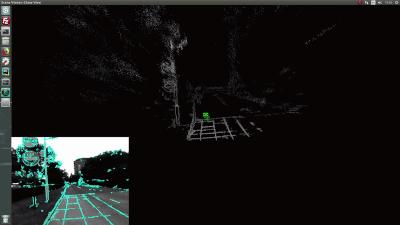
To implement this low - cost solution, "YouShi Technology" spent seven years on technological R & D and market exploration. Different from other competitors who generally use multi - line lidar, YouShi has firmly taken the pure visual route since its establishment - using binocular cameras to achieve three - dimensional positioning and navigation.
"If relying on high - precision maps, the market price for sending people to re - scan 3D maps is about 2,000 RMB per kilometer." An unmanned vehicle engineer revealed. This is an unbearable hidden burden for high - traffic scenarios with frequently changing structures.
Although the hardware of binocular cameras is cheap, real - time generation of 3D information requires extremely high computing power. For this reason, YouShi uses self - developed algorithms: extracting the core three - dimensional contours in an environment with alternating strong and weak light and filtering out high - dynamic interference. This mechanism ensures that environmental changes do not affect navigation and operation.
2. Next step: Humanoid robots in high - traffic scenarios
"YouShi Technology has always positioned itself as a robot company. The six - wheeled cart is a product form we focus on. Next, our product matrix will include humanoid robots, and in the future, the two will have in - depth integration of scenarios and IP." Lin Peisen said.
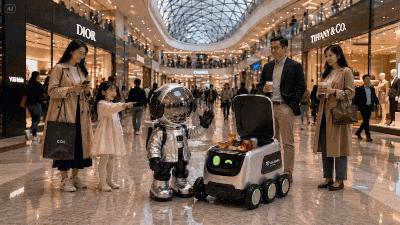
In the plan, humanoid robots will mainly undertake interaction functions, while six - wheeled carts will bear the load and movement. Lin Peisen explained: "High - traffic scenarios require high - frequency human - machine interaction and have extremely high requirements for battery life. If a humanoid robot carries goods, the power consumption is very high. Without a battery life of more than 7 to 8 hours, it is difficult to be viable in real - world commercial operations."
In Lin Peisen's view, the development of embodied intelligence has two core components: The first component is Locomotion (mobility) and Interaction (interaction ability); the second component is Manipulation (fine operation ability).
He believes that for robots to penetrate the physical world and coexist with humans, they first need to solve the problems of "coexistence and passage" in complex environments - can they accurately predict human intentions? Can they understand instructions? Do they know how to avoid? This is exactly the first - mover advantage of the "YouShi Carts". Shuttling through crowded and noisy shopping malls every day, they have accumulated a large amount of human - robot coexistence data and trained "social navigation ability", endowing robots with the ability to predict intentions, integrate into order, and have appropriate interactions.
"Although the physical carriers of carts and humanoid robots are different, the 'social navigation brain' and 'spatial cognitive model' for dealing with complex pedestrian flows are the same." Lin Peisen pointed out. "This can first solve the pain points of mobility and interaction in the first component. As technology develops, we will gradually improve the fine operation ability in the second component."
3. Self - sustaining data collection: Offline business closed - loop
In addition to the reuse of visual algorithms, "YouShi Technology" uses high - frequency offline business scenarios to solve the core pain point of the high cost of data collection in the embodied intelligence industry - using commercial value to pay for data collection, allowing robots to continuously feed back AI training data while creating benefits for B - end customers.

In high - traffic scenarios, YouShi has spent many years refining the self - sustaining link: The "YouShi Carts" are no longer just simple physical mobile carriers, but mobile commercial intelligent terminals (AI Agents) that can actively find high - traffic and high - popularity areas based on visual algorithms, providing dynamic displays, mobile product experiences, and offline traffic distribution for offline customers.
This active interaction mode of finding people breaks the pain point of traditional business in passive customer acquisition, converting public - domain traffic into private - domain traffic. With quantifiable commercial returns, the carts have become infrastructure, significantly reducing the customer acquisition cost for customers.
Now, thousands of high - frequency operating terminal carts form a self - sustaining monetization network and a continuously updated world database. The carts have accumulated a large amount of multi - modal data and dynamic spatial information in high - frequency commercial interactions with the crowd.
The person in charge of the project investment of Qianhai Ark, the lead investor in this round, said: "Replicating AGI in the physical world is a game for the brave. YouShi Technology has achieved a low - cost and high - precision L4 autonomous driving solution through technological innovation. It further uses the advantages of its self - developed solution to target the market of offline high - traffic and high - dynamic environments. While quickly establishing a closed - loop business model, it has gradually built up scale effects and data barriers in the physical world. This project is a key move by the Qianhai Ark Fund Group in the vertical field of 'AI + physical agents'."
It is reported that the funds from this round will be mainly used for the large - scale migration of L4 autonomous driving technology to embodied intelligence, the grid - based deployment of general visual technology commercial terminals, and the R & D and market expansion of multi - modal AI Agents and generative action large models.