Are entrepreneurs using AI unknowingly becoming "workers" for Zhipu and Kimi?
The domestic large AI model, Zhipu Qingyan, has been making quite a splash in the market recently. Due to its excellent performance, some foreigners have even started teaching themselves Chinese in order to use it smoothly.
However, for some domestic users, although Zhipu's large AI model is powerful, issues such as speed reduction during certain periods, rapid consumption of quotas, and occasional account - blocking mistakes may inadvertently reduce users' favorability.
For entrepreneurs, they thought the large AI model would give them an edge, but it often slows down their work progress instead.
On the other hand, large models like Kimi, DeepSeek, and MiniMax may also encounter problems such as opaque computing power, speed reduction, and weakened capabilities. Users who once loved large AI models may end up hating them.
The root cause of the frequent setbacks that various large AI models present to users seems to be the insufficient computing power. Behind the frequent price hikes of Tokens by major manufacturers is the ever - increasing demand.
The rising cost of computing power has put great pressure on AI - related entrepreneurs. Therefore, they have to maintain the hard - won computing power by switching models, using them during off - peak hours, and deleting historical records.
In this context, for entrepreneurs eager to make a mark, after struggling with AI tools, it's uncertain whether their companies and businesses will make money, but the manufacturers selling the "shovels" (providing related services) will surely make a fortune.
01
Three Heavy Blows from Zhipu
If the price of a large AI model is much lower in China than abroad, as a tech enthusiast, would you feel extremely happy?
Recently, the membership pricing of Zhipu Qingyan has allowed many domestic users to enjoy the AI dividend.
This is because the membership of Zhipu Qingyan's large AI model is currently divided into three levels: Lite, Pro, and Max, with the latest domestic prices being 49 yuan, 149 yuan, and 469 yuan respectively.
On the other hand, for the overseas version of Zhipu Qingyan, the prices of the same three membership packages are 18 US dollars, 72 US dollars, and 160 US dollars respectively, which are equivalent to 123 yuan, 491 yuan, and 1091 yuan in RMB, 74 yuan, 342 yuan, and 622 yuan more expensive than the domestic prices.
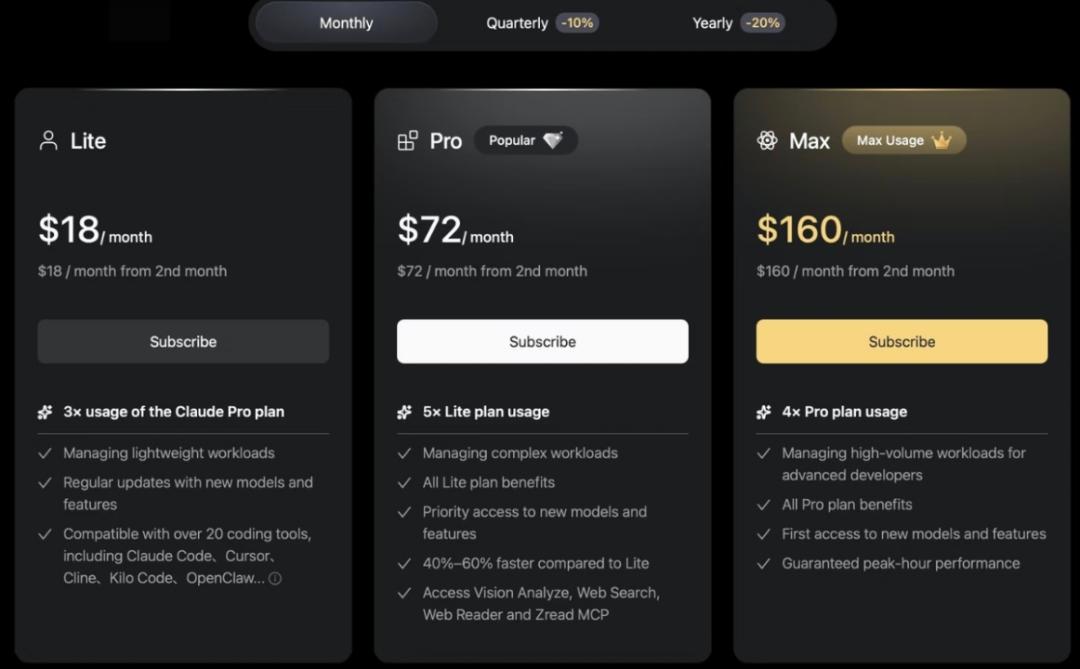
The huge price difference between the domestic and overseas versions of the same Zhipu Qingyan membership package has led some foreigners to start reverse overseas shopping.
Some of them study Chinese characters online to recognize Chinese captchas; some find people to register WeChat and Alipay accounts to log in to Zhipu and make payments; others use a proxy to get a Chinese IP address and pretend to be Chinese users.
The reason why Zhipu Qingyan's large AI model membership dares to charge a "foreigner tax" seems to stem from its absolute confidence in its product.
However, some domestic users may encounter three heavy blows when using Zhipu Qingyan.
The first blow is called "speed reduction".
Since the trend of lobster farming emerged, Xiaoyu, a computer science graduate, has been trying to use the large AI model to develop a recipe - combination application. However, he didn't expect that his dream of starting a business with a one - month membership fee would be thwarted by the difficulties of using the platform.
He purchased the Max membership package on Zhipu Qingyan and used the latest GLM5.1 intelligent agent to generate program code for himself.
However, after using it for a few days, Xiaoyu found that the output efficiency of his Zhipu Qingyan "lobster" (a metaphor for the AI) decreased every afternoon. The code it wrote was intermittent, which greatly affected the development progress.
Did the "lobster" he paid for develop the bad habit of taking a nap? Xiaoyu was very speechless about this lazy behavior. But before he could find a solution, the second blow called "quota limit" quietly arrived.
Seeing that the code - generation efficiency was low, Xiaoyu, eager to make money, stopped the application development project and instead asked the "lobsters" to study finance.
He asked the GLM5.1 intelligent agent of Zhipu Qingyan to send morning and evening reports about the A - share market every day. As a result, the "lobsters" that were lazy in the afternoon became extremely diligent this time, providing a lot of analysis and using up a week's worth of Tokens in three days.

Xiaoyu said, "Although the reports generated by Zhipu are of relatively high quality, the Tokens are consumed a bit too quickly. I can't track the stock market for the next few days."
Out of desperation, Xiaoyu had to put aside his ambition to be a stock god temporarily and wait for Zhipu's skills to cool down for a week. As a result, he waited for the third blow: "account blocking".
Since Xiaoyu often switches between using his Zhipu Qingyan account on his computer, phone, and tablet in his daily work and life, and he also travels to other places from time to time, his IP address changes frequently.
Therefore, after using Zhipu Qingyan for some time, Xiaoyu found that his account was blocked. The reason for this block may be that the system suspected that his account was shared by multiple people.
01
Is Computing Power the Key?
The three - pronged approach of speed reduction, quota limit, and account blocking of Zhipu Qingyan has caused Xiaoyu, who was in the middle of starting a business, to fail several times.
In addition to Zhipu Qingyan, you can also see similar phenomena in other large AI models.
Recently, Awen spent 99 yuan to apply for the Moderato membership of Kimi and used its K2.6 intelligent agent to help him write an MCP plugin.
This level of Kimi membership has two quota conditions: a five - hour limit and a weekly limit. When users trigger the five - hour limit, they need to wait for five hours to continue using it; when they trigger the weekly limit, they need to wait for a week to continue using it.
However, in actual experience, Awen found that Kimi triggered the five - hour limit after only half an hour of work. On the third day of use, it even triggered the weekly limit, causing the project to be postponed.
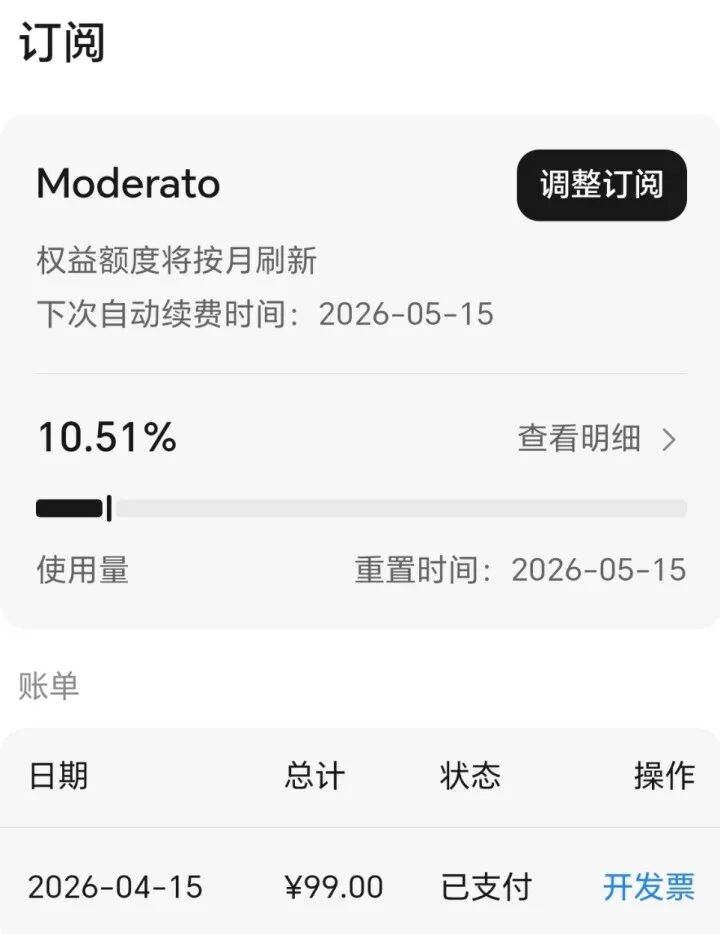
Awen said, "After triggering the weekly limit, I saw on the Kimi page that I had only used 10.51% of my monthly quota. Calculated by four weeks a month, I should use at most 40% of the quota. How is this quota calculated?"
After communicating with Kimi's customer service, Awen learned that Kimi's membership quota includes PPT, Agent, Code, etc. However, how much quota a single task specifically consumes is still an unknown black box for users.
Nowadays, various large AI models are booming. However, after users excitedly become members, they may easily get stuck in a state where they can't see clearly, touch, or understand the speed, quota, etc. Why is this?
The most fundamental reason seems to be that large AI models on the market generally have the problem of insufficient computing power. Therefore, they must use methods such as speed limit and quota limit to ensure the user experience.
In March 2026, the daily average Token call volume in China exceeded 140 trillion. Compared with the daily average call volume of 100 billion at the beginning of 2024, it increased by 1000 times; compared with the daily average call volume of 100 trillion at the end of 2025, it increased by about 40%.
The most direct impact of the sharp increase in computing power demand is the rise in computing power prices.
On March 11, 2026, Tencent Cloud announced a price increase of up to 463% for its Hunyuan large model 2.0 Instruct. On April 9, it issued an announcement to uniformly increase the prices of products such as AI computing power, container services, and EMR by 5%.
On March 18, 2026, Alibaba Cloud announced a price increase of 5% to 34% for products such as AI computing power and storage. On April 13, it announced an adjustment to the free API quota for Data Works users and started charging by usage. On April 15, it issued an announcement to increase the prices of some services of the Bailian large model by 2% to 5%.
Moreover, Baidu Cloud also officially announced on March 18 that it would adjust the prices of products related to AI computing power and storage by 5% to 30%.
Zhipu has adjusted its prices three times in a year. After two price hikes on February 12 and March 16, it announced a 10% price increase for all APIs when it launched the GLM5.1 intelligent agent on April 8.
Will the frequent price hikes by large AI model manufacturers discourage some users? Actually, no.
For example, at the 2025 annual report performance briefing, Zhang Peng, the CEO of Zhipu, said that in the first quarter of 2026, the pricing of Zhipu's API calls increased by 83%, but the market was still in short supply, and the call volume actually increased by 400%.
At the beginning of April this year, after Alibaba's Qwen3.6 - Plus large model was launched, its daily call volume exceeded 1.4 trillion Tokens, making it the world's first large model to process more than 1 trillion Tokens in a single day.
03
Can Ordinary People Still Let AI Work for Them?
It can be seen that as AI becomes more and more integrated into people's lives, the cost and demand for computing power are rising in a spiral.
However, for users of large AI models, although they still pay for them, the dual increase in price and demand makes them feel a lot of pressure. Especially for some users who are trying to start a one - person company using AI tools, they are gradually intimidated by the cost.
Related reports show that for an entrepreneur in the AI SaaS field, out of a total revenue of 1.2 million yuan, the Token cost accounted for 920,000 yuan. After deducting various miscellaneous expenses, instead of making money, he even suffered a loss.
It can be seen that the increase in the cost of large AI models forces those who want to start a business with AI to face cost problems. Some of them have come up with three strategies to reduce costs and increase efficiency:
First, when performing relatively simple tasks, switch to a lower - level version in time.
Different levels of large AI models have different charging rules. Therefore, some entrepreneurs first sort out the task levels at work and assign the most difficult tasks to the most powerful AI to save the hard - won computing power.
For example, when Xiaoyu mentioned above conducts A - share analysis later, he no longer uses the Zhipu GLM5.1 intelligent agent but switches to the free version of Zhipu Qingyan.
Second, use large AI models during off - peak hours.
Since various large AI models generally consume more computing power during the day, not only does the user experience decline, but manufacturers also face considerable pressure. Therefore, some AI manufacturers have launched a midnight discount model to share the computing power.
For example, DeepSeek has launched an off - peak discount. From 12:30 a.m. to 8:30 a.m. Beijing time, the price of the V3 model is reduced to 50% of the original price, and the price of the R1 model is reduced to 25% of the original price. Cost - sensitive entrepreneurs have become night owls.
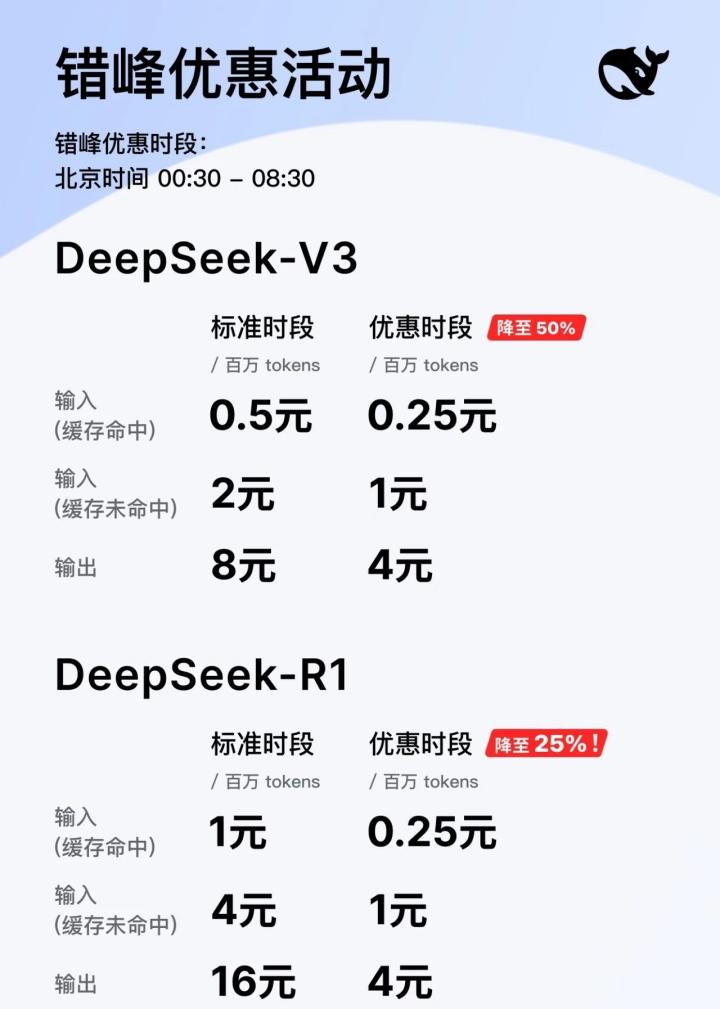
Finally, clear historical records in time to make the large AI model work more smoothly.
Most large AI models do not have true long - term memory. Therefore, every time they process a problem, they will re - read all the content in the current dialog box.
This leads to the phenomenon that many large AI models become slower and dumber with use. Especially when some users use AI without the habit of restarting the problem and always make requests in one dialog box, it not only makes the AI more and more difficult to work but also wastes a lot of computing power.
Therefore, clearing the AI's memory in time after completing a task has become a more cost - effective way of using it.
It can be seen that for many entrepreneurs, although the idea of having large AI models work for them sounds wonderful, the cost may not be lower than hiring real people. The unclear computing power calculation rules, the output that saves energy but cannot be self - controlled, and the ever - escalating membership systems all require those who want to use AI to carefully consider whether they have enough money.
If one day, entrepreneurs with the dream of getting rich suddenly find that after leaving the company to start a business, they have become the "workers" of AI manufacturers, this may not be the original intention of using AI to change the world.
This article is from the WeChat official account "Longitudinal Youth". Author: Jieshi, Editor: Zhishang. Republished by 36Kr with permission.