Internet of Intelligence: The Next Stop of Mobile Internet - When AI Agents Rewrite the Rules of the Digital World
A New Species is Breaking In
In March 2025, Manus, as the world's first general AI Agent, set off a storm in the tech circle. Just one year later, Open Claw swept across the globe. Before people could fully grasp the booming ecosystem of various "claws", Hermes entered the scene with self - evolving capabilities. How fast is the pace? Before the previous hit product has even had its "honeymoon period" over, the next one is already knocking on the door.
This is not an ordinary wave of product iterations. In the past, we were used to the rhythm of a new mobile phone every year and a major version update every six months. However, the emergence rate of AI Agents is more like the Cambrian explosion of a new species.
In the past decade or so, the mobile Internet has changed the way we access information, consume entertainment, and conduct transactions. However, one thing has remained unchanged: all operations ultimately have to be done by humans. No matter how user - friendly an app is, we still need to open it, learn how to use it, and click step by step. The emergence of these Agents is rewriting the previous basic assumptions. In the future, we may no longer need to operate anything. We just need to say a word and tell it what we want.
The emerging new network form is the Agentic Internet, which is a new - generation digital infrastructure with AI Agents as core nodes, natural language as the interaction method, and task completion as the value metric. It is not an upgraded version of the mobile Internet, nor a more user - friendly search engine, nor a smarter app. It is a rewrite of the underlying logic. The transaction chain has changed, the core assets have changed, the billing method has changed, and even the concept of users themselves is being redefined.
Act One: The Critical Point - Why Now?
The outbreak of each technological wave is not due to the breakthrough of a single technology, but the resonance after multiple capabilities cross the critical point simultaneously. The explosion of the mobile Internet was not just because of the iPhone, but because the 3G/4G network, capacitive touch screen, ARM chips, and the App Store business model were all ready within the same time window.
The same goes for the Agentic Internet. Between 2025 and 2026, we witnessed the maturity of at least three key capabilities almost simultaneously, which jointly triggered the emergence of AI Agents.
I. The Three - stage Rocket of Large Models
If we compare the evolution of large - model capabilities to a rocket launch, then in the past three years, we have experienced three clear stages of propulsion.
Stage One: Language Understanding and Generation. The release of ChatGPT at the end of 2022 allowed the world to experience for the first time that machines could talk like humans. This stage of the rocket solved the communication problem between AI and humans. Machines could finally understand what we were saying and respond in fluent natural language. However, at this stage, AI was essentially just a good talker and could not take action.
Stage Two: Programming and Tool Usage. Between 2023 and 2024, large models learned two key things: writing code and calling external tools. Claude 3.5 and GPT - 4 demonstrated amazing programming capabilities, and the Function Calling mechanism enabled models to call APIs, operate databases, and read and write files. This means that AI is no longer just a conversation partner but begins to have practical capabilities. It can help us write a Python script to process data, call the weather API to query the temperature for the next week, and operate the browser to fill out forms for us.
Stage Three: Deep Reasoning and Autonomous Planning. From the end of 2024 to 2025, the emergence of inference models such as OpenAI's o1/o3 series and DeepSeek - R1 filled in the last piece of the puzzle. These models are no longer just for simple conversations but can conduct long - chain logical reasoning, break down complex tasks, formulate execution plans, and gradually verify them, that is, complete long - term tasks. This is a qualitative change from being able to take action to being able to work independently. Just like an intern, who used to only be able to execute step by step according to instructions, now given a goal, he can figure out how to achieve it on his own.
It is only when the three - stage capabilities are combined that the AI Agents we see today are truly born. They can understand what we say (language understanding), mobilize tools to do things (programming and tool usage), and figure out how to do things on their own (deep reasoning). This explains why AI chatbots became popular as early as 2022, but the truly capable Agents did not start to emerge until 2025. Although the first two stages of the rocket were amazing, only after the third stage was ignited did AI truly have the ability to complete complex tasks autonomously.
II. Three Agents, Three Proven Propositions
After reaching the technological critical point, the Agent products that emerged intensively between 2025 and 2026 were no longer just experimental products. Three of the most representative cases each answered a key question.
The question answered by Agents such as Manus and Genspark is: Can Agents make money? Manus was launched in March 2025, and its ARR exceeded $100 million eight months later. Genspark achieved an ARR of $36 million in 45 days after its establishment and exceeded $100 million in ARR nine months later. A new track for Agents was officially opened, and more startups flocked to it, becoming the pioneers of the Agentic Internet.
OpenClaw answered the question: Who do Agents belong to? This AI Agent, open - sourced under the MIT license, advocates that everyone should have their own "claw". As of April 2026, it had over 360,000 stars on GitHub, but this number is not the key. What's really interesting is the flourishing of various "claws" it triggered. Tencent, Zhipu, MiniMax, Kimi, ByteDance, etc. all launched various versions of OpenClaw in a short period. This means that OpenClaw has the opportunity to become the entrance for the next - generation interaction.
The question answered by Hermes is: Can Agents improve themselves? The first two Agents are essentially tools. Once given an instruction, they execute it and that's it. Hermes is trying to break this boundary. It not only has long - term memory like OpenClaw, remembering users' preferences, habits, and context, but also can automatically create skills. Every time it solves a new problem, it generates reusable skill documents and calls them when encountering similar problems in the future. It can even generate sub - Agents for parallel processing. This may sound like a pile of technical features, but the meaning behind it is profound. Hermes is not just performing tasks; it is evolving itself through task execution. This is a key step for Agents to transform from tools to digital employees. Because a real employee not only completes the tasks assigned by the boss but also learns independently, accumulates experience, and becomes more proficient in the process.
Three products, three proven propositions: Agents can make money (Manus and Genspark), Agents belong to everyone (OpenClaw), and Agents can self - evolve (Hermes). When these three capabilities are simultaneously available, what we are discussing is no longer the possibility of a new technology but the inevitability of a new era.
III. Agents Find Their "Mother Tongue"
Having a smart brain and capable hands is not enough. For Agents to truly integrate into the digital world, they need a key condition, which is to find the right way to interact with this world.
That is the recently very popular CLI (Command - Line Interface) . CLI is to Agents what HTTP is to web pages.
At the beginning of the Internet, users saw colorful interfaces, but what really drove everything were those invisible protocols and requests. The HTTP protocol operates silently at the bottom. It is not for people to see, but it makes the entire web world function.
The world of Agents is also undergoing a similar evolution. In the past few decades, we have been used to the graphical user interface (GUI) interaction method, such as icons, buttons, swiping, and clicking. These designs are optimized for human eyes and fingers. However, Agents do not need to see a beautiful interface; they need to do things efficiently. The command - line interface, which seems ancient and obscure to ordinary users, is precisely the most efficient language for Agents to communicate with the system.
This has been verified in the developer community. Between 2025 and 2026, terminal - native AI programming tools such as Claude Code, Codex CLI, and Gemini CLI emerged, forming a sharp contrast with traditional graphical IDEs. Developers found that when AI can directly read and write files, run scripts, and operate version control in the command - line interface, its efficiency far exceeds that of clicking around in the graphical interface. GUI is designed for human eyes, while CLI is designed for Agents' capabilities.
On top of the command - line interface, protocols such as MCP and A2A can also connect Agents with external services, enabling Agents not only to move freely in the local operating system but also to call various capabilities across systems and platforms. Thus, the "highway" for Agents to operate the world has been built.
The thrust of the three - stage rocket, the emergence of landmark products, and the readiness of interaction protocols all came into place almost simultaneously between 2025 and 2026. Technology is no longer a bottleneck.
It can be said that AI Agents are at the turning point from technology demos to infrastructure. Similar to the mobile Internet around 2010, when the 3G/4G network was already in place and the iPhone had proven the way, but the real explosion of applications (WeChat, Didi, Meituan, Douyin) took another two to three years to appear. Although today's Agent products are already amazing, they are probably not the ultimate form. The real killer - app Agent, the product that will make everyone say "So that's how it is", may still be on the way.
Another question worthy of in - depth discussion is: How will the operating logic of the entire digital world change when Agents can do work?
Act Two: Paradigm Shift - Five Dimensions of the Agentic Internet
If the first act is about the readiness of technology, then the second act is about deeper issues. When AI Agents become the core participants in the digital world, which rules that we are used to will be rewritten?
Before delving into it, let's take a panoramic comparison. This table condenses the most core structural differences between the mobile Internet and the Agentic Internet. This is not a simple comparison of technical parameters but a migration of economic logic.
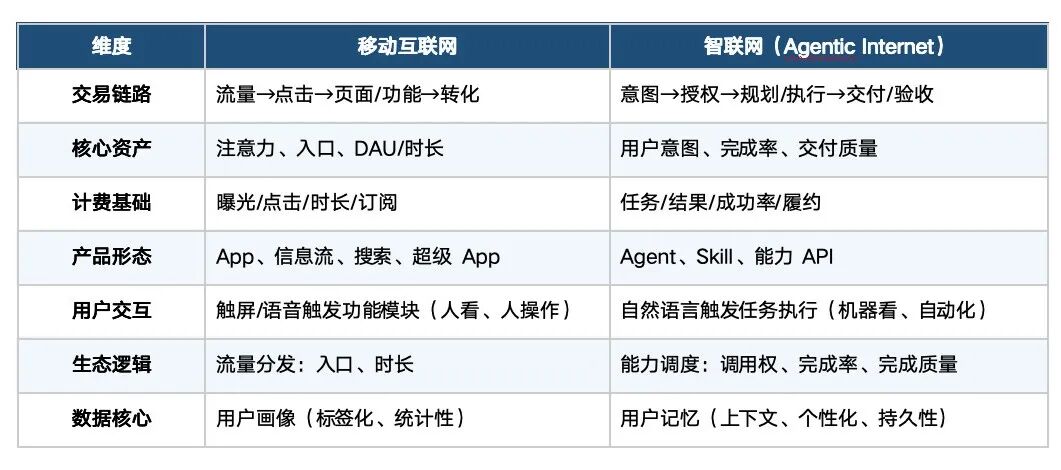
Everything in the mobile Internet is built around attention, while everything in the Agentic Internet will be rebuilt around capabilities. This is not a gradual optimization but a replacement of the underlying pricing unit. Just like the switch from the gold standard to credit currency, all economic relationships at the upper level will change accordingly. Let's explore it from five dimensions.
I. From GUI to CLI: The Generational Leap of Interaction Paradigms
Let's start with a counter - intuitive trend.
In most people's minds, technological progress means more beautiful interfaces and simpler operations. From the DOS command - line interface to the Windows desktop, and from the desktop to the touch screen, each generation of interaction has lowered the user's usage threshold. According to this logic, the next - generation interaction should be more cool AR/VR, more natural gesture recognition, or smarter voice assistants.
However, what actually happened is unexpected: the command - line interface is making a comeback.
This is not a regression but a fundamental shift in perspective. Because this time, the subject of interaction has changed. In the era of the Agentic Internet, a large number of operations will be completed by Agents. Agents don't need to see a red "Buy Now" button to know to place an order. They only need a clear API interface or a command - line instruction. Agents don't need to swipe up and down on a carefully designed hotel list page to compare. They only need structured data and clear filtering conditions.
In other words, GUI is an interaction paradigm designed for human viewing and operation, while CLI and API are interaction paradigms designed for machine viewing and automatic execution. When the subject of operation changes from humans to Agents, the underlying logic of the interaction paradigm will inevitably shift.
For ordinary users, this change is manifested in another form: users no longer need to learn to operate complex software interfaces. They only need to clearly state what results they want.
Users don't need to open the Ctrip app, enter the departure place, select the destination, filter the time, compare prices, choose seats, fill in passenger information, and make payments. They just need to say "Book me the cheapest high - speed train ticket to Shanghai tomorrow" and then receive a confirmation message. They also don't need to check the candidate train schedules and seats on 12306 one by one before the May Day holiday. They just need to say "Grab me a train ticket for the evening of April 30th or the morning of May 1st".
They don't need to type formulas, create pivot tables, and adjust chart formats in Excel. They just need to say "Make a comparative analysis of last quarter's sales data by region" and then receive a report with both text and graphics.
This is what we call result - based interaction. Users care about the results, not the implementation process. And what Agents use behind the scenes is precisely the efficient but perhaps "ugly - looking" interaction methods such as the command - line interface and API.
This means that in the future, the design of digital products will show an interesting differentiation: the front - end facing users may become extremely simple (perhaps just a dialog box), while the back - end facing Agents will become extremely rich (a large number of API interfaces, command - line tools, and structured data). Just like a good restaurant, customers see an elegant dining environment, but what really determines the quality of the dishes is the efficiency of the kitchen. And the efficiency of the kitchen does not depend on how good - looking the kitchen is arranged but on whether its layout is reasonable and its equipment is handy.
In the past decade, Internet companies have invested a huge amount of resources in front - end UX, including a large number of interaction designers, visual designers, and user researchers, to optimize the user's operating experience. In the era of the Agentic Internet, an equal amount of investment will be shifted to the construction of "Agent experience", including the clarity of API documentation, the response speed of interfaces, and the standardization of data structures. In other words, the KPI of product managers may change from user retention rate to Agent call success rate. This is not just a rhetorical change but a fundamental shift in resource allocation.
When the operator changes from humans to Agents, the pricing method in the entire business world will also inevitably change.
II. From Attention Monetization to Effect Monetization: The Reconstruction of Business Models
The essence of the mobile Internet business is that attention is the core.
Over the past decade or so, the industry has developed a sophisticated monetization system. Traffic flows in from search engines, e - commerce platforms, and information streams. Every click and every second of a user's stay is precisely measured and then sold to advertisers in the form of CPM (cost per thousand impressions), CPC (cost per click), and CPA (cost per action). The entire business chain can be simplified as: traffic → click → page/function → conversion. The core assets are attention, entrances, and user time.
This system has been operating for more than a decade, giving rise to a trillion - dollar digital advertising market. However, it has an implicit premise that the user must be present. There must be a pair of eyes to see the advertisement, a finger to click the link, and a person to make a purchase decision on the page.
In the era of the Agentic Internet, this premise is being broken.
When a user delegates the task of "Book me a restaurant suitable for a business dinner tomorrow night" to an Agent, the entire transaction chain becomes: intention → authorization → planning → execution → delivery → acceptance. The user doesn't need to open Dianping to compare ratings, browse restaurant photos, or see any advertisements. The Agent will directly screen, compare, and book according to the user's preferences, budget, geographical location, and occasion requirements, and finally push the confirmation information to the user.
In this new chain, the core assets are no longer attention and time but user intention, task completion rate, and delivery quality. The billing basis also shifts from exposure, click, and subscription to task, result, success rate, and fulfillment.
This change is giving rise