Mass production of sodium batteries: Is CATL cutting off the supply to automakers?
Developing sodium-ion batteries isn't just about changing a dish; it's about rebuilding the entire kitchen. However, many "restaurants" are on the verge of closing.
On April 21, 2026, CATL announced that its sodium-ion batteries would enter large-scale mass production in the fourth quarter of this year.
The mood of automakers is complex.
Having new options is, of course, a good thing. But it's only been a few years since they completed the "de-CATL" strategy. Through the support of second-tier battery manufacturers, CATL's domestic market share has been forced down to a five-year low of 43.42%, especially in the mid - and low - end markets.
Now, the mass production of sodium-ion batteries is just around the corner. Currently, CATL is the only company in the world that can achieve large-scale mass production.
Will the pattern that automakers have finally loosened tighten up again because of this?
01 2.35 million vehicles: The first battlefield to fall?
It's still too early to say that sodium-ion batteries can disrupt the entire automotive industry. After all, the energy density of sodium-ion batteries is limited by basic physical laws. However, micro-cars (A00 class) and small cars (A0 class) are already feeling the chill.
The energy density of sodium-ion batteries is 175 Wh/kg, which is lower than that of lithium iron phosphate. But in the mid - and low - end markets where small profits and quick turnover are the norm, cost is more important. This is naturally the comfort zone for sodium-ion batteries.
Although small cars are small, they represent a significant market. In 2025, 1.323 million A0-class pure electric sedans and 1.036 million A00-class cars were sold, with a total of over 2.35 million vehicles, accounting for 15% of the total new energy vehicle sales. Although the gross profit margin is low, the carbon credits they bring are still valuable. More importantly, low gross profit for the whole vehicle doesn't necessarily mean low gross profit for the batteries.
—— Compared to selling cars, the battery profits and the right to speak behind this may be a more important battlefield. It's crucial for someone to capture the battery profits behind the huge shipment of 2.35 million vehicles.
CATL is relatively weak in this part of the profit. In the market above 200,000 yuan, CATL's market share exceeds 60%, and Seres, Li Auto, BMW, and Xiaomi are all its major customers. But in the market below 100,000 yuan, its share drops to only 22%.
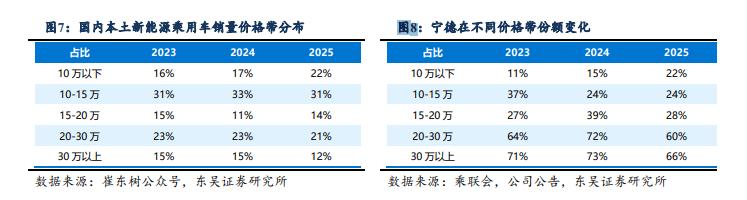
Who has snatched the market share in the small car market?
The answer is simple: CATL's customers - automakers.
Popular small car models such as Geely Xingyuan, BYD Seagull, and Wuling Bingo all use lithium iron phosphate batteries. The battery supplier for Xingyuan is CATL and Honeycomb Energy. Seagull uses BYD's own Fudi Battery, and Bingo's batteries mainly come from Guoxuan High - tech and CATL.
All of these battery manufacturers have the backing of automakers. Honeycomb Energy was spun off from Great Wall Motors, Fudi is BYD's, and Guoxuan High - tech has the support of Volkswagen.
This is an epitome of a multi - year "anti - CATL" movement. Automakers have invested in battery manufacturers to replace CATL. After years of unremitting efforts by automakers and battery factories, the effect of "de - CATL" is already visible. CATL's domestic market share has been pushed down from over 48% in 2022 to 43.42%, a five - year low. Meanwhile, CALB is approaching 7%, and Guoxuan High - tech has risen to 5.65%.
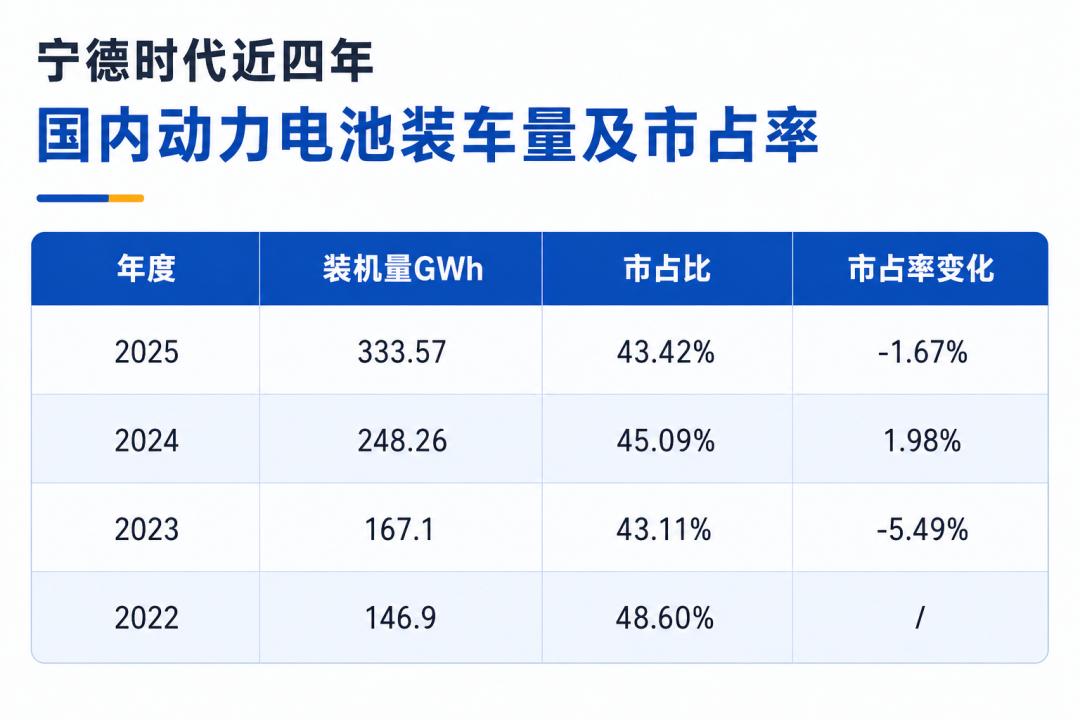
The lost market share is mainly concentrated in the mid - and low - end markets. Currently, CATL's market share in the expensive ternary lithium market exceeds 80%. But in the lithium iron phosphate field, which is more suitable for the low - end market, it has never been able to widen the gap with its competitors. Some media have estimated that under the same working - condition range for specific models, Guoxuan High - tech's battery packs are 5,000 yuan cheaper than CATL's, and the main selling price of small cars is between 50,000 and 60,000 yuan.
Low cost is the confidence of second - tier battery manufacturers to compete with CATL. But with the upcoming mass production of sodium - ion batteries, it will also become CATL's own confidence.
In the first quarter of this year, the cost of sodium - ion battery cells was about 0.35 to 0.40 yuan/Wh, almost the same as that of lithium iron phosphate at 0.34 to 0.40 yuan/Wh. As the scale expands in the future, this figure will surely decrease.
The stability of the upstream material sodium carbonate also needs to be considered. The price of lithium carbonate has been on a roller - coaster ride, causing automakers to complain. It soared from 50,000 yuan in 2021 to 600,000 yuan in 2022 and then dropped back to 170,000 yuan at the beginning of 2026. The procurement cost of automakers has also fluctuated greatly. In contrast, the price of battery - grade sodium carbonate has remained low for decades, at only over 4,000 yuan per ton. Moreover, the crustal abundance of sodium resources is hundreds of times that of lithium, so there is no problem of being "choked" by supply.
02 Turn back or resist?
In the business world, there are no permanent enemies, only permanent interests.
The relationship between automakers and CATL is no exception to this rule. In the past two years, automakers supported second - tier suppliers and "complained about CATL for a long time." Now, with the mass production of sodium - ion batteries approaching, automakers are starting to turn back.
In February 2026, Changan signed a comprehensive deep - cooperation strategic agreement. Changan's Deepal, Avatr, and Qiyuan will all launch sodium - ion battery models. Chery, GAC, Seres, SAIC - GM - Wuling, and BAIC have also joined the cooperation list. They are adopting sodium - ion batteries on the battery side and the "Chocolate" battery - swapping network on the battery - swapping side, following CATL's rhythm on both fronts. Their models such as Changan's Lumin, Chery's iCAR, Wuling's Bingo, and GAC's Aion UT are all well - known in the small and micro - car markets.
They all have their second - tier suppliers. But in the lithium - battery field, it took second - tier suppliers many years to barely reduce CATL's market share. It's really difficult to build a new sodium - ion battery supply system.
There aren't many battery manufacturers developing sodium - ion batteries. Most of them are still betting on solid - state batteries. A few companies like Guoxuan High - tech, EVE Energy, and Honeycomb Energy have research and development reserves for sodium - ion batteries, but there is still a gap between laboratory samples and large - scale mass production.
Mass - producing sodium - ion batteries requires a large amount of capital investment. Unlike solid - state batteries, sodium - ion batteries don't have an exciting story in the capital market to attract investment. CATL has spent nearly 10 billion yuan on sodium - ion battery research and development in the past five years. CALB's annual net profit in 2025 was about 2.025 billion yuan. Honeycomb Energy only achieved single - quarter profitability for the first time in Q4 of 2025 and had been in long - term losses before that.
The automakers, the financial backers, are also unable to do much. In 2025, the profit margin of the entire automotive industry reached a record low of 4.1%, and most companies are struggling on the verge of break - even.
Developing sodium - ion batteries isn't just about changing a dish; it's about rebuilding the entire kitchen. However, many "restaurants" are on the verge of closing.
BYD is an exception. With a cash reserve of over 150 billion yuan and full - chain self - control, it has not only invested 10 billion yuan in Xuzhou to build a 30 GWh production line but also launched commercial sodium - ion batteries in the forklift field at the beginning of the year. Sodium - ion batteries dedicated to energy storage are expected to enter large - scale production this year.
This may be good news for other automakers because competition leads to lower prices. But choosing BYD is just handing their fate to another giant.
When it comes to batteries, they never really have a choice. The so - called "multi - supplier strategy" is more like a temporary respite before CATL makes its move. And now, the cards are on the table.
Automakers don't know what the next card is, but it will probably still involve CATL.
This article is from the WeChat official account "Slightly Larger Reference" (ID: hyzibenlun), written by Liu Ran and published by 36kr with authorization.