In 2026, capital is pricing AI companies "along the industrial clusters".
For investors, the focus of AI investment has shifted from models, teams, and stories to evaluating whether a company can integrate into the real industrial system and achieve implementation with the help of a region's supply chain, scenarios, and data. For companies, developing AI is no longer just about creating a technological product; it's about finding the real entry point for the combination of industry and AI and entering a system that allows for continuous iteration, delivery, and expansion.
The AI industry has entered a stage of "competing in implementation, delivery, and compound interest." AI that is detached from the industrial foundation can, of course, tell an appealing story. However, companies that can truly weather market cycles often emerge in areas with the densest industrial clusters and the deepest industrial collaboration.
In 2026, capital is re - evaluating AI companies along industrial clusters.
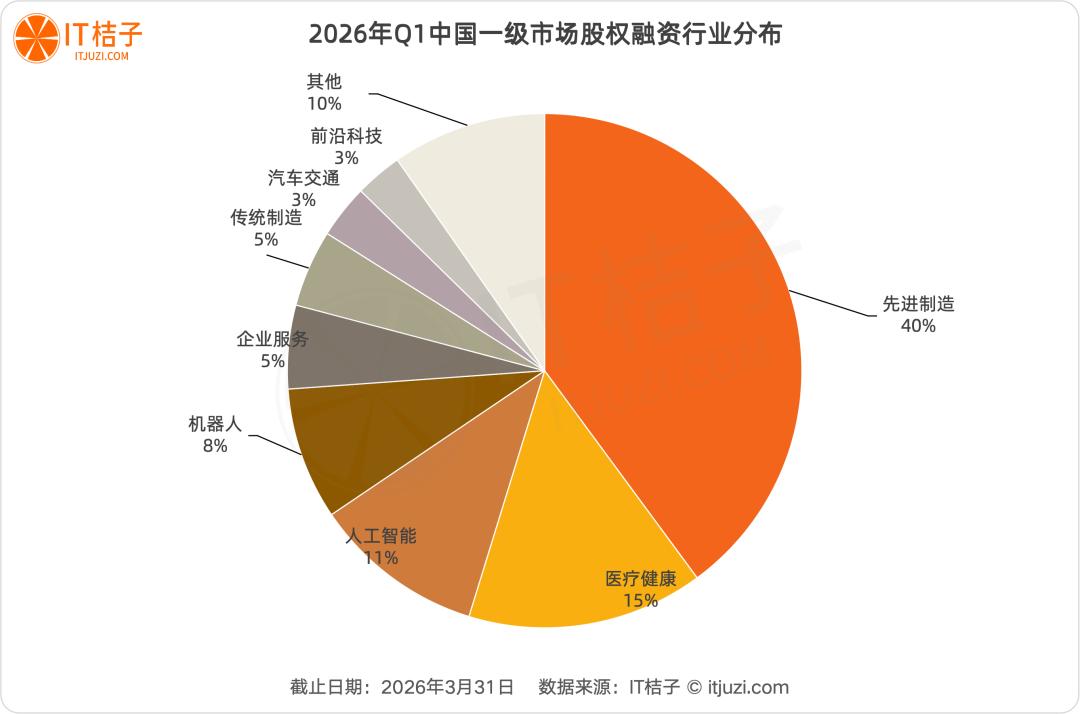
According to the first - quarter venture capital data from IT Juzi, in Q1 2026, there were a total of 2,865 financing events, a 2.5% increase from the previous quarter and a staggering 52% increase year - on - year. The transaction amount reached 256 billion yuan, a 11.4% increase from the previous quarter and a 48% increase year - on - year.
However, at the same time, the distribution of funds is shrinking.
In terms of sectors, advanced manufacturing, with a 40% share of events, remains at the top and is the most attractive sector for investment. Artificial intelligence ranks third with an 11% share of events. Behind this is the demand for intelligent upgrades, which drives the deep integration of traditional manufacturing with AI and the Internet of Things, forming an investment derivative logic of "advanced manufacturing +".
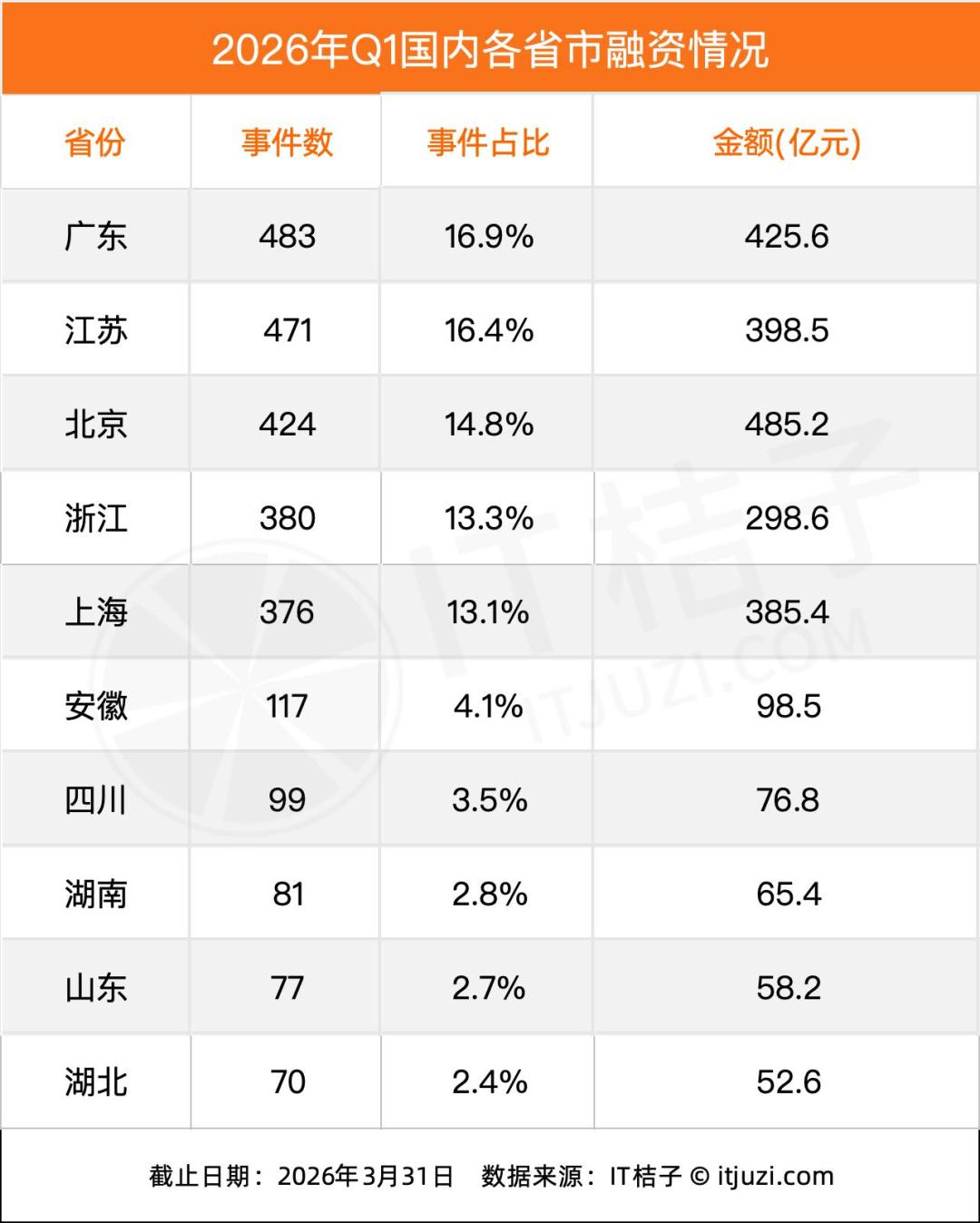
In terms of regions, the concentration trend is even more obvious. Five provincial - level administrative regions, namely Guangdong, Jiangsu, Beijing, Zhejiang, and Shanghai, account for 74.5% of the financing events and 76.3% of the financing amount. The regional concentration of venture capital activities remains at a high level.
On the surface, it seems that capital is continuing to bet on top - tier cities. However, upon closer inspection, it's not simply the siphon effect of first - tier cities. Capital is not flowing indiscriminately to big cities but is being more precisely allocated along different industrial belts.
For example, Beijing attracts model, algorithm, and high - valuation projects. Shenzhen and Dongguan draw in robotics, embodied intelligence, and intelligent hardware. Suzhou and Shanghai take on industrial AI, automotive AI, and enterprise - level intelligence. In other words, what capital focuses on is no longer the "city level" but the industrial system behind the city.
The question is, what changes have occurred in the investment logic of capital in the AI field? Why, in the AI era, does a technology industry that could be highly de - localized in the Internet era become increasingly dependent on a few industrial belts and city clusters? Under the new investment logic, what changes will traditional industries undergo in the AI era?
Capital values the "industrial circle of friends" more and more
The fact is, in the AI field, money is concentrating in industrial belts, and this concentration is not limited to the financing side.
The "2026 China Unicorn Enterprise Development Report" shows that as of December 2025, there were 416 unicorn enterprises in China, accounting for nearly 30% of the global total and ranking second in the world in terms of scale. Hard technologies represented by artificial intelligence have taken the most prominent "C - position" among unicorn enterprises. In 2025, the artificial intelligence sector, with 69 enterprises and a valuation of 638 billion US dollars, ranked first among all sectors, with an average valuation close to 10 billion US dollars.
Notably, according to the report analysis, more than 85% of AI unicorn enterprises are mostly distributed in the three major city clusters of Beijing - Tianjin - Hebei, the Yangtze River Delta, and the Guangdong - Hong Kong - Macao Greater Bay Area.
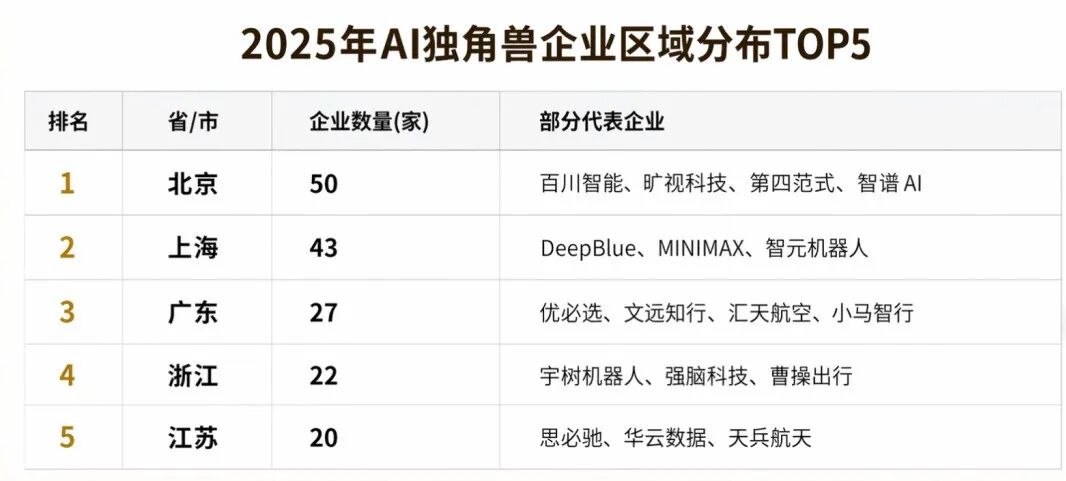
When both financing and leading companies are concentrating in the same group of regions, it's hard to explain it as a "coincidence." The question then becomes, what does capital see in these places?
If we shift our perspective from "cities" to "industrial structures," the answer becomes clearer. Today's AI landscape has essentially been re - divided by several major core industrial clusters.
Beijing is a typical "technology - origin cluster." According to the "Beijing Artificial Intelligence Industry White Paper (2025)," in the first half of 2025, the scale of Beijing's core artificial intelligence industry reached 215.22 billion yuan. By the end of 2025, Beijing had more than 2,500 artificial intelligence enterprises and 183 registered large - scale models, both ranking first in the country. Companies such as Zhipu AI, MoonArk, and Lightwheel Intelligence are concentrated here. This is not only the choice of enterprises but also the spill - over effect of long - term accumulation of top - tier universities like Tsinghua and Peking University and leading scientific research resources, gradually forming a complete chain of "basic research - model training - application spill - over."
Shanghai is the region with the most concentrated AI chip enterprises in the country. The "Four GPU Dragons," including Biren Technology, Suyuan Technology, Tianshu Zhixin, and Hanbo Semiconductor, are all here.
Shenzhen is a cluster of robotics and intelligent hardware. Companies such as DJI, Ubtech, DeepRoute.ai, and Simei Technology are backed by the world's most complete electronic manufacturing supply chain system.
Suzhou provides the most typical "manufacturing scenarios." There are more than 1,600 "AI + manufacturing" enterprises here. Companies like Jiushi Intelligence, Megagenta, and SmartVoice are directly embedded next to the production lines. The continuous generation of equipment, process, and production data from thousands of manufacturing enterprises allows AI to be naturally in the scenario without having to "find a scenario."
When looking at these cities together, we can find a commonality: AI enterprises are not randomly distributed but "grow" along the industrial foundation.
This also explains why the "regional concentration" is becoming more and more obvious. Because in essence, it is the industry that is screening.
This has been clearly written into the investment logic on the capital side.
According to the "China Financial Technology Combustion Index Report (2025)," artificial intelligence enterprises in the Yangtze River Delta, Beijing - Tianjin - Hebei, and the Guangdong - Hong Kong - Macao Greater Bay Area are the most attractive to venture capital. Among them, artificial intelligence enterprises in Beijing, Shanghai, Hangzhou, and Shenzhen receive the most venture capital investments.
From this perspective, the so - called "regional binding of AI companies" is actually an attachment to industrial clusters. The stronger the industrial cluster, the easier it is for AI enterprises to obtain data, scenarios, supply chains, resources, and financing. The more capital concentrates in the cluster, the more AI companies rely on this region. Eventually, an irreversible pattern of "strong industrial cluster - AI enterprises clustering - highly concentrated financing" is formed.
There is a growing consensus that what capital values is no longer just the company itself but the "industrial circle of friends" behind the company.
Industrial clusters: the "shortest physical path" for AI commercialization
The question is, why has the investment and financing logic of AI enterprises changed?
In fact, a fundamental change is that AI is evolving from a "pure software industry" to a "semi - real economy" that increasingly depends on the real world.
In the Internet era, software could grow independently without specific scenarios. Companies could develop products first and then find users. However, in the AI era, simply developing a model is no longer sufficient. It must be integrated into real business processes, be repeatedly invoked, continuously verified, and finally delivered.
In other words, the value of AI no longer lies in whether it can be developed but in whether it can operate in the real world and continuously produce results.
For this reason, the judgment criteria of capital have changed, shifting from "investing in the possibility of technology" to "investing in the certainty of implementation." Once it comes to the implementation stage, the value of industrial clusters begins to emerge. The most obvious is the supply chain.
Take the embodied intelligence sector as an example. Shenzhen's "Robot Valley" has formed a full - chain ecosystem from sensors, lidars, servo systems, 3D vision to whole - machine manufacturing. Enterprises such as Ubtech, Yuejiang, and RoboSense are clustered in the same area. The upstream and downstream enterprises are just a floor apart, and the industrial park is the industrial chain.
Dongguan Songshan Lake fills the key link from R & D results to productization. The XbotPark Shared Factory integrates CNC machining, prototyping, trial production, and supply chain organization, providing one - stop manufacturing capabilities from samples to products and then to commodities. In other words, the reason why leading enterprises can stay ahead is not only their model capabilities in the laboratory but also the core component clusters in Shenzhen, the engineering and prototyping capabilities in Songshan Lake, and the iterative speed supported by the extensive manufacturing scenarios in the Pearl River Delta.
Going deeper, it's about data.
It is widely believed that AI depends on data, and industrial clusters have data. However, the real key is whether the data comes from real, continuous, and repeatedly invokable scenarios.
Industrial AI in Suzhou is a typical example. Its core advantage does not lie in leading algorithm capabilities but in the real scenarios provided by the manufacturing cluster. Through the industrial Internet, intelligent manufacturing system, and a large number of digital production lines, the park enables equipment data, process data, and production data to be continuously generated in the real production process and repeatedly used for model optimization, gradually forming a cycle of "scenario - driven - data precipitation - model iteration - feedback optimization."
For example, the rapid implementation of enterprises like Jiushi Intelligence highly depends on the real application scenarios provided by the park. In the Suzhou Industrial Park, its unmanned delivery vehicles can conduct regular tests and operations on open roads. These complex road conditions and high - frequency scheduling scenarios continuously provide real - data input for the model. In contrast, teams that only rely on historical or simulated data can hardly obtain such continuous iteration capabilities.
Moreover, the value of data does not lie in its scale but in its degree of binding to specific industrial scenarios. For example, the AI application in the wool - weaving industry in Dalang Town relies on highly concentrated design styles, production processes, and supply chain data. These data are deeply coupled with the local industrial system, and their value will decline rapidly once they are separated from the cluster. Similarly, the port AI capabilities of Ningbo - Zhoushan Port must rely on real port scheduling, loading and unloading, and shipping scenarios to exert their maximum effectiveness.
This explains why AI companies cluster in industrial clusters and why a large amount of money is invested in AI enterprises in industrial belts.
The so - called regional concentration is not a return of geographical worship but capital's search for the shortest path for AI commercialization. Industrial clusters provide the "shortest physical path" for AI commercialization.
In the AI era, a new batch of industrial belts begins to form self - contained closed - loops
In the past, many people understood the relationship between AI and industrial belts as technology being attached to traditional manufacturing to improve efficiency, optimize processes, or upgrade products.
However, in the AI era, this relationship is changing. AI is no longer just an additional module of traditional industries but is starting to become the core variable for reorganizing industrial chains and reshaping value chains. That is to say, AI is no longer simply attached to old clusters but is leading the birth of new clusters and activating traditional industrial belts.
Dongguan is a typical example.
In the past, Dongguan played the role of the "world's factory" for a long time. Relying on cheap labor, land costs, and the OEM system, it developed and became one of the most important processing nodes in the global manufacturing chain. However, with the rising labor costs, the relocation of low - end manufacturing, and the continuous compression of traditional OEM profit margins, Dongguan once faced the pressure of industrial hollowing out. That is, the factories were still there, and the orders were still there, but the industrial added value was not in the local area, and the growth momentum was weakening.
Now, AI is bringing Dongguan back to life.
In Q1 2026, there were 12 financing events in Dongguan's embodied intelligence sector, with a total amount of 2.1 billion yuan. The Songshan Lake High - tech Zone has gathered more than 300 robotics and AI enterprises, gradually forming a complete chain from core components, whole - machine manufacturing to system integration.
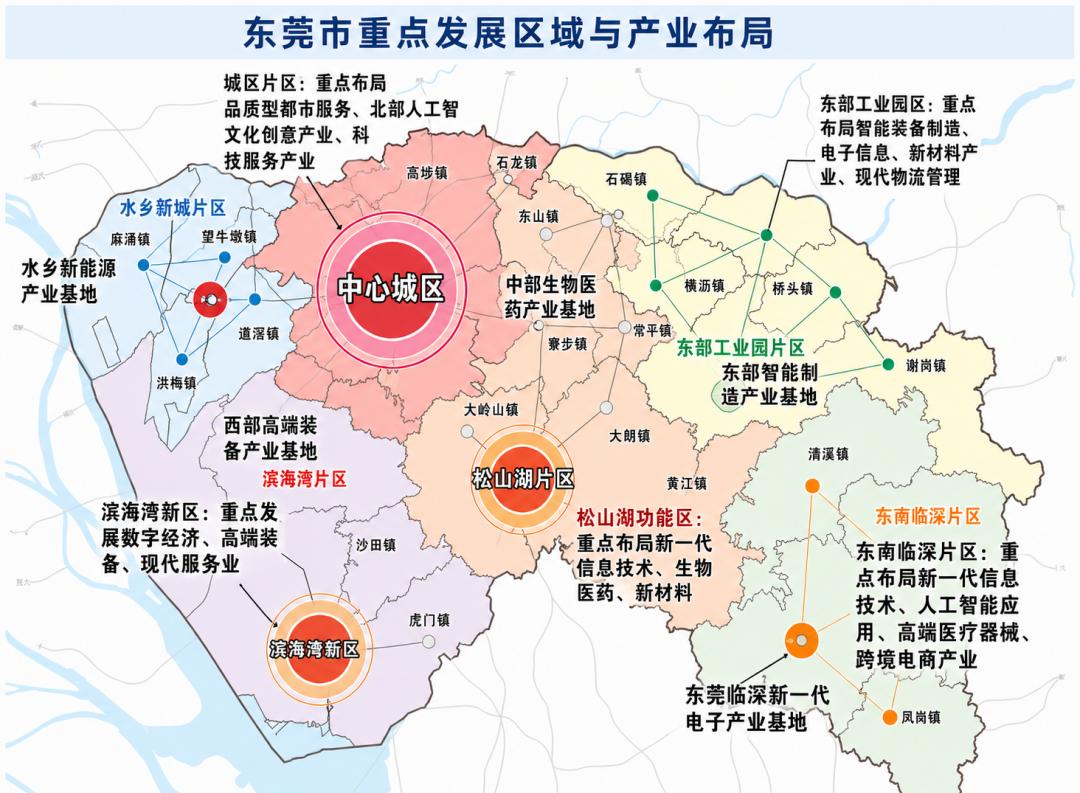
The key change is that Dongguan is no longer just an OEM for others but is starting to become a core part of the AI hardware and embodied intelligence industrial chain. The former OEM factories are being transformed into suppliers of key components such as robot joints, motors, sensors, and controllers. The past single "processing" ability is also being upgraded to a comprehensive ability of "R & D + manufacturing + delivery."
The industrial belt in Foshan has also changed.
Foshan was originally one of the most mature home appliance industrial belts in China, with a complete manufacturing system, a stable supply chain, and a large number of leading enterprises. However, precisely because the industry is so mature, it has long faced a common problem: the products are becoming more and more homogeneous, the market is becoming more and more competitive, and enterprises are easily caught in price wars. Relying solely on manufacturing efficiency and channel capabilities, it is difficult to gain an edge.
Currently, traditional products such as refrigerators, air conditioners, and washing machines are evolving from one - time - delivered hardware to intelligent terminals that are continuously online, can understand user needs, and continuously optimize service experiences. For this reason, the value center of Foshan's home appliance industry is starting to shift from the manufacturing end to the software, data, and service ends.
The result is that Foshan's home appliance industry no longer has to compete solely on scale and cost. It has the opportunity to move towards high - end, intelligent, and brand - building with the help of AI, gradually activating the growth mode of the entire traditional home appliance industrial cluster.
From Dongguan to Foshan, a clearer trend can be seen: the role of AI in traditional industrial belts has shifted from "empowering" to "reconstructing." On the one hand, it helps the links with the thinnest profit margins and the most easily replaceable parts in the original industrial chain to find new positions. On the other hand, it is promoting traditional industrial belts to shift from "low - value - added manufacturing" to a new model integrating "technology, products, and services."
In the past, a city's industrial status might have been determined by land, labor, and cost. Now, it increasingly depends on whether it can integrate AI into its core industrial system.
This also means that in 2026, the competition in the AI industry is further evolving from technological competition to industrial cluster competition.
For investors, the focus of AI investment has shifted from models, teams, and stories to evaluating whether a company can integrate into the real industrial system and achieve implementation with the help of a region's supply chain, scenarios, and