36Kr Exclusive | South Korea's Hyundai and MicroLight Ventures Bet on Welding Robots, Revenue Expected to Exceed Hundreds of Millions, Secured Tens of Millions in Orders from Shipyards
Author: Ou Xue
Editor: Yuan Silai
Yingke learned that Shengshi Weisheng, an embodied intelligent robot company focusing on the vertical welding scenario, has completed tens of millions of yuan in Series A+ financing. This round of financing was jointly invested by Hyundai of South Korea and Weiguang Venture Capital. The funds will be mainly used for the R & D of the "embodied brain", the iteration of software and hardware products, and market promotion.
Shengshi Weisheng was founded in 2020. Its core team consists of experts in the field of robotics from universities such as Harbin Institute of Technology and Shanghai Jiao Tong University, as well as senior personnel with many years of experience in industrial automation. Founder Wang Dezhao and the core team have more than a decade of industrial experience in the field of robotics and automation, and have a deep understanding of the process requirements and industry pain points of the welding scenario.
The core technological advantage of Shengshi Weisheng lies in its independent core ability of "AI algorithm + welding process + robot body" integration. The company acquired Harbin Institute of Technology Hyundai Robotics Co., Ltd. in 2022. The smart factory of its holding subsidiary, Harbin Institute of Technology Hyundai Robotics, located in Haining, Zhejiang, has an annual production capacity of thousands of robots, with a cumulative shipment of nearly ten thousand units.
This makes the company one of the few intelligent robot enterprises in China with the ability to independently develop and deeply integrate from the design and manufacturing of the body hardware, to the embodied AI model, and then to the welding process data.
At the AI algorithm level, Shengshi Weisheng adopts the path of "end - to - end embodied AI model", training robots to understand welding tasks based on a large - scale vertical multimodal welding model. This model conducts simulation training in combination with a large amount of process data accumulated by the company in the welding field, enabling robots to have stronger adaptability under non - standard and complex working conditions, and to achieve high - level functions such as real - time molten pool tracking and dynamic process adjustment.
"Most players in the industry only have one or two of these abilities, while we develop everything independently from the bottom up," Wang Dezhao told Yingke. This closed - loop ability gives the company significant advantages in cost control and product iteration, and the technological ceiling will be higher.
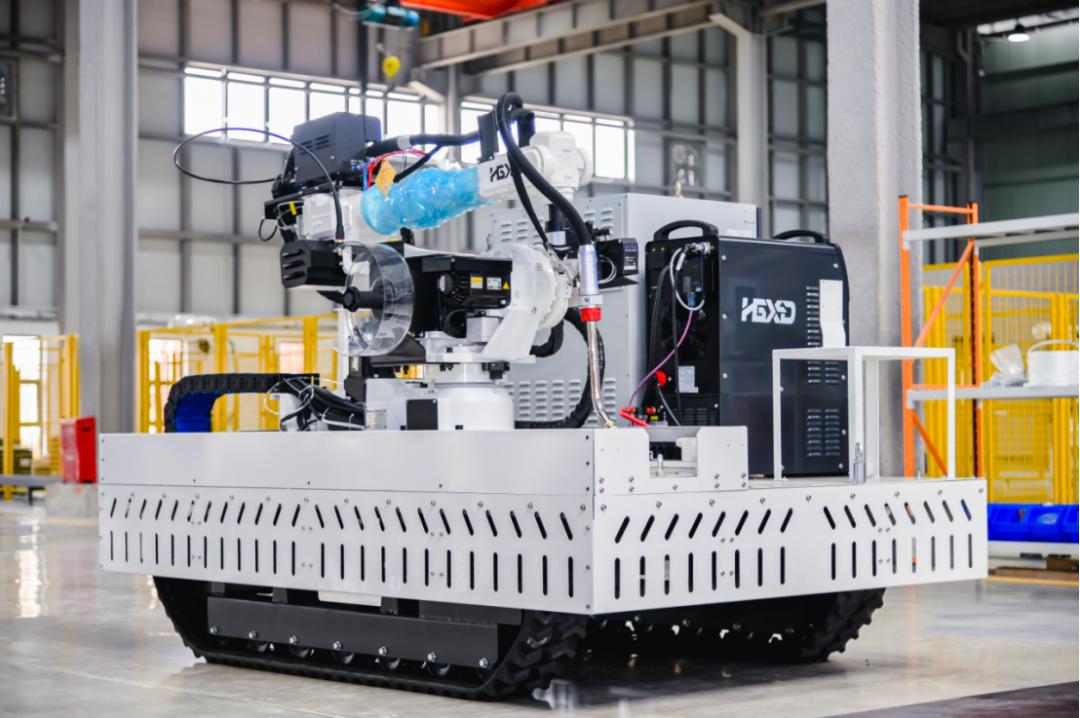
(Image source: Company)
Shengshi Weisheng's product line is divided into three generations: The first generation is general - purpose industrial robots; the second generation is intelligent welding robots, which have AI recognition and 3D reconstruction capabilities, and can be started with one key without teaching; the third generation is autonomous mobile welding robots, supporting wheeled and multi - legged forms, further expanding flexible operation scenarios.
Currently, the second - generation products have been shipped in batches. The third - generation wheeled products were launched and applied in 2025. The demo version of the mobile embodied welding robot has been released and is expected to be officially launched in the market this year.
"The second - generation products work in a fixed space, while the third - generation products with four - legged and wheeled forms can truly achieve autonomous perception and movement in the entire factory space, becoming a 'mechanical welder' without space limitations," Wang Dezhao explained the core difference between the two generations of products.
Technically, the third - generation products add multi - group collaborative control to the algorithm and conduct a new iteration of the embodied model, enabling it to adapt to a wider range of open scenarios. Wang Dezhao said that in the actual implementation of the second - generation products, the time for hoisting workpieces accounts for about 30% of the entire production time. The third - generation products can help customers save this 30% of the time through the "robot - to - workpiece" working mode, with an efficiency improvement of about 30%.
In terms of market strategy, Shengshi Weisheng adopts a "three - pronged approach" model to promote sales: agent sales through integrators, direct contracts with end - users, and robot labor services. Its customers cover large state - owned enterprises and manufacturing leaders such as China Railway, Baosteel, State Grid, CRRC, and SAIC.
In 2025, Shengshi Weisheng made significant breakthroughs in the shipbuilding field. Wang Dezhao introduced that the company signed an order worth tens of millions of yuan with Hyundai Heavy Industries in South Korea, and also cooperated with civilian shipbuilding enterprises along the Yangtze River and the coast in China.
"The shipbuilding industry is still growing. Shipyard orders have been scheduled until 2029, and more than 70% of ship production involves welding processes, which is a very suitable scenario for us to replace manual labor."
Shengshi Weisheng's annual revenue growth rate has exceeded 50% in the past three years. Its revenue was nearly 100 million yuan in 2025, and the company expects to exceed hundreds of millions in 2026.
In terms of technological iteration, Wang Dezhao said that the company will continue to deeply cultivate the embodied ability in the welding scenario, improve generalization ability, execution efficiency, and reduce error rates. At the same time, in the future, it will also explore the cluster control of a "unified brain" to mobilize multiple robots for collaborative production.
"We position ourselves as embodied intelligent robots in the field of industrial manufacturing. Welding, grinding, and spraying are the real core manufacturing links. We hope to rely on the models and data accumulated in the welding field to extend to such a cluster of mechanical workers in the future and complete the synergy of the entire production and manufacturing process," Wang Dezhao said.
In terms of going global, the company has entered the overseas market through the investment of Hyundai of South Korea and plans to focus on exploring markets in Southeast Asia, the Middle East, Japan, and South Korea in the future. Wang Dezhao said that the wages of welders in Japan and South Korea are 3 - 4 times that of those in China, and the demand for intelligent welding robots is very strong.
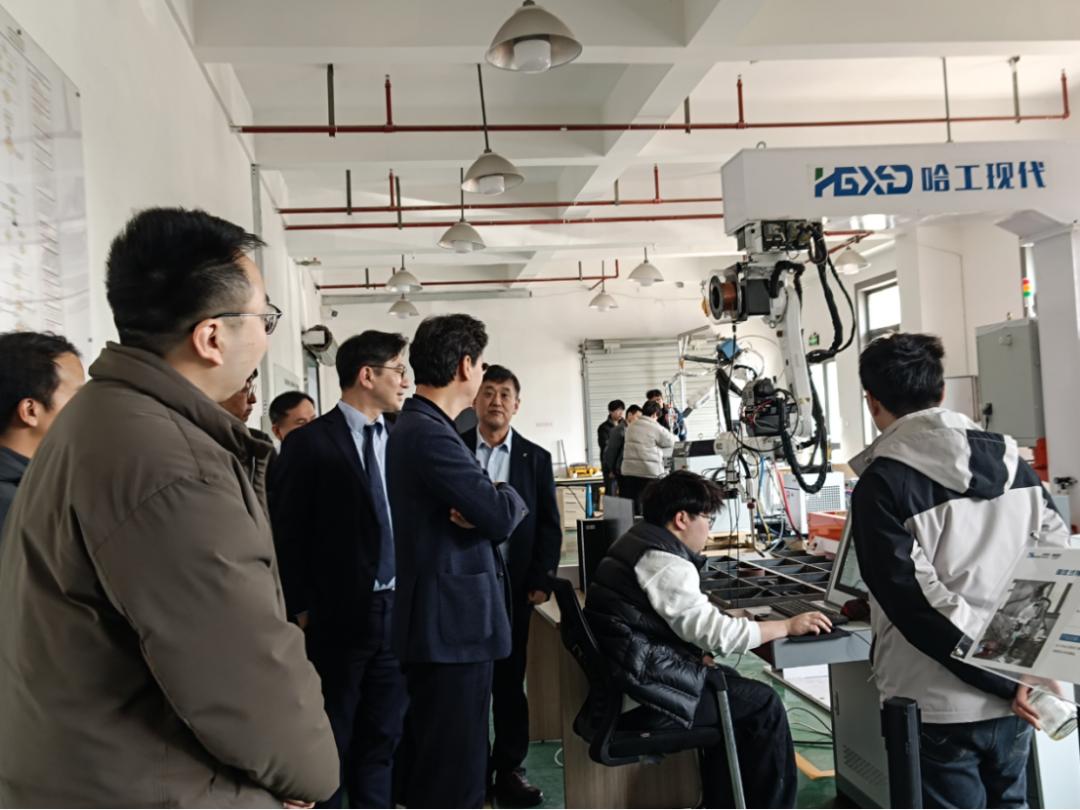
The president of the headquarters of Hyundai Robotics in South Korea visited the company (Image source: Company)
Views of the investors:
The representative of Hyundai of South Korea said: As a wholly - owned subsidiary of Hyundai Robotics, Hyundai Robotics has established a long - term and in - depth strategic cooperation with Shengshi Weisheng and Harbin Institute of Technology Hyundai Robotics. We highly recognize the core competitiveness of Shengshi Weisheng's "robot body + AI algorithm + welding process" integration and its technological advantages in the fields of embodied intelligence and AI + 3D vision welding. Its products can meet the non - standard welding needs of the shipyard clusters under the HD Hyundai Group, help the group's shipbuilding sector achieve intelligent transformation, and solve pain points such as the shortage of welders and complex working conditions. This round of financing will accelerate its technological iteration and production capacity improvement. In the future, we will deepen the tripartite cooperation, rely on Hyundai Robotics' global sales network and the industrial resources of the HD Hyundai Group, jointly explore overseas markets in South Korea, Europe, the United States, India, etc., promote the large - scale implementation of intelligent welding robots, and create a global benchmark for embodied intelligent industrial manufacturing.