The mobile phone that OpenAI intends to develop goes a step further than Doubao.
Is OpenAI going to make a mobile phone?
According to the revelation by Guo Mingji, OpenAI is collaborating with MediaTek and Qualcomm to develop a smartphone processor, and Luxshare will serve as the exclusive system co - designer and manufacturer. Mass production is expected to be achieved in 2028.
This means that OpenAI is getting closer to the mobile phone industry chain, approaching the most mature, most personal, and hardest - to - bypass personal terminal today.
In the past year, OpenAI's moves into hardware have become increasingly clear: it acquired Jony Ive's hardware team, was reported to have contacted the consumer electronics supply chain, and continuously pushed ChatGPT from the chat box to more complex Agent tasks.
There have been many speculations about OpenAI's hardware: screenless devices, smart speakers, headphones, glasses, table lamps, smart pens... However, so far, OpenAI has not released any purchasable AI hardware products.
If AI Agents want to truly enter people's daily lives, it's difficult to achieve this with just a novel small device. OpenAI has finally realized that instead of testing the waters in various AI hardware forms, it's better to focus resources on the mobile phone, which users can't live without.
Doubao Phone has proven that AI is not just about answering questions; it can really start to operate a mobile phone.
01 OpenAI's Hardware Finally Points to Mobile Phones
Altman once said, "I don't think we should try to make a better mobile phone." He believed that mobile phones are already mature, and the hardware in the AI era should be in a new form.
Now it seems that he spoke too soon.
In 2025, OpenAI acquired the hardware company io Products founded by Jony Ive.
Jony Ive is one of the most important product designers at Apple. Products such as the iMac, iPod, iPhone, and Apple Watch are closely related to his design system.
So when OpenAI recruited him and his team, it was easy for the outside world to think: Does OpenAI also want to make an iPhone for the AI era?
However, Altman said that the device developed in cooperation with Jony Ive "is not a mobile phone."
According to The Information, OpenAI already has a hardware team of over 200 people, advancing a series of AI devices. The first product may be a smart speaker with a camera, priced between $200 and $300, and the shipment time will not be earlier than February 2027; the smart glasses may not enter mass production until 2028, and products such as smart table lamps are still in the early prototype stage.
So far, OpenAI has not released any purchasable AI hardware products.
Guo Mingji, an analyst at Tianfeng International Securities, released the latest industry survey, stating that OpenAI is collaborating with MediaTek and Qualcomm to develop a mobile phone processor, and Luxshare will serve as the exclusive system co - designer and manufacturer. Mass production is expected to be achieved in 2028.
In terms of the processor, MediaTek and Qualcomm are participating in the collaborative development, and the final specifications and suppliers are expected to be finalized by the end of 2026 or the first quarter of 2027. On the manufacturing side, Luxshare Precision has secured the position of exclusive co - designer and manufacturer.
He also provided a set of data for reference: Taking the TPU Zebrafish jointly developed by MediaTek and Google as an example, the revenue of a single AI chip is approximately equivalent to that of 30 to 40 AI Agent mobile phone processors.
OpenAI is initially targeting the global high - end mobile phone market of 300 to 400 million units per year. If it can really enter this market, for supply chain companies such as MediaTek, Qualcomm, and Luxshare, the subsequent replacement cycle may become a new source of growth.
02 Why Does OpenAI Want to Make a Mobile Phone?
OpenAI's previous imagination of hardware was similar to Apple's product universe: speakers, headphones, glasses, desktop devices, and portable devices, aiming to occupy an entry point in each scenario.
However, OpenAI is not Apple. It doesn't have enough time, channels, and hardware organizational capabilities to simultaneously expand a complete ecosystem. Compared with creating a full range of AI hardware products, a more reasonable choice is to focus resources on the mobile phone.
From a product perspective, making a mobile phone is also a reasonable choice: In the past two years, ChatGPT has evolved from a Q&A tool to more of a task entry point. However, no matter how powerful ChatGPT is, it is still just an app, restricted by the permissions of the system and mobile phone manufacturers.
It can call some tools but cannot truly take over the entire device; it can understand a sentence input by the user but has difficulty continuously understanding the user's complete state. This is a fundamental limitation for AI Agents.
OpenAI is of course aware of this problem. In fact, it has already started to address it on the computer side: The latest change in Codex is to transform AI from a "chat window for generating code" to a "work assistant capable of operating a computer." It can view the screen, use applications, process files, switch between different tools, and break down complex tasks into multiple steps for continuous progress.
OpenAI's direction is clear. It is not satisfied with keeping AI in a dialog box. It wants AI to enter the real work environment, obtain context, and directly execute tasks.
On the computer side, this can be achieved through Codex first because computers are originally productivity devices, and users are more accepting of automation, file operations, and multi - window collaboration.
However, on the mobile side, the problem is more complex: Mobile phones are more personal and private than computers. They involve location, notifications, photo albums, address books, payments, calendars, social relationships, and real - time status.
And in the foreseeable future, smartphones will still be the largest - scale personal terminal devices. It can be said that the closer one is to the mobile phone system, the more opportunities one has to understand what the user is currently doing and what they need.
This is the importance of mobile phone hardware and the system entry point.
Taking Doubao Phone as an example, although Doubao didn't make hardware but took the route of transforming existing Android phones, it allowed many people to see for the first time that AI can not only chat with you on the phone but also really operate the phone.
It can recognize screen content, understand user intentions, jump between different applications, and complete some specific tasks for the user.
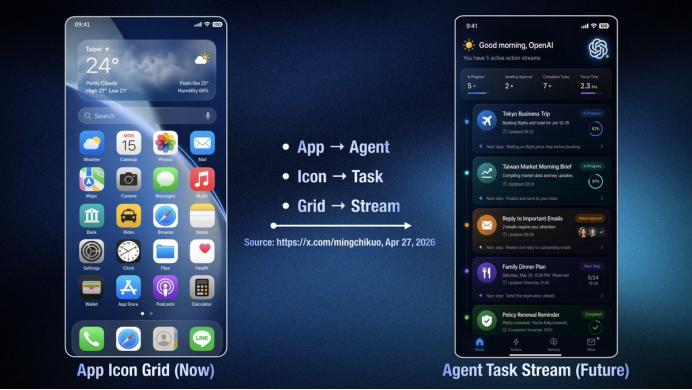
Although its experience may not be mature, the direction is clear: The mobile phone is no longer just a container for apps; it may become the execution environment for Agents.
According to Guo Mingji's analysis, if OpenAI really makes a mobile phone, it probably won't pack all AI capabilities into the local device.
A more realistic solution is a high - level integration of edge - side AI and cloud - side AI: The mobile phone side is responsible for continuously understanding the user's context, while more complex tasks will still be handed over to the cloud - side AI.
For example, where you are now, what you are looking at, what notifications you've just received, and whether you have any upcoming schedules... These capabilities require low latency, need to be on standby at all times, and involve a large amount of private data, so they can't always rely entirely on the cloud.
So the mobile phone processor itself becomes very crucial: How to control power consumption, how to manage memory hierarchically, and whether small models can run locally for a long time will all be issues that must be considered when designing an AI mobile phone chip.
However, tasks such as multi - step planning, complex reasoning, long - text processing, research across a large amount of data, and using large - scale models to complete professional tasks... These are not suitable to be run entirely on the local mobile phone. They are more likely to be processed by cloud - side models, and then the results are synchronized back to the mobile phone.
This also explains why OpenAI chooses to cooperate with the supply chain instead of building all the hardware from scratch.
Smartphone hardware is already highly mature. There are quite mature industry chains for screens, cameras, batteries, antennas, structural components, and whole - machine manufacturing.
OpenAI doesn't need to become Apple or Samsung. Its real advantage lies not in traditional hardware but in the consumer - level brand established by ChatGPT, the real - world usage feedback from over 800 million weekly active users, and its model capabilities that are still in the first echelon.
03 AI Hardware That Bypasses Mobile Phones Has All Failed
If OpenAI just wants to make a novel piece of hardware, it can take many forms. But if OpenAI wants AI Agents to truly enter users' daily lives, it's difficult to bypass the mobile phone. The previous round of AI hardware has already tested the waters for OpenAI.
The Humane AI Pin is the most typical failed example: It once tried to turn AI into a small device that could be clipped to the chest, interacting through voice, camera, and projection to reduce users' dependence on mobile phones. However, it received poor reviews after its launch, with returns once exceeding sales. Finally, Humane stopped selling the AI Pin and sold its assets to HP, and the cloud service for the sold devices was also shut down in February 2025.
Although the Rabbit R1 didn't shut down like Humane, it didn't become a new daily entry point either. Its slogan at the time of release was "Let AI operate apps for you," and it once sold over 100,000 units. But five months after its release, it was reported that only about 5,000 people were using it at any given time. It proved that the concept was appealing, but also that a single small piece of hardware can hardly truly replace a mobile phone.
More vertical AI recording devices and AI companion devices have also failed to break into the mass market. For example, the previously popular Limitless Pendant has stopped selling; the Friend AI necklace has sparked a lot of controversy regarding its experience and privacy.
Even the relatively well - performing AI smart glasses only serve as a supplement to the mobile phone: They are more like an entry point for shooting, audio, and lightweight AI, rather than a new personal computing center.
The mobile phone is the device that users use the longest, carry the longest, have the most complete permissions for, and have the most mature application ecosystem. It has a camera, positioning, payment functions, social relationships, and the most concentrated real - time information in users' lives.
Users of course hope that devices are smarter, with fewer operations and fewer jumps, but they have no reason to carry an additional new device for an immature AI function.
04 The Exploration Path of AI Mobile Phones
OpenAI is not the pioneer on the exploration path of AI mobile phones.
Google started making its own mobile phone, the Pixel, as early as 2016. At that time, the official called it a "phone by Google," which was the first mobile phone truly launched under Google's own brand.
In 2025, when the Pixel 10 series was released, Google clearly focused on AI, emphasizing AI more than hardware upgrades in the release: The Pixel 10 is equipped with the Tensor G5 and adds more Gemini - related capabilities to support functions such as Magic Cue, Voice Translate, and Pro Res Zoom.
In addition to self - development, Google also cooperated with Samsung to promote AI into a larger mobile phone market.
Starting from the Galaxy S24, Samsung introduced Gemini Pro and Imagen 2 into Galaxy AI; by the Galaxy S25, this cooperation became more systematic. Gemini can now be activated through the side key and can perform tasks collaboratively among Samsung, Google, and even some third - party applications.
Samsung's official website calls it Cross App Action, which means that users only need to make a request, and AI can complete multi - step operations across multiple applications.
Apple is also doing the same thing, but it doesn't call it an AI mobile phone. It's more like an AI transformation of the mobile phone.
At the 2024 WWDC, Apple released Apple Intelligence. The core narrative is that AI is no longer a separate app but is built into iPhones, iPads, and Macs. It can understand personal context, perform actions across apps, and reach users through Siri.
However, Apple encountered a very serious problem: The most crucial new - version Siri wasn't ready on time.
Bloomberg reported that the Apple executive in charge of Siri internally called this delay "ugly and embarrassing" and believed that publicizing it before the technology was ready made the situation worse.
Of course, it can't be considered a complete failure because Apple still released new Apple Intelligence capabilities at the 2025 WWDC, but it did not achieve the kind of AI mobile phone leap that the outside world expected.
Elon Musk, the "old rival" who has been entangled with OpenAI and is about to go to court, has also circled around the direction of AI mobile phones several times, but so far, it's more like a peripheral layout for mobile phones.
When there was tension between X and the Apple and Google app stores, he said that if there were no other options, he would make a replacement mobile phone. Later, rumors about the Tesla Phone, X Phone, and Starlink Phone have never stopped.
In 2025, SpaceX spent approximately $17 billion to buy a batch of wireless frequency bands from EchoStar to enhance Starlink's satellite - to - mobile - phone direct - connection capabilities.
With these frequency bands, SpaceX can enable Starlink satellites to directly provide network services to mobile phones. That is to say, even if a mobile phone is not within the coverage of a ground base station, it may be able to directly connect to a satellite to send text messages, make calls, and even watch videos.
However, the problem is that most mobile phones currently cannot directly use these frequency bands.
So Musk said that mobile phone manufacturers and chip manufacturers need to modify the communication chips in mobile phones to make them support these new frequency bands. This adaptation process will probably take about two years.
So far, Musk's system has not really produced a usable AI mobile phone.
It can be said that both SpaceX and OpenAI are approaching the most important personal terminal in the AI era. Now it depends on who can make it happen first.
For Chinese companies, many attempts have also been made in AI mobile phones. Doubao Phone is just the earliest - seen example, which proves that in the high - frequency terminal of mobile phones, AI doesn't have to be just a chat assistant; it can also become a new entry point for understanding the screen, calling applications, and executing tasks.
This route will be more obvious among mobile phone manufacturers: Whether it's Honor, OPPO, vivo, Huawei, Xiaomi, or Meizu, they are all trying to let AI break out of apps.
If OpenAI really makes the AI mobile phone route work, it will be a stress test for all companies that want to create a super entry point.
They have to face complex issues such as hardware, system, privacy, security, ecosystem, and supply chain, and may also miss the entry - point dividend when switching from the app era to the Agent era.
But risks and opportunities coexist: The company whose model can better understand users and whose Agent can complete tasks more safely and reliably is more likely to occupy the next - generation mobile entry point.
Although the news that OpenAI is going to make an AI mobile phone has not been officially confirmed yet, the speculation based on this direction is already very clear.
The mobile phone is already in users' hands. It has a screen, network, camera, microphone, positioning, payment, notifications, address book, calendar, and a complete application ecosystem.
For an AI giant like OpenAI, if it wants its model to truly enter people's lives, it's better to enter the mobile phone itself rather than develop a new piece of hardware from scratch.
This article is from the WeChat official account "Zimu AI", author: Yuan Xinyue. Republished by 36Kr with authorization.