Just now, the OpenAI phone was exposed and will be mass-produced in 2028.
As we mentioned before, the number of Apple's new iPhones is going to catch up with that of Xiaomi. After Apple's AI Siri is launched at this year's WWDC, AI phones will become Apple's new main line.
However, the AI phone market will soon see a new disruptor, which is OpenAI.
Tianfeng International Securities analyst Guo Mingji released the latest industry survey today, stating that OpenAI is collaborating with MediaTek and Qualcomm to develop mobile phone processors. Luxshare Precision has won the exclusive contract for system co - design and manufacturing, and mass production is expected in 2028.
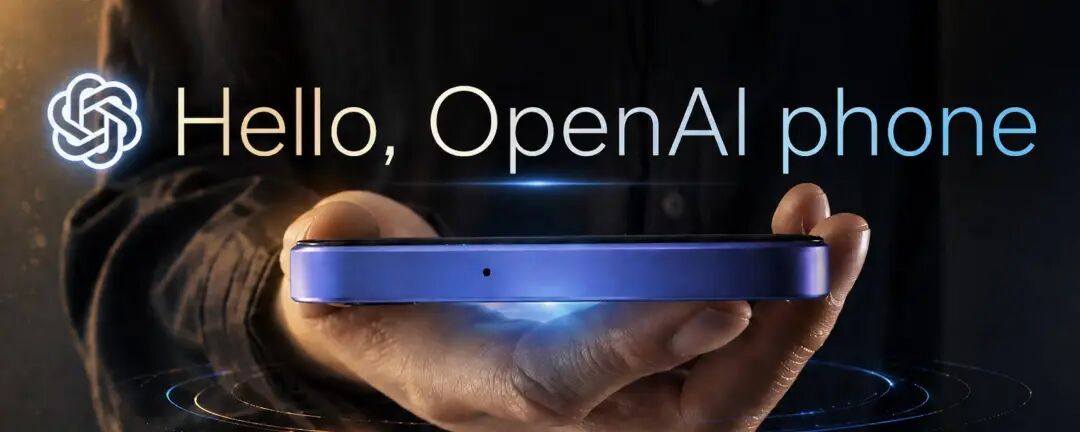
Speakers, glasses, headphones, table lamps, pens... OpenAI's hardware product lineup isn't enough. This time, it's directly targeting the mobile phone market.
Let's first take a look at the limited product information of the OpenAI phone. In terms of the processor, MediaTek and Qualcomm are jointly involved in the development. The final specifications and suppliers are expected to be finalized by the end of 2026 or the first quarter of 2027. On the manufacturing side, Luxshare Precision has secured the position for exclusive co - design and manufacturing.
Guo Mingji also provided a set of reference data: Taking the TPU Zebrafish jointly developed by MediaTek and Google as an example, the revenue of a single AI chip is approximately equivalent to that of 30 to 40 AI agent mobile phone processors.
OpenAI is initially targeting the global high - end mobile phone market of 300 to 400 million units per year. The incremental volume brought by the replacement wave will be a real source of revenue.
For Luxshare, the strategic significance of this project may be greater than short - term revenue. In Apple's supply chain, it's difficult for Luxshare to surpass Hon Hai in the assembly position. However, the OpenAI phone gives it a ticket to become the "main manufacturer of next - generation mobile phones".
Why does OpenAI insist on making its own mobile phone?
Sam Altman may finally have realized one thing: If only focusing on software, AI will always be a guest in others' houses.
Guo Mingji provided three reasons in his analysis, all pointing to the same conclusion.
Only by fully controlling the operating system and hardware can the AI agent provide truly "comprehensive services". Currently, ChatGPT runs on the iPhone. Limited by Apple's permission sandbox, it has to go through multiple steps just to help you order takeout. Making its own mobile phone means starting from the bottom layer, allowing the AI to call whatever it needs without any restrictions.
The mobile phone is the only device that always has access to all of the user's current states. Your location, schedule, chat history, physical data, and payment habits. These real - time information are the most crucial inputs for the AI agent's reasoning services. Without these inputs, the AI is like an assistant who can only listen but can't see or touch, being smart but ineffective.
In the foreseeable future, the mobile phone will still be the terminal device with the largest quantity. No matter how well speakers sell, it's mainly for home use. No matter how cool smart glasses are, they are still in the early - adopter circle. However, with billions of mobile phones shipped globally every year, whoever captures the mobile phone market will capture the largest distribution channel for AI.
What does the OpenAI phone look like?
Guo Mingji created a concept design drawing. When comparing it with the current iPhone's home screen, the differences are obvious.
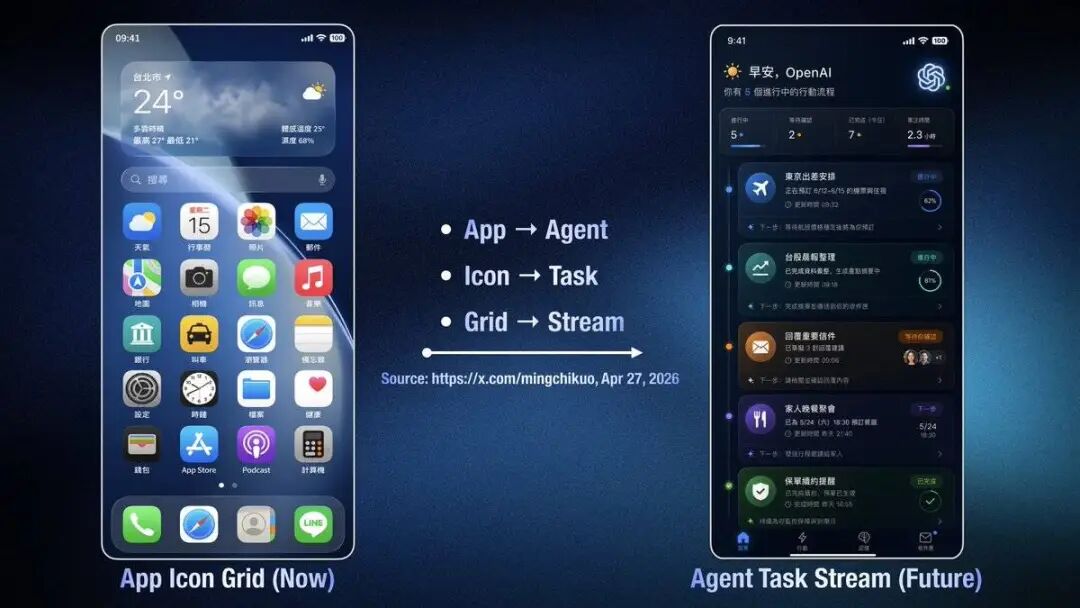
The home screen of a traditional mobile phone is like a "shelf" of a bunch of app icons. You have to find, click, and operate them by yourself. In contrast, the logic of the OpenAI phone is completely reversed. The user's goal is no longer to open a certain app, but to directly tell the phone "what I want to do", and the rest will be handled by the AI agent.
In other words, the apps are still there, but you may never need to click them manually again.
In terms of technical implementation, OpenAI's solution is to highly integrate cloud - based and edge - side AI. The mobile phone processor needs to continuously understand the user's context information. Power consumption management, memory hierarchy, and local operation of small models are all key considerations in chip design. Complex or high - intensity tasks will be handled by the cloud - based AI.
In terms of business model, Guo Mingji predicts that OpenAI may bundle the subscription system with the hardware. Will it be "buy a phone and get ChatGPT Plus for free"? Or vice versa, will ChatGPT subscribers enjoy hardware subsidies? The specific plan is unknown, but the direction is clear: to build a brand - new ecosystem around the AI agent and attract developers to participate.
Speakers, glasses, headphones, the mobile phone is the last piece of the puzzle
Actually, OpenAI's hardware ambitions have long been an open secret.
Earlier this year, according to The Information, OpenAI has internally established a 200 - person hardware team, and the product design is handled by LoveFrom studio, led by former Apple chief design officer Jony Ive.
The team has a high "Apple content": Tang Tan is a 25 - year veteran at Apple and used to be in charge of the product design of the iPhone and Apple Watch; Evans Hankey is the former head of Apple's industrial design and took over the entire design team after Jony Ive left.
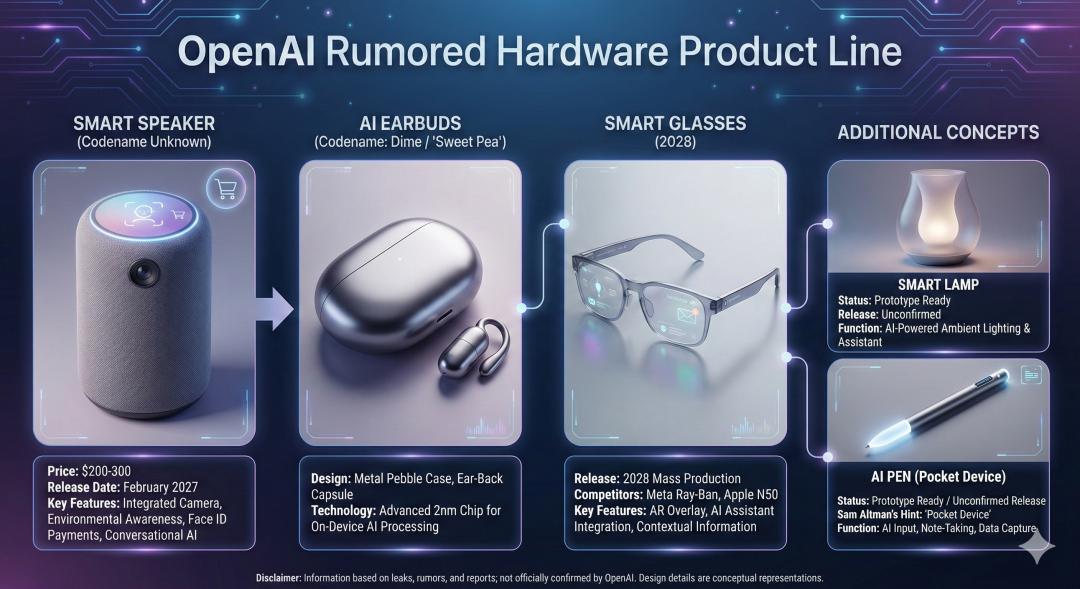
OpenAI's hardware product line (compiled by APPSO based on exposed information)
- Smart speaker (code name unknown): The first product, priced at $200 - $300, will be shipped in February 2027.
- AI headphones (code name Dime/ "Sweet Pea"): With a metal cobblestone shape, the capsule - shaped earphones are placed behind the ears, equipped with a 2nm chip.
- Smart glasses: Mass production is expected in 2028, competing directly with Meta Ray - Ban and Apple N50.
- Smart lamp: The prototype is ready, and whether to launch it is to be determined.
- AI pen: The "pocket device" repeatedly hinted at by Sam Altman.
However, if you look closely at this product matrix, you'll find that speakers are for home scenarios, glasses are for travel scenarios, and headphones are for fragmented time. Each category fills the gaps when it's "inconvenient to take out the phone". The mobile phone itself, as the device with the highest information density and the longest usage time on the user, has always been the missing piece of this puzzle.
Now OpenAI has filled this gap.
Sam Altman once said in an interview: "Smartphones are like Times Square, with information bombardment and fragmented attention. What OpenAI wants to do is a lakeside cottage where you can close the door when you need to focus."
From speakers to mobile phones, OpenAI's hardware logic is becoming clearer: It doesn't want to be an app at the mercy of others in Apple's territory. Instead, it wants to build a whole set of AI - native hardware ecosystem from scratch.
Speakers are the central hub in the living room, mobile phones are the portable entry points, and glasses and headphones are the extended tentacles. Each device collects data, understands the user, and executes tasks.
To achieve this, OpenAI has poached many talents from Apple. According to The Information, OpenAI poached more than 20 hardware experts from Apple last year alone. Apple was so anxious that it even cancelled its annual closed - door meeting originally planned to be held in China, citing "preventing more executives from jumping to OpenAI" as the reason.
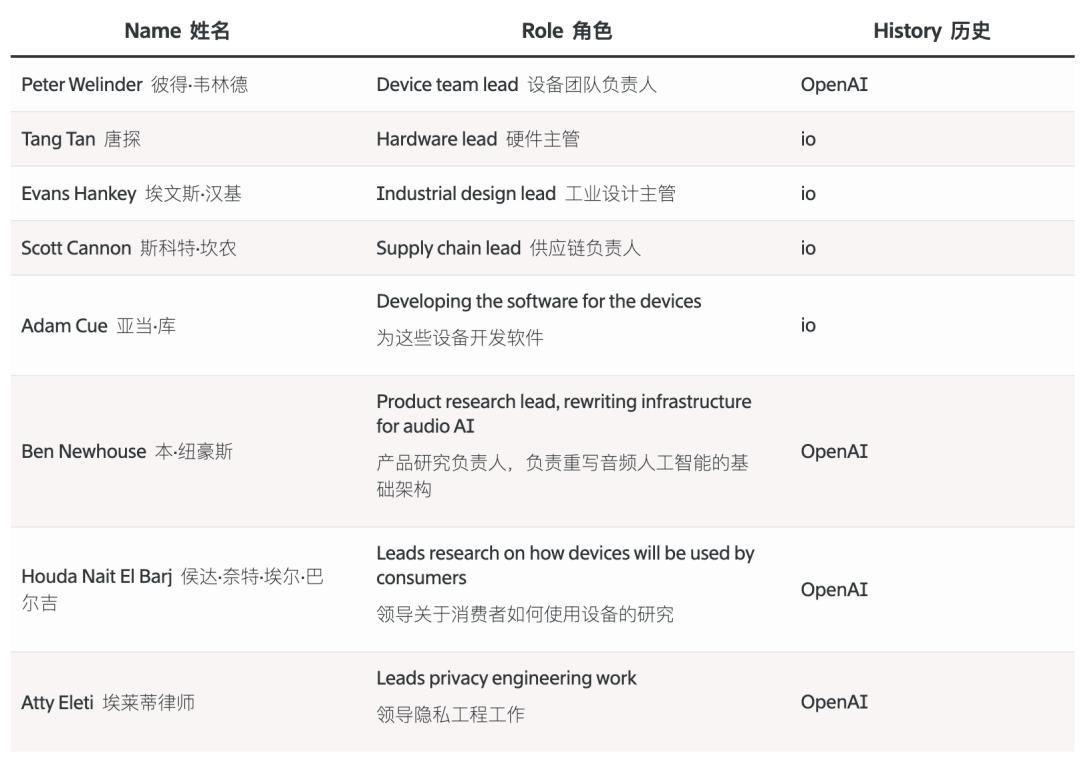
Image source: The Information
The supply chain is also accelerating the binding process. Luxshare Precision has won the assembly contract for at least one OpenAI device, and Goertek is also in talks and may provide components such as speaker modules for future products. One of them is the main contract manufacturer for the iPhone and AirPods, and the other has assembled AirPods, HomePod, and Apple Watch.
OpenAI is essentially using Apple's talents and supply chain to build its own products.
The Doubao phone and the OpenAI phone, different paths leading to the same goal
The OpenAI phone is expected to be launched in 2028. However, in China, the cooperation between AI manufacturers and mobile phone manufacturers has taken the lead.
At the end of last year, ByteDance collaborated with ZTE to launch the first - generation Doubao phone (Nubia M153). The engineering prototypes were sold out instantly as soon as they were launched. The original price of 3,499 yuan was once speculated up to 36,000 yuan, driving ZTE's stock price to the daily limit.
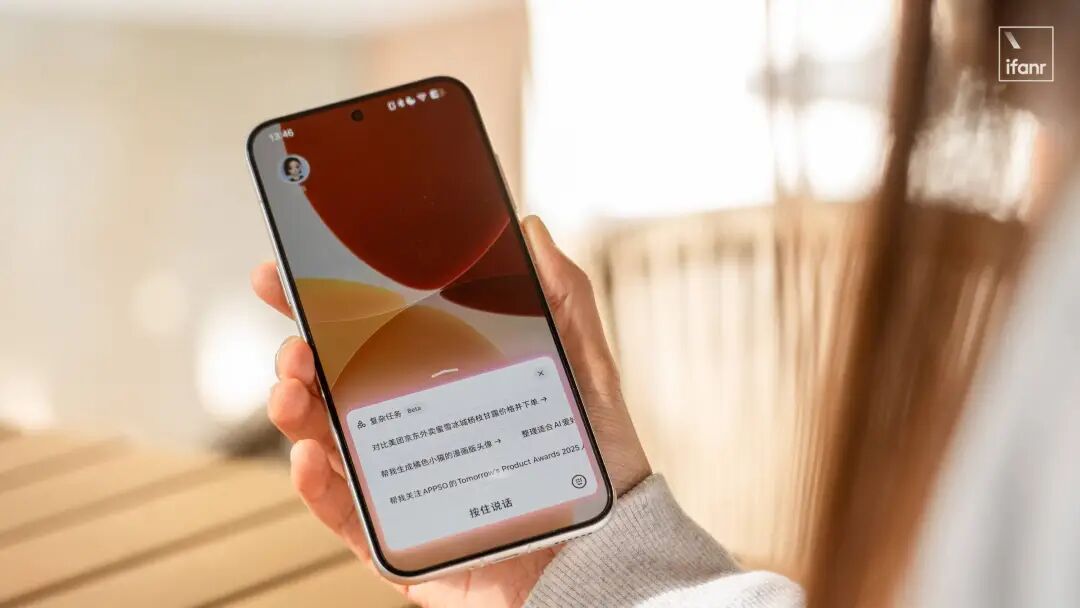
Its approach is very radical. The large - scale model directly recognizes the screen content and simulates manual operations through the GUI Agent, bypassing the limitations of traditional APIs, enabling the AI to truly order takeout, send messages, and book air tickets for you.
Actual test of the Doubao phone assistant: cross - platform price comparison, file organization, high - EQ WeChat replies... The phone can finally do things on its own.
The price is also obvious: WeChat, Alipay, Taobao, and bank apps have successively blocked the Doubao phone for security reasons. After all, the AI bypasses the app sandbox and permission control, which is like opening a hole in the security mechanism. Mainstream platforms can't just sit back and do nothing.
Currently, the R & D of the Doubao phone 2.0 has been launched and is expected to be released in the second half of the second quarter of this year. More notably, this cooperation is spreading to more mobile phone manufacturers.
According to Lanjing News citing an informed source, the first mobile phone manufacturer that ByteDance contacted was actually Honor, but Honor was cautious. The statement of an informed source is quite representative: "The Doubao phone can be more radical as an exploratory engineering machine. However, Honor has hundreds of millions of users. Once there are problems with the stability, compatibility, or security of the new service, it may very likely lead to large - scale functional abnormalities and user complaints."
Previously, there were reports that Honor was in talks with ByteDance about the Doubao phone cooperation, but Honor denied it, responding that "after internal confirmation, the relevant rumors are not true. Honor is always committed to providing high - quality products for consumers through technological innovation. If there are any strategic cooperation progress, it will be announced through official channels immediately."
However, according to the blogger "Digital Chat Station", vivo is currently in talks with Doubao, and other top 5 domestic manufacturers are queuing up. In his words, "a wave of AI OS and a wave of Doubao AI phones are approaching."
As this informed source said: "For mainstream mobile phone manufacturers, the promotion of AI phones can only be carried out step by step and cannot be achieved overnight."
Looking back, OpenAI and Doubao are actually taking two completely different paths.
Doubao chose to cooperate with existing mobile phone manufacturers and provide a bottom - layer service solution on the Android system. The advantage is speed, as there was already a product available for hands - on experience at the end of last year. The drawback is that it is restricted by others' systems and ecosystems, and there are continuous problems with security and compatibility.
OpenAI, on the other hand, chose a slower but more thorough path, developing its own operating system, processor specifications, and supply chain. Mass production is not expected until 2028. It's slow, but once it's done, it has full control over everything from the chip to the system to the AI model and doesn't have to rely on anyone.
The two paths lead to the same conclusion: If AI only stays at the app level, it will always be just a "new function" on the mobile phone. To make AI the soul, either transform the existing mobile phone or build a new one from scratch.
In 2028, when the OpenAI phone is truly launched, there may no longer be rows of neatly arranged app icons on your mobile phone's home screen.
Instead, there will be an AI quietly waiting for you to speak. Will you let it "use the phone" for you?
This article is from the WeChat public account "APPSO", author: APPSO, which discovers tomorrow's products. It is published by 36Kr with authorization.