"700 machines are running day and night", and some young people are "earning 100,000 yuan a month" from it.
“During the Spring Festival this year, I went to the market to set up a stall with my parents. The total daily turnover of the three of us was about 1,600 yuan.” On the 22nd, Shen Sanmei (a pseudonym), a post - 95s 3D printing entrepreneur from Jiangsu, told China News Service. She said that after deducting the costs of consumables, stall fees, and labor, “we earn a few hundred yuan on a bad day and up to 1,000 yuan on a good day.”
Recently, many online posts have appeared on social platforms, in which young people share their experiences of earning 10,000 yuan a month using desktop 3D printers costing a few thousand yuan. What is the real situation of the 3D printing business?
“Those who earn 50,000 - 60,000 yuan a month are ‘farmers’”
China News Service learned that there are mainly three ways to make money using 3D printing equipment at present: mass - printing toys for online sales or sales at stalls; taking customized orders and charging design fees plus material costs; and operating on a large - scale as a “farmer” to take orders.
Di Zan (a pseudonym), a post - 80s who does 3D printing as a side job in Singapore, told China News Service that he bought the equipment and officially started his business half a year ago.
“It cost me more than 1,000 US dollars (about 6,800 yuan) to buy the 3D printing equipment and transport it to Singapore. Including various consumables, the upfront cost was more than 10,000 yuan.” Di Zan said that his monthly income can currently cover the operating costs such as consumables, but when it comes to making a profit, he said bluntly that “he is still in the stage of recovering the cost.”
Di Zan's business is divided into two categories. One is to commercialize products for rehabilitation medical research projects, and the other is to take customized orders on social platforms. The design fee for small desktop ornaments ranges from 100 to 400 yuan, and the printing fee is calculated based on the weight of the consumables, about 1 - 2 yuan per gram. The average unit price of the products is 300 - 400 yuan.
“Don't think the ornaments are small. Most of the time, you have to keep an eye on the printer. The most feared thing is the so - called ‘noodles’,” Di Zan explained. In the industry, “noodles” refers to printing failures where the consumables get tangled up. For a component product that takes more than 30 hours to print, once there is a malfunction, the time cost will increase significantly.
Different from Di Zan, who takes orders online, Shen Sanmei's 3D printing business is mainly carried out at market stalls during holidays.
“I basically don't take scattered orders. I mainly sell finished products at offline markets and set up stalls on Fridays, Saturdays, and Sundays,” Shen Sanmei said.
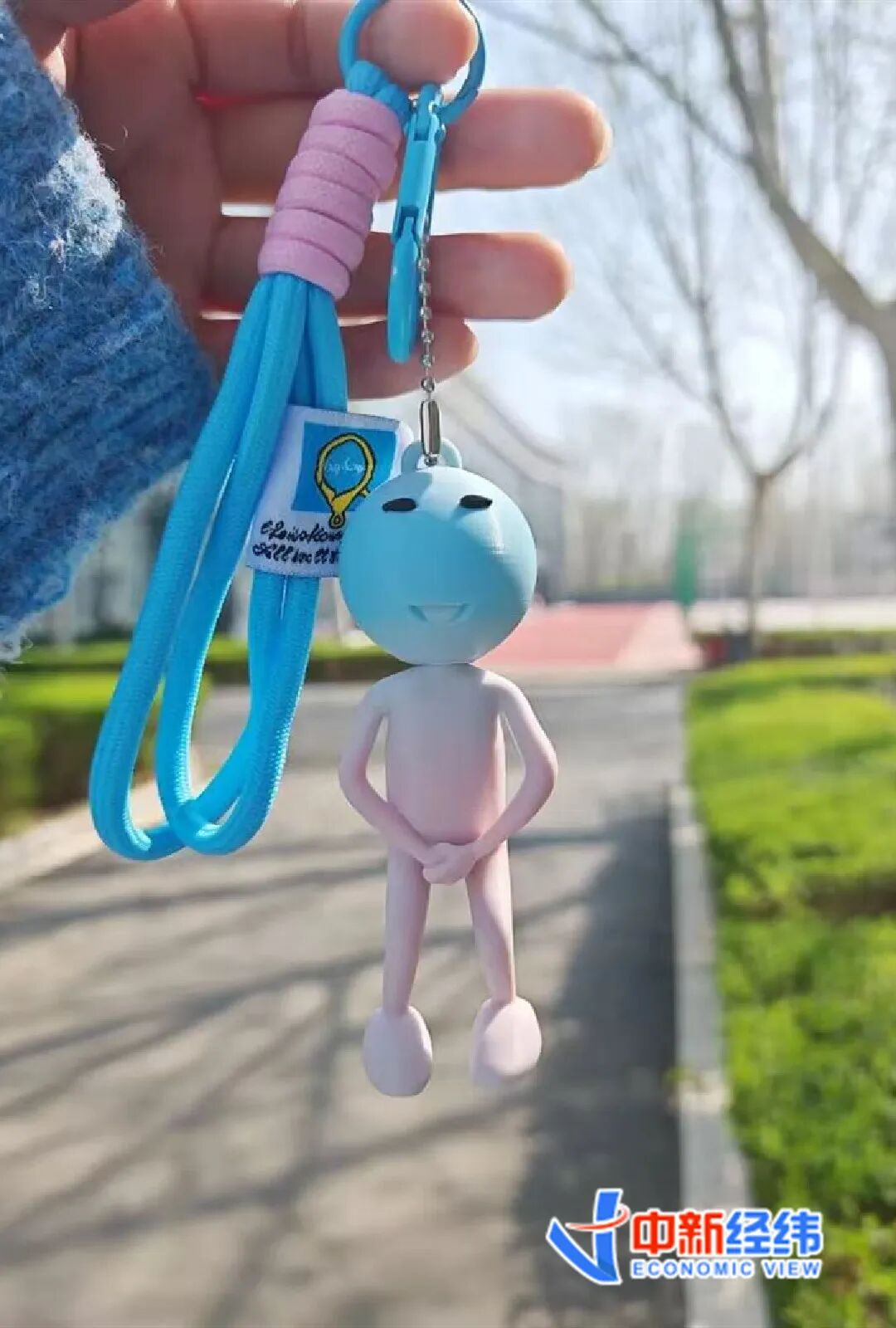
Original 3D printing works of Shen Sanmei. Photo provided by the interviewee.
In terms of equipment investment, Shen Sanmei spent about 3,500 yuan on two printers. Consumables are another major expense. So far, she has consumed about 100 rolls. Calculated at an average purchase price of 40 yuan per roll, the cumulative cost of consumables is about 4,000 yuan. The electricity cost can be almost ignored - “Even if both machines are running all day, it only costs 2.2 yuan a day.”
Di Zan said bluntly: “It's rare for individuals with one or two devices to earn more than 10,000 yuan a month. Generally, it's more common to earn 3,000 - 4,000 yuan a month. Those who can earn 50,000 - 60,000 yuan a month through 3D printing are mainly ‘farmers’.” In the industry, “farmers” refer to operators who operate multiple 3D devices for centralized and mass production.
When she is too busy, Shen Sanmei will also transfer orders to “farmers”. She will outsource the design of complex models, and the modeling fee for a cartoon image is about 100 yuan. “The ‘farmers’ charge me 0.15 yuan per gram for consumables, and I charge my customers 0.25 yuan per gram. The difference of about 0.1 yuan per gram is the channel profit I earn from occasionally ‘transferring orders’,” Shen Sanmei said.
Di Zan has found another more stable source of income overseas: the supply - chain price difference. “The 3D printing industry chain in China is more complete than that in foreign countries, and the cost of consumables is also lower. So I will purchase consumables in bulk from China and resell them locally to earn the price difference. This part of the income is more stable than simply providing 3D printing services,” Di Zan said.
“The machine is making money when it's running”
“The machine is making money when it's running. The model of small - order and quick - response is more flexible than traditional contract manufacturing,” said Xiao K (a pseudonym), a post - 95s 3D printing “farmer” from Hangzhou.
In October 2025, Xiao K and several friends jointly purchased 700 3D printers one after another and opened a 3D printing farm, mainly printing ornaments, toys, and engineering parts. According to Xiao K, their orders are mainly from foreign trade and local enterprise customization, and the startup rate of the equipment is maintained at about 80%. “When there are many orders, all 700 machines run day and night, and the monthly net profit can be about 100,000 yuan.”
Ju Zheng, the market leader of 3D printing enterprise Creality, told China News Service that the number of “3D printing farmers” who purchase multiple devices for small - batch and customized production has increased significantly in the past two years.
“The core driving force behind this is the maturity and popularization of technology. When the speed , accuracy, and material compatibility of consumer - grade 3D printers can meet the commercial delivery standards, it becomes a new type of infrastructure for micro - entrepreneurship,” Ju Zheng said.
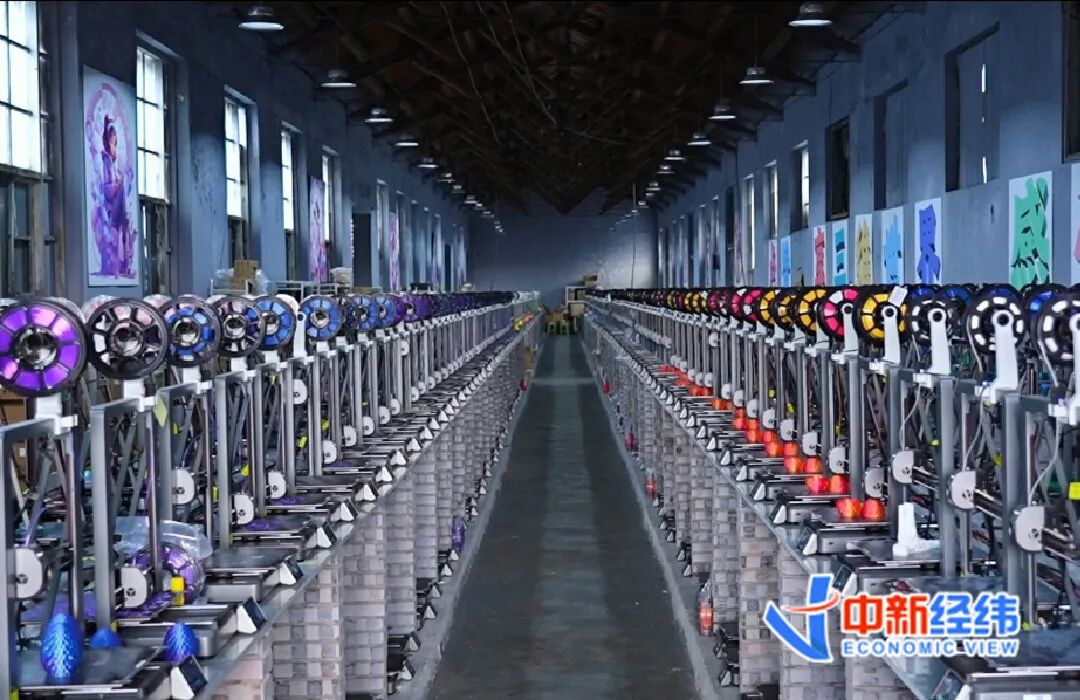
3D printing farm. Photo provided by the interviewee.
Wu Jie, the marketing manager of Zhejiang FlashForge Co., Ltd., a 3D printing equipment company, said: “Judging from the equipment sales volume, our growth is real, and the ‘farmers’ have become an important purchasing force. Although we can't directly say that all users are engaged in production, the growth of entrepreneurial users and B - end customers is undoubtedly an important driving force for the soaring sales volume.”
How far can it go?
On April 14th, the State Council Information Office held a press conference on China's import and export situation in the first quarter of 2026. Wang Jun, the deputy director of the General Administration of Customs, said at the press conference that the export of 3D printer products in China increased by 119% in the first quarter.
On April 16th, Mao Shengyong, the deputy director of the National Bureau of Statistics, mentioned at a press conference of the State Council Information Office that the output of 3D printing equipment in the first quarter of 2026 increased by 54.0% year - on - year.
The industry is developing, but the entrepreneurs who have already entered the market are relatively calm. “Many people's enthusiasm only lasts for two or three months. After the novelty wears off, the machines gather dust,” Di Zan said. He observed a key change: with the popularization of AI modeling tools, homogeneous products are flooding the market, and “it's becoming increasingly difficult for individual creators to stand out through design.”
Shen Sanmei is also planning to gradually increase the proportion of self - modeled products and transfer to online platforms. “In the long run, we still need to have our own designed models. Printing is just a tool, and the model is the soul,” Shen Sanmei said.
In Ju Zheng's view, the current consumer market's demand for personalized, differentiated, and limited - edition products is booming, which perfectly matches the characteristics of 3D printing's “small - order and quick - response”. “As AI further lowers the threshold of modeling and smart hardware further reduces the operation threshold, 3D printing micro - factories will be as popular as today's printing shops in the future,” Ju Zheng said.
Shang Jigeng, the global president of 3D printing enterprise Atom Reconstruction, believes that this wave of upsurge has both short - term popularity and long - term trends. “For some users, 3D printing is gradually changing from an interest tool to a lightweight production tool. But the growth will not be evenly distributed. Only a few long - term players with product, software, material, ecological, and globalization capabilities can really go far,” Shang Jigeng said.
Jiang Han, a senior researcher at the Pangu Think Tank, told China News Service that family workshops have unique advantages in small - batch and personalized orders - they can quickly respond to non - standard needs without complex processes. However, in the face of large - scale standardized orders, family workshops are difficult to compete with factories. The current industry is still in the dividend period, but as more and more people enter the market, price wars are inevitable, and reshuffle is just a matter of time.
Jiang Han said that ordinary people should not be satisfied with basic operations. They should in - depth study modeling and materials science to build barriers; accurately position the niche market to provide differentiated services; and actively expand the business chain, extending from simply taking orders to consumable research and development or brand operation. “Finding an irreplaceable position in the ecosystem is the key to avoid being squeezed out,” Jiang Han said.
This article is from the WeChat official account “China News Service” (ID: jwview). Author: Li Ziman, Yan Shuxin. Republished by 36Kr with authorization.