Tesla discloses patents for dexterous hands: Technology convergence and consensus have arrived.
The dexterous hand has finally embraced its "VLA" paradigm and reached the moment of consensus.
In the wave of the embodied intelligence industry in the past few years, the dexterous hand track has been the most bustling and fragmented "battlefield" in the entire embodied intelligence industry. Whether it's direct drive, cable drive, pneumatic drive, or hybrid solutions, global research institutions and industry players have presented various technical routes, pushing the limits in laboratory parameters such as degrees of freedom, grasping accuracy, and response speed. For a while, it formed a pattern of "each has its own unique skills and solutions."
However, almost all technical solutions are trapped in the dilemma of being unable to balance "performance, cost, reliability, and mass - production capability" and find a perfect equilibrium. Even if a few solutions can achieve perfect results in the laboratory environment, once they enter real and complex scenarios such as industrial and household settings, they will encounter problems such as tendon rope wear and slack, joint transmission crosstalk, and long - term accuracy drift.
Just as the entire industry was wandering in the fog of technical routes, Tesla recently publicly released five core patents for the Optimus V3 dexterous hand, directly addressing the core pain point that has troubled the industry for years.
As the well - deserved technological vanguard and pioneer in the global embodied intelligence industry, Tesla did not present another flashy laboratory prototype this time. Instead, it provided a complete solution, subverting from the underlying structure with a highly bionic design to create a pair of hands that truly balance the difficulties of implementation and achieve dexterous and reliable operations.
The emergence of this solution marks that the dexterous hand has finally ended the "wild exploration period" and welcomed the technical consensus and route convergence in the true sense. Just as the VLA architecture has set the paradigm for the underlying model of embodied intelligence, Tesla's solution does not add a new competitive route to the industry but puts an end to the years - long route dispute. Perhaps, with this pair of "hands that can truly do work," the implementation process of humanoid robots will officially enter a new stage of large - scale implementation from the technical verification stage.
What kind of hands is Tesla actually creating?
By dissecting the five core patents publicly released by Tesla this time, we can clearly see that it did not make marginal optimizations within the existing technical routes in the industry. Instead, starting from the bionic underlying logic, it completely reconstructed the three core modules of the dexterous hand: the underlying innovation of the cable - drive architecture, the structural breakthrough of the integrated arm - hand design, and the ultimate engineering of the actuator system.
The cable - drive technical solution is not a new technology in the industry. On the contrary, it is one of the oldest and most competitive technical routes in the dexterous hand track.
However, Tesla has reconstructed the transmission logic of the cable - drive from the bottom up, avoiding the problem of "redundant tension" in cable - drive transmission. Its wiring method does not simply pass through the central axis of the joint but bypasses the pivot point of the joint at a specific angle and distance. With a non - central wiring method combined with a "horizontal and vertical two - way" layered wiring design, the tension transmission of each tendon rope can be completely independent, achieving a variable force arm. When the finger starts to contact an object, the force arm is short and the torque is small, allowing the finger to fit the object softly. When the grasping action occurs, the force arm becomes longer and the torque increases, and the finger starts to tighten to complete the clamping.
If the innovation of the cable - drive architecture is the solution to the problem of "how to move" by Tesla, then the structural breakthrough of the integrated arm - hand design is the direction of "how to build."
Tesla has chosen the "integrated arm - hand" solution, returning to the biological logic of the human arm. It replicates the evolutionary result of the human hand, where "the muscles are in the forearm and the tendons are connected to the palm." The dexterous hand appears in an integrated arm - hand structural design, significantly reducing the weight of the hand space. The power source is moved to the forearm cavity, and the palm joints are remotely pulled by high - strength tendon ropes to complete the actions.
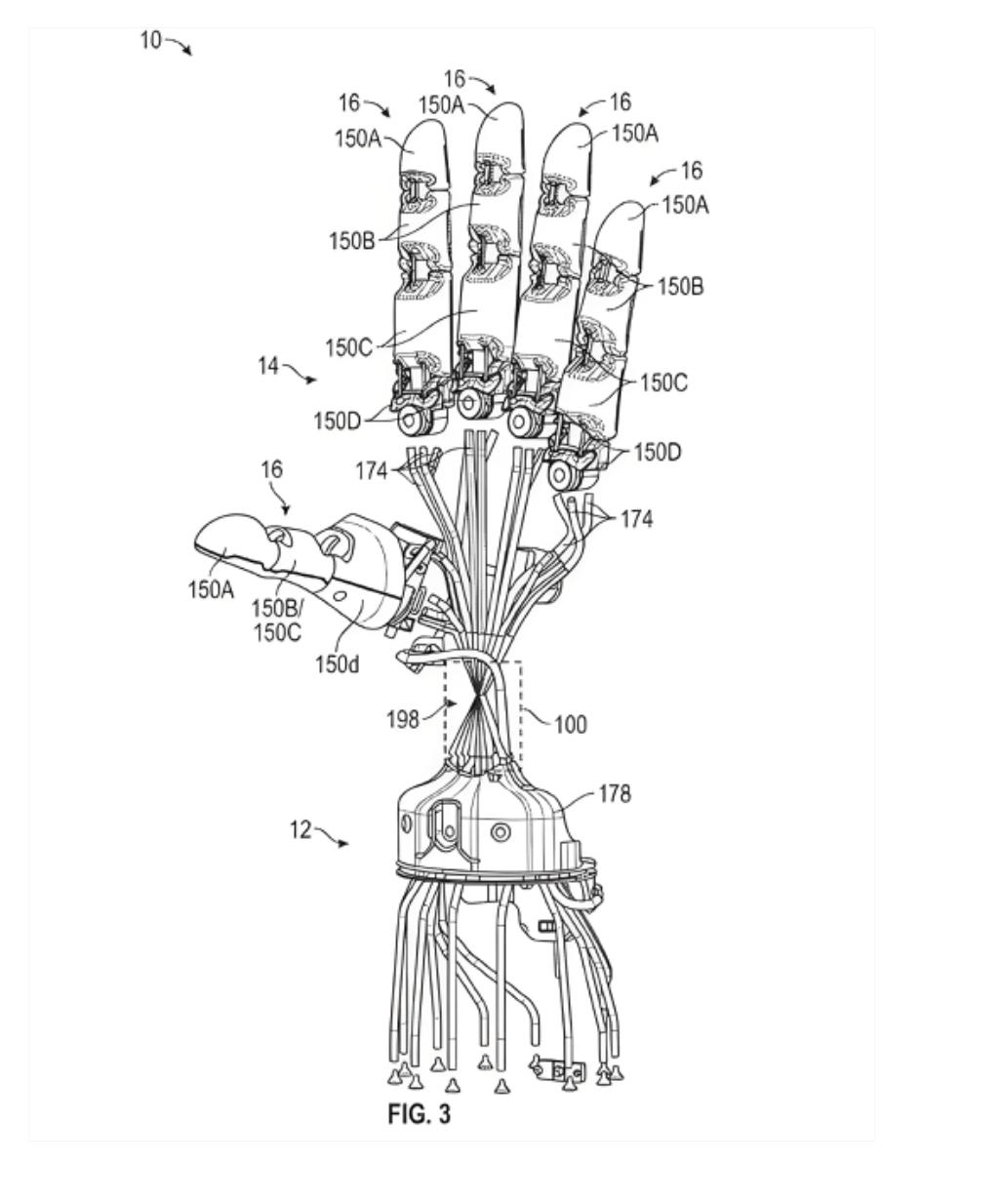
Image source: Tesla
This seemingly simple structural reconstruction not only avoids the limitations of the fixed thinking in the dexterous hand solutions but also meets multiple control requirements. Firstly, it achieves extreme lightweight. The palm body without actuators has its weight compressed, solving the problem of the traditional dexterous hand being "top - heavy" and imposing a huge load on the whole machine. Secondly, the supporting design of the independent degrees of freedom of the wrist allows the robot to lock the optimal working position and posture only by fine - tuning the wrist without mobilizing the entire arm.
Interestingly, this technical route is not unique to Tesla. Xinuo Future in China has already completed in - depth technical verification and large - scale implementation on this route, resonating with Tesla globally in terms of technology and standing in the first echelon of the dexterous hand track.
As one of the few domestic embodied intelligence manufacturers with the complete self - research and self - production capabilities of motors, electronic controls, reducers, lead screws, and algorithms, Xinuo Future has targeted the bionic route of cable - drive + integrated arm - hand design since its establishment. It launched the Xynova Flex 1 dexterous hand in early 2025, coincidentally choosing the same technical core as Tesla's Optimus V3 dexterous hand: both adopt the integrated arm - hand architecture with all actuators placed at the rear of the forearm, and both achieve the human - like movement ability with 25 degrees of freedom. Moreover, through self - research and innovation of components such as micro - electric cylinders, it has achieved breakthroughs in smaller size, lighter weight, and more anthropomorphic design, precisely meeting the requirements of real - world scenarios for dexterous operations.
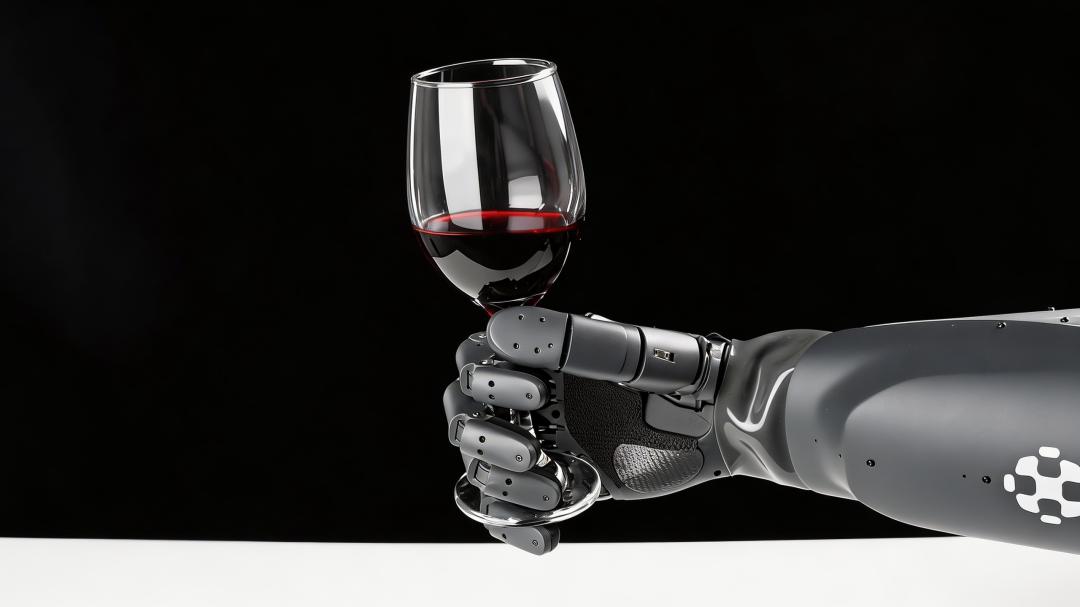
Image source: Xinuo Future
One in the West and one in the East, two globally top - notch players have coincidentally abandoned the "palm - integrated" route that the industry has been competing on for years and jointly chosen to return to the biological origin of the human arm. This in itself is the strongest evidence of the correctness of this technical route. When the final answer of the industry becomes clearer, true pioneers will always choose the same path.
The third core breakthrough in Tesla's patents this time is the micro - actuator system customized for the integrated arm - hand architecture, achieving the "last - mile" leap from "usable" to "user - friendly."
In this solution, Tesla has adopted a self - developed integrated actuator design, which can compactly arrange 20 independent drive units in the limited cavity space of the forearm, solving the heat - dissipation problem caused by the dense arrangement of multiple motors. At the same time, at the finger joints, Tesla has adopted a hybrid transmission architecture, achieving a real combination of "rigidity and flexibility."
This feature is also highly similar to the features of the brushless hollow - cup motor (8mm) and planetary roller screw (7mm) self - developed by Xinuo Future. The micro - electric cylinder of Xinuo Future is the product with the largest thrust and the smallest size on the market, with a maximum output torque of 300N. What is more in line with the actual implementation requirements is its "integrated heat - dissipation housing," which allows the heat generated by the core components to be quickly and evenly transferred to the entire housing and then efficiently exchanged with the external environment. It is worth mentioning that the planetary roller screw of Xinuo Future has higher accuracy, which was previously difficult to achieve in the industry. Xinuo Future has solved the problems of low production consistency and high prices in the industry through self - research and self - production.
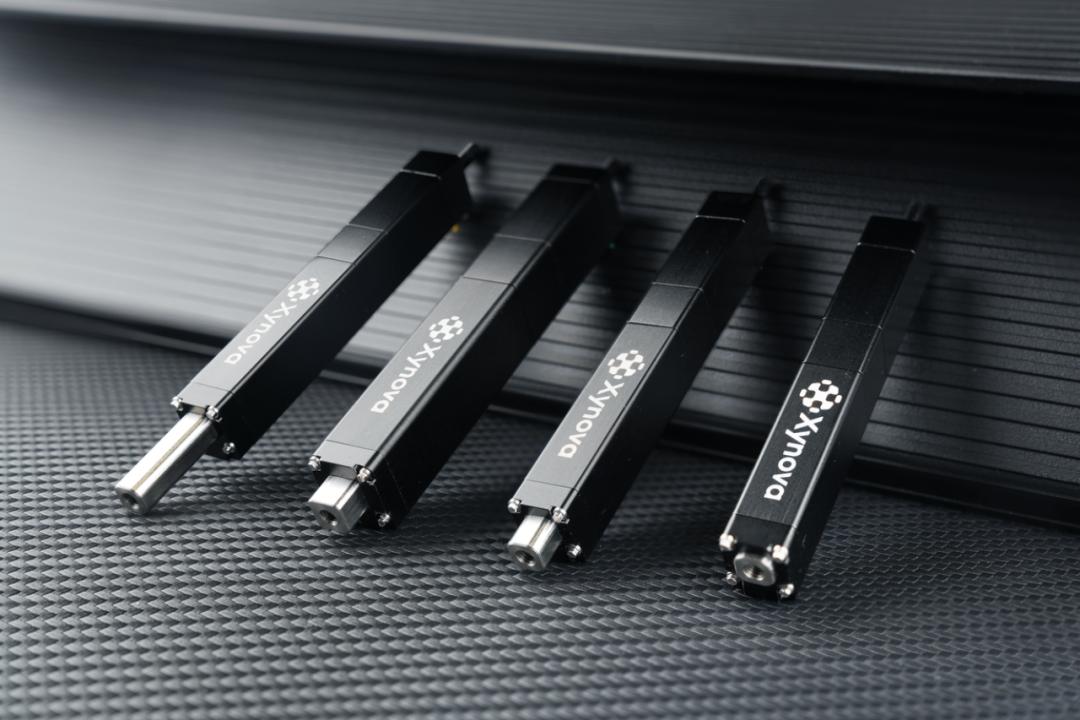
Image source: Xinuo Future
After dissecting every detail of these five patents, we can clearly understand that what Tesla has been trying to create is never a "mechanical device that can grasp things," but a pair of bionic hands that truly replicate the operating logic of the human arm and can interact naturally with the real world.
The human arm and palm have evolved over millions of years. Our muscle groups are concentrated in the forearm, and the fingers are pulled by slender tendons to complete actions, achieving the most flexible operations with the least energy consumption. What Tesla and Xinuo Future have done is to completely bid farewell to the fixed thinking of mechanical engineering and return to the original logic of biological evolution. The ultimate proposition it aims to solve is never to make the robot accurately "grasp" an object, but to enable the robot to interact with the real world naturally and without discrimination, just like us humans.
This is the real soul of general humanoid robots.
Why is this route probably the right one?
When Tesla's Optimus V3 dexterous hand solution presses the confirmation button for technical convergence in the entire track, there will inevitably be such doubts in the industry: Why is Tesla's route the right one? Why isn't this just another flashy gimmick in the laboratory?
The most classic example is the long - term development of FSD. At first, almost no one believed Musk's logic that a car could move forward relying only on "eyes" like a human. When Tesla chose the end - to - end architecture, most people said that the "black - box feature" of the end - to - end architecture could not meet the vehicle - grade safety requirements. But later, the entire industry witnessed what happened. The technical choice that was regarded as an "outlier" at that time eventually became the global consensus in the industry.
Reviewing Tesla's every technical bet, we can clearly see its consistent underlying logic: it never follows the "conventional" trends in the industry and never makes technical compromises for short - term exhibition effects or public praise. Its judgment criteria are always two: first, starting from the real needs of the final scenario and deducing the technical route from the first - principles; second, all technical R & D must ultimately point to "large - scale mass production and implementation," rather than getting stuck in the competition of laboratory parameters. This is the case for FSD and also for integrated die - casting.
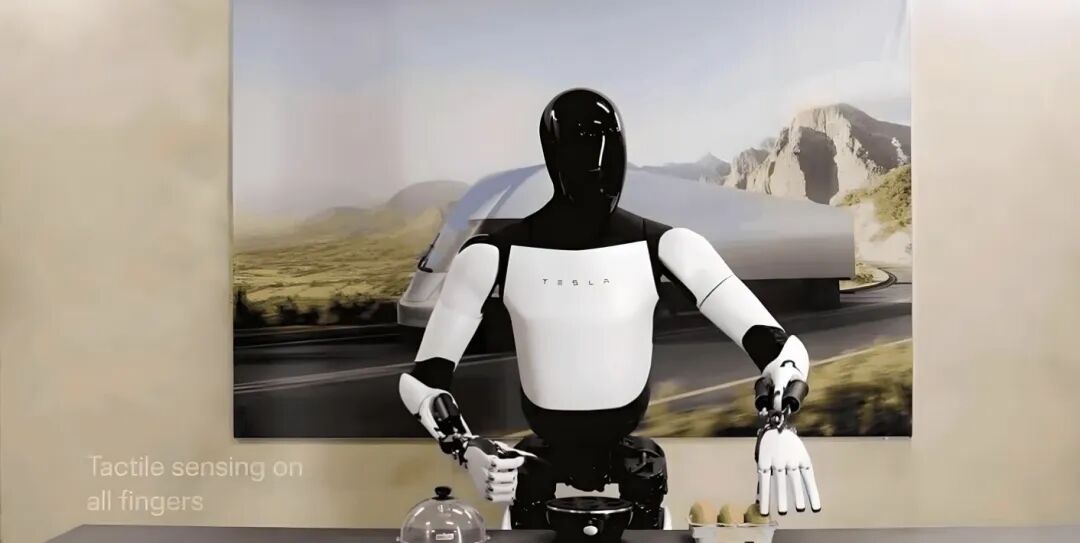
Image source: Tesla
The dexterous hand in the spotlight today is still the same.
Of course, we are not prophets, and we cannot assert with 100% certainty that this solution is the ultimate form of the dexterous hand track, nor can we predict how many times it will be technically iterated in the future. But we can still believe that Tesla is still on the right track this time because all technical routes will ultimately return to the first - principles of the scenario and be tested by the market. Tesla has previously conducted internal competitions and eliminated multiple rounds of solutions. Among various "possibilities," it has finally seen the "feasibility" in the cable - drive solution.
The ultimate goal of humanoid robots is never an exhibit that can perform a few threading operations in the exhibition hall. Instead, it is a productivity tool that can truly enter factories and households, replacing humans in repetitive, cumbersome, and dangerous work. The core prerequisite for all this is that it must have a pair of "hands like a human." It should have sufficient human - like degrees of freedom and fine - operation capabilities; it should have the inertia of movement and the flexibility of operation like a human; and it should have the cost - control ability to support mass production.
The five core patents publicly released by Tesla this time precisely address the core requirements of the scenario. Once again, using its consistent thinking, starting from the core needs of the real scenario, it has made the most correct technical choice. Just as FSD rewrote the technical rules of the entire autonomous driving industry with pure vision + end - to - end, this time, Tesla is using the same logic to write the prologue of the final chapter for the dexterous hand track.
From route consensus to implementation race, Chinese players are accelerating in sync
However, the correctness of the technical route is only the admission ticket to the embodied intelligence industry. Whether one can turn the perfect laboratory solution into a mature product with million - level mass production and full - scenario implementation is the key to winning this race.
Tesla has always understood this well. During the same period when the patents were publicly released, an internal signal from Tesla indicated that in order to make way for the large - scale mass production of the Optimus V3 dexterous hand, Tesla will replace the production capacity planning of the original Model S and Model X production lines and give priority to humanoid robots. This seemingly "putting the cart before the horse" decision precisely hits Tesla's consistent business logic: it is not about creating a humanoid robot prototype for exhibitions but about building a general productivity tool that can replace human labor and be mass - produced in millions.
Xinuo Future, which has already been on the same technical route as Tesla, has taken the logic of "mass production first" to the extreme and even accelerated ahead of the world in the progress of industrial implementation.
Xinuo Future focuses on the research and application in the fields of motors and electronic controls and understands every nuance in the mass - production process. Therefore, since the development of its first product, Xinuo Future has placed the mass - production ability and supply - chain layout at the same important level as technical R & D.
Currently, Xinuo Future has the full - chain self - production ability from components to the whole machine assembly. It has not only won orders for tens of thousands of units from domestic leading humanoid robot body manufacturers, becoming the first domestic dexterous hand manufacturer to achieve a large - scale commercial closed - loop but also received investments from many leading capitals. In 2026, Xinuo Future will promote the production lines for 200,000 micro - electric cylinders and tens of thousands of dexterous hands.
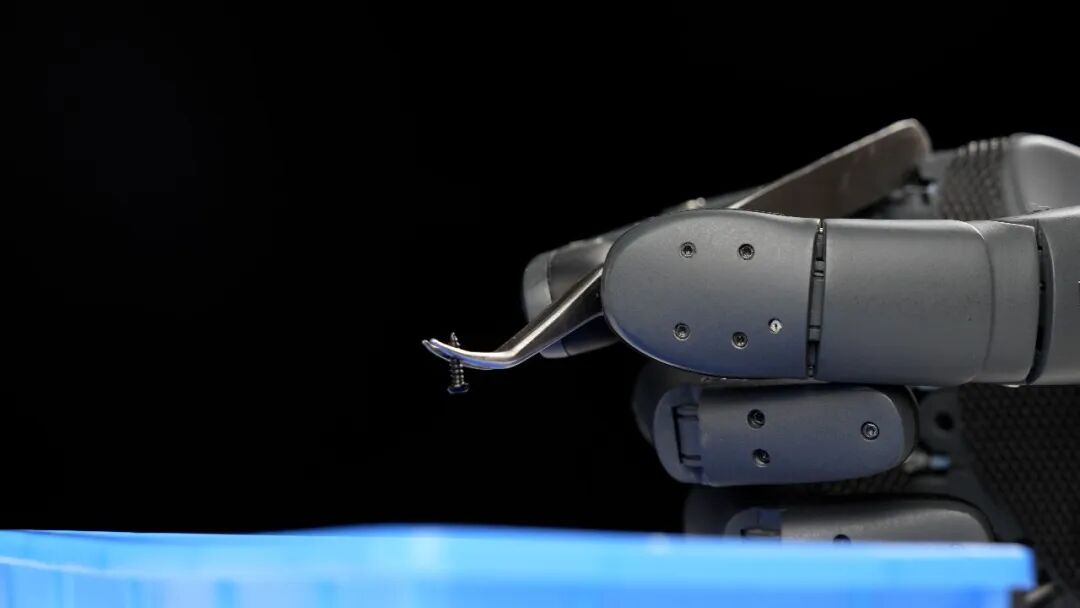
Image source: Xinuo Future
This approach of "simultaneously promoting technical R & D and mass - production implementation" has brought Xinuo Future double core advantages. On the one hand, large - scale implementation in real - world scenarios has formed a positive cycle of "the more it is used, the better it becomes, and the more it is used, the cheaper it gets." On the other hand, the reduction of marginal costs brought by large - scale mass production has broken through the cost threshold for commercial implementation, turning the "large - scale" concept that the industry is still imagining into a reality.
From the perspective of the evolution of the embodied intelligence industry, the curtain of the next chapter is about to open. A pair of hands that can truly interact with the world naturally like a human not only requires accurate action - execution ability but also depends on a complete "perception - analysis - control - feedback" full - link data closed - loop. Perception is precisely the core key to opening this closed - loop.