Looking at China's quantum computing from the top 10 valuations: When academicians, professors, and returnee scientists start companies
Quantum computing is experiencing a crucial turning point from the laboratory to industrialization.
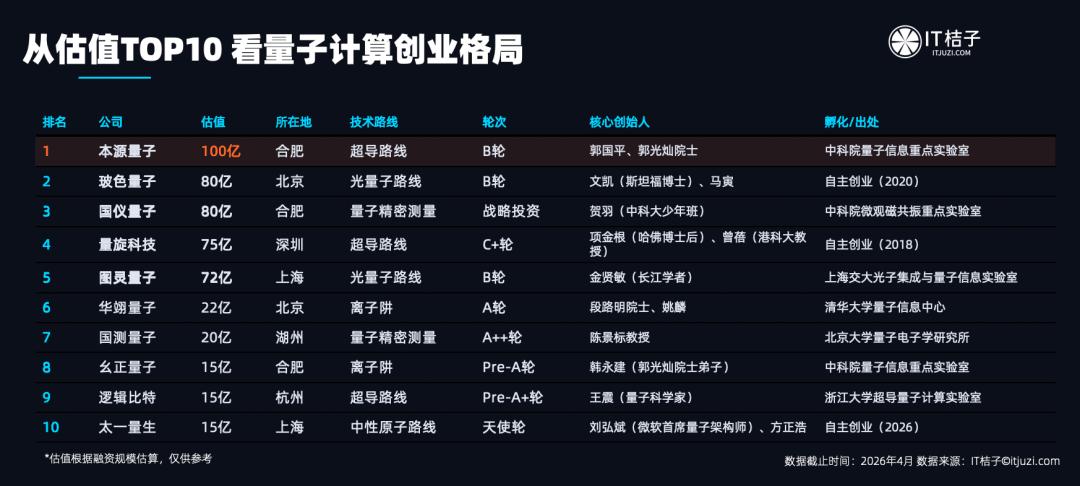
According to IT Juzi data, as of April 2026, 92 companies have been tracked in the Chinese quantum computing track. Among them, the total valuation of the top 10 companies with the highest valuations exceeds 49 billion yuan, accounting for an absolute majority of the industry's total valuation.
These 10 companies are not homogeneous entrepreneurs.
The backgrounds of their founders, sources of technology, and entrepreneurial paths present three distinct portraits:
The "academic lineage continuation type" led by professors/academicians and inherited by disciples;
The "overseas return type" where overseas returnee researchers start their own businesses upon returning to China;
And the "achievement incubation type" directly transformed from laboratories of universities and research institutes.
The three paths together support the entrepreneurial landscape of Chinese quantum computing.
I. Led by professors/academicians and inherited by disciples: Academic lineage continuation type
Among the top 10 in terms of valuation, 3 companies belong to the typical "mentor - disciple entrepreneurship" model, with a total valuation of 13.7 billion yuan.
Origin Quantum (with a valuation close to 10 billion yuan) is the benchmark of this model. The founder, Guo Guoping, has long studied under Academician Guo Guangcan, and the team is from the Key Laboratory of Quantum Information of the Chinese Academy of Sciences. As one of the founders of Chinese quantum optics and quantum information science, Academician Guo Guangcan's academic influence provides strong technical endorsement and talent cohesion for Origin Quantum. Origin Quantum follows the superconducting route, which is currently the most mainstream and technically most challenging engineering path internationally. Being able to become the domestic leader in this route is inseparable from the decades - long engineering capabilities accumulated by the Chinese Academy of Sciences system.
Huayi Quantum is led by Academician Duan Luming of Tsinghua University, and the core team is from the Quantum Information Center of Tsinghua University. Academician Duan Luming is an internationally renowned quantum information expert. Huayi Quantum focuses on the ion trap route and has achieved a two - dimensional ion array of hundreds of qubits, making it the leader in the domestic ion trap field.
Unitary Quantum also comes from Academician Guo Guangcan's system. The founder, Han Yongjian, is a disciple of Academician Guo Guangcan, and the team is also from the Key Laboratory of Quantum Information of the Chinese Academy of Sciences. It is worth noting that Unitary Quantum is the only domestic ion trap company using the QCCD (Quantum Charge - Coupled Device) architecture, which was developed to solve the scalability bottleneck of ion traps.
The core advantage of this model lies in "academic authority + team continuation". Academicians or senior professors not only bring top - notch technology but, more importantly, bring a stable research team, long - term government trust, and a continuous supply of doctoral students.
However, the challenges are also obvious: How to transform from a "research group" to a "market - oriented company" and how to find a balance between academic ideals and business rhythms are common issues faced by such enterprises.
II. Overseas returnee researchers return to China and start their own businesses: Overseas return type
Among the current top 10 in market valuation, 3 companies were founded by researchers with top - notch overseas academic or industrial backgrounds, with a total valuation of 17 billion yuan. This is the category with the highest average valuation among the three models.
Bose Quantum's founder, Wen Kai, is a Ph.D. from Stanford University and studied under Professor Yoshihisa Yamamoto, an international authority in the field of quantum computing, and has been deeply involved in the field of coherent optical quantum computing. The co - founder, Ma Yin, is from the National Space Science Center of the Chinese Academy of Sciences.
Bose Quantum was founded in Beijing in 2020 and operates completely in a market - oriented manner without being attached to a specific research institute. However, it has received the most 11 rounds of financing in the track, with a total financing amount of 1.84 billion yuan. This shows that in a field like quantum computing that is extremely dependent on top - notch talents, the international vision and technological scarcity of overseas returnee founders can themselves become hard currency in the capital market.
SpinQ Technology was jointly founded by Xiang Jingen (a post - doctoral fellow at Harvard) and his wife, Zeng Bei (a professor at the Hong Kong University of Science and Technology), and started in Shenzhen in 2018. SpinQ Technology has taken a pragmatic path: In the early stage, it entered the education market with nuclear magnetic resonance technology to quickly generate cash flow and then reinvested in the research and development of superconducting quantum chips. This "using business to support technology" strategy is more common among founders with overseas backgrounds - they are usually more sensitive to international industrial rhythms and better at balancing short - term survival and long - term technology.
Taiyi Quantum is a new company founded in January 2026. The founder, Liu Hongbin, previously served as the chief quantum architect at Microsoft, and another founder, Fang Zhenghao, is from the investment circle. Taiyi Quantum has chosen the differentiated direction of ytterbium atoms in the neutral atom route and received 300 million yuan in angel - round financing, with its valuation directly reaching 1.5 billion yuan. This is a typical capital premium brought by "top - notch industrial background + scarce technology route".
The advantage of the overseas returnee model is that the founders often master the most cutting - edge international technology routes and engineering experience and have no burden of transformation from the institutional system, making their decision - making more market - oriented.
However, the challenge lies in how to rebuild the supply chain in China and how to adapt to the local scientific research cooperation ecosystem, which requires time for adjustment.
III. Direct transformation from university/institute laboratories: Achievement incubation type
Among the top 10, 4 companies were directly incubated from key laboratories of universities or research institutes, with a total valuation of 18.7 billion yuan. This is the category with the largest number.
Guoyi Quantum's founder, He Yu, graduated from the Special Class for the Gifted Young of the University of Science and Technology of China, and the company originated from the Key Laboratory of Micro - Magnetic Resonance of the Chinese Academy of Sciences. Guoyi Quantum focuses on quantum precision measurement rather than quantum computing itself, but it is the earliest commercialized direction of quantum technology - its products can already generate revenue. This "close - to - money" characteristic has enabled it to gain the same valuation recognition in the capital market as quantum computing companies.
Turing Quantum's founder, Jin Xianmin, is a Yangtze River Scholar, and the team is from the Photonic Integration and Quantum Information Laboratory of Shanghai Jiao Tong University. Turing Quantum follows the optical quantum route, and its investors include local industrial capital in Shanghai such as Fosun Group and SenseTime, showing typical "university + industrial CVC" linkage characteristics.
Guoce Quantum was founded by Professor Chen Jingbiao of the Institute of Quantum Electronics of Peking University and is located in Huzhou, focusing on the direction of quantum frequency standards and atomic clocks in quantum precision measurement. Its characteristic is the combination of Peking University's basic research capabilities and the industrial implementation needs of local governments.
Logic Bit was incubated from the Superconducting Quantum Computing Laboratory of Zhejiang University. The founder, Wang Zhen, led the team to follow the superconducting route and has been deeply involved in superconducting quantum computing technology for nearly 20 years, having set the world record for the number of globally entangled qubits in superconducting quantum systems three times. Zhejiang University has a deep accumulation in the field of superconducting quantum computing, and Logic Bit represents the industrialization attempt of Yangtze River Delta universities in this direction. It won the first - class award of the Zhejiang Provincial Technological Invention Award in 2026.
The core logic of the laboratory incubation model is the overall migration of "scientific research achievements + talent echelon + equipment platform". The founder is usually the core backbone of the laboratory or the professor himself. The team is ready - made, the equipment is shared, and the technology verification is completed.
This model starts the fastest and has the lowest technical risk. However, the potential problem is that there is still a gap between laboratory achievements and productization, and the assessment logic of the university system (papers, patents) is not fully compatible with the enterprise logic (revenue, gross profit).
Conclusion: Three models, one consensus
Judging from the background distribution of the top 10 companies in terms of valuation, the three models are not mutually exclusive but are intertwined and complementary. Origin Quantum is both a "academician + student" model and a transformation result of a Chinese Academy of Sciences laboratory; Jin Xianmin of Turing Quantum is both a Yangtze River Scholar professor and has an overseas academic background.
However, regardless of their origins, these 10 companies have a common feature: They were all born in the academic systems of top - notch Chinese research institutes or top - notch overseas universities, and all of their founders have a doctoral degree or a professor/academician title.
The extremely high technical threshold of quantum computing determines that this is not a "grassroots entrepreneurship" track - it is first and foremost an entrepreneurial movement of top - notch scientists.
The three models also reflect the regional pattern of the Chinese quantum computing industry:
The Chinese Academy of Sciences system (Hefei) gave birth to Origin Quantum, Guoyi Quantum, and Unitary Quantum; Tsinghua University (Beijing) gave rise to Huayi Quantum; Shanghai Jiao Tong University (Shanghai) incubated Turing Quantum; Zhejiang University (Hangzhou) spawned Logic Bit; Peking University (Huzhou) established Guoce Quantum. The distribution of research institutes directly determines the urban distribution of quantum computing companies.
With the establishment of a quantum special project and the implementation of the "Quantum +" Action Plan in the 2026 Government Work Report, capital is accelerating into this track. The competition and integration among the three entrepreneurial models will determine the pattern of the Chinese quantum computing industry in the next five years.
This article is from the WeChat official account "IT Juzi" (ID: itjuzi521), author: Judy, published by 36Kr with authorization.