$20 billion: What DeepSeek wants is not just money, but also the pricing power of AI.
In mid-April, a rare scene emerged on flights and high-speed trains from Beijing, Shanghai, and Shenzhen to Hangzhou: within the same week, partners from multiple institutions flocked to Hangzhou in quick succession.
They had only one goal: to meet Liang Wenfeng.
This founder of DeepSeek, a tech "geek" who once had an intermediary convey his refusal to Ma Huateng and politely declined an offer from Alibaba, had kept a host of industry giants and VCs at bay for nearly three years. He once declared that he would not seek financing and single-handedly supported the technological vision of an AI company with his quantitative "treasury."
However, on April 22nd just passed, according to the latest report from The Information, there was a dramatic twist in the plot: Tencent and Alibaba, who were previously rejected, have now officially entered the negotiation stage for investing in DeepSeek. Even more eye-catching is that the valuation target for this round of financing has soared from the previously disclosed "not less than $10 billion" to over $20 billion (approximately 136.4 billion RMB).
Liang Wenfeng, the entrepreneur who refused the richest men in China and was known as the most "stubborn" in the AI circle, not only opened the door to capital but also took a seat in the middle of the table to play the game with the giants.
When the news broke, the reaction in the investment circle was not surprise but rather a sense of "finally." His phone was bombarded with calls.
Why did Liang Wenfeng change his stance after rejecting all the giants for the past three years, especially when the valuation is now aiming for $20 billion?
01 From "No Financing" to the Knock of Capital
The last time DeepSeek caught public attention was when its model performance continuously broke records in global benchmark tests; this time, it's because it's seeking capital.
Putting these two events together creates a subtle sense of drama.
Liang Wenfeng's commitment to "no financing" lasted for a considerable period. People familiar with the matter revealed that he had successively rejected investment intentions from giants like Tencent and Alibaba, with a simple and clear reason: capital would interfere with technological decision-making. He has said more than once within the company that DeepSeek should do the right thing, not what investors want to hear.
This is an extremely rare stance in the AI circle. While almost all large model startups are relying on financing to survive and using valuations to tell stories, DeepSeek, supported by the funds from Magic Square Quantitative, has become a sample of technological idealism. Investors tried every possible means, such as using connections, sending messages, and inviting him to dinner, but the response they always got was: no financing. Even Baidu Ventures, which shares the same building as DeepSeek's Beijing office, failed to invest successfully. Its CEO, Gao Xue, later specifically clarified that it was because the large model business of Magic Square Quantitative was not independently spun off for financing, so they missed the opportunity just like other VCs.
But in 2026, the story changed. It's not that the ideal died; it's that the reality changed.
After the financing news was released, two distinct forces quickly emerged in the investment circle. The most eager ones are the VC institutions that have been waiting patiently for a long time. According to a report from Securities Times, Cao Bin, the founding partner of Gao Xin Capital, openly and unabashedly expressed his willingness, saying that if the opportunity arises, he "would be more than willing to invest." In his investment philosophy, the key is to find a company led by "a lion leading a group of tigers" - and Liang Wenfeng is that lion.
Wang Jie, the angel investor of Moore Threads, also expressed interest but had reservations about the rumored financing terms. In his view, a financing amount of $300 million is "not very significant" compared to the earning power of Magic Square Quantitative. And whether it's a valuation of $10 billion or $20 billion, in the context of the intense competition in the large model track, the pricing logic has deviated from a simple financial model.
Meanwhile, some institutions have actively chosen to withdraw. Kong Lingguo, the angel investor of Cambricon and Muxi Co., Ltd., clearly stated that Heliy Capital focuses on the semiconductor and integrated circuit track and will not consider investing in DeepSeek. However, he also emphasized that DeepSeek "has made an irreplaceable contribution to China's AI industry."
The general consensus is that the main participants in this round of financing are expected to be domestic RMB funds. The latest news that Tencent and Alibaba are getting involved further confirms that this is a game dominated by domestic capital with a touch of industrial strategic synergy.
No matter who ultimately gets the entry ticket, everyone realizes one thing: Once DeepSeek's financing window opens, it will be one of the rarest opportunities in China's AI field in recent years. And the scene of investors flocking to Hangzhou precisely reflects a deeper anxiety: in the AI race, they don't want to miss the next DeepSeek.
02 Why Now?
DeepSeek's decision to open the capital door at this time is not an impulsive move but an inevitable choice under the superposition of three real pressures.
Computing power isn't free. DeepSeek's model efficiency is well-known globally - it can train products with performance comparable to that of closed-source cutting-edge models at a lower computing power cost, which makes its technological route a kind of business narrative. However, even the most efficient model requires continuous investment in computing power. The success of V3 and R1 was achieved based on the funds accumulated by Magic Square Quantitative over the years. The semiconductor research institution SemiAnalysis once conducted a detailed calculation: the total capital expenditure on DeepSeek's servers is nearly $1.6 billion, of which more than $900 million is just for running the computing cluster. As the model iterates to V4 and V5, the single training cost is soaring from tens of millions of dollars to hundreds of millions of dollars. When the model enters the next-generation competition - with larger parameters, longer context, and more Agent capabilities - relying solely on the support of a quantitative fund, the marginal effect is visibly decreasing.
The shortcoming in the application layer is also eroding the glory of the model layer. DeepSeek has one of the best open-source models globally, but it lacks a super application entry point like TikTok or WeChat. The number of stars on GitHub is impressive, but these stars can't be directly monetized. While OpenAI, Anthropic, and Google have successively launched their own Agent platforms and commercial products, DeepSeek's layout on the terminal product side is significantly lagging behind. An industry insider summed up the current situation in one sentence: Only those who can build a complete ecological closed-loop in the application layer can truly survive. No matter how powerful the model is, if it can't find a bridge to reach users, the technological advantage will gradually become a castle in the air.
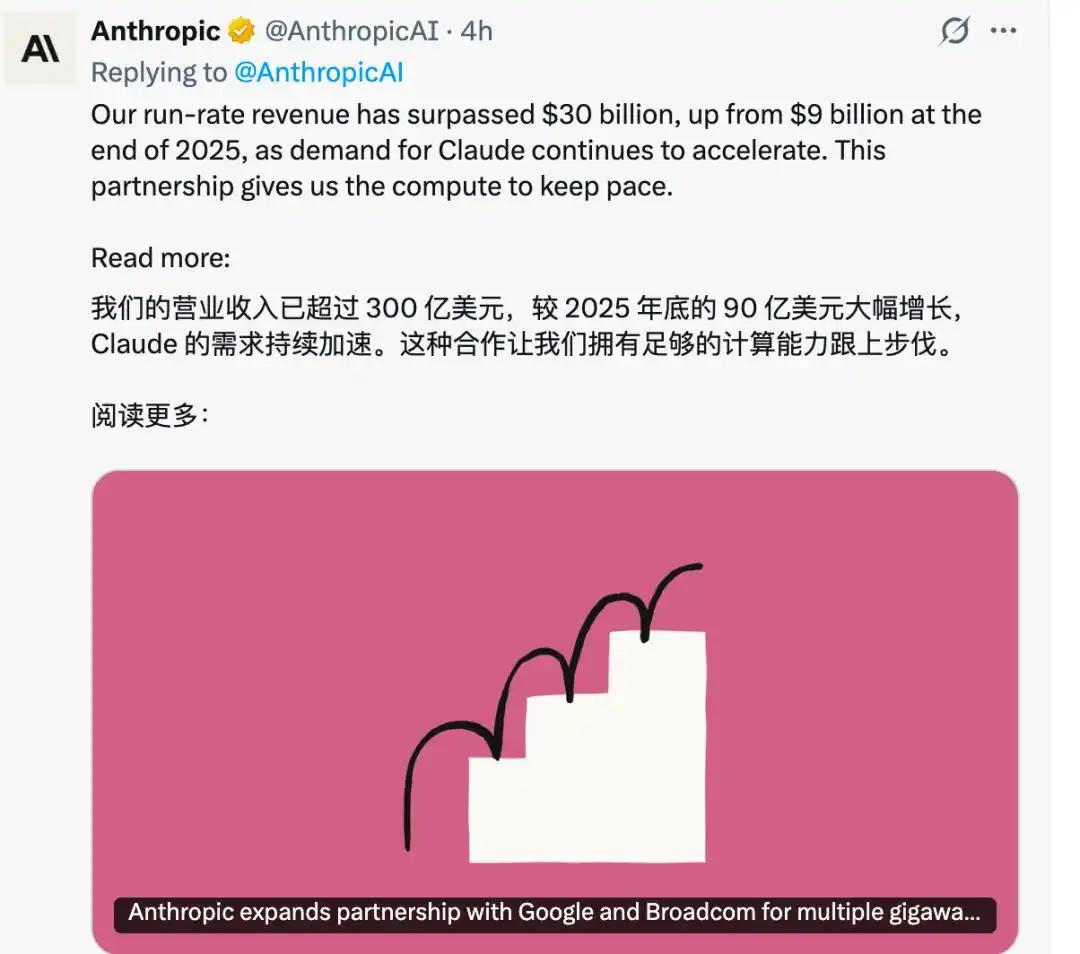
The anxiety of investors also needs an outlet. In April 2026, Anthropic's annual recurring revenue (ARR) reached $30 billion, an increase from $9 billion at the end of 2025. According to industry-disclosed data, this figure has exceeded the previously announced $25 billion annual revenue of OpenAI. Soon after, the news that DeepSeek was seeking financing spread in the investment circle. In the large model race, investors don't want to only bet on American companies, and top Chinese projects are becoming scarce targets. And DeepSeek is one of the most certain choices at present.
Liang Wenfeng's confidence in rejecting capital previously came from the real money in his pocket. Before founding DeepSeek, he had been in charge of Magic Square Quantitative for many years. This top domestic quantitative private equity firm once managed assets of over 70 billion RMB. Even during market fluctuations, the management fees and performance commissions it generated each year were still an astonishing amount. According to industry insiders' estimates, in 2025 alone, Magic Square Quantitative's high returns contributed over $700 million in income to Liang Wenfeng personally. In the past few years, it's rumored that he has personally invested over 20 billion RMB in DeepSeek.
With such a financial background, he had the confidence to say, "I don't need VC money." He once publicly stated that VCs need to make money for LPs and face exit pressure, which naturally conflicts with DeepSeek's long-term pursuit of AGI.
However, no matter how profitable the quantitative "treasury" is, it can't withstand the investment rhythm of the "trinity" of "computing power infrastructure + cross-border migration + talent competition." An AI entrepreneur analyzed, "Liang Wenfeng can't keep using Magic Square's money to subsidize DeepSeek indefinitely. Spinning it off independently and seeking financing at a market valuation is a more reasonable business choice."
If the investment in computing power is the obvious pressure, then the loss of talent is the undercurrent beneath the surface, quietly eroding DeepSeek's technological foundation.
In the past six months, this R & D team, once known for its stability, has faced rounds of targeted poaching. Luo Fuli, a key contributor to the V2 model architecture, was hired by Xiaomi with a high salary to lead its AI business; Wang Bingxuan, the core author of the first-generation large language model, chose to join Tencent; Guo Daya, the proposer of the GRPO algorithm, jumped to ByteDance's Seed team, and it's reported that his salary has tripled. Ruan Chong, a researcher in the multi-modal direction, defected to the self-driving company Yuanrong Qixing, and it's rumored that Wei Haoran, the core author of the OCR series, will also join a large company. This list is constantly growing, and each personnel change has caused quite a stir in the outside world.
The people who left don't necessarily disagree with Liang Wenfeng's technological vision; it's just that the offers from the competitors are really hard to resist. Since DeepSeek has long not sought financing or gone public, the stock options in the employees' hands have never had a market-based price anchor. Before external institutions confirm the price with real money, this paper wealth lacks sufficient liquidity and attractiveness in the eyes of top talents. While the stock options of employees in other companies have become tangible wealth benchmarks in successive rounds of financing, the team members of DeepSeek can only "quench their thirst by looking at plums."
What's more realistic is the price offered by the competitors. Li Liang, the vice president of Douyin Group, although denying the rumor that "Guo Daya's annual salary is nearly 100 million," also admitted that the salary system for the technical personnel in the Seed team includes cash, ByteDance stock options, and Doubao stock options. If the business develops smoothly, "the total income of some technical personnel after four years may indeed reach hundreds of millions of dollars."
An investor who has invested in the large model track said that even if DeepSeek opens up for financing, "it's not a game for most people," and according to Liang Wenfeng's style of doing things, "the terms will definitely be extremely strict." He judged that this shift in financing is "probably to price and cash out the employees' stock options," but also frankly said that "this step has come too late."
In such an environment, an option agreement without a market-based price is quickly losing its persuasiveness. If DeepSeek can't give the people who stay a clear wealth expectation, the loss of talent will be difficult to stop. Perhaps the real purpose of this round of financing is not the $300 million in cash but to find a market-based price anchor for the option system through a valuation of $20 billion. This is not only an explanation to the past contributors but also a sign of sincerity to potential future joiners. As an industry insider said, "With a valuation, there is certainty, and only then can it compete head-on with the poaching mechanisms of large companies."
In addition to the talent issue, DeepSeek also faces a more fundamental challenge: the rhythm of technological iteration has been disrupted. It has been a full 15 months since the last major version update. The V4 model, originally planned to be released in February 2026, has been repeatedly postponed, and doubts have begun to surface in the industry - "Is DeepSeek falling behind?" "How long can Liang Wenfeng maintain his leading edge?"
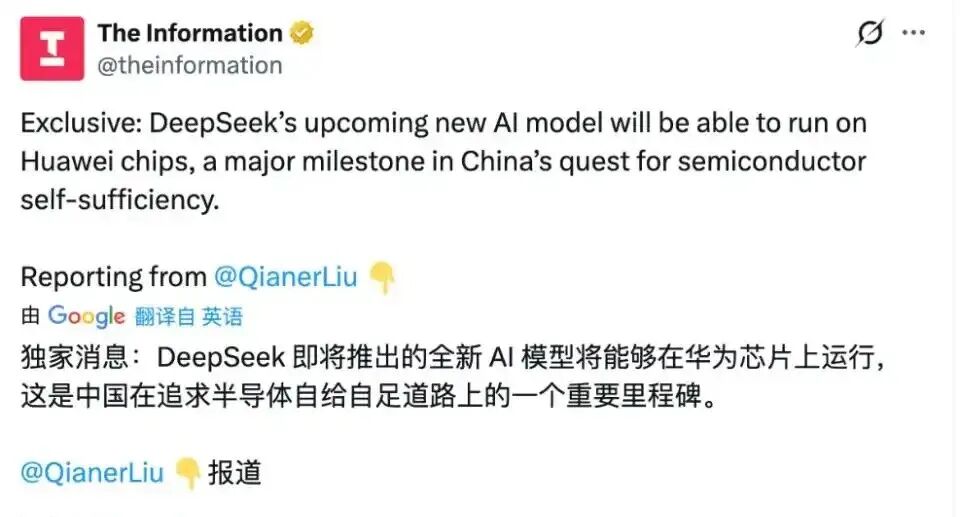
In fact, the delay of V4 is not due to a lack of technical ability but an active strategic choice. According to reports, DeepSeek V4 will abandon the previous path based on the NVIDIA CUDA framework and fully switch to Huawei's Ascend chips and complete the adaptation and migration to Huawei's CANN framework. This is not a simple "card replacement" but a reconstruction of the entire technology stack. From the operator library to the communication library, a large amount of underlying code needs to be rewritten.
It is reported that when DeepSeek was trying to train the next-generation model with the Ascend 910C, it encountered problems such as insufficient training stability and the communication speed between chips not meeting expectations. An industry insider told the media that "DeepSeek's model has always been developed based on NVIDIA chips, so migrating to the Ascend architecture requires great effort, involving a series of work such as overall architecture reconstruction and system stability enhancement."
But Liang Wenfeng obviously hasn't given up on this route. It is reported that DeepSeek even gave the pre-release version of V4 to Huawei's new-generation Ascend 950PR chips for adaptation first, rather than NVIDIA. The strategic significance of this choice far exceeds the model itself. If DeepSeek V4 can successfully run on the domestic computing power stack, it will become the world's first top AI large model that does not rely on NVIDIA. This is not only an important milestone for the self - controllability of China's AI industrial chain but will also directly reshape the ecological pattern of AI chips.
NVIDIA CEO Jensen Huang once publicly stated in an interview that if DeepSeek V4 is deeply adapted to Huawei's Ascend chips, "it will weaken the US's barriers in the AI technology ecosystem," which is "a change with far - reaching implications" for the United States. The fact that Jensen Huang said such things is enough to show the significance of this move. But the cost is huge: the project is massive, the cost is high, and the time is constantly being extended. This is one of the reasons why Liang Wenfeng needs external funds - to reserve sufficient resources for this long and expensive migration.
03 The New $20 Billion Valuation and DeepSeek's New Role
In terms of numbers, a valuation of over $20 billion has catapulted DeepSeek into the first echelon of global AI unicorns.
Horizontally compared, OpenAI's latest valuation is $852 billion, and Anthropic's is $380 billion; among domestic peers, the market value of Zhipu AI and MiniMax once exceeded hundreds of billions of Hong Kong dollars after going public, and the latest valuation of Yuezhianmian has also reached $18 billion. If this round of financing is successful, DeepSeek will surpass most domestic peers in valuation, second only to un - spun - off giant businesses like ByteDance's Seed.
The Hurun Global Unicorn List once even valued DeepSeek at $145 billion. Although that was more like a sentimental pricing based on its technological influence, the negotiated valuation of over $20 billion this time is the real money after the game between secondary - market sentiment and industrial capital.
Within just one week, the valuation jumped from the rumored "not less than $10 billion" to "over $20 billion." This is not simply asking for a sky - high price. The negotiations with Tencent and Alibaba have directly reconstructed DeepSeek's valuation coordinate system. For industrial capital, investing in DeepSeek is not just about financial returns but also an entry ticket for computing power procurement, cloud - computing ecosystem synergy, and the implementation of application scenarios. Therefore, $20 billion is not only buying Liang Wenfeng's technology but also a ticket to the future infrastructure of China's AI large models.
But whether it's expensive or not depends on how you view DeepSeek's revenue structure. There is currently no publicly available commercialization data for DeepSeek. Its revenue mainly comes from API calls - selling model inference services to developers and enterprises. This is a path, but the ceiling of this path depends on whether it can establish an Agent ecosystem and a super - application entry point.
DeepSeek's moat is real: the activity in the open - source community, the good reputation of its model performance, and the brand recognition formed among the global developer community. This is the technological route that Jensen Huang publicly paid attention to and is also the confidence for Huawei's Ascend chips to deeply adapt to it.