Among the "Four Little Dragons of Shenzhen", who will be the top in 3D printing?
Recently, a niche segment - consumer-grade 3D printers - has become popular.
This boom is most intuitively reflected in the capital market. On March 9, the established manufacturer Creality submitted its prospectus to the Hong Kong Stock Exchange, aiming to become the "first stock in consumer-grade 3D printing." On April 20, Intamsys announced the completion of a new round of financing worth hundreds of millions of yuan, only about five months after its previous round of financing. And Atomstack, a new player founded just one year ago, has also completed its third round of financing. The leading players are rushing to go public, and start - up companies are intensively attracting capital. All these signs indicate that this industry is at the verge of an explosion.
The price of a mainstream consumer - grade 3D printer ranges from $2000 to $3000, which is equivalent to the price of a tablet computer. However, in terms of usage scenarios, it seems more likely to be left unused. So, how did it become popular?
Firstly, the integration of AI technology has lowered the threshold for modeling, allowing more people to use it; secondly, the price of hardware has dropped to the thousand - yuan level, making more people willing to buy it.
According to data from CIC, the global consumer - grade 3D printing market reached $4.1 billion in 2024 and is expected to grow to $16.9 billion by 2029, with a compound growth rate of 33%.
Currently, the main battlefield of this rapidly growing industry is in Shenzhen, China. The "Four Little Dragons" in Shenzhen, consisting of Tiertime, Creality, Anycubic, and Intamsys, together account for about 90% of the global market share. This means that for every 10 consumer - grade 3D printers sold globally, 9 are produced in Shenzhen.
The leading enterprises are starting to seek to break into new markets. According to media reports, Tiertime is about to enter more than 64 Sam's Club stores across the country, and its products are expected to be on the shelves by the end of April or early May. This may mean that consumer - grade 3D printers no longer want to be just smart hardware but aim to penetrate into the household scenario.
While the leading players are in fierce competition, new entrants are seizing opportunities in niche segments such as multi - color printing and multi - head printing. Many people are curious: Is consumer - grade 3D printing, which combines high growth and high competition, really a good business?
01. How did a $2000 machine become popular?
In the past, 3D printing was regarded as a technology in the industrial manufacturing field and was mainly used in industrial scenarios. However, in recent years, 3D printers have gradually made their way to ordinary people's desktops.
What exactly does consumer - grade 3D printing refer to?
It essentially belongs to additive manufacturing, which uses methods such as laser and hot - melting to melt and stack materials layer by layer to form objects. Compared with traditional subtractive manufacturing, its greatest advantage is that it eliminates complex processes such as mold - making, has a lower trial - and - error cost, and is suitable for producing small - batch and diversified products. It is mainly targeted at individuals and small and medium - sized enterprises, focusing on creative design and home decoration. Although its precision is limited, it is sufficient to meet the fun of DIY.
There are two main mainstream technology routes in the consumer - grade market: FDM (Fused Deposition Modeling) and photopolymerization.
FDM is the most widely used. It heats and melts consumables and extrudes them layer by layer through a nozzle. The material cost is low, but the surface is prone to layer lines, making it suitable for daily scenarios such as toys and home decoration. Photopolymerization uses ultraviolet light to cure liquid resin layer by layer, with higher precision and almost no visible layer lines to the naked eye. It is more suitable for delicate scenarios such as figurines and jewelry, but the equipment and consumable costs are also higher. The complementary advantages of the two further enrich the application scenarios of consumer - grade 3D printing and make this technology closer to ordinary people.
For this reason, consumer - grade 3D printing has achieved a faster growth rate in recent years. According to data from CIC, the global shipment volume of consumer - grade 3D printers reached 4.1 million units in 2025 and is expected to grow to 13.4 million units by 2029.
There has also been an increase in financing in the primary market. According to Wind statistics, since 2025, there have been 72 investment and financing events in the 3D printing industry in the global primary market, and a total of 52 related enterprises have received investments, mainly concentrated in the domestic market. Industrial capital from large companies such as DJI, Meituan, and Tencent has also entered the market one after another.
In addition to sales volume and capital, the policy level is also making efforts. In September 2025, eight departments including the Ministry of Commerce jointly issued the "Guiding Opinions on Vigorously Developing Digital Consumption and Jointly Creating a Better Life in the Digital Age", which included consumer - grade 3D printers in the category of digital product consumption. This means that 3D printers are beginning to be regarded as popular consumer electronic products similar to smart home devices and smart wearables.
Image source / pexels
So, how did this boom happen? For a consumer electronics category to truly reach the general public, it usually needs to meet three conditions:
Firstly, the price should drop to make it affordable for more people. In recent years, with the maturity of the domestic supply chain and the implementation of large - scale mass production, the price of consumer - grade 3D printers has dropped to the thousand - yuan level. After national subsidies, entry - level models can be purchased for $2000. In terms of consumables, the prices of mainstream consumables such as PLA and PETG have dropped to an average of $50 per kilogram, reducing the cost of a single print.
Secondly, the user experience should be upgraded to make it easy for ordinary people to use. An important reason why early consumer - grade 3D printers discouraged users was that the machines needed to be assembled by themselves, and the platform needed to be leveled repeatedly before printing (ensuring that the distance between the nozzle and the printing platform was the same at all positions). A slight mistake could lead to printing failure. Now, mainstream brands have generally achieved "out - of - the - box usability", eliminating the cumbersome assembly steps. At the same time, automatic leveling is achieved through sensors and algorithms, supplemented by functions such as one - click slicing and preset parameters, greatly reducing the usage threshold.
Thirdly, the usage scenarios should be rich enough to prevent the product from being left unused. In recent years, various 3D printing companies have established online model communities. Users can download a large number of model files for free and upload their own designs. The community ecosystem has transformed 3D printers from novelty toys into creative tools, continuously generating motivation for creation.
With the reduction of the usage threshold and the decrease of the purchase price, coupled with the increasing interest in DIY and personalized creation, consumer - grade 3D printers have evolved from niche toys for geeks to a new type of "household equipment" that many families are willing to buy and use.
02. Which of the "Four Little Dragons in Shenzhen" is leading the way?
In this rapidly growing segment, to what extent has the product evolved? And how has the competitive landscape changed?
Consumer - grade 3D printers were initially imported products. In 2009, with the expiration of foreign core open - source patents, domestic enterprises began to enter this segment on a large scale. Around 2014, a number of 3D printing companies focusing on the consumer - grade market were established one after another. Relying on the mature electronic supply chain in the Pearl River Delta, they quickly localized and scaled up the production of equipment and rapidly opened up the global market with high cost - effectiveness.
According to a report from CONTEXT, in the fourth quarter of 2025, the shipment volume of global entry - level (priced below $2500) 3D printers increased by 47% year - on - year, and Chinese manufacturers contributed more than 90% of the share.
It is mainly the "Four Little Dragons in Shenzhen" that support this 90% share. The strategies of these four companies are also different.
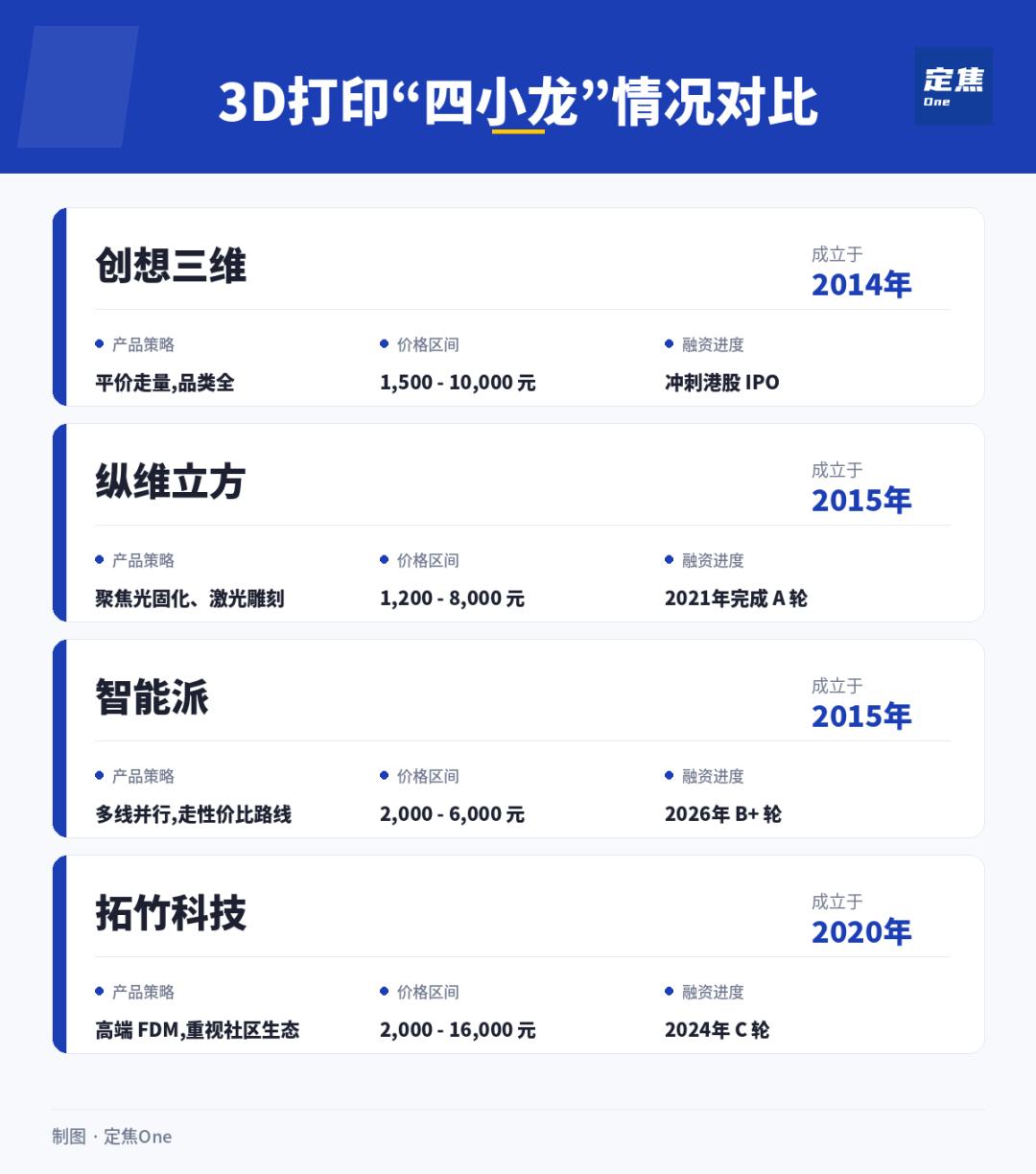
Creality is the "big brother" in the industry. It was established in 2014 and is an established enterprise that was among the first in China to produce consumer - grade 3D printers. It adopts a low - price and high - volume strategy, opening up the overseas market with cost - effectiveness. Its products cover multiple types such as FDM and photopolymerization, with a focus on a wide range of product categories and low prices. It relies on a rich variety of SKUs to cover a wider range of consumers.
Anycubic is the most "low - key" one. It was established in 2015. Due to the founder's background in the foreign trade industry, it was an early brand to go global among the "Four Little Dragons" and has accumulated a certain brand awareness in the European and American markets. It focuses on photopolymerization 3D printing and laser engraving equipment, targeting professional users and makers, and adopts a vertical deep - diving strategy.
Intamsys (Aileku) is a cross - border transformer. It entered the photopolymerization 3D printing segment in 2019 after transforming from the STEM field. Its product layout is diversified, with both FDM and photopolymerization technology routes in the 3D printing field, and it also expands into the laser engraving machine field. It adopts a high - cost - effectiveness strategy and mainly targets makers and small studios.
Tiertime is a late - comer who is catching up. It was founded in 2020 by Tao Ye, a former DJI engineer. The team has mature R & D and supply chain management experience. It directly enters the mid - to - high - end FDM segment. Through automatic leveling, a fully enclosed structure, and an AMS multi - color system, it enables non - technical users to easily get started. Its product prices range from entry - level models at a thousand yuan to high - end models at ten thousand yuan, covering novice users at home to professional groups such as 3D printing farms and small studios.
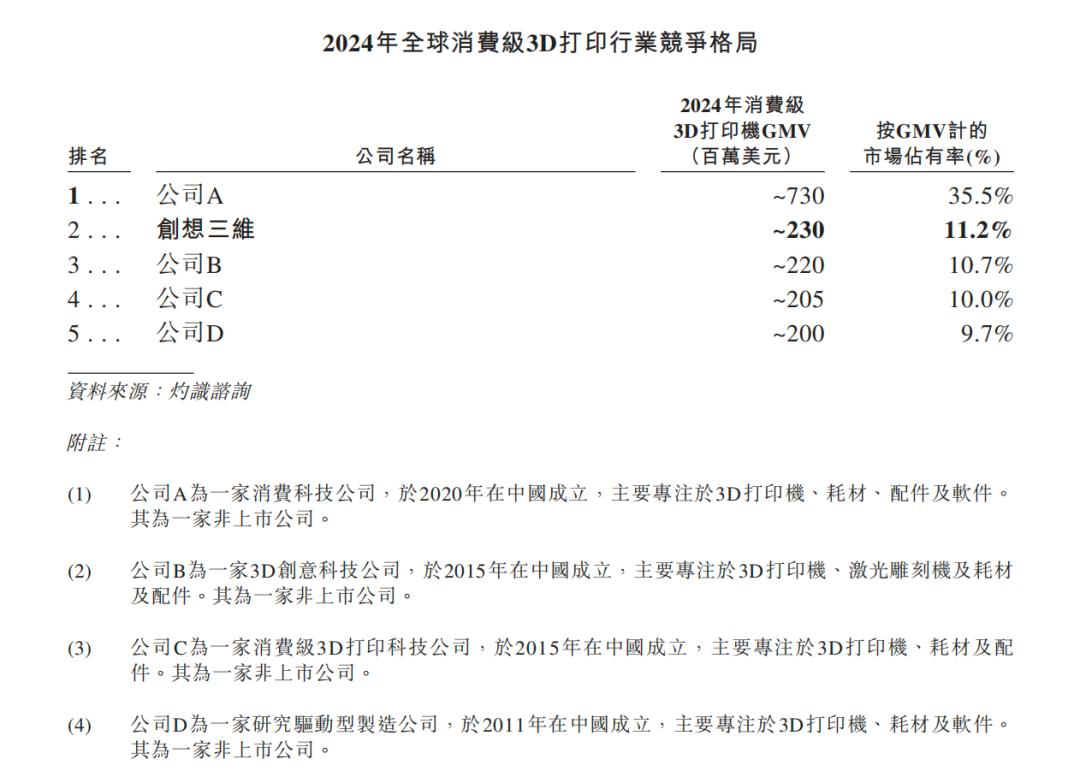
Image source / Creality's prospectus
According to the annotations in Creality's prospectus, it can be inferred that the market share is Tiertime (35.5%) > Creality (11.2%) > Intamsys (10.7%) > Anycubic (10.0%).
The differences among these four enterprises are mainly concentrated in product positioning and user group selection. In addition to product strategies and user experience, the key to supporting this round of rapid growth also lies in channel expansion and technological iteration.
In terms of channels, the industry has completely shifted from the traditional offline distribution system to online. Leading manufacturers have entered mainstream e - commerce platforms one after another, and at the same time, they reach a wider audience through short - video marketing and live - streaming sales, accelerating the process of products moving from professional circles to ordinary consumers.
Technologically, consumer - grade 3D printers have been iteratively upgraded in terms of speed, precision, and personalization. In terms of speed, the printing efficiency has increased by 5 - 10 times. A model that used to take several hours can now be completed in dozens of minutes. In terms of precision, FDM and photopolymerization models have been continuously optimized, and the surface finish of the finished products can meet the requirements of high - precision scenarios such as figurines and cultural and creative accessories. In addition, multi - color and multi - nozzle solutions have been gradually popularized, improving problems such as slow color - changing and waste of consumables, and making personalized creation more efficient.
These upgrades address the core pain points that have long existed in the industry. Hu Xian, the co - founder of 3D printing company WonderMaker, pointed out that the industry has long faced three major pain points: slow speed, single - color printing, and material waste. Even after the popularization of high - speed multi - color solutions, the problems of long color - changing time and double waste of consumables still exist, which has directly given rise to a new development direction of multi - head and multi - color technology.
Li Jing, an overseas marketing staff member of Tiertime, also added that although some manufacturers use AI as a marketing selling point, the core of truly reducing the usage threshold is the joint optimization of software and hardware design, which reduces the difficulty of maintenance and the cost of consumables.
On the basis of the above - mentioned function iterations, leading manufacturers are currently extending in the following new directions:
Firstly, the materials are more environmentally friendly. Taking FDM printers as an example, some materials will emit odors after melting. Enterprises are researching high - performance consumables that are odorless and environmentally friendly, and are also exploring high - stability and bio - friendly materials.
Secondly, more investment is being made in AI algorithms. Many enterprises are focusing on AI R & D, which is mainly applied in scenarios such as AI automatic leveling, anomaly detection, and fault early warning to improve the intelligent self - inspection ability of the equipment.
Thirdly, community ecosystems are being built. Many leading manufacturers have built their own user communities, providing users with spaces for model sharing, downloading, and communication. This not only drives the continuous sales of printing consumables but also strengthens user stickiness and brand promotion.
It can be seen that all the changes in the industry revolve around the same core: making the equipment more user - friendly and simpler.
03. Selling more but earning less - this business is not that easy
Let's return to a key question: Is the business of consumer - grade 3D printers really easy to do? This question needs to be analyzed from three dimensions: demand, sales volume, and revenue.
First, let's look at market demand: It is strong overseas but needs to be cultivated in China.
Li Jing mentioned that the demand in the overseas market is significantly stronger than that in the domestic market. The reason is that labor and commodity prices are relatively high overseas, so the cost advantage of self - printing is very obvious. Coupled with the mature maker culture, consumers have a stronger willingness to pay.
According to Creality's prospectus, as of the end of last year, it had opened 64 online stores overseas, while the number of domestic online stores was only 17 during the same period.
Image source / pexels
The core challenge in the domestic market is the diversion of low - price substitutes. E - commerce platforms such as Pinduoduo are flooded with various low - price small ornaments and cultural and creative accessories, making it difficult to reflect the cost advantage of self - made 3D - printed products. Although there is some demand in scenarios such as jewelry, support materials, and Cosplay props, ordinary household users have not yet formed the habit of using 3D printers, and the domestic demand has far from been fully released.
Next, let's look at sales volume. The overall market of consumer - grade 3D printers is growing, but the market shares of different