Huawei is going to outperform Honor, Xiaomi, OPPO, and vivo.
On April 20th, Huawei's imaging flagship Pura 90 series was released.
What's most surprising is that regarding the much - concerned price, there are polarized views online. On one hand, people praise the Pura 90 series for offering more features without increasing the price. On the other hand, some question that Huawei is raising the price indirectly through renaming and reducing configurations.
Anyway, Huawei has implemented a relatively stable pricing strategy.
This forms a sharp contrast with vivo's recent release of the X300 Ultra, whose price was significantly increased by 1000 yuan.
Huawei has played its cards well.
In the first quarter of this year, Huawei has already taken the top spot in the Chinese smartphone market. While other Android manufacturers are generally raising prices due to the rising memory prices, Huawei aims to further expand its market share.
Not long ago, Huawei released the Enjoy 90 Pro Max, which is equipped with HarmonyOS 6.0 and has a starting price of only 1999 yuan. It has continuously topped the daily sales list.
By making a small move in the cost - effective market, Huawei has shown great competitiveness. It is going to undermine the foundation of "Honor, Xiaomi, OPPO, and vivo".
Huawei's ability to resist cost pressure is one step ahead of other domestic competitors. Similarly, Apple also tries not to raise prices in the face of rising costs.
With Huawei and Apple on the offensive, "Honor, Xiaomi, OPPO, and vivo" are in danger.
Indirect Price Hike, Stealthy Maneuver
Whether there is a price increase needs to be comprehensively evaluated in combination with the configurations.
Compared with the previous Pura 80 series, Huawei's Pura 90 series has cancelled the Ultra model and only retained the standard version, Pro, and Pro Max. The starting price of 4699 yuan is the same as that of the previous generation.
Obviously, the standard version is designed to meet basic needs, the Pro version targets the mainstream market with balanced configurations, and the Pro Max version aims at users who pursue extreme imaging with top - level imaging capabilities.
However, this adjustment is considered by netizens as a "naming upgrade" strategy. Simply put, the standard version of the previous generation is now called Pro, the original Pro is called Pro Max, and the Ultra version with the highest cost is cancelled.
For example, the Pura 90 Pro actually corresponds to the positioning of the standard version of the previous Pura 80 series. The screen size, resolution, charging power, weight, and thickness are the same or similar, with regular upgrades in configurations such as the chip and battery capacity.
The pricing logic also confirms this:
The starting price of the Pura 90 standard version is 4699 yuan, which is the same as that of the previous Pura 80 standard version.
The starting price of the Pura 90 Pro is 5499 yuan, 1000 yuan cheaper than the previous Pura 80 Pro.
The starting price of the Pura 90 Pro Max is 6499 yuan, which is also lower than the same - level product of the previous generation.
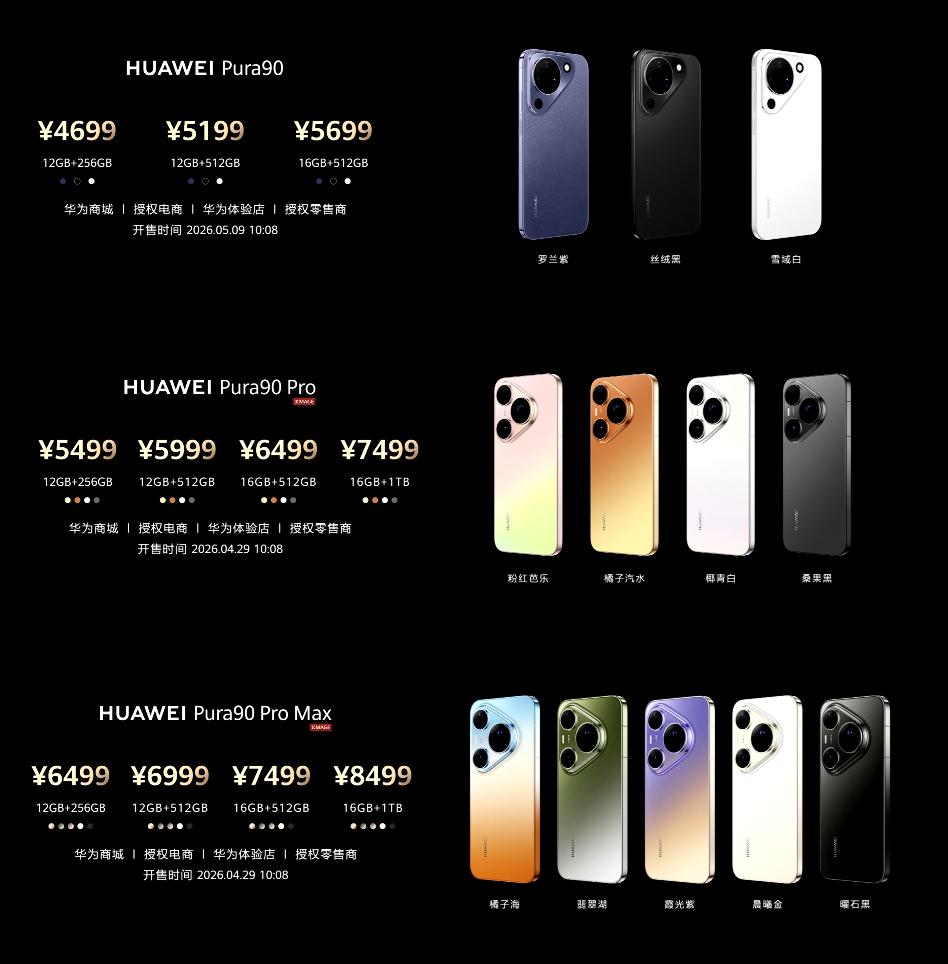
On the surface, the Pro version has a "price cut of 1000 yuan". However, if we accept the logic of the "naming upgrade" - that is, the Pura 90 Pro is essentially the same as the standard version of the previous generation in terms of positioning, it means that consumers are actually getting a product with the configuration of the previous standard version by spending the same 4699 yuan. The price increase is hidden in the naming.
In terms of core hardware, the Pro and Pro Max are equipped with the Kirin 9030S, which is specially designed from the Kirin 9030 chip. The Pura 90 standard version is equipped with the Kirin 9010S chip, which has been used in the Pura 80 series and the nova 15 Ultra before.
This means that the core configurations of the Pura 90 standard version are highly similar to those of the previous - generation products and even the previously released nova 15 Ultra, including the processor, lens module, battery, and screen specifications.
Some reviews point out that there is a "big gap" between the standard version and the Pro version, and the standard version uses relatively basic imaging configurations, rather than the advanced imaging capabilities such as the 50 - megapixel super - converging main camera and the periscope macro telephoto lens of the Pro series.
In short, with the same starting price of 4699 yuan, consumers do not get a generational upgrade in the core configuration of the Pura 90 standard version compared with the product a year ago.
Behind this strategy is the real cost pressure.
Yu Chengdong admitted at the press conference that affected by the rising prices of the supply chain such as memory, the average cost per unit of the Pura 90 series flagship phones has increased by 1200 - 1500 yuan. He said, "We've tried our best with this price. Buy it early. If we can't hold on, the price may go up later."
Under such cost pressure, it really requires a high - level balancing act to maintain the market image of "no price increase" and control costs at the same time.
Moreover, due to reasons such as complete self - sufficiency in the supply chain, Huawei phones at this stage are not known for their powerful performance but for the seamless experience of self - developed software and hardware integration.
Liang Zhenpeng, a senior industrial economic observer, told AI Lan Media that "Huawei's stable price can effectively consolidate its user base and seize market share. It can later make up for the hardware cost through ecological revenues such as software services."
This gives Huawei more room to maneuver, which is an advantage that other domestic manufacturers do not have.
All for Market Capture
In the current mobile phone market, storage chips are stirring up the whole situation.
According to SemiAnalysis data, the price of mobile LPDDR5 memory has tripled since the first quarter of 2025. The current contract price is about 10 US dollars per GB, and it is expected to have a double - digit increase in 2027.
Affected by this, the global smartphone shipments in the first quarter of this year decreased by 4.1%, breaking the continuous growth trend for ten quarters since mid - 2023.
The BOM cost of BBK's mobile phones has forced many leading brands such as OPPO, vivo, Honor, and Xiaomi to raise prices, with an increase ranging from 200 yuan to 1000 yuan.
While other Android manufacturers are raising prices, Huawei did not directly increase the price by 1000 yuan like vivo but chose a stable pricing strategy.
This is to exchange price for market share.
Judging from the price increases of Xiaomi and vivo, they focus more on profit, while Huawei, on the contrary, focuses more on sales volume in the face of profit.
On the one hand, Huawei has a significantly higher market share in the domestic high - end mobile phone market than other Android manufacturers, which gives it more profit margins.
IDC data shows that in the third quarter of 2025, in the Chinese high - end mobile phone market with a price of 600 US dollars and above, Huawei ranked second after Apple (48%) with a 33.4% share. This gives Huawei stronger bargaining power and cost - control ability in the supply chain.
Moreover, in the higher - end folding - screen market, Huawei has an overwhelming market share. According to the industry blogger "Wisdom Chip Insider", in the Chinese folding - screen market in 2025, Huawei led with a 66.6% market share, more than the sum of other domestic manufacturers.
In the first quarter of this year, the shipments of the Pura X priced above 10,000 yuan exceeded 1.5 million units. The newly released Pura X Max is a rare wide - folding phone on the market, with an outer - screen ratio of 1:1 and an inner - screen ratio of 10:16. There are basically no competitors, and it may even trigger a trend for other manufacturers to follow.
Liang Zhenpeng believes that "Huawei has large sales volume. Through long - term agreements and vertical integration (such as the Kirin chip and HarmonyOS), it can reduce the dependence on core components and buffer the pressure of the rising external memory price."
Lin Xianping, an associate professor at Zhejiang University City College, also believes that "Huawei's self - developed Kirin core chip can significantly reduce the hardware cost. With full - chain localization and long - term price locking, it can hedge against the pressure of rising material prices."
These are the reasons why Huawei has the confidence to bear the rising costs.
On the other hand, boosting sales volume is also to quickly expand the user base of the Harmony ecosystem and build a long - term moat.
Currently, HarmonyOS is not yet perfect. In terms of the coverage of compatible apps and the perfection of in - app functions, more time is needed for ecological construction. Now is a critical window period for the development of Huawei's native Harmony. The user base is one of the core factors determining the ecological construction.
Not long ago, Huawei released the Enjoy 90 Pro Max, featuring an 8500mAh battery life, a 1.5K eye - caring screen, and Harmony 6 system. The top - end 512GB version is priced at only 2039 yuan, precisely targeting the extremely cost - effective market. The activation volume of this model exceeded 400,000 units in the first week, and it topped the single - product sales list for many weeks, surpassing the iPhone 17 series.
Rapidly increasing the installation volume of native Harmony devices and attracting more developers and partners to join can help improve the application ecosystem earlier. Yu Chengdong said that as of now, the number of native Harmony devices has exceeded 55 million.
With a two - pronged approach, Huawei has played its cards well.
In the first quarter of this year, Huawei led the Chinese smartphone market with a 20% market share, reaching the highest level since the fourth quarter of 2020. In a market environment with continuous supply - chain pressure, Huawei's market - capture strategy may further increase its market share.
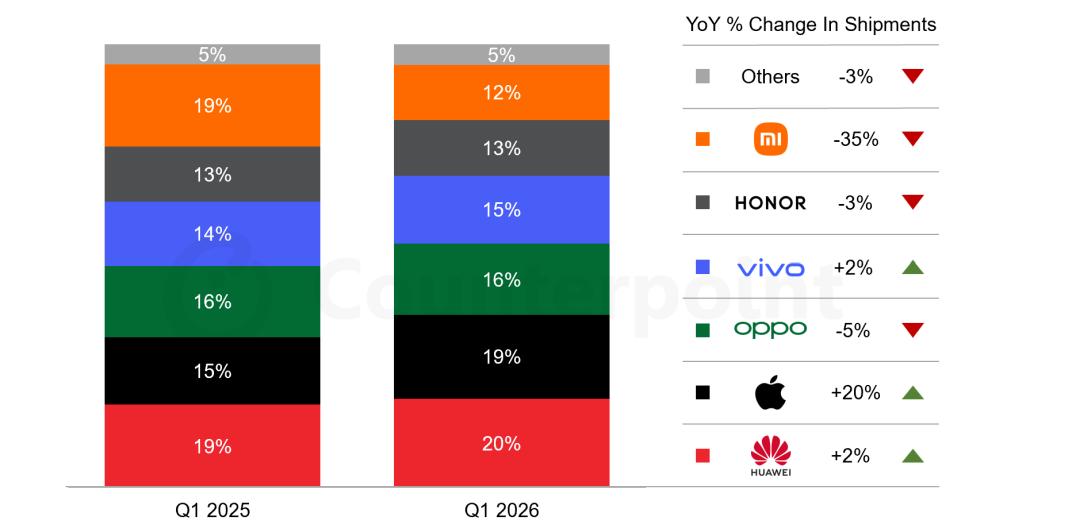
And Huawei is not the only one trying to capture the market.
Thanks to the continuous strong performance of the iPhone 17 series, promotional price cuts, and government subsidies, Apple ranked second in the Chinese market in the first quarter. Meanwhile, its shipments increased by 20% year - on - year, which was the highest growth rate among the top six brands.
Market analysts believe that with its high - end product matrix and strong supply - chain management ability, Apple is the most advantageous manufacturer in dealing with the current global storage price increase. In the short and medium term, Apple is more likely to absorb the cost - rising pressure internally and further expand its market share.
In the Chinese market, whether it is a comprehensive competition in market share or a head - on confrontation in the high - end market, it is still a "king - to - king" battle between Huawei and Apple.
As the Harmony ecosystem becomes more and more perfect, Huawei's competitiveness will become stronger.
This article is from the WeChat official account "AI Lan Media". Author: Feng Hua, Editor: Wei Xiao. Republished by 36Kr with permission.