The Dilemma of $4 Trillion: Apple Needs Chaos, but Cook Left Order
One Step Back for the Steward
Over the years, the controversy over whether Cook should step down has never ceased. Now, Cook has really stepped down.
On April 20th, Apple officially announced that Tim Cook will transition to the position of Executive Chairman on September 1st, 2026. John Ternus, the current head of hardware engineering, will succeed him as CEO. On the same day, Johny Srouji was also appointed as the Chief Hardware Officer.
What really makes this leadership transition intriguing is not that the question that has been debated for many years finally has an answer, but that Cook is not really leaving the stage.
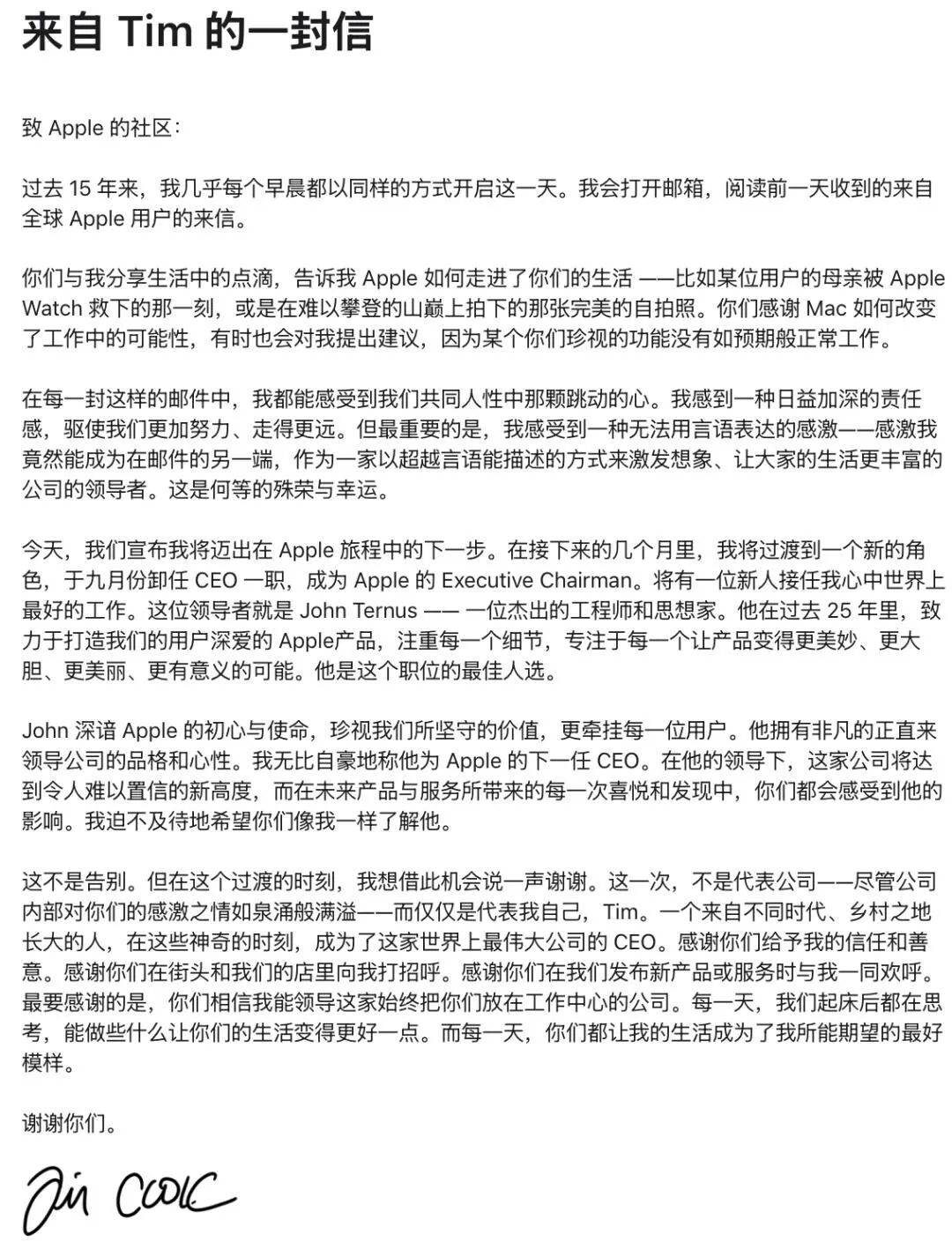
Caption: Internal letter from Apple Inc.
The position of Executive Chairman is not a mere ceremonial placement. It is to ensure that someone continues to hold the reins of Apple during the leadership transition. What Cook still has to handle are precisely those most complex and least suitable affairs to deal with lightly: external relations, policy communication, and the overall stability of the entire company.
In other words, Apple is not trying to overturn the Cook era. Instead, it is reallocating the most important capabilities for the next stage.
This in itself shows that Cook's problem has never been that he didn't do well enough. On the contrary, he did extremely well in the part of the work he was best at.
Jobs solved the problem of "what Apple should do." What Cook took over was an Apple that had already reached great heights and a whole system that had to continue to expand and operate stably.
When Jobs left, the iPhone, iPad, and Mac had already answered the question of "what to do" for Apple. The difficult problem left for Cook was no longer to invent an Apple from scratch, but to organize these proven successful products into a system that could operate in the long term, continue to expand, and continuously create returns.
Over the past decade or so, what he really accomplished was precisely this: pushing the supply chain, service business, capital returns, and global collaboration to an unprecedented level of maturity, turning Apple from a company driven by genius into a well - run and precisely - operating machine.
Judging from the results, this report card is quite impressive.
When Cook took over in 2011, Apple's market value was approximately $350 billion. By the time of the leadership transition announcement in 2026, the company's market value had reached $4 trillion. Over the past 15 years, Apple's annual revenue has grown from $108 billion to over $416 billion, the active device installation base has expanded to over 2.5 billion units, and the service business has grown into a revenue pillar worth tens of billions of dollars.
For a technology company of such a large scale, such expansion is by no means a simple achievement that can be easily described as "maintaining the status quo."
More importantly, the reason for Cook to stay on the stage is not abstract.
In the past few years, his role has long gone beyond just stabilizing performance and stock prices. Facing the tariff pressure from the Trump administration, Cook had to continuously strive for policy space for Apple. Whether it was attending Trump's second inauguration ceremony, donating to the inauguration fund, or later announcing additional investment in the US manufacturing industry in the Oval Office and promising to increase domestic manufacturing in the next few years, Cook has actually been using capital expenditure and manufacturing commitments to secure a more favorable external environment for Apple.
For a company with a global supply chain and market and highly dependent on hardware revenue, these capabilities obviously cannot be easily removed during the leadership transition.
That's why what this leadership transition at Apple really announces is not just the end of an era, but that Cook's historical mission has been completed to a certain extent.
In the previous stage, what Apple needed most was to turn a super - company into a stable, efficient machine with almost no obvious weaknesses. Cook has done an excellent job in this regard.
But now, the problems facing Apple have obviously changed: What it will face in the future may no longer be just "how to continue to be stable," but "how to come up with eye - catching products again."
In this sense, what Cook steps down from is not just the position of CEO, but the power to define the priorities for Apple's next stage.
The One Who Builds the Foundation and the One Who Makes the Products
If Cook's one - step back means that Apple is ready to hand over the problems of the next stage to different people, then what is more worth watching is who will provide the answers.
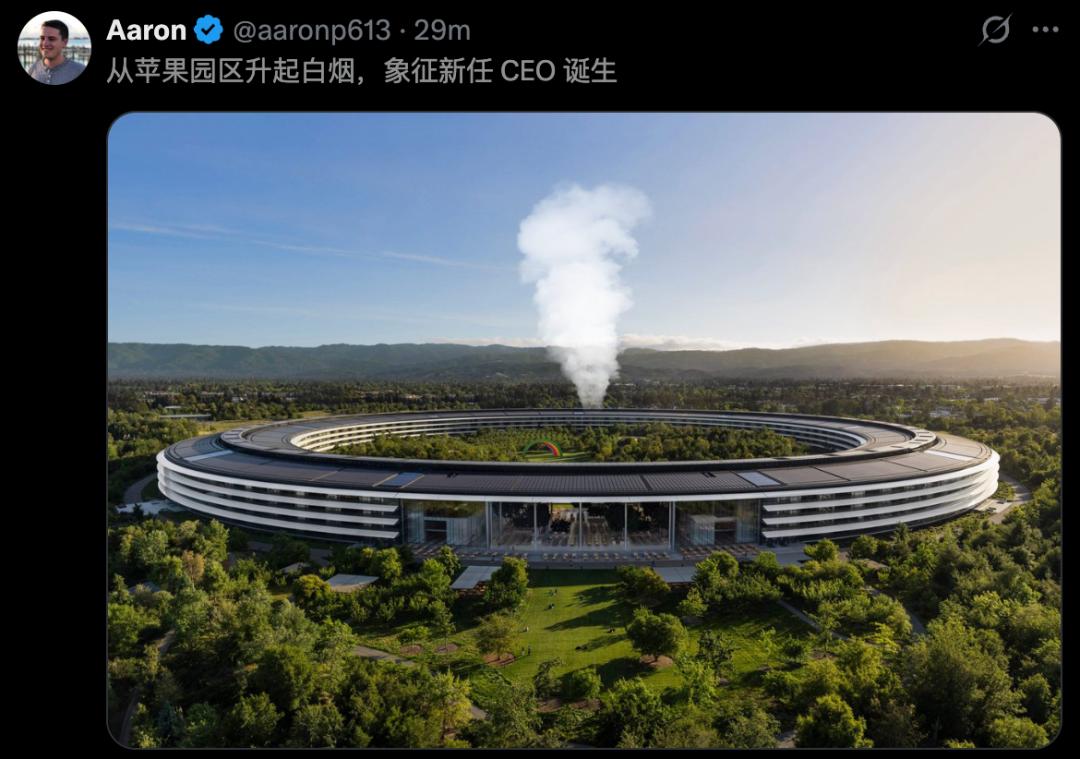
Caption: Announcement of Apple's new CEO
Apple's choice did not surprise the market. It chose John Ternus to succeed as CEO. On the same day, Apple also announced that Johny Srouji would serve as the Chief Hardware Officer.
The foreshadowing for this power transfer did not suddenly appear on the day when Cook announced his resignation.
As early as 2025, Ternus and Srouji had both taken a step forward within Apple. The former moved from the position of Senior Vice President of Hardware Engineering to a more core decision - making position in the company, while the latter was promoted from the head of chips to the Chief Hardware Officer, starting to oversee both the hardware technology and hardware engineering systems.
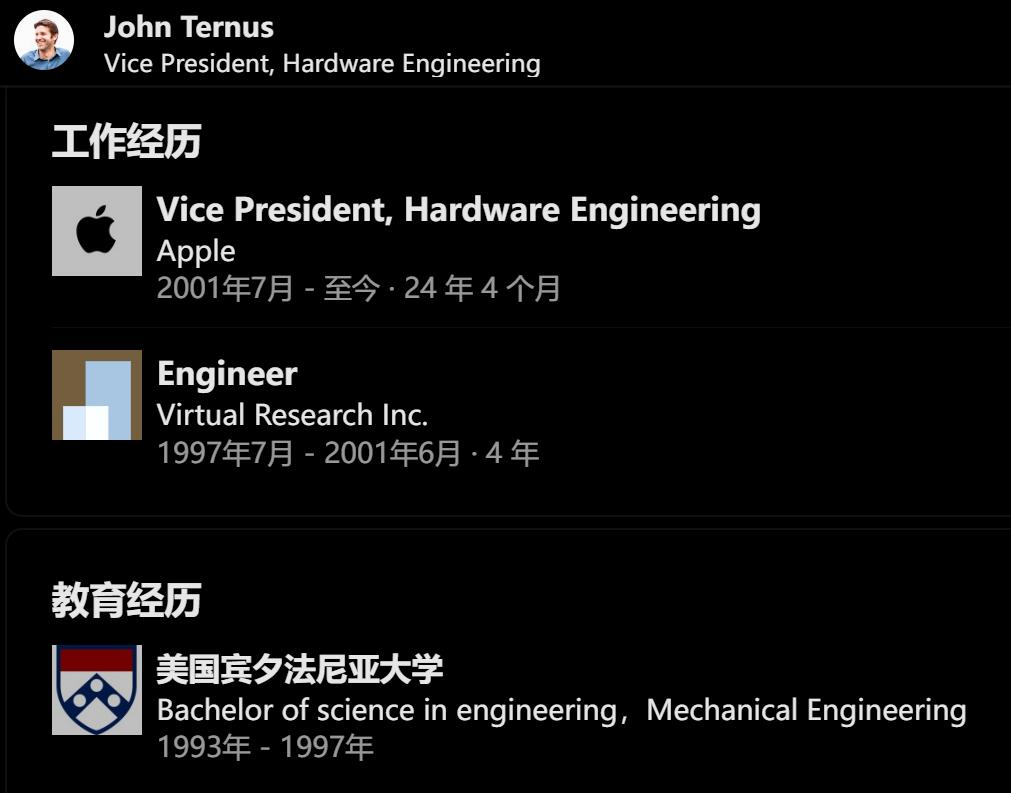
Caption: John Ternus's resume
It is not a coincidence that two people in two positions were promoted in the same year.
Their resumes also tell a lot. Ternus is a typical doer nurtured within Apple. He has worked in the company for more than twenty years, starting from mechanical structure and finally overseeing the core hardware engineering. Srouji is a chip architect that Jobs recruited from IBM back then. He built the self - developed chip route for the iPhone from scratch, and the A - series and M - series chips were all shaped under his leadership.
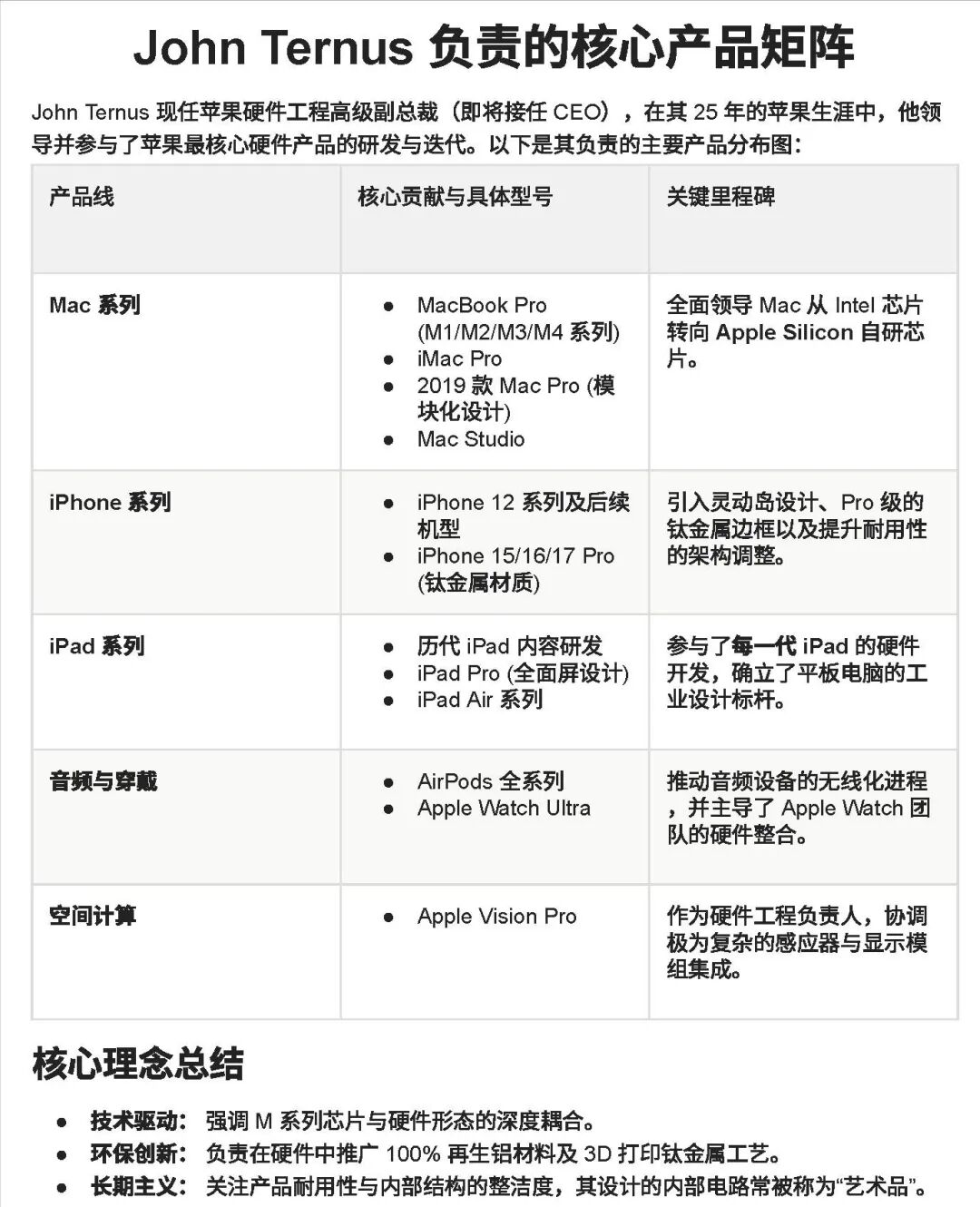
Caption: John Ternus's core product matrix (Source: Zhihu: Classmate Maidou)
One is closer to the whole device, and the other is closer to the underlying technology; one has long been dealing with what the product will ultimately look like, and the other has long been dealing with what extent it can be achieved. Apple's decision to promote these two people simultaneously makes its intention quite clear:
Firstly, Apple is not just looking for a "successor." Instead, it is repositioning several capabilities within the company.
The Apple left by Cook is already an extremely stable machine: the supply chain, capital returns, service business, and global collaboration have all been optimized to the extreme. However, no matter how stable the machine operates, it cannot replace another thing - it still needs to come up with eye - catching products. What Apple needs to improve now is obviously not just management, but to put the products and underlying technology back in a more prominent position.
This urgency is closely related to the changes in the AI era.
In the past few years, companies such as Google, OpenAI, and Meta have been rapidly turning AI into a more and more common service. The user's entry point could be a browser or a chat window, and the model's capabilities themselves are becoming the focus.
Under this trend, hardware is easily reduced to a neutral carrier: as long as it can open web pages and run applications, the differences between the iPhone and Android, and between the Mac and PC could theoretically be gradually blurred.
But this is exactly the situation that Apple least wants to see. The fundamental difference between Apple and these companies is that Apple's business is not to first have a service and then find a way to distribute it, but to first have a device and then let the device carry the user experience. The iPhone still contributes more than half of the company's revenue to this day. Hardware is not the periphery of Apple's business, but its most core revenue and brand support.
For a company like this, what is really dangerous in the AI era is not just whether it can catch up with the models, but that if the hardware becomes more and more like a neutral pipeline, the premium foundation that Apple has built over the past few decades will also be shaken.
That's why Apple's real advantage lies not only in the models themselves, but in the end - side.
With more than 2.5 billion active devices, from the A - series of the iPhone to the M - series of the Mac, and then to the operating system, sensors, and overall device design, the company's deepest moat has always been on the device side. It doesn't necessarily have to have the world's most powerful model, but it must prove one thing:
The same capabilities will be more natural, more complete, and more like a product when placed on Apple's devices.
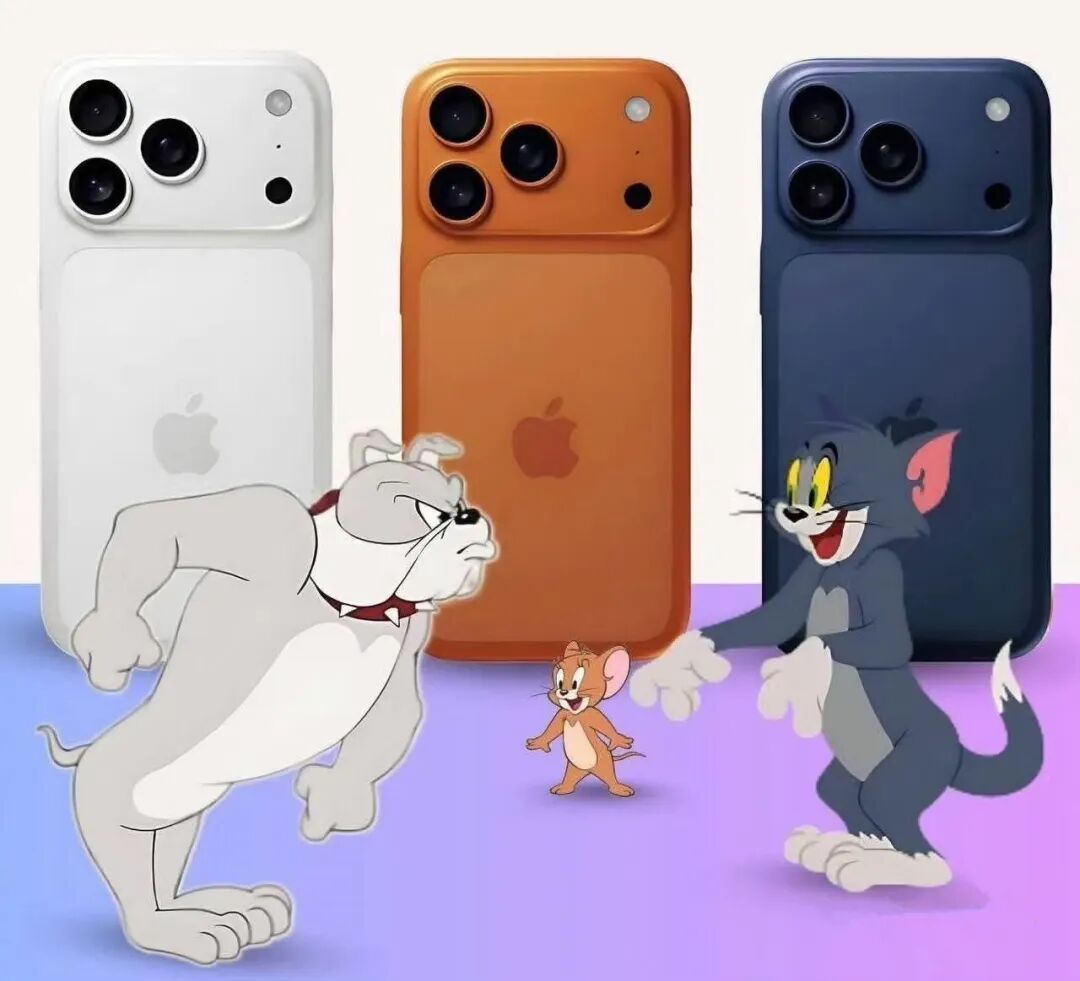
Looking back at the combination of Ternus and Srouji, the meaning becomes clearer:
Ternus doesn't need to create another ChatGPT. What he needs to solve is another thing - how to organize more and more AI capabilities into a real product experience on Apple's devices.
And Srouji's task is more downstream - no matter what kind of experience Ternus wants to create, the underlying technology cannot hold back at critical moments. Instead, it is better to open up new possibilities.
The chip replacement with the M1 in 2020 has actually verified this kind of cooperation once.
Srouji built the chip, and the hardware engineering team represented by Ternus turned it into a MacBook Air without a fan and with a battery life of up to 18 hours. The most important significance of that success was not just that Apple finally got rid of Intel, but that it proved one thing: when the underlying technology and the whole device product are truly integrated, Apple still has the ability to redefine the experience of a type of device.
Now, Apple obviously wants to extend this method to a larger scope within the company.
From this perspective, Ternus and Srouji being promoted to more prominent positions is not just because of their deep qualifications and solid resumes, but because they happen to form a combination that Apple needs most at this moment: one manages the whole device, and the other manages the chips; one is closer to what the users finally see, and the other is closer to the premise for these things to exist.
What Apple really wants to elevate is not someone's title, but the decision - making weight of product judgment and underlying technology within the company.
This is of course a risk. People who are good at making products may not be naturally good at managing a large organization, and technical intuition may not always be in line with the short - term patience of the capital market. But for Apple today, continuing along Cook's path can at most ensure that no major mistakes are made, but it is difficult to answer an increasingly real question: When the "big tree" of the iPhone gradually leaves its prime, can Apple grow another one?
Readjusting the Mindset
In the past few years, the most obvious change in Apple may not be that it has become weaker, but that the sense of leading the era that has long surrounded it has loosened.
Whether it is the new round of technological imagination brought by AI or the ability of new products to re - ignite market excitement, Apple is no longer naturally at the center of the storm as it used to be. When talking about this company, people no longer get as excited as before. In the past, every time there was a product launch, the Moments would be flooded with related posts, and the next day everyone in the coffee shop would be discussing "whether the new iPhone is worth upgrading." That kind of excitement was real, like waiting to watch a definitely wonderful movie.
But this doesn't mean that Cook is not an excellent leader. On the contrary, if Jobs left Apple the edge to create a new world, then what Cook accomplished after taking over was another more difficult thing - he brought this company, which is extremely large - scale, has a long - chain operation, and is most likely to be dragged down by complexity, into a rare state of stability.
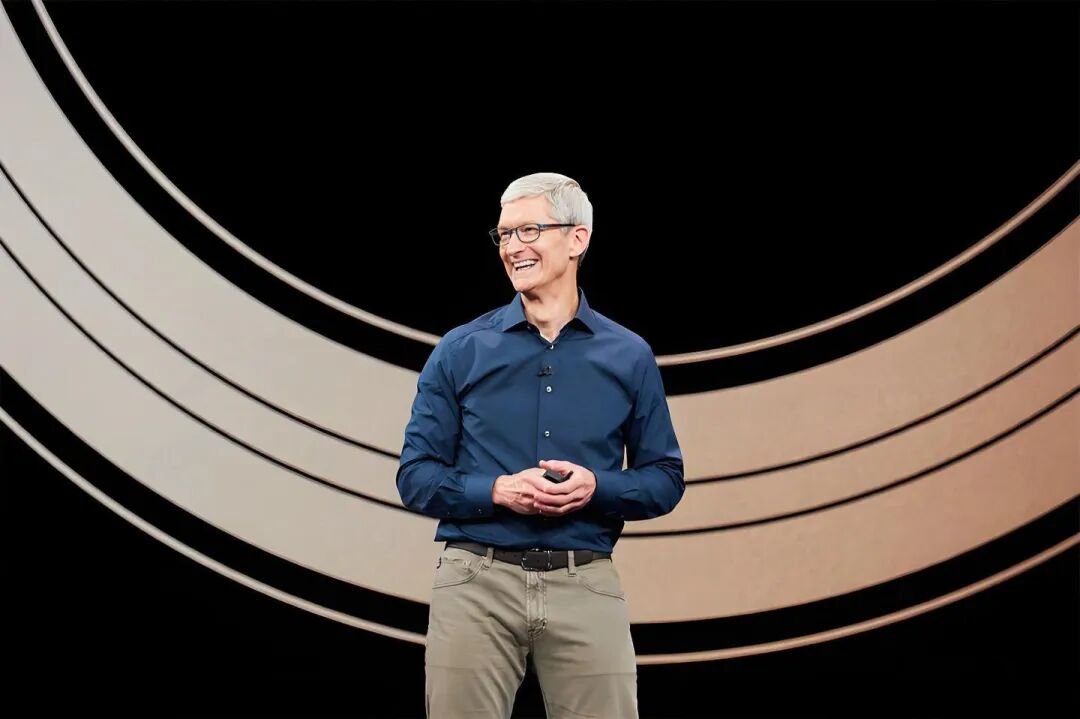
However, for a company like Apple, stability has never been the end. Capital is both infatuated with certainty and reluctant to give up surprises. Cook is good at the former, but in the new cycle, he is unable to achieve the latter.
This is exactly what this leadership transition really points to. For Apple, this is by no means a revolutionary overhaul, but more like a long - overdue turn: The order left by Cook will not immediately become invalid, and the capabilities accumulated in the old era are still valuable. But now, what Apple faces is no longer just "how to continue to be stable," but another more difficult and dangerous question - how to learn to take risks again.
Stability is of course great, but it is also the most hidden enemy of innovation. It will make a company more and more good at assessing risks, avoiding mistakes, and extending the life cycle of old products, but less and less good at betting on an uncertain future. Apple's problem today may not just be the lack of a Jobs - like figure, but that the entire leadership team has become too familiar with "how not to make mistakes," and fewer and fewer people are really willing to bear the cost of a possible failed breakthrough.
This is exactly the most delicate part.
Apple in the Jobs era did not win by mastering the most complete underlying technology: in 2005, the Mac switched to Intel; it was not until 2020 that Apple officially announced that the Mac would switch to Apple silicon. In other words, what Apple later supplemented was stronger control over the underlying technology. However, the enhancement of control did not automatically lead to an equal level of product innovation.
Today's Apple has stronger chips and a more closed - loop system than before, but it comes up with fewer new and risky things than in the past.
So, the question becomes more acute: when a company's foundation is more stable than ever, why is it more difficult to excite people?