Don't investors watch the robot marathon?
In recent days, the Beijing Yizhuang Half Marathon has become a hot topic on social media.
The race was truly amazing. Without any remote control and with full autonomous navigation, the Honor Lightning robot crossed the finish line in 50 minutes and 26 seconds, breaking the human world record for the half - marathon. This record was just set in March this year by Ugandan athlete Jacob Kipruto, with a time of 57 minutes and 20 seconds.
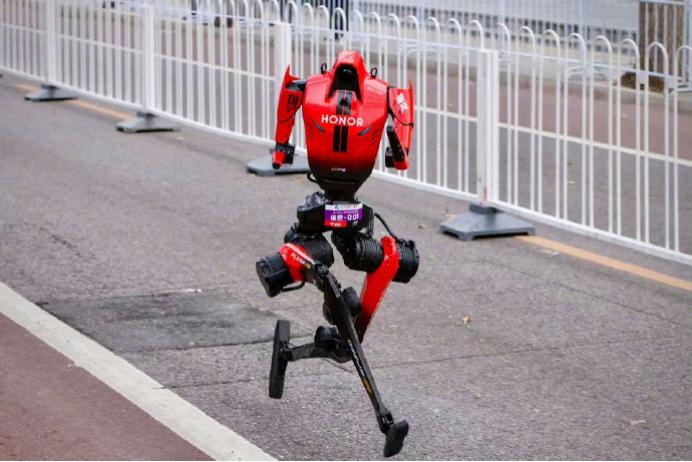
However, beyond the excitement, the industry's focus has already gone deeper than the racetrack. While it's great that robots can run fast, what the industry is more concerned about now is the robot's "brain".
Jiang Yi, the founding partner of Hengye Capital, said that for investors, 2026 is the first year for embodied intelligence to transform from "kinematic show - off" to "in - depth exploration of cognitive intelligence". If high - dynamic motion control is the "industrial foundation" of embodied intelligence, then the cognitive decision - making ability based on large models is the "soul" that determines its commercial ceiling.
This judgment has already been reflected in this year's capital trends. The general direction of the embodied intelligence industry is becoming increasingly clear, and a large amount of capital is flowing rapidly to companies that are betting on the "brain".
For example, Independent Variable Robotics, which recently received investment from Xiaomi and has a valuation of over 10 billion yuan, released its latest model, WALL - B, on April 21. It claims to be the world's first embodied intelligence basic model with a unified world model architecture. Its founder, Wang Qian, also said at the press conference that getting robots into households is one of the most difficult technological problems of this era.
A
As a newcomer in the industry for only one year, Honor's performance is quite impressive.
In this half - marathon, Honor not only won the championship but also swept the top three places, all finishing within 53 minutes and 30 seconds, breaking the human world record for the half - marathon. Even more amazingly, Honor's robots also took the top six places in this event.
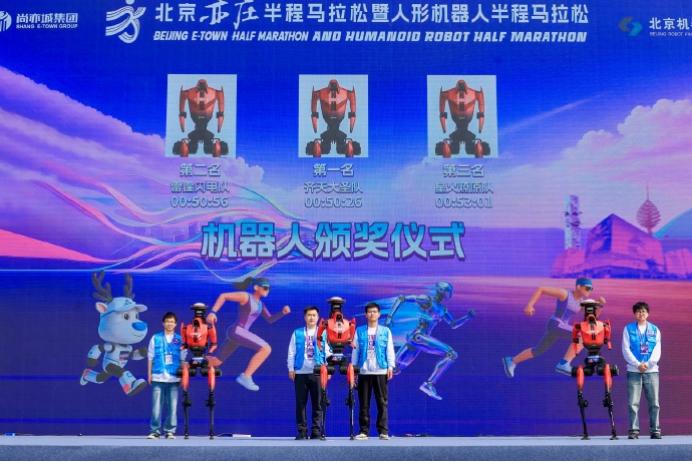
This is not only because Honor adopted a "numbers game" by sending 10 teams to participate but also because of its technological breakthroughs. According to Economic Observer, an embodied intelligence practitioner said that from the physical structure of the champion "Lightning", it is a robot very suitable for running.
Compared with last year, the running ability of humanoid robots has significantly improved. Last year's champion, Tiangong Robot, finished in 2 hours, 40 minutes, and 42 seconds. This means that in one year, the running speed of robots has increased by about three times.
Du Xiaodi, a test and development engineer at Honor, said in an interview that there are several main reasons for the victory: First, the overall structure of the robot is reliable, and the motors are powerful; Second, the R & D personnel learned from the physical structure of long - distance runners and moved the center of rotation upward, making the effective leg length of "Lightning" reach 0.95 meters; Third, Honor transferred the liquid - cooling system technology from mobile phone terminals to the robot.
In fact, Honor has not been in the humanoid robot business for a long time. It officially established its humanoid robot department in February 2025, making it a latecomer compared to companies like Unitree and Zhipu.
However, its breakthrough in running ability was foreshadowed. In May last year, three months after the establishment of Honor's humanoid robot department, Honor CEO Li Jian demonstrated the running of its self - developed robot, setting a new industry record at a running speed of 4 m/s.
After Honor's victory, there were both praises and doubts in the public opinion. One view is that its speed advantage mainly comes from the large - scale stacking of motors, batteries, and liquid nitrogen cooling modules.
According to Intelligence Era AGI, Fu Sheng, the chairman of Cheetah Mobile, also said bluntly, "What does Honor's victory mean? Does it mean it's a god - like existence? I don't think so. I think it's precisely because it entered the market late, so its goal is clearer. While other companies' robots are already finalized, it (Honor) is now optimizing specifically for the half - marathon, which gives it a late - comer advantage."
Fu Sheng's doubt points out a key issue: Optimizing extremely for a single task can indeed achieve amazing results, but it doesn't represent generalizability.
Behind the controversy lies a core question: So what if humanoid robots can run fast?
On the public level, this kind of questioning is not without reason. In the past year, humanoid robots have shown off their athletic performance too frequently, from Unitree robots stumbling on the Spring Festival Gala stage, to later long - distance running, fighting, and football matches, and then to the martial arts performance on this year's Spring Festival Gala stage. The public's expectations for humanoid robots have changed. On the one hand, the novelty of athletic performance is gradually fading; on the other hand, people are starting to ask, 'When can robots really do useful work?'
And the latter is exactly what we can't see on the marathon track and is also the current focus of the embodied intelligence industry. The investment circle sees it most clearly. Since this year, the capital in the embodied intelligence industry has mainly flowed to companies focusing on "brain" R & D. After all, whether robots can really "do useful work" depends on the brain.
B
Focusing on "brain" R & D is the core competitive direction of current leading embodied intelligence companies.
Unitree, which is sprinting for an IPO, previously established itself in the humanoid robot field with its hardware capabilities, especially excelling in athletic performance. Now, Unitree is also officially focusing on the "brain" field. According to its prospectus, Unitree plans to raise 4.2 billion yuan through its IPO, and about half of it will be used for the R & D of intelligent robot models.
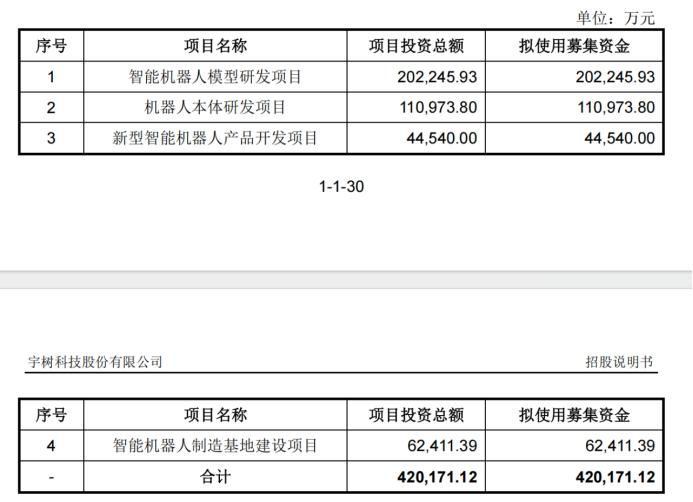
Jiang Yi said that this means that current robots can perform perfect atomic actions but cannot handle long - horizon tasks. Only by investing in training the VLA large model and achieving seamless migration from Sim - to - Real can robots truly leave the laboratory and enter households and factories.
Its founder, Wang Xingxing, has long said that the hardware of humanoid robots at this stage is sufficient, but the ability of the embodied intelligence AI model is still lacking. In January this year, he also said in the "Yang Sheng" program, "Whoever can develop the large model for robots will be the most powerful AI company and robot company in the world. I think it's completely worthy of a Nobel Prize."
Developing large models for embodied intelligence has become an industry consensus. Currently, most humanoid robot companies that have received large - scale financing and entered the club of companies with a valuation of over 10 billion yuan have attracted attention because they are betting on "brain" R & D.
Galaxy Universal has a valuation of over 20 billion yuan. Its robots can already pick up medicines on the shelves and make coffee for consumers in the diner.
On this year's Spring Festival Gala stage, Galaxy Universal's Galbot G1 robot demonstrated fine operation abilities such as playing with walnuts and folding clothes. It is equipped with the self - developed Galaxy AstraBrain embodied large model. This model is also the world's first full - body and full - hand end - to - end large model that integrates "brain - cerebellum - neural control" into a single architecture, enabling robots to get rid of preset programs and achieve full autonomous decision - making and execution.
Another embodied intelligence company, Xinghaitu, with a valuation of over 20 billion yuan, also has remarkable model capabilities. In January this year, Xinghaitu launched the upgraded G0 Plus, positioned as "the world's first out - of - the - box VLA model", mainly focusing on cross - scenario task generalization and optimization of general grasping ability, emphasizing the ability of a single set of models to adapt to different robot bodies.
Independent Variable Robotics has a valuation of over 10 billion yuan, with Meituan, Alibaba, ByteDance, and Xiaomi behind it. It has been focusing on the R & D of the "general embodied large model" from the beginning. Its self - developed WALL - A model can enable robots to perform complex operations such as folding clothes and organizing. Moreover, the robot equipped with the WALL - A model independently completed the "last 100 meters" of food delivery.
The newly released WALL - B model of Independent Variable Robotics has significantly improved the zero - shot generalization ability, allowing robots to learn and progress in practice.
Itstone Zhihang, which recently received a new round of financing of 455 million US dollars, set the highest single - round financing record in the history of Chinese embodied intelligence. Its post - investment valuation is about 15 billion yuan, and the next - round valuation is expected to exceed 20 billion yuan. Itstone Zhihang's strategic focus is also on the basic large model for embodied intelligence, and it has released the AWE 3.0 model that enables robots to generalize and perform practical tasks.
This is even more so in the overseas market. Figure AI, with a valuation of 39 billion US dollars, has its core competitiveness in the robot brain model. It has launched the self - developed end - to - end VLA model "Helix", which has increased Figure AI's valuation by about 15 times in one and a half years. In January this year, Figure AI also released Helix 02. The functions of its Figure series robots have evolved from simple box - moving to complex household chores such as folding clothes and loading the dishwasher.
It can be said that these high - valued robot companies are essentially "building brains" for robots.
However, although the industry has made some progress in brain R & D, the bottleneck is also obvious. The biggest problem is data. Without enough and good data, it is difficult to train a large model that truly understands the physical world.
Different companies have proposed their own solutions. Galaxy Universal uses a method that mainly relies on simulation data and supplements with real data; Unitree uses real - machine collection in real - world scenarios. In March this year, Unitree open - sourced the real - machine dataset of humanoid robots; Zhipu also uses real - machine collection and open - sourced the real - world scenario dataset AGIBOT WORLD 2026.
This dilemma is also attracting the entry of Internet companies. Recently, JD.com announced the launch of the "largest data collection campaign in human history" with up to 600,000 people, aiming to accumulate 10 million hours of real - world human scenario video data within two years.
There are different solutions to the data problem, but a more fundamental question arises: After putting so much effort into training the "brain", what exactly do we want robots to do?
C
Running is, of course, a step for humanoid robots to show off their performance. Honor's victory also means that humanoid robots have surpassed humans in running performance.
But beyond the cheers, we hope to see competitions focusing on "brain" abilities. Because the final landing scenario for humanoid robots is the living environment, which is far more complex than the racetrack. What we need are robots that can take care of the elderly, do housework, and even replace guide dogs.
A user who follows the embodied intelligence industry said bluntly, "If a robot can sweep the floor and cook, I'm willing to spend 200,000 yuan to buy one."
This means that there is a market for humanoid robots to land, but the current products still fall short of expectations. However, the industry is working towards this goal.
There are different opinions in the industry about when humanoid robots will enter households. The most optimistic view is 1 - 2 years, while a more cautious view is 5 - 10 years.
Elon Musk is the most radical. He predicts that the Optimus robot will start to change human life next year, have an obvious impact in 2028, and have a huge impact in 2029.
Domestic views are more conservative. Wang Xingxing predicts that it will take 3 to 5 years for robots to enter factories and households on a large scale, and at the latest, no more than 10 years. Zhou Jian, the founder of Ubtech, believes that it will take at least 3 to 5 years for humanoid robots to enter households, and perhaps up to 10 years.
Regardless of the timeline, the industry is accelerating. Correspondingly, competitions should not only focus on the display of athletic performance such as long - distance running, fighting, and dancing. For robots to enter households, they need the ability to handle housework such as moving, grasping, folding, and even washing dishes, vegetables, cutting, and cooking.
To give a simple example, the above - mentioned housework actions rely on the flexibility of the hands. This leads to another key technical hurdle: the dexterous hand.
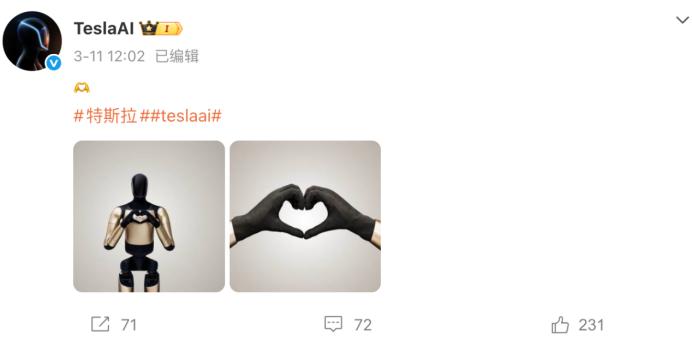
Elon Musk deeply understands the difficulty of the dexterous hand. He once said that in the R & D of humanoid robots, the hand has always been one of the most challenging core problems, and its complexity even accounts for half of the entire electromechanical system. One of the reasons for the delay in the production cycle of Optimus is related to the dexterous hand. In March this year, Tesla released a photo of the Optimus robot making a heart shape with its hand, showing excellent hand flexibility.
Domestically, this field is also starting to be valued. "Lingxin Qiaoshou", which focuses on the R & D of dexterous hands, is seeking financing with a valuation of about 24 billion yuan. It is one of the few component companies in the embodied intelligence industry to enter the club of billion - dollar unicorns.
However, although the dexterous hand is so crucial, there is currently no corresponding competition to test and promote it.
In fact, current robots are in a "teasing dilemma", which was also the initial dilemma of Chatbot. For example, at first, most people used Doubao just for fun; it was not until Doubao's monthly active users reached a certain scale and it began to have search capabilities that its practicality truly emerged. With the breakthrough of AI in programming ability, the commercial landing scenarios of Chatbot became more prominent, and the teasing dilemma was further broken.
Now, humanoid robots are trapped in the marathon track and somersault shows, which is essentially no different from teasing Doubao at the beginning. Although it's fun and exciting, it doesn't solve practical problems.
When will this situation be broken?
When robots truly have practical value. Therefore, we also look forward to seeing robot cooking competitions, laundry competitions, and cooking competitions next year. Only when robots find their use will they no longer be toys for onlookers but real life partners in households.
This article is from the WeChat official account "Zimu PRO", written by Xue Yaping and published by 36Kr with authorization.